
![You are currently viewing Do Formative Assessments Count Towards Your Grade? UK University Rules Explained [2026]](https://gradeforuni.com/wp-content/uploads/2026/10/featured-formative-assessments.png)
Do Formative Assessments Count Towards Your Grade? UK University Rules Explained [2026]
Here is the short answer students keep asking for on forums like The Student Room: no — at UK universities, formative assessments do not normally count towards your grade. Your module mark is calculated from summative assessments only, and the rulebooks say so in plain language. UCL’s Academic Manual states that marks from formative assessment do not contribute to the award of credit and are excluded from the classification calculation. The University of Manchester’s assessment guidance says a formative piece of assessment “will provide no direct contribution to the final mark of the unit”. Bristol’s regulations say formative forms of assessment “will not contribute to the award of credit points”. That zero is the sector-wide default.
But most students asking “do formative assessments count” are really asking a sharper question: can skipping them hurt me? There, the answer flips. LSE’s General Academic Regulations let departments designate a formative task as a compulsory “threshold assessment” — skip it or submit it late, and the department may deduct up to 10% from the mark of the corresponding summative assessment. Newcastle’s regulations allow “zero-weighted pass/fail assessments”: they add nothing to your module mark, but you must pass them to pass the module. And LSE also warns that repeated failure to complete formative work can lead, via a formal warning, to exclusion from future assessment or from the School entirely. The marks don’t count. The consequences do.
This guide sets out the actual rules as written: the QAA’s sector-wide definitions of formative and summative assessment, the default 0% rule with a full worked calculation, the five verified mechanisms by which formative work can still move your grade or block your progression, what six universities’ published policies say side by side, a worked example of a skipped formative costing a full degree class, and a practical framework for deciding how much effort each type of formative task deserves.
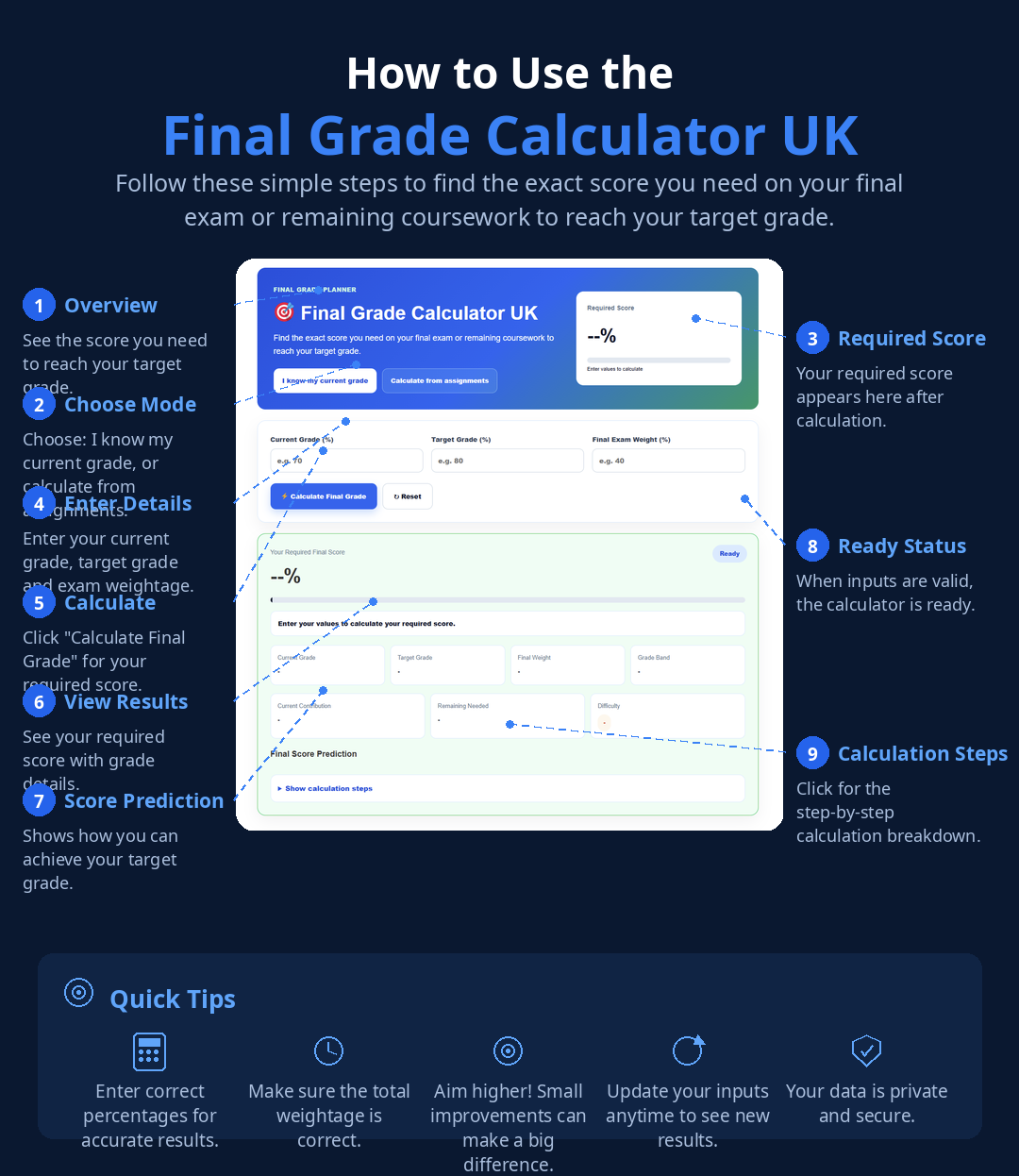
Click Here: Final Grade Calculator UK
Formative vs Summative: What UK Universities Actually Mean
The words “formative” and “summative” are not casual adjectives — they are defined terms in the UK Quality Code for Higher Education. The QAA’s Advice and Guidance: Assessment defines formative assessment as assessment with a developmental purpose: it exists to help you learn more effectively by giving you feedback on your performance and how it can be improved or maintained. Summative assessment, by contrast, measures the extent of your success against the assessment criteria for the module’s learning outcomes — and, the QAA notes, within summative assessment the marks awarded typically count towards the final mark of the course, module or award. That single word “typically” carries the whole system: it is the summative column of your module outline where the marks that build your degree live.
The QAA’s guidance on explaining contact hours adds two refinements students often miss. First, in summative assessment — “assessment of learning” — the outcome counts towards the final marks or grade awarded. Second, assessment can be both formative and summative at the same time: a piece of work can give you developmental feedback and still carry a mark that counts. So the label in your module handbook matters more than the format. An essay can be formative in one module and summative in another; only the weighting table tells you which it is.
| Aspect | Formative assessment | Summative assessment |
|---|---|---|
| Purpose | Developmental — feedback to improve future work | Judgemental — measures achievement of learning outcomes |
| Does the mark count? | No — 0% weighting by default (UCL, Manchester, Bristol all confirm) | Yes — marks feed the module mark and classification |
| Anonymity | Not required (UCL Academic Manual §5.2) | Usually anonymous marking required |
| Feedback | The whole point — detailed, forward-looking | Provided, but the mark is the main output |
| Typical examples | Practice quizzes, essay plans, draft paragraphs, mock exams | Final essays, exams, dissertations, presentations |
| On your transcript | No — only summative marks are recorded | Yes — module marks appear on the transcript |
Practical takeaway: when you open a module outline, ignore the adjectives and find the assessment weighting table. Any row with a percentage next to it is summative. Any row marked 0%, “formative”, “ungraded” or “for feedback only” contributes nothing to the arithmetic — but read the fine print around it, because that is where the five mechanisms below hide.
Do Formative Assessments Count Towards Your Module Mark? The Default Rule: 0%
The default rule is blunt and consistent across the universities whose regulations we checked for this guide. UCL’s Academic Manual (Chapter 4, Section 5.2, published for 2025–26) says a formative assessment may include an indicative mark, but “these marks do not contribute to the award of credit and are not included in the calculation of the Classification.” Manchester’s eAssessment guidance states that a formative piece of assessment “will provide no direct contribution to the final mark of the unit, while summative assessment does contribute to the final mark.” Bristol’s Regulations and Code of Practice for Taught Programmes say that “formative forms of assessment will not contribute to the award of credit points.” Three different institutions, one identical arithmetic: formative weight = 0%.
Worked Example 1 — the 0% in action. Take a 15-credit module, “Research Methods”, with this assessment structure:
• Formative problem set (week 4): weighting 0% — you score 45%
• Summative coursework essay: weighting 60% — you score 72%
• Summative final exam: weighting 40% — you score 62%
The module mark uses only the weighted summative components:
Module mark = (0.60 × 72) + (0.40 × 62) = 43.2 + 24.8 = 68.0 → 68
The 45% on the formative problem set contributes exactly 0 to that 68. If you had scored 95% on it, the module mark would still be 68; if you had scored 12%, it would still be 68. (For the full mechanics of how module marks combine into your degree average, see our guide to how university exam marks are calculated in the UK.)
One trap sits inside this rule: the indicative mark. UCL explicitly allows formative work to carry an indicative mark — a number that looks like a grade but is really feedback wearing a costume. Students misread these in both directions. A 45% indicative mark is not a prediction that you will fail the module; it is a diagnostic of one practice attempt. A 78% indicative mark is not 78% banked towards your degree; it is unmoderated, often un-anonymised feedback that evaporates the moment the summative task begins. Treat every formative number as a comment, never as currency.
5 Ways Formative Work CAN Affect Your Grade
The zero in the arithmetic does not mean zero consequences. These are the five mechanisms we verified in published university regulations — each one a real way formative work reaches into your results.
1. Threshold assessments: skip the formative, lose summative marks
This is the most direct hit. LSE’s General Academic Regulations (2026/27, regulations 39–40) allow a department to designate a formative assessment as a threshold assessment, which makes it compulsory. If a threshold formative is submitted late or not submitted at all, the department “may apply up to a 10% mark deduction from the mark awarded for the corresponding summative assessment.” Read that again: skipping an ungraded essay plan can shave a tenth off the mark of the graded essay it was attached to. The deduction is discretionary (“may apply up to”), so practice varies by department — but the power is written into the regulations, and Worked Example 2 below shows what it does to a degree classification. LSE’s late submission penalties on summative work are bad enough; this is the formative equivalent, and most students never see it coming.
2. Zero-weighted pass/fail hurdles: 0% of the mark, 100% of the requirement
Newcastle University’s Assessment Regulations for Taught Programmes (2025/26, regulation 15) allow module outlines to specify “zero weighted pass/fail assessments” — assessments that do not contribute to the module mark but that must be passed in order to pass the module. The same regulation allows “essential” components with prescribed thresholds: fail to meet the threshold and the consequence is either failure in the module or a deferred pass with no increase to the original mark. Bristol’s code works the same way: programmes may require a component to be “satisfactorily completed in order for a unit to be passed and enable the credit points to be awarded.” In these designs the formative task is a gate, not a grade. You can score 80% on every summative component and still fail the module if you never walked through the gate. Note also that a module failed on a hurdle is a genuine fail — it is not the kind of marginal failure that condonement can quietly absorb.
3. Engagement dereliction: from warning to exam barring
LSE’s regulations 37–38 require students to engage with their studies by attending classes and “producing required work promptly”, and state that failure to engage — explicitly including “repeated failure to complete formative work or required summative assessment” — “may result in a warning and, if it continues, exclusion from future assessment under the Exam Barring Procedure or from the School, as appropriate.” That is the nuclear option: not a deduction, but removal from the assessment itself. UCL’s student guidance makes the same point in plainer language — attempt every part of every unit, because work marked “not complete” can block progression or an Honours degree. Exam boards, which make these calls, take engagement records seriously; our guide to how university exam boards work explains what boards can and cannot do when your record comes up for discussion.
4. Formative drafts that feed your summative mark
The most common — and most productive — mechanism is the draft-then-submit model. UCL’s module approval documents describe the standard pattern explicitly: the formative assessment is “an essay on a topic other than that on which the student will write their summative assessment on which feedback will be given”, or “a plan of the essay that the student will write for the summative assessment on which feedback will be given.” Bristol’s assessment regulations describe the same arrangement: students submit work for formative feedback which then “informs subsequent summative assessment”, while the formative itself remains “not for credit.” The marks do not transfer; the improvement does. A formative essay plan that earns the feedback “your argument lacks evidence” is worth nothing on paper and potentially 10 marks on the final essay — the difference between a 58 and a 68. UCL even mandates this for dissertations: supervisors must give feedback on a draft on at least one occasion. Skipping the formative here doesn’t trigger a penalty; it just deletes free marks.
5. The both-at-once exception: check the weighting, not the label
Finally, the QAA itself warns that assessment “can also be both formative and summative at the same time.” Some departments set tasks that give rich developmental feedback and carry a small summative weight — a weekly problem set worth 5% with detailed model answers, for instance. The word “formative” in a lecture slide does not override the weighting table in the module outline. Whenever a task is described as formative, confirm two things: its percentage weight (is it truly 0%?) and whether it is designated as compulsory, threshold, must-pass, or hurdle. If either answer surprises you, you have found one of the mechanisms above wearing casual clothes.
What Real University Policies Say
Side by side, the published positions of the institutions checked for this guide. Every claim below was read in the institution’s own current regulations — linked at the end of this article.
| University | Default position on formative marks | Hurdle / engagement rule |
|---|---|---|
| QAA (sector-wide) | Summative marks “typically count towards the final mark”; formative is developmental | Notes assessment can be both formative and summative at once |
| UCL | Indicative formative marks “do not contribute to the award of credit” and are excluded from classification | Students must attempt all parts; “not complete” can block progression; draft feedback mandatory for dissertations |
| LSE | Weightings set per course in Course Guides | “Threshold” formatives are compulsory — up to 10% deduction from the corresponding summative mark if late/missed; repeated non-completion can lead to warning → exam barring/exclusion |
| Manchester | Formative provides “no direct contribution to the final mark of the unit” | — |
| Bristol | “Formative forms of assessment will not contribute to the award of credit points” | Components may be required to be “satisfactorily completed” for the unit to be passed |
| Newcastle | — | “Zero weighted pass/fail assessments” must be passed to pass the module; essential-component thresholds can fail or defer the module |
The pattern is unmistakable: nobody gives formative marks any weight, and almost everybody attaches some non-mark consequence to skipping them. Your university’s academic manual sets the framework; your module outline sets the local traps. Read both.

Worked Example 2: When a Skipped Formative Costs a Degree Class
Now the LSE-style scenario, with full arithmetic. A second-year module is assessed as follows:
• Summative essay: weighting 50% — you score 74%
• Summative final exam: weighting 50% — you score 66%
• Formative essay plan (week 6): weighting 0% — designated a threshold assessment; you never submit it
Without the penalty, the module mark is:
(0.50 × 74) + (0.50 × 66) = 37.0 + 33.0 = 70.0 → 70 (First)
With the threshold penalty applied, the department deducts 10% from the corresponding summative mark (the essay):
Adjusted essay mark = 74 × 0.90 = 66.6
Module mark = (0.50 × 66.6) + (0.50 × 66) = 33.3 + 33.0 = 66.3 → 66 (2:1)
One unsubmitted essay plan — a task worth literally nothing — has moved the module from a First to a 2:1. Across a degree, a single module rarely decides a classification alone, but borderline profiles are decided by exactly this kind of margin: a 69.4 average stays a 2:1, a 70.0 becomes a First, and the difference is often one module. Two caveats keep this honest. First, the deduction is discretionary (“may apply up to 10%”), so not every department applies it and not every missed formative triggers it — but the regulation exists whether or not your department uses it this year. Second, this example assumes the deduction is applied to the raw mark before weighting, which is the natural reading of the regulation; your department’s course guide is the final authority on the mechanics.
How Much Effort Should You Actually Put In? A Decision Framework
“It doesn’t count” is the wrong conclusion; “do everything perfectly” is the wrong strategy. Formative tasks differ enormously in their return on effort. Use this framework, built from the regulations above, to triage them:
| Scenario | Effort level | Why |
|---|---|---|
| Designated threshold / compulsory formative (LSE-style) | Full effort, on time | Direct mark deduction or pass/fail consequence attaches |
| Essay plan or draft feeding a summative essay | Full effort | Feedback converts directly into summative marks — highest ROI task you have |
| Zero-weighted must-pass component (Newcastle-style) | Complete to a passing standard | Gate, not grade: clear the bar, then redirect energy to summative work |
| Practice quiz / mock with indicative mark | Targeted effort | High diagnostic value, zero direct marks — do it, but don’t polish it |
| Seminar tasks tied to attendance records | Attend and make a good-faith attempt | Engagement records feed exam boards and dereliction procedures |
| Optional extra problem sets | As time allows | Diminishing returns — prioritise summative preparation once core feedback is banked |
A practical rule of thumb for essay-based modules: spend roughly 15–20% of your study time on formative work, concentrated on the tasks that feed summative submissions. For exam-heavy modules, formative mocks deserve real exam conditions — they are the only place you can fail safely. The one allocation that is never correct is zero: even where no regulation bites, the feedback is the cheapest grade improvement available at university.
6 Myths About Formative Assessment
| Myth | Reality |
|---|---|
| “Formative marks are added to my module mark at a small weight.” | No. UCL, Manchester and Bristol all state the contribution is zero — not small, zero. |
| “An indicative mark of 72% means I’m on track for a 2:1.” | Indicative marks are unmoderated feedback, not predictions. Treat them as comments, never as currency. |
| “I can safely skip formative work — it doesn’t count.” | LSE can deduct up to 10% from your summative mark; Newcastle can fail the module on an unpassed hurdle; repeated skipping can trigger exam barring. |
| “Formative feedback doesn’t help with resits.” | Resits are new summative attempts, but formative feedback is the cheapest diagnosis of why the first attempt failed — use it before you re-sit. |
| “If it’s called formative in one module, it’s formative everywhere.” | Departments designate threshold, must-pass and compulsory tasks locally. Check each module outline’s weighting table. |
| “Formative assessments appear on my transcript.” | No — transcripts record summative module marks (UCL: formative marks are excluded from classification). Some departments record completion, not marks. |
Do formative assessments count towards your final grade at UK universities?
No — not by default. At UCL, Manchester, Bristol and across the sector, formative assessments carry 0% weighting and their marks are excluded from module marks and degree classification. However, five verified mechanisms let them affect your results anyway: threshold-assessment mark deductions (LSE), zero-weighted must-pass hurdles (Newcastle), engagement dereliction procedures, formative drafts that feed summative submissions, and tasks that are both formative and summative at once.
Do formative assessment marks appear on your transcript?
No. UK transcripts record your summative module marks — the marks that count towards your degree. UCL’s Academic Manual states explicitly that formative marks are not included in the calculation of the Classification. Some departments may record whether you completed a compulsory formative task, but no formative mark appears on the transcript itself.
Can you fail a module by skipping formative assessments?
Yes, in specific designs. At LSE, skipping a compulsory ‘threshold’ formative can trigger up to a 10% deduction from the corresponding summative mark. At Newcastle, ‘zero weighted pass/fail assessments’ must be passed for you to pass the module. And LSE’s regulations allow repeated failure to complete formative work to escalate from a warning to exclusion from future assessment. Always check your module outline for ‘threshold’, ‘must-pass’ or ‘compulsory’ labels.
What is an indicative mark on formative work?
An indicative mark is a feedback number your tutor puts on formative work to show roughly where it stands — UCL’s regulations explicitly allow formative assessments to include one. It does not contribute to credit or classification, is not moderated like a summative mark, and should be read as a comment (‘this is roughly 2:1 standard’) rather than a banked grade.
Do formative assessments have deadlines?
Often, yes — and missing them can cost you. LSE’s regulations allow departments to apply up to a 10% mark deduction to the corresponding summative assessment when a threshold formative is submitted late or not at all. Even where no deduction applies, late formative work usually means late feedback, which defeats its purpose. Treat formative deadlines as seriously as summative ones.
Are formative assessment rules the same at every UK university?
No. The QAA sets sector-wide definitions, but each university writes its own academic manual and each department sets its own module outlines. LSE’s threshold-assessment deductions, Newcastle’s zero-weighted pass/fail components and UCL’s indicative-mark rules are institutional choices, not national law. Your module handbook is the only document that describes your exact position.
Can extenuating circumstances cover a missed formative assessment?
Extenuating circumstances procedures normally apply to summative assessments, not formative ones — but a missed compulsory formative can still trigger real penalties, so do not stay silent. If illness or another serious issue stops you completing a threshold or must-pass formative, contact your personal tutor or department as early as possible; departments have discretion over whether to apply deductions, and early communication is what makes that discretion work in your favour.
Should I still bother with formative work if it doesn’t count towards my grade?
Yes — it is usually the highest-return study activity available. In draft-then-submit models (standard at UCL and Bristol), tutor feedback on a formative essay plan converts directly into marks on the summative essay. Formative mocks are the only place you can fail safely before an exam. Budget around 15–20% of study time for formative work, concentrated on tasks that feed your summative submissions.
Conclusion
So, do formative assessments count towards your grade? In the arithmetic, no: the default across UK universities is a clean 0%, confirmed in the published regulations of UCL, Manchester and Bristol and grounded in the QAA’s sector-wide definitions. Your module mark is built from summative components only, and no amount of excellent formative work will nudge that number upward by itself. If that were the whole story, skipping formative tasks would be rational — but it isn’t the whole story, and the students who treat it as such are the ones who get caught by the fine print.
The fine print is where this guide earns its keep. A formative task your department has designated as a threshold assessment can cost you up to 10% of a summative mark at LSE; a zero-weighted pass/fail component can fail your entire module at Newcastle; repeated non-completion can escalate to exam barring; and the draft-feedback loop that UCL and Bristol build into their modules is the single cheapest source of grade improvement in higher education. None of these mechanisms appears in the weighting table as a percentage — which is exactly why students miss them. The protective habit is simple: for every module, read the assessment section of the module outline looking for the words “threshold”, “must-pass”, “compulsory” and “hurdle”, and treat any task carrying those labels as seriously as a summative deadline.
Done properly, formative work is not charity you perform for your tutors — it is rehearsal you perform for yourself. The essay plan you submit in week 6 is the 68 you collect in week 12; the mock you sit in November is the exam technique that holds in May. The numbers don’t count, but everything they teach you does. Check your handbook, do the formative work that feeds your summative submissions, and never let a task worth nothing cost you something.

![Read more about the article Integrated Masters Grading: How MSci, MEng & MMath Degrees Are Classified [2026]](https://gradeforuni.com/wp-content/uploads/2026/10/featured-integrated-masters-uk-300x192.png)
![Read more about the article Do UK Universities Curve Grades? How Scaling, Moderation & Final Marks Really Work [2026]](https://gradeforuni.com/wp-content/uploads/2026/10/featured-curve-grades-uk-300x192.png)
![Read more about the article How Are Open University Degrees Classified? Marks, Grades & Honours Explained [2026]](https://gradeforuni.com/wp-content/uploads/2026/10/featured-open-university-grades-300x192.png)