
![You are currently viewing Integrated Masters Grading: How MSci, MEng & MMath Degrees Are Classified [2026]](https://gradeforuni.com/wp-content/uploads/2026/10/featured-integrated-masters-uk.png)
An integrated masters — the MSci, MEng, MMath, MChem or MPhys — looks like a postgraduate degree and sounds like one, but it is classified, funded and regulated as an undergraduate degree. That single fact explains almost everything students get wrong about how these four-year programmes are graded, from the funding that covers the final year to the honours classification printed on the certificate.
The grading machinery has two parts most applicants never hear about at open days. First, a progression hurdle you must clear to be allowed into the fourth year at all — typically a 55–60% average in your second or third year, with real teeth: miss it and you are moved onto the three-year BSc. Second, a classification algorithm in which the final year carries enormous weight. At some universities, years three and four together decide more than 70% of your degree class, which is why a shaky final-year project can drag a First down to a 2:1 after three strong years.
This guide explains exactly how integrated masters grading works at UK universities: the undergraduate funding rules, the stay-on thresholds published by eight universities, the level-by-level weightings used to calculate your classification, what happens when you fail a masters-level module, and whether the four-year route actually beats doing a BSc followed by a standalone MSc.
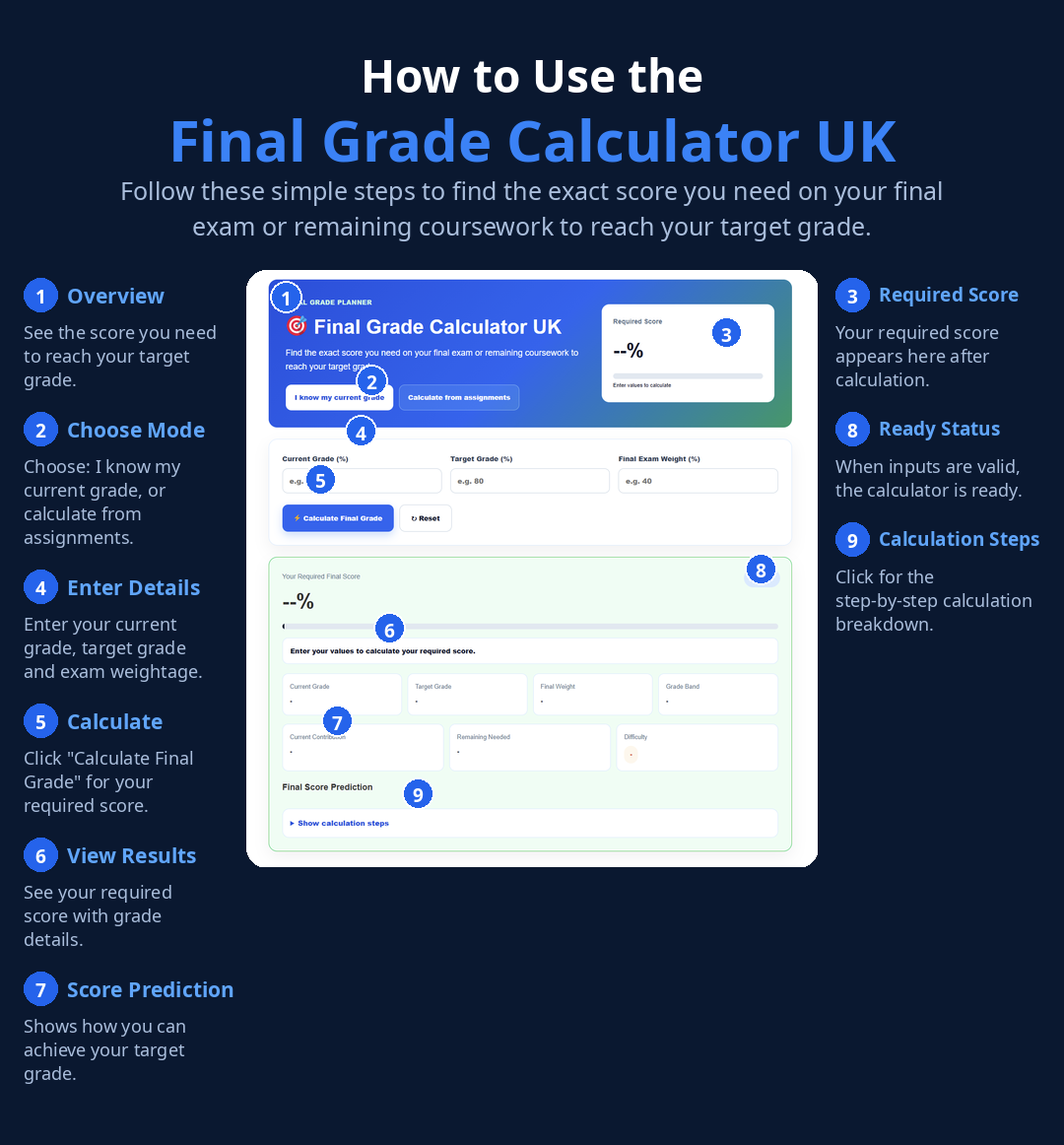
Click Here: Final Grade Calculator UK
What an integrated masters actually is
An integrated masters is a single four-year undergraduate programme that takes you from first-year level (Level 4) straight through to masters level (Level 7) without a break or a second application. The awards have subject-specific names — MSci for science, MEng for engineering, MMath for mathematics, MChem for chemistry, MPhys for physics — but structurally they are all the same deal: one UCAS application, one continuous course, one final classification.
The “undergraduate” part matters more than most students realise. UCAS lists the MSci explicitly as a four-year undergraduate integrated master’s degree, and Imperial College London tells applicants plainly that these degrees “are still regarded as undergraduate courses.” The practical consequence is funding: GOV.UK lists an integrated master’s degree among the courses eligible for undergraduate Tuition Fee Loans and Maintenance Loans, and Imperial confirms that this funding “will still apply in the final postgraduate year.” You do not need a separate postgraduate loan for year four — a meaningful financial difference from the BSc-plus-MSc route, where the masters year is funded (or self-funded) separately.
| Feature | Integrated masters (MSci/MEng) | BSc (Hons) | Standalone MSc |
|---|---|---|---|
| Course level | Undergraduate (Levels 4–7) | Undergraduate (Levels 4–6) | Postgraduate (Level 7 only) |
| Duration | 4 years, one programme | 3 years | 1 year, separate application |
| Funding (England) | Undergraduate SFE loans all 4 years | Undergraduate SFE loans | Postgraduate loan, different terms |
| Final award style | Honours classification (First–Third) | Honours classification (First–Third) | Merit/Distinction (or Pass) |
| Commitment point | At UCAS application (but see the hurdle below) | At UCAS application | During or after final UG year |
The rule nobody mentions at the open day: you have to earn year four
Here is the clause that changes how you should think about every mark from year two onwards. At most UK universities, enrolling on an integrated masters does not guarantee you will finish one. Departments set a progression hurdle — usually a credit-weighted average of 55% or 60% at the end of Level 5 (year two) or Level 6 (year three) — and students who miss it are transferred onto the related three-year bachelor’s degree. You are not failed out; you simply graduate a year early with a BSc or BEng. But the fourth year, and the masters title with it, is conditional.
The thresholds are remarkably consistent across the sector, clustering around the 2:1 boundary. UCL’s mathematics department requires a year-two weighted mean of at least 60% to transfer from the BSc onto the MSci, and then demands an overall 2:1 standard plus at least 60% in year three to continue to year four — “otherwise, if you have passed, you are awarded a BSc at this stage.” Across UCL’s Mathematical and Physical Sciences faculty the general rule is the same shape: pass enough credits and hold an overall average of at least 60% to progress to the fourth year, or be considered for a BSc after three years.
| University | When the hurdle bites | Threshold to stay on | Miss it and… |
|---|---|---|---|
| UCL (Mathematics) | End of year 2 (BSc→MSci); end of year 3 (→year 4) | 60% year-2 mean; 2:1 overall + 60% in year 3 | Awarded BSc at that stage |
| Durham | End of Level 2 (→Level 3 of integrated masters) | 40% in each module + 55% overall average | Cannot progress on integrated masters route |
| York | End of Stage 2; end of Stage 3 | Stage 2 average 55; Stage 3: 40 plus 50 across Stages 2–3 | Transferred to the bachelor’s programme |
| Sheffield (Chemistry MChem) | End of Level 2; end of Level 3 | 60 at Level 2; 55 at Level 3 | Transferred onto BSc Chemistry |
| Leicester (Natural Sciences) | End of year 2; end of year 3 | 60%+ automatic; 55–60% at committee discretion; 55% in year 3 | Continue on BSc route |
| Coventry (Ethical Hacking MSci) | Level 6 → Level 7 | 60% average at Level 6 + 60% on the project | Awarded the BSc instead |
| Manchester | End of year 2; end of year 3 | Transfer-to-BSc mechanism confirmed current (older handbooks cite 60%) | Transferred to the 3-year BSc by the exam board |
Two details in that table deserve emphasis. First, Leicester’s 55–60% band is not automatic: students in it face a Teaching Committee decision, with an interview and a personal-tutor recommendation. The hurdle is a judgement, not just a number. Second, York’s rule shows the safety net working as designed — a Stage 2 average of 40–54 moves you to the bachelor’s programme rather than out of the university. The system is built to catch you, not to punish you, though losing the masters year still stings.
Real students encounter this exactly as the regulations describe. In one widely-read Student Room thread, an MEng student explains their department’s stay-on rule as “55% in 2nd year and 55% in 3rd year,” adding the detail that matters: resits are capped, so a resit score does not rescue your progression average — the original mark is what counts. If your university’s condonement and compensation rules let a failed module through at undergraduate level, check whether the same failed module still satisfies the masters progression bar. Often it does not.
How the final classification is calculated
Integrated masters graduates receive a standard honours classification — First, 2:1, 2:2 or Third — not the Merit/Distinction scale used for standalone taught masters. York’s regulations state it outright: “integrated masters degrees with honours are classified degrees.” UCL’s assessment regulations place the four-year integrated masters inside the honours classification scheme with the familiar bands: a First needs a final weighted mark of at least 69.50% (or 68.50% with strong final-year credits), a 2:1 needs 59.50%, a 2:2 needs 49.50%. If you were expecting a “Distinction,” reset that expectation now — your MSci certificate will say “First Class Honours” just like a BSc. Our guide to Merit vs Distinction covers the separate postgraduate scale so you can see exactly where the two systems diverge.
What differs from a standard BSc is how the years are weighted. Because the degree spans four levels, universities publish explicit level-weighting ratios, and the final year is always the heavyweight. Four verified examples show the range:
| University | Level weighting (year 1 : 2 : 3 : 4) | What it means in practice |
|---|---|---|
| UCL | 1 : 3 : 5 : 5 | Year 1 counts best 90 credits only; years 3 and 4 each count 5/14 of the degree |
| York | — : 2 : 3 : 3 | Stage 1 excluded entirely; Stages 2–4 decide everything |
| Brunel | 0 : 1 : 2 : 2 (fifths) | Level 4 unweighted; Levels 6 and 7 each worth 40% of the classification |
| Manchester | 6% : 19% : 37.5% : 37.5% | The 120-credit final-year project alone is 37.5% of the whole degree |
To make those ratios concrete, here is what ten extra marks in each year are worth on your final average under UCL’s 1:3:5:5 scheme. Ten marks gained in year one move the final average by about 0.7 percentage points; the same ten marks in year two are worth about 2.1 points; in year three or year four, about 3.6 points each. Years three and four together control just over 71% of the classification. Effort is never wasted, but on an integrated masters it is very unevenly rewarded — a fact worth remembering when you are deciding where to spend your revision hours. (For comparison, see how first-year marks feed into standard degrees: the principle is the same, the skew is steeper.)
Worked example 1: Sofia’s MSci under UCL-style 1:3:5:5 weighting
Sofia’s year averages are 62% in year one (best 90 credits), 64% in year two, 68% in year three and 71% in year four. Her final weighted mark is (62×1 + 64×3 + 68×5 + 71×5) ÷ 14 = (62 + 192 + 340 + 355) ÷ 14 = 1009 ÷ 14 = 72.1%. That clears UCL’s 69.50% First boundary comfortably — a First Class MSci. Note she also sailed through the progression check: her 68% in year three is above the 60% stay-on bar.
Now the cautionary version, and it is the single most-shared warning about integrated masters on student forums. Suppose Sofia’s final-year project goes badly and year four comes in at 58% instead of 71%. The calculation becomes (62 + 192 + 340 + 290) ÷ 14 = 884 ÷ 14 = 63.1% — a 2:1. Three years of First-level work, erased by one weak final year, because year four alone is worth 5/14 of the degree. This is not a freak outcome; it is the arithmetic the weighting scheme was designed to produce. The masters year is where the degree is won or lost.
Worked example 2: Liam’s MEng under York-style 2:3:3 weighting
Liam’s stage averages are 57% in Stage 2, 66% in Stage 3 and 69% in Stage 4 (Stage 1 is excluded from the classification at York). His award mark is (57×2 + 66×3 + 69×3) ÷ 8 = (114 + 198 + 207) ÷ 8 = 519 ÷ 8 = 64.9% — a solid 2:1. He also cleared the progression hurdle: 57% in Stage 2 beats the required 55.
The counterfactual shows the hurdle biting. Had Liam’s Stage 2 average been 52% instead of 57%, York’s rules would have transferred him to the bachelor’s programme at the end of Stage 2 — no fourth year, no MEng, regardless of how well he might have done later. And one more York detail worth knowing: if an award mark lands within two marks below a classification boundary, it is recalculated under two alternative weightings (1:1:1 and 1:2:2), and the higher class is awarded if either alternative crosses the boundary. Borderline cases get a genuine second look.
Failing and resitting at masters level
Level 7 modules play by tougher rules than the undergraduate levels below them. The pass mark is effectively 50% rather than 40% — UCL’s condonement criteria, for example, demand a credit-weighted mean of at least 50% in the masters year — and resits are capped at 50% rather than 40%. Three universities’ current regulations tell the same story with slightly different wording:
| University | Resit a failed Level 7 module? | Cap on the resit | Fail the resit and… |
|---|---|---|---|
| Royal Veterinary College | Yes — a right to resit at first failure | 50% | Required to relinquish the course (with a right of appeal); BSc eligibility preserved |
| Suffolk | Yes, reassessment offered | 50% at Level 7 (40% at Levels 4–6) | Framework reassessment rules apply |
| York | Yes, reassessment offered | 50 for M-level modules (40 for lower levels) | Maximum two assessment attempts per module on the integrated masters |
The crucial safety net is the bachelor’s fallback. A student who fails at Level 7 but has passed the required Level 6 modules remains eligible for the BSc or BSc (Hons) — the RVC regulations say so explicitly, and even allow a student to opt to take the BSc after the first sitting rather than gamble on a capped resit. UCL’s mathematics rules work the same way at the year-three boundary: miss the 60% stay-on mark and “if you have passed, you are awarded a BSc at this stage.” Failing the masters year costs you the masters title, not the degree. The standard referral and resit mechanics still operate underneath all of this — the difference is only the higher cap and the higher pass bar.
Integrated masters vs BSc plus standalone MSc: which route wins?
This is the decision the grading rules should inform. Both routes take four years and both can leave you with a masters-level qualification, but the risk profiles are almost opposite.
| Decision factor | Integrated masters (4 yrs) | BSc (3 yrs) + standalone MSc (1 yr) |
|---|---|---|
| Total funding | Undergraduate SFE loans cover all 4 years | UG loans for 3 years; separate postgraduate loan for the MSc |
| Classification risk | One classification; a bad final year can drag the whole degree down | Two separate outcomes; a weak BSc does not cap the MSc |
| The hurdle | Must hold ~55–60% to reach year 4 or drop to BSc | No hurdle — BSc is secure once earned |
| Flexibility | Locked into one department from day one | Choose any university (or industry first) for the MSc |
| Final award | Single honours class (e.g. MEng First) | BSc class plus MSc Merit/Distinction — two signals |
| Best for | Students sure of their subject who want one continuous run and UG funding throughout | Students who want optionality, a change of institution, or whose grades peak late |
The framework points to a simple rule of thumb. Choose the integrated route if you are confident in the subject, want the cheapest funding structure, and can live with the stay-on hurdle. Choose the BSc-plus-MSc route if you want to keep your options open — including the option of a different university, a year in work first, or a masters in a slightly different field. Note the asymmetry the table reveals: the integrated masters concentrates all your risk into one classification, while the two-degree route diversifies it.

Six things students get wrong about integrated masters grading
1. “It’s a postgraduate degree.” It is classified, funded and regulated as an undergraduate degree — which is exactly why undergraduate student finance covers the fourth year.
2. “You graduate with a Distinction.” No — integrated masters carry honours classifications (First to Third). Merit and Distinction belong to the standalone taught masters scale.
3. “Once you’re accepted, the fourth year is guaranteed.” The 55–60% progression hurdle is real and enforced every year at universities from Durham to Sheffield. Plan your year-two effort accordingly.
4. “Year one doesn’t count, so it doesn’t matter.” Year one is lightly weighted or excluded, but you still have to pass it — and at UCL your best 90 first-year credits still count at weight 1. A failed first year stops the whole machine.
5. “A failed masters module means starting over.” Resits are normal at Level 7 (capped at 50%), and the bachelor’s fallback means the worst realistic outcome is graduating with a BSc, not leaving empty-handed.
6. “An MSci is the same as an MSc to employers.” They are different qualifications at different course levels — one is an undergraduate honours degree with a masters year built in, the other a standalone postgraduate degree. Both are respected; they are not interchangeable labels.
Frequently asked questions
Is an integrated masters a postgraduate degree?
No. Integrated masters degrees (MSci, MEng, MMath, MChem, MPhys) are undergraduate degrees spanning Levels 4 to 7. That is why undergraduate Student Finance England loans — tuition fee and maintenance — cover all four years including the masters year, with no separate postgraduate loan needed.
Do you get a Merit or Distinction on an MSci or MEng?
No. Integrated masters are classified on the honours scale: First, 2:1, 2:2 or Third — the same scale as a BSc. Merit and Distinction are the award bands for standalone taught postgraduate masters (MSc/MA), which are separate qualifications.
What average do you need to stay on an integrated masters?
It varies by university but clusters around 55–60%. Examples from current regulations: Durham requires 55% overall at Level 2; York requires a Stage 2 average of 55; Sheffield Chemistry requires 60 at Level 2 and 55 at Level 3; UCL Mathematics requires 60% in year three to continue to year four. Always check your own department’s progression rules.
What happens if you miss the progression grade on an integrated masters?
You are transferred to the related three-year bachelor’s degree — you do not fail out of the university. UCL awards the BSc at that stage if you have passed; York transfers you to the bachelor’s programme; Sheffield moves MChem students onto BSc Chemistry. You graduate a year early with a bachelor’s.
How is an integrated masters degree classified?
On the honours scale using level-weighted year averages, with the final year carrying the most weight. Verified examples: UCL uses 1:3:5:5 across years 1–4; York uses 2:3:3 across Stages 2–4 (Stage 1 excluded); Brunel uses 0:1:2:2 by level; Manchester weights years at 6%, 19%, 37.5% and 37.5%.
Can you resit a failed masters-level (Level 7) module?
Yes. Universities including the RVC, Suffolk and York all offer reassessment at Level 7, normally capped at 50% (rather than the 40% cap used at undergraduate levels). York allows a maximum of two assessment attempts per module on integrated masters programmes. If you pass your Level 6 modules, you remain eligible for the bachelor’s award as a fallback.
Is an integrated masters better than a BSc followed by a standalone MSc?
Neither is universally better. The integrated route offers undergraduate funding for all four years and one continuous programme, but concentrates all classification risk into a single award with a progression hurdle. The BSc-plus-MSc route costs more in funding terms but gives two separate outcomes, no hurdle, and the freedom to change university or subject for the masters year.
Can you switch from a BSc to an integrated masters after starting?
At many universities, yes — usually by meeting the same progression threshold in reverse. UCL Mathematics, for example, lets BSc students transfer to the MSci with a year-two weighted mean of at least 60%, and Leicester considers students in the 55–60% band at Teaching Committee discretion. Ask your department about the transfer window, which is typically at the end of year two.
Conclusion
Integrated masters grading rewards a very specific shape of student career: steady enough in years two and three to clear the 55–60% stay-on hurdle, then excellent in the final year, where the largest single share of the classification is decided. The undergraduate funding and the honours classification make the four-year route financially and structurally simpler than bolting a standalone MSc onto a BSc — but the progression bar and the brutal final-year weighting concentrate your risk in a way the two-degree route does not.
If you take one practical lesson from this guide, make it this: find your department’s progression threshold in writing before you start year two, and treat it as the most important number in your degree until you have cleared it. Everything else — the weighting ratios, the resit caps, the BSc fallback — matters only after that bar is behind you. And when the final year arrives, give the masters project the weight it deserves in your timetable, because the algorithm certainly will.
Run your own numbers through the Final Grade Calculator linked above, check the regulations your exam board actually uses, and choose the four-year route — or the BSc-plus-MSc alternative — with your eyes open. The students who get the most from an integrated masters are not necessarily the cleverest in the room; they are the ones who understood the rules early enough to play them well.


![Read more about the article Degree Apprenticeship Grading Explained: How EPA, Merit and Distinction Work [2026]](https://gradeforuni.com/wp-content/uploads/2026/10/featured-degree-apprenticeship-grading-300x192.png)
![Read more about the article Oxbridge Admissions Tests Explained: TMUA, ESAT & TARA Scores [2026]](https://gradeforuni.com/wp-content/uploads/2026/10/featured-admissions-tests-uk-300x192.png)