
![You are currently viewing How Are Open University Degrees Classified? Marks, Grades & Honours Explained [2026]](https://gradeforuni.com/wp-content/uploads/2026/10/featured-open-university-grades.png)
How Are Open University Degrees Classified? Marks, Grades & Honours Explained
More than 200,000 students study with the Open University, making it the largest university in the UK — and the only one where a “First” is decided by a number you’ve probably never seen: your weighted grade credit score. If you’ve just started an OU degree, or you’re weighing one up, the marking system can feel like it’s written in a foreign language. Distinction at 85%? A grade of 4 that means you passed? A classification calculated on a scale that runs from 360 to 1440, where a lower number is better?
This guide explains exactly how Open University degree classification works, step by step: how your module grade is decided, how the double-weighted classification formula turns those grades into a single score, the borderline test that can lift you into a higher class, and what counts — and what doesn’t — along the way. Every rule here comes from the OU’s own official classification guidance, so you can plan your study with the real numbers in front of you.
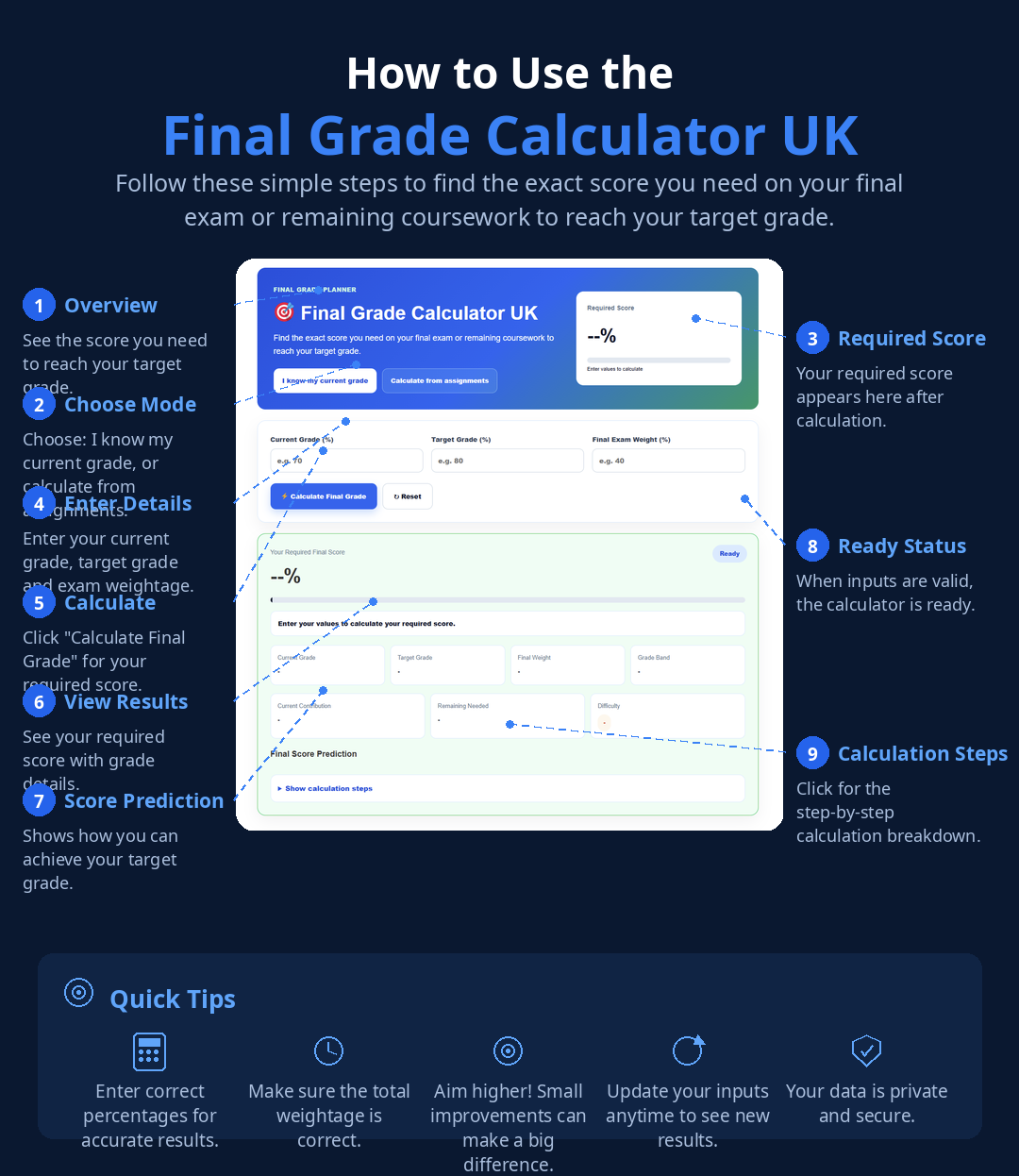
Click Here: Final Grade Calculator UK
The Big Flip: At the OU, a Lower Number Means a Better Degree
Before anything else, you need to rewire one instinct. At a traditional “brick” university, your marks run on a percentage scale where higher is better: 70%+ is a First, 60%+ a 2:1, and so on. The Open University still classifies its honours degrees as First, Upper Second (2:1), Lower Second (2:2) and Third — exactly like every other UK university — but the calculation underneath runs on grade points, and on that scale 1 is the best and 4 is the lowest pass.
Your Open University degree classification is built from module grades, not percentages. Each module you pass is awarded one of four grades: Distinction (grade point 1, the highest), Pass grade 2, Pass grade 3, or Pass grade 4. When the OU calculates your classification, it multiplies your credit by these grade points — so a Distinction contributes less to your total score than a Pass grade 4, and the lowest total score wins the highest classification. It sounds backwards until you work through it once. By the end of this article, you’ll be able to compute your own classification by hand.
One more thing to settle early: only honours degrees are classified at the OU. The university’s own regulations state that no other undergraduate qualification is classified — so ordinary or designated degrees (typically 300 credits), Diplomas of Higher Education and Certificates of Higher Education are awarded unclassified. Everything in this guide applies to the 360-credit bachelor’s honours degrees (and the 480-credit Scottish honours degrees) that make up the vast majority of OU study.
How Your OU Module Grade Is Decided: OCAS, OES and the Four Grades
Every graded OU module assesses you through up to two components. The OCAS (Overall Continuous Assessment Score) is your weighted average across the tutor-marked assignments (TMAs) and interactive computer-marked assignments (iCMAs) you complete during the module. The OES (Overall Examinable Component Score) comes from the end-of-module assessment — usually an exam, but sometimes a project or dissertation-style piece of work. Some modules have only one component; most have both.
Your module grade comes from where those scores sit against four thresholds set out in the OU’s Module Results Determination Policy. For undergraduate modules with a 40% pass mark, the thresholds are the same for both components:
| Module grade | Grade point | OCAS threshold | OES threshold |
| Distinction (Pass 1) | 1 | 85+ | 85+ |
| Pass grade 2 | 2 | 70+ | 70+ |
| Pass grade 3 | 3 | 55+ | 55+ |
| Pass grade 4 | 4 | 40+ | 40+ |
| Fail | — | Below 40 | Below 40 |
Here is the catch that trips up new students every year: you must reach the threshold on BOTH components. The OU’s policy is explicit — the “85 and 85”, “70 and 70” pairing in the official table means exactly what it says. Your final grade is effectively the lower of the two components. An OCAS of 74 (Grade 2 territory) paired with an OES of 58 (Grade 3 territory) earns you a Pass grade 3, not a Grade 2. The exam-board discretion that occasionally nudges borderline students up exists, but you should never plan around it.
Worked micro-example: Amara finishes a 60-credit Level 2 module with an OCAS of 81 and an OES of 72. Both clear the 70 bar, so she takes a Pass grade 2 (grade point 2). Her coursemate Tom gets an OCAS of 88 and an OES of 69. Despite the distinction-level coursework, the OES misses the 70 threshold, so Tom’s module grade is a Pass grade 3 (grade point 3). One examinable component worth a single mark can swing an entire module grade — and, as you’ll see, module grades are the only currency the classification formula accepts.
Two quirks worth knowing. First, Level 1 modules are usually graded on a simple pass/fail basis — you need 40%+ on both components, and that’s it. Second, some modules determine your grade from the OES alone (as long as you pass the OCAS); the exact rule is always in your module’s assessment strategy, so check it rather than assuming. Either way, the four-grade scale above is what feeds the classification machine.
The Classification Machine: Your Best 240 Credits, Double-Weighted
When you’ve completed the credit your honours degree needs, the OU calculates your classification from your best 240 credits at OU Level 2 and above — nothing else. That’s 120 credits at Level 3 and 120 credits at Level 2 (or above). For each module, the OU multiplies the module’s credit size by its grade point, and then doubles the result for Level 3 modules. Add everything together and you get your weighted grade credit score — one number between 360 and 1440 that decides your degree class.
The formula, straight from the OU’s official classification guidance:
| Module | Credits × Grade | Weighting | Module score |
| Level 3, 60 credits, Distinction (1) | 60 × 1 | Double | 120 |
| Level 3, 60 credits, Pass grade 2 | 60 × 2 | Double | 240 |
| Level 3, 30 credits, Pass grade 3 | 30 × 3 | Double | 180 |
| Level 2, 60 credits, Pass grade 2 | 60 × 2 | Single | 120 |
| Level 2, 60 credits, Pass grade 4 | 60 × 4 | Single | 240 |
Notice what the double-weighting does: your Level 3 modules carry twice the influence of Level 2. A Distinction on a 60-credit Level 3 module scores 120 — the same as a Pass grade 2 on a 60-credit Level 2 module scores 120. In other words, one strong final-year-equivalent module can cancel out a weaker one from the year before. If you’re deciding where to put your effort, the answer is unambiguous: Level 3 is where classifications are won and lost.
Once your weighted grade credit score is calculated, it’s read off against four bands. Remember the flip: the lowest scores get the highest classes.
| Weighted grade credit score | Classification |
| 360 – 630 | First Class |
| 631 – 900 | Upper Second Class (2:1) |
| 901 – 1170 | Lower Second Class (2:2) |
| 1171 – 1440 | Third Class |
The extremes make the system intuitive. A student with Distinctions across all 240 classification credits scores 360 — the minimum, and a First. A student scraping Pass grade 4s everywhere scores 1440 — the maximum, and a Third. Everyone else lands somewhere in between, and the bands above are where the lines fall for the standard 240-credit calculation.
Worked Example 1: Priya’s First — Won by a Single Point
Let’s run a full classification. Priya is finishing a 360-credit honours degree. Her Level 1 modules don’t count, so we start at Level 2:
| Module (illustrative) | Level | Credits | Grade | Calculation | Score |
| Research methods | 3 | 60 | Distinction (1) | (60 × 1) × 2 | 120 |
| Specialist topic A | 3 | 30 | Pass grade 2 | (30 × 2) × 2 | 120 |
| Specialist topic B | 3 | 30 | Pass grade 2 | (30 × 2) × 2 | 120 |
| Core module | 2 | 60 | Pass grade 2 | 60 × 2 | 120 |
| Option module | 2 | 30 | Pass grade 3 | 30 × 3 | 90 |
| Skills module | 2 | 30 | Pass grade 2 | 30 × 2 | 60 |
Total weighted grade credit score: 120 + 120 + 120 + 120 + 90 + 60 = 630. That sits exactly on the top edge of the First Class band (360–630) — Priya graduates with a First, by a single point. Had that 30-credit Level 2 option module been a Pass grade 4 instead of a grade 3, the score would have been 660 and she’d have landed in the 2:1 band. At the OU, classification really can hinge on one module grade at one level — which is why the “Level 1 doesn’t count, Level 3 counts double” rule matters so much when you’re choosing modules and pacing your effort.
The Borderline Test: How 60 Points Can Lift You a Whole Class
The OU doesn’t leave borderline students to the mercy of a hard cut-off. If your weighted grade credit score falls within 60 points of the next higher classification band, you’re in the borderline zone — and you get the higher class if you’ve achieved at least 60 credits at Level 3 at that higher grade or better. The official borderline ranges for the standard 240-credit calculation:
| Your score is in… | Borderline for… | You need 60+ Level 3 credits at… |
| 631 – 690 | First Class | Distinction (grade 1) |
| 901 – 960 | Upper Second (2:1) | Grade 1 or 2 |
| 1171 – 1230 | Lower Second (2:2) | Grade 1, 2 or 3 |
Worked example 2 — Daniel’s 2:1, rescued by the borderline rule. Daniel’s classification credits:
| Module (illustrative) | Level | Credits | Grade | Calculation | Score |
| Dissertation project | 3 | 60 | Pass grade 2 | (60 × 2) × 2 | 240 |
| Advanced theory | 3 | 60 | Pass grade 3 | (60 × 3) × 2 | 360 |
| Core module | 2 | 60 | Pass grade 3 | 60 × 3 | 180 |
| Option module | 2 | 60 | Pass grade 3 | 60 × 3 | 180 |
Total: 240 + 360 + 180 + 180 = 960. That’s inside the Lower Second band (901–1170) — but it’s also inside the 2:1 borderline range (901–960). Daniel has 60 Level 3 credits at Pass grade 2, which meets the “grade 1 or 2” requirement, so the borderline test lifts him to an Upper Second Class (2:1). The counterfactual shows how much the rule matters: if that 60-credit Level 3 project had been a Pass grade 3 instead, his total would have been 1080 — outside the borderline zone, and a 2:2 with no way back. Sixty Level 3 credits at the right grade are worth an entire degree class.
What Doesn’t Count Towards Your Open University Degree Classification
The 240-credit calculation sounds generous until you see what’s excluded. The OU’s guidance lists the exclusions explicitly, and they’re wider than most students expect:
Level 1 modules never count. Your first year of OU study — typically 120 credits at Level 1 — is entirely outside the classification formula. You need to pass them (40%+ on both components for graded ones; most Level 1 modules are simple pass/fail), and they appear on your transcript, but they contribute zero to your weighted grade credit score. This is the OU’s built-in adjustment period: the year you’re learning how to study at a distance is the year that can’t hurt your degree class. If you’re coming from a traditional university background, this is the mirror image of first-year weighting at brick universities — except at the OU the rule is absolute, not a 0–10% sliding scale.
Credit transfer (RPL) doesn’t count. If you brought in credit from previous study elsewhere — an HND, a foundation degree, or earlier university modules — that credit counts toward the 360 credits your degree needs, but your performance on it is invisible to the classification formula. The OU even publishes reduced score bands for credit-transfer students: with only 180 classification credits available, for example, the First band becomes 300–525 instead of 360–630. The fewer of your own graded OU modules the formula can see, the more each remaining module matters.
Ungraded modules don’t count. Some OU modules award only a pass with no grade — those modules give you credit but no grade points, so they can’t move your score. And if you’ve completed more valid classification credit than your qualification requires, the OU uses your best grades — with ties broken by earliest completion, then module code order. You can’t game this by stacking extra modules, but it does mean a poor early Level 2 result can be displaced by a better one later.

Which OU Awards Are Actually Classified
Not every OU qualification gets a First, 2:1, 2:2 or Third. The rule is simple: bachelor’s honours degrees are classified; nothing else at undergraduate level is. That means the 300-credit ordinary or “designated” degrees, the Diploma of Higher Education (240 credits) and the Certificate of Higher Education (120 credits) are all awarded unclassified — you pass, and that’s the award. If classification matters to you — for postgraduate study, for example, where a 2:1 is often the entry bar — make sure you’re on a 360-credit honours route, not a 300-credit designated one.
Two special cases. Scottish honours degrees at the OU run to 480 credits rather than 360, and the classification guidance includes them in the same weighted-score system. And postgraduate OU modules use a different grade scale entirely — Distinction, Merit and Pass — which is why the classification of an OU taught master’s follows the familiar Merit vs Distinction pattern rather than the undergraduate grade-point machine. If postgraduate credit is ever counted down into an undergraduate honours degree, the OU converts it: Distinction becomes Pass grade 1, Merit becomes Pass grade 2, and Pass becomes Pass grade 4.
Open University vs Traditional University Grading: The Honest Comparison
| Open University | Typical brick university | |
| Module marks | Four grades (Distinction / 2 / 3 / 4), not percentages | Percentage marks, 0–100 |
| Distinction-level work | 85%+ on both components | 70%+ overall (First) |
| First-year modules | Never count toward classification | Usually 0%, sometimes up to 10% |
| Final-year weighting | Level 3 double-weighted, always | Varies (40:60, 25:75, 30:70…) |
| Classification maths | Weighted grade credit score, 360–1440 | Weighted percentage average |
| Borderline uplift | Automatic 60-point zone test | Exam-board discretion, varies |
| Rounding | Whole-number bands, no decimals | 0.5% rounding rules, varies |
The comparison explains why OU students on forums constantly ask whether their degree is “harder” to get a First in. The honest answer: it’s different, not necessarily harder. An 85% distinction threshold looks brutal next to a brick university’s 70% First boundary — but OU assessment is built around specific, criterion-marked tasks (short focused questions marked against what you covered and applied correctly) rather than the long discursive essays where 70%+ is rare by design. The two systems were calibrated for their own assessment styles. What is objectively true is that the OU’s formula is more transparent: there is no exam-board discretion lottery, no mysterious “predominant class” rule — just arithmetic and one published borderline test.
What Happens If You Fail an OU Module
A failed module earns no credit and no grade, so it can’t enter the classification calculation at all — but you still need those credits to complete your degree, which means retaking or replacing the module under your qualification’s regulations. This is where the “best grades” rule does quiet work in your favour: because the OU takes your best 240 credits when you hold more valid credit than required, a poor result you later improve on can effectively be displaced from the formula. The practical lesson is to check your specific module’s resit and retake rules early — the classification guidance describes the maths, but the permission to re-sit sits in the module and qualification regulations.
One important boundary: the classification formula only ever sees passed, graded modules. A condoned or compensated fail — the mechanism some brick universities use to let you progress past a failed module — has no real equivalent in the OU grade-point system, because there’s no percentage average to absorb it into. If a module is in your classification set, you passed it with a grade of 1 to 4. Full stop.
7 Things Students Get Wrong About OU Grades
1. “85% is a First.” No — 85%+ on both components is a Distinction, which is a module grade, not a degree class. Distinctions are the fuel; the degree class comes from the 360–1440 scale.
2. “My first year counts a little.” It counts for zero. Level 1 is pass/fail for classification purposes, full stop — use it to learn how to study, not to chase grades.
3. “Averaging my percentages gives my classification.” The OU never averages percentages. It converts each module to a grade point (1–4), weights by credit, doubles Level 3, and sums. Averaging your OCAS/OES percentages will give you a wrong answer.
4. “Credit transfer grades boost my average.” Transferred credit is invisible to the formula. It helps you finish faster; it can’t help your class.
5. “A Grade 3 means I can’t get a First.” Priya’s worked example above includes a Pass grade 3 and still lands a First at 630. What matters is the total, not any single module.
6. “The borderline test needs an appeal.” It’s automatic. If your score lands in the 60-point zone and your Level 3 grades qualify, the higher class is awarded — no forms, no begging.
7. “All OU degrees are classified.” Only honours degrees. The 300-credit designated degrees and the DipHE/CertHE exit awards are unclassified.
How to Plan Your Grades Like an OU Strategist
With the rules laid bare, the strategy writes itself. First, treat Level 1 as training: pass everything, learn the TMA rhythm, and don’t burn out chasing distinctions that can’t count. Second, from Level 2 onward, every module is a grade-point asset — aim to bank as many grade 1s and 2s as you can, because the formula keeps your best 240 credits. Third, protect Level 3 above all: with double weighting, one Distinction on a 60-credit Level 3 module (score 120) is worth as much as two Pass grade 2s on 60-credit Level 2 modules. If you have limited study hours in your final stage, spend them where the multiplier is.
Fourth, know your borderline. The 60-point uplift zone means the difference between a 2:2 and a 2:1 can come down to a single Level 3 module grade — Daniel’s example proves it. Before your final modules, compute your running weighted score and identify exactly which grades would push you into the borderline zone. And fifth, if you’re transferring credit in, do the maths on the reduced bands early: fewer classification credits means less room to absorb a weak module, so transfer students should be the most grade-conscious of all.
Do Open University degrees get the same classification as other UK universities?
Yes. OU honours degrees are classified as First Class, Upper Second (2:1), Lower Second (2:2) or Third — exactly the same classes as traditional UK universities. Only the calculation underneath is different: the OU uses grade points and a weighted credit score rather than percentage averages.
What mark do you need for a distinction at the Open University?
You need 85% or more on BOTH your OCAS (continuous assessment) and your OES (examinable component). Your module grade is effectively the lower of the two — an 88% OCAS with a 69% OES earns a Pass grade 3, not a distinction.
Do first-year modules count towards your OU degree classification?
No. Level 1 modules never count towards classification — you need to pass them, but they contribute nothing to your weighted grade credit score. Only your best 240 credits at Level 2 and above are used, with Level 3 double-weighted.
How does the OU calculate your degree classification?
The OU multiplies each module’s credits by its grade point (Distinction = 1, Pass grade 2 = 2, Pass grade 3 = 3, Pass grade 4 = 4), doubles the result for Level 3 modules, and sums your best 240 credits. The total — between 360 and 1440 — is read off against four bands: 360–630 First, 631–900 2:1, 901–1170 2:2, 1171–1440 Third.
Can you get a First with a Pass grade 3 at the Open University?
Yes. Classification depends on your total weighted score, not any single module. A student with mostly Distinctions and grade 2s at Level 3 can absorb a Pass grade 3 and still land in the 360–630 First band — our worked example shows exactly this.
Does credit transfer count towards your OU classification?
No. Credit transferred from previous study elsewhere counts towards the credits your degree needs but is invisible to the classification formula. The OU publishes reduced score bands for credit-transfer students, and with fewer graded OU modules in the calculation, each remaining module matters more.
What happens if you fail an OU module?
A failed module earns no credit and no grade, so it cannot enter the classification calculation. You still need those credits to complete your degree, so you must retake or replace the module under your qualification’s regulations. Because the OU uses your best 240 credits, an improved retake grade can displace a weaker result.
Is an Open University degree worth the same as a traditional university degree?
OU honours degrees carry the same classifications — First, 2:1, 2:2, Third — as any UK university, and the OU is subject to the same QAA quality regulation. Employers and postgraduate admissions treat the classification the same way; what differs is only the internal marking and calculation system.
Conclusion
The Open University’s grading system looks alien from the outside — distinctions at 85%, grades where 1 beats 4, a classification score where lower is better — but it’s one of the most transparent systems in UK higher education. There are no hidden exam-board uplifts, no departmental weighting lotteries, no borderline discretion to lobby for. Your classification is pure arithmetic: grade points times credits, Level 3 doubled, read off four published bands, with one automatic borderline test. If you can do the sums in this article, you can predict your own degree class to the point.
The strategic takeaways are few but powerful. Level 1 is for learning, not for grades. From Level 2 onward, every module is an asset the formula will keep or discard on merit. Level 3 is double-weighted, so that’s where your effort earns its highest return — a single Distinction on a 60-credit Level 3 module can be worth an entire classification. And if you’re anywhere near a band boundary, check the 60-point borderline zone before you assume the worst: as Daniel’s example shows, sixty Level 3 credits at the right grade can lift you a whole class without a single form to fill in.
Whether you’re just starting out or deep into Level 3, run your own numbers now rather than at results time. Plug your expected module grades into the classification formula, find your borderline, and study with a target instead of a hope. The OU gives you the rules in writing — use them.

![Read more about the article Pass/Fail Modules at UK Universities: What They Do to Your Average, Degree and Transcript [2026]](https://gradeforuni.com/wp-content/uploads/2026/10/featured-pass-fail-modules-300x192.png)

![Read more about the article How Do University Marking Criteria Work? Rubrics Explained [2026]](https://gradeforuni.com/wp-content/uploads/2026/10/featured-marking-criteria-300x192.png)