
![You are currently viewing Joint Honours Grading: How Your Two Subjects Become One Degree Class [2026]](https://gradeforuni.com/wp-content/uploads/2026/10/featured-joint-honours-uk.png)
Joint Honours Grading: How Your Two Subjects Become One Degree Class [2026]
Every year, thousands of UK students enrol on degrees like History and Politics, or Mathematics with French, and quietly assume something that is not true: that they will get a grade for History and a grade for Politics. They won’t. A joint honours degree produces one degree and one classification — and every mark from both subjects goes into the same pot.
That single fact changes how you should think about module choices, resits, dissertations and even which subject to prioritise in final year. A weak subject doesn’t just sit on your transcript looking sad; it actively drags down the weighted average that determines whether you graduate with a 2:1 or a 2:2. This guide explains exactly how joint honours grading works at UK universities: the credit splits, the single-classification rule, the dissertation question, and two fully worked calculations showing how the maths plays out.
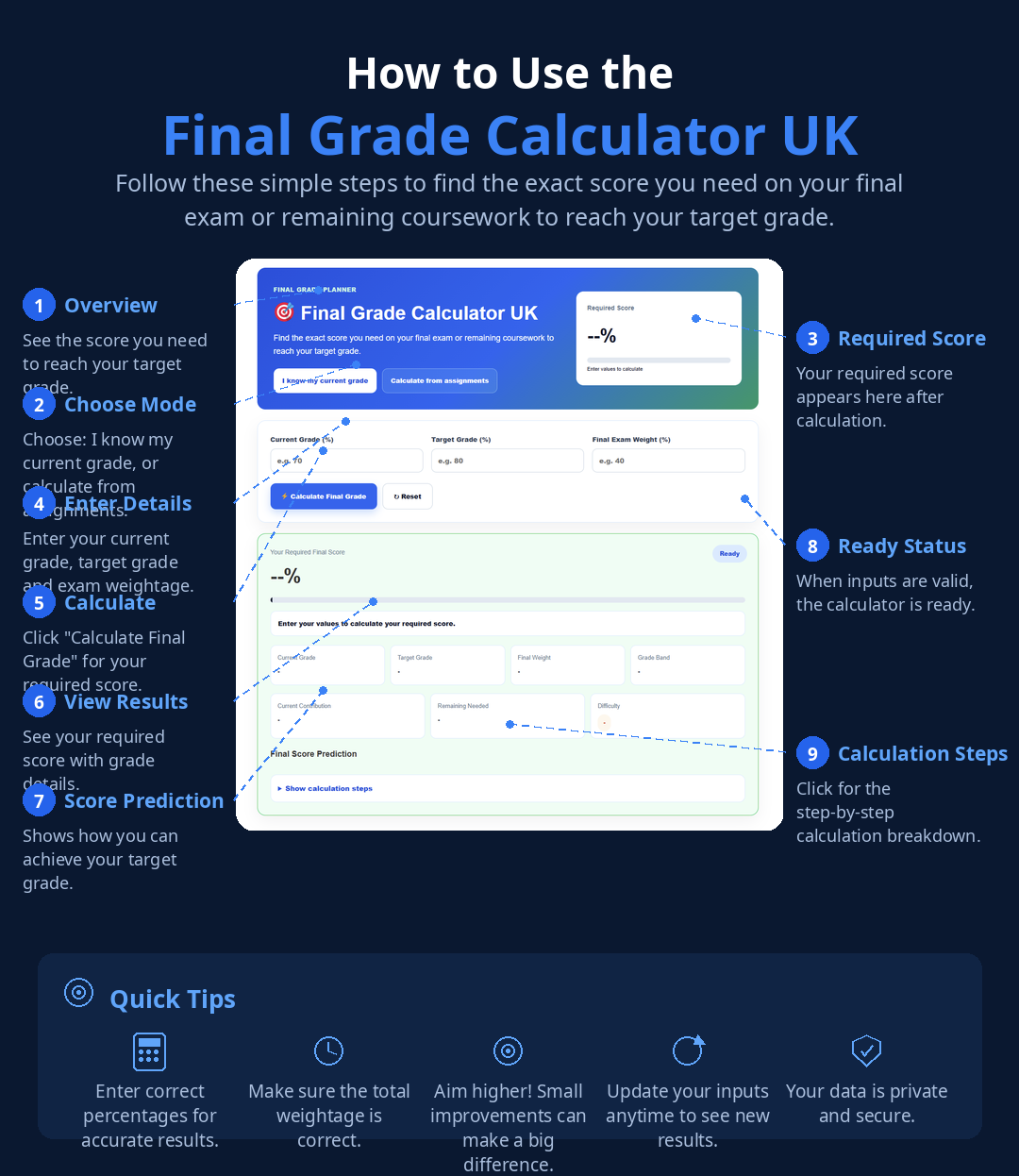
Click Here: Final Grade Calculator UK
What a Joint Honours Degree Actually Is
A joint honours degree is one degree programme built from modules taught by two different departments. You study both subjects to honours level, and both appear in your degree title — but the university awards you a single BA (Hons) or BSc (Hons), classified once, using one algorithm.
The wording of the degree title tells you how the workload splits between the two subjects. This is not marketing fluff; it reflects the credit balance your exam board will use:
| Degree title pattern | Meaning | Typical credit split |
|---|---|---|
| “X and Y” (e.g. History and Politics) | True joint honours — both subjects are majors | 50:50 |
| “X with Y” (e.g. English with Spanish) | Major/minor — X is the major, Y the minor | ~75:25 |
| “Combined Honours” (e.g. Exeter’s Flexible Combined Honours) | Bespoke combination, sometimes three subjects | Varies by pathway |
| Two separate degrees (e.g. a BA plus a BSc) | Double degree — genuinely rare in the UK | Two full programmes |
The “and” versus “with” distinction is confirmed across university guidance: “and” courses split your study evenly between the two subjects, while “with” courses concentrate roughly three-quarters of your effort on the first-named subject. Queen’s University Belfast describes its Major-Minor degrees the same way, with two-thirds of study in the first-named subject and one-third in the second. And a joint honours degree is emphatically not a double degree — a double degree means two entirely separate degrees, each with its own requirements, which is uncommon in the UK system.
The Golden Rule: One Degree, One Classification
Here is the sentence that clears up most confusion: joint honours students are classified by exactly the same algorithm as single honours students at the same university. There is no special joint-honours formula, no subject-by-subject grading, and no averaging of two separate classifications.
Newcastle University’s programme regulations for its joint honours degrees state this plainly: candidates are assessed for degree classification on the basis of all modules taken at Stages 2 and 3, with the stages weighted 1:2 — the standard university algorithm, applied to the combined module list. Your History modules and your Politics modules are simply thrown into one credit-weighted average together, exactly as if they were all modules from a single department.
In practice, that means your exam board does this:
- Take every module mark from the years that count (usually years 2 and 3, i.e. Levels 5 and 6).
- Weight each mark by its credit value — a 30-credit module counts double a 15-credit one, regardless of which department taught it.
- Apply the university’s year weighting (for example 40:60 or 1:2 between second and final year).
- Compare the final percentage against the standard boundaries: 70+ First, 60–69 2:1, 50–59 2:2, 40–49 Third.
Because credits are what count, the split between your subjects matters enormously. On a 50:50 joint honours degree, half of every credit that feeds your classification comes from each subject. On a 75:25 major/minor, your major contributes three times as many credits as your minor. The subject you are weaker in cannot hide — but a minor structure at least limits the damage, as the worked examples below show.
Worked Example 1: A 50:50 Joint Honours Degree
Amara studies English and History (50:50) at a university that weights Year 2 at 40% and Year 3 at 60%. Her marks:
| Year | English (60 credits) | History (60 credits) | Year average |
|---|---|---|---|
| Year 2 | 61% | 66% | (61 × 60 + 66 × 60) ÷ 120 = 63.5% |
| Year 3 | 64% | 69% | (64 × 60 + 69 × 60) ÷ 120 = 66.5% |
Final classification average: (0.40 × 63.5) + (0.60 × 66.5) = 25.4 + 39.9 = 65.3% — a 2:1.
Now look at what each subject contributed on its own. English across both years: (0.40 × 61) + (0.60 × 64) = 62.8%. History: (0.40 × 66) + (0.60 × 69) = 67.8%. Amara’s combined 65.3% sits exactly between them — her weaker English pulled 2.5 percentage points off the level her History alone would have reached. That is the 50:50 bargain: neither subject can rescue or ruin you alone, but both move the needle.
The counterfactual is sobering. If Amara’s English marks had been 58% and 60% instead, her English average would be 59.2%, and her combined average would fall to 63.5% — still a 2:1, but only just. A few more marks lost in English and she drops to a 2:2. On a joint honours degree, borderline rules apply to the combined average, not per subject — no department can “uplift” its half independently.
Worked Example 2: A Major/Minor Degree Protects Your Average
Daniel studies Politics with International Relations — a major/minor split of roughly 75:25. In his final year he takes 90 credits of Politics and 30 credits of IR. His final-year subject averages: Politics 68%, IR 54%.
Final-year weighted average: (68 × 90 + 54 × 30) ÷ 120 = (6,120 + 1,620) ÷ 120 = 7,740 ÷ 120 = 64.5%.
Compare that with the alternatives. If those 30 IR credits had been Politics modules at 68%, his average would be 68% — the minor cost him 3.5 percentage points. But if the same marks had been earned on a 50:50 joint honours degree (60 credits at 68%, 60 at 54%), the average would be just 61%. The minor structure contained the damage: because only a quarter of his credits came from the weaker subject, its drag on the average was proportionally smaller.
This is worth knowing when choosing between “and” and “with” versions of similar courses. If you are significantly stronger in one subject, the major/minor structure is mathematically kinder to your classification. If your two subjects are evenly matched, the 50:50 split makes no difference either way.
The Dissertation Question: Which Subject Gets It?
On most UK joint honours degrees you write one dissertation, in one of your two subjects — not both. Nottingham Trent’s joint honours course specification states that students must choose to take a dissertation in one of their subjects and may not take one in both. Aberdeen’s History dissertation catalogue puts it the same way: the dissertation is obligatory for single honours students, while joint honours students choose to write it in either of their two subjects.
This is a bigger decision than it looks, because the dissertation is usually a 30-credit final-year module — a quarter of your final-year credits, and at most universities final year is the most heavily weighted year. A strong dissertation mark in your better subject can lift your whole classification; a weak one drags it down with the same force. Some departments also set eligibility thresholds: Warwick’s modern languages dissertation, for example, normally requires an average above 65% in intermediate-year non-language modules before you are even permitted to take it.
Worked mini-example: suppose your final year (weighted 60% overall) contains a 30-credit dissertation. You score 72 on it, and your other 90 final-year credits average 63. Your final-year average is (72 × 30 + 63 × 90) ÷ 120 = (2,160 + 5,670) ÷ 120 = 65.25%. Without the dissertation — 63% across the board — it would be 63%. That single module added 2.25 percentage points to your final-year average, which at 60% year-weighting is worth 1.35 points on your final classification average. Choose the subject where you write best, not the one you find most interesting.
Different Departments Mark Differently — and That’s Normal
One thing that surprises joint honours students: the two departments can feel like different grading universes. A History essay marked at 68 might have earned 75 in English, or vice versa. Marking criteria, assessment styles (exams versus coursework), and departmental cultures genuinely differ — which is why universities publish detailed marking criteria for each subject.
What does not differ is the classification machinery. The 70/60/50/40 boundaries are university-wide, the year weightings are university-wide, and borderline and discretionary uplift rules apply to your combined average. Departments do not “scale” one subject’s marks to match the other’s as a matter of routine — though universities can and do moderate marks within modules. The practical consequence: you cannot assume a 65 in Subject A represents the same effort or achievement as a 65 in Subject B, and your strategy should be to maximise marks where your personal return on effort is highest.

Resits, Condonement and Borderlines Work the Normal Way
Because joint honours students sit under the same regulations as everyone else, the safety nets work identically:
- Resits and referrals: if you fail a module in either subject, the standard referral and resit rules apply — usually a capped mark (commonly 40%) on the resit, with the capped mark feeding your average.
- Condoned passes: a failed module can be condoned if your overall profile is strong enough, regardless of which department taught it.
- Borderline uplift: discretionary uplift rules look at your combined average and your credit profile across both subjects — for example, the proportion of credits at the higher boundary. A strong subject can supply those higher-boundary credits just as well as a single honours student’s strong modules can.
The one joint-honours-specific wrinkle is failing disproportionately in one subject. If every failed or condoned module sits in Subject B while Subject A is clean, your transcript still shows the fails, and some postgraduate admissions tutors do read transcripts module by module. The classification, though, only ever sees the numbers.
Joint vs Combined vs Major/Minor: Which Structure Suits You?
If you are still choosing, this decision framework distils the grading implications of each structure:
| Structure | Best for | Grading risk |
|---|---|---|
| Single honours | Depth in one subject; simplest classification maths | None specific — the baseline |
| Joint honours 50:50 (“and”) | Two evenly-matched strengths | A weak subject drags the average at full weight |
| Major/minor 75:25 (“with”) | One clear strength plus an interest | Minor’s drag is contained to ~25% of credits |
| Flexible combined honours | Unusual combinations; bespoke title | Variable splits — check your pathway’s credit map |
Two practical checks before you commit. First, confirm the minimum credit requirements per subject — Buckingham’s framework, for instance, requires a minimum of 150 units in each subject for a joint honours award, which stops you drifting too far toward one side. Second, check whether you can rebalance later: some flexible programmes let you weight optional modules toward your stronger subject in final year, effectively turning a 50:50 into something closer to 60:40 when it matters most.
6 Mistakes Joint Honours Students Make
- Expecting two grades. There is only one classification. Plan your effort around the combined average, not per-subject pride.
- Ignoring the credit maths. A 15-credit module counts half as much as a 30-credit one, whatever the department. Students routinely over-invest in low-credit modules they enjoy.
- Writing the dissertation in the wrong subject. Pick the subject where your writing scores highest, not the trendiest topic. It is worth over a point on your final average.
- Assuming departments mark alike. Learn each department’s criteria separately; a technique that earns 70 in one can earn 60 in the other.
- Letting the weaker subject slide. On a 50:50 degree, every mark lost in your weaker subject costs exactly as much as a mark lost in your stronger one.
- Forgetting the year weighting. Final year usually counts double second year. A 50:50 split across subjects does not mean a 50:50 split across years — prioritise final-year modules in both subjects.
If your average is sitting below where you want it, the recovery tactics are the same as for any degree — our 2:2 to 2:1 recovery guide walks through the module-triage maths, and it applies credit-by-credit to joint honours students too.
Frequently Asked Questions
Do you get two grades on a joint honours degree?
No. A joint honours degree results in a single degree award with one classification (First, 2:1, 2:2 or Third). Marks from modules in both subjects are combined into one credit-weighted average, which is then classified using the university’s standard algorithm — the same one used for single honours students.
How is a joint honours degree classification calculated?
All module marks from the years that count (usually years 2 and 3) are weighted by their credit value and combined into one average, then the university’s year weighting (for example 40:60) is applied. The final percentage is matched against the standard boundaries: 70+ for a First, 60-69 for a 2:1, 50-59 for a 2:2 and 40-49 for a Third. There is no separate per-subject calculation.
What is the difference between ‘and’ and ‘with’ in a degree title?
‘And’ (for example History and Politics) means a true 50:50 joint honours degree where both subjects are majors. ‘With’ (for example English with Spanish) means a major/minor structure, typically around 75:25, where most of your credits come from the first-named subject. The split determines how much each subject can move your final average.
Do I write one dissertation or two on a joint honours degree?
One, in one of your two subjects — not both. Universities including Nottingham Trent, Aberdeen and Warwick all require joint honours students to choose a single subject for the dissertation. Because it is usually a 30-credit final-year module, it can shift your final-year average by more than two percentage points, so choose the subject where your writing scores highest.
Can a weak subject drag down my joint honours classification?
Yes, directly. On a 50:50 joint honours degree, half of the credits feeding your classification come from each subject, so a weak subject pulls the combined average down at full weight. On a major/minor (‘with’) degree the damage is contained because only around a quarter of credits come from the minor. Worked example: 90 credits at 68% plus 30 at 54% gives 64.5%, while the same marks on a 50:50 split give only 61%.
Do borderline and discretionary uplift rules apply to joint honours degrees?
Yes. Borderline uplift rules apply to your combined average, exactly as for single honours students. The exam board looks at the overall percentage and the credit profile across both subjects — strong marks in either subject can supply the higher-boundary credits some uplift rules require. No department can uplift its half independently.
Is a joint honours degree the same as a double degree?
No. A joint honours degree is one degree programme combining two subjects, awarded as a single BA (Hons) or BSc (Hons). A double degree means two entirely separate degrees, each with its own requirements — which is rare in the UK. Employers treat a joint honours degree as one qualification, not two.
Which is better for my grades: joint honours or major/minor?
It depends on your strengths. If you are evenly good at both subjects, a 50:50 joint honours degree is neutral. If one subject is clearly stronger, a major/minor (‘with’) structure is mathematically kinder, because the weaker subject contributes fewer credits to your average. Check whether your programme lets you rebalance optional modules toward your stronger subject in final year.
Conclusion
Joint honours grading is simpler than it looks and more consequential than most students realise. Simpler, because there is only ever one calculation: every module from both subjects, weighted by credits, fed through your university’s standard algorithm into a single classification. More consequential, because the split between your subjects decides how much leverage each one has over that number — a 50:50 degree gives your weaker subject full power to drag you down, while a major/minor structure contains it.
The three decisions that matter most are choosing the right structure for your strengths, writing your dissertation in the subject where you score highest, and directing your final-year effort by credit weight rather than by affection. Get those right, and two subjects become one strong degree class instead of two halves pulling in opposite directions.

![Read more about the article Late Submission Penalties at UK Universities: Exactly What Each Day Costs You [2026]](https://gradeforuni.com/wp-content/uploads/2026/10/featured-late-submission-penalties-300x192.png)
![Read more about the article Do UK Universities Drop Your Lowest Module Marks? Discounting Rules Explained [2026]](https://gradeforuni.com/wp-content/uploads/2026/10/featured-drop-lowest-marks-300x192.png)
![Read more about the article Do Predicted Grades Matter for UCAS? How Conditional Offers Work [2026]](https://gradeforuni.com/wp-content/uploads/2026/10/predicted-grades-ucas-featured-300x192.png)