

What Is a Condoned Pass? How UK Universities Let You Progress After Failing a Module
Priya is in the final year of her BSc Psychology. Five of her six 20-credit modules are safely passed — 68, 64, 62, 58 and 52. Then her Cognitive Neuroscience result arrives: 37%. Not a pass, but not a disaster either. She is two marks short on one module, and her first thought is the one thousands of students have every results day: does this one module stop me graduating?
At most UK universities, the answer is no — thanks to a mechanism called a condoned pass (also called compensation, condonement or a compensated pass, depending on the university). It is the exam board’s way of saying: your overall performance is strong enough that this single marginal failure does not need to be resat. You are awarded the credits, you graduate, and you never sit that exam again.
But condonement is not a free pass, and it comes with catches that students consistently misunderstand. This guide explains exactly what a condoned pass is, how the rules differ between UK universities, the credit limits and mark thresholds that decide whether you qualify, the worked numbers showing what a condoned fail does to your degree classification, and the situations where condonement is simply unavailable.
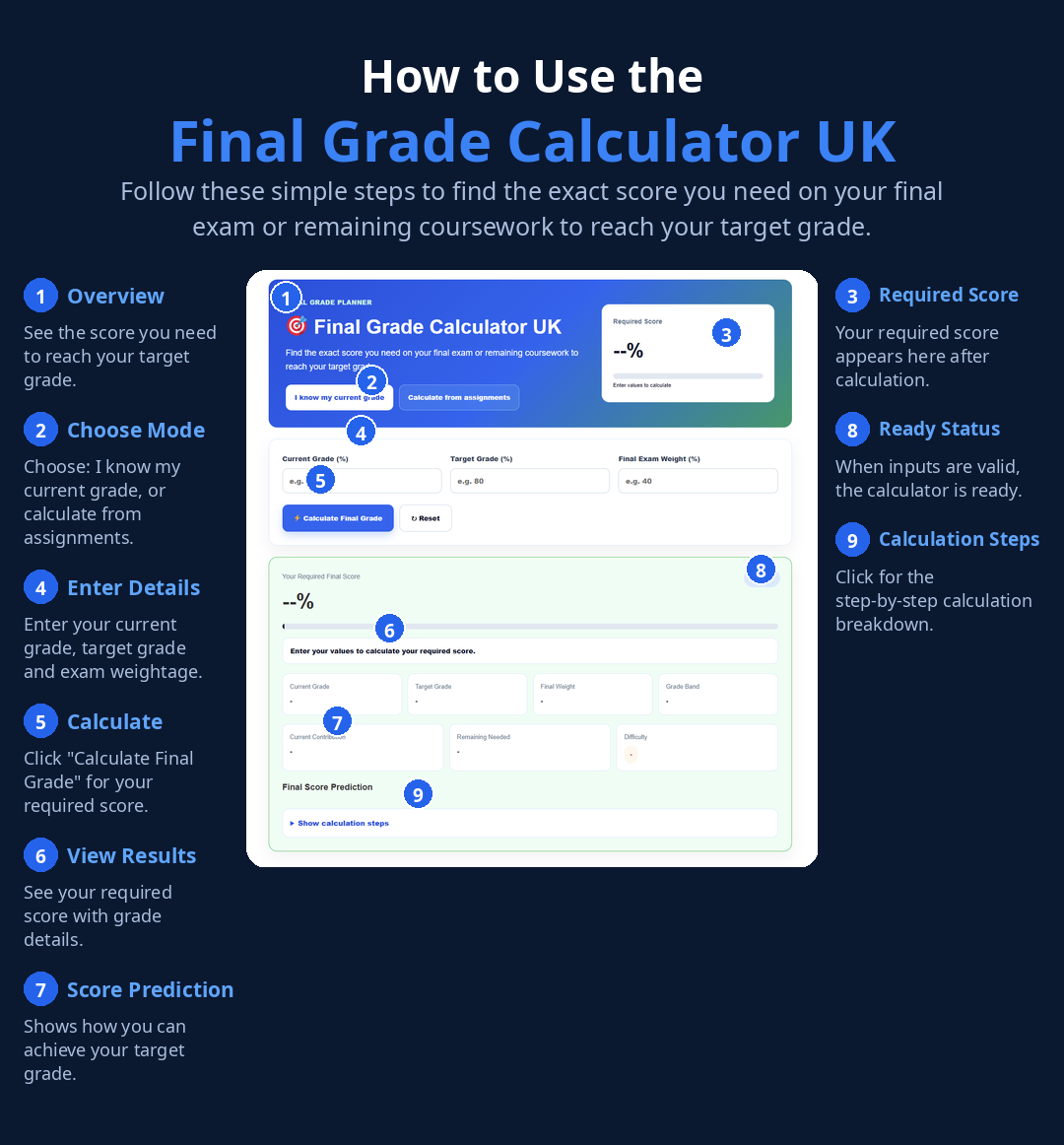
Click Here: Final Grade Calculator UK
What a Condoned Pass Actually Means
A condoned pass is an award of credit for a module you failed, granted by the exam board without any reassessment. The logic is straightforward: if you have passed everything else and your overall average comfortably clears the pass mark, forcing you to resit a single marginal fail adds delay and expense for no educational benefit. Condonement recognises that the learning outcomes have been demonstrated well enough elsewhere in your profile.
The terminology is the first thing that trips students up, because UK universities do not agree on a name. UCL and King’s College London call it condonement. UWE Bristol and the University of Manchester call it compensation (Manchester’s final-year version is formally titled “special compensation”). Regent’s University uses both terms together in its regulations. The mechanism is the same in every case: failed credits are awarded without a resit, and the original fail mark usually stays on the record.
Three things distinguish a condoned pass from every other outcome after a fail. First, there is no resit — the module is over. Second, the fail mark is not erased — at UCL, UWE and Manchester the mark stays exactly as it was and still counts in your average (more on why that matters below). Third, it is the exam board’s decision, not yours — at most universities, if you meet the criteria, condonement is applied automatically; you cannot demand it, and in several systems you cannot refuse it either.
Condoned Pass Rules Compared: Five UK Universities
There is no single national rule for a condoned pass — each university sets its own in its academic regulations, and the details vary more than students expect. The table below compares five institutions, drawn directly from their published regulations:
| University | Term used | Max condonable credits | Mark threshold for condonement | Key exclusions |
|---|---|---|---|---|
| UCL | Condonement | 30 credits per year; 60 max across the whole programme | 1.00–39.99% (undergraduate); 1.00–49.99% (Level 7/Masters) | Non-condonable modules must be passed; marks of 0% (no attempt) cannot be condoned |
| King’s College London | Condonement | 30 credits across levels 5 and above (3-year programmes) | 1–39% (levels 3, 5, 6); 40–49% (level 7) | Core modules can never be condoned; professional-body (PSRB) programmes may exclude it |
| University of Manchester | Special compensation (final year) | Up to 40 credits for 2:2/2:1/First; up to 60 for a Third (with a one-classification penalty) | Typically 30–39% compensation zone | Marks are not changed — compensation is for credit only; accreditation programmes set their own rules |
| UWE Bristol | Compensation | 30 credits at Level 3; 30 at Level 4; 45 across Levels 5–6 combined; 30 at Level 7 | Below pass but marginal, with 40% overall at the level (50% at Level 7) | Learning outcomes must be shown to be met elsewhere; student may decline compensation in favour of a retake |
| University of Dundee | Condonement / compensation | 25% of the stage (30 credits) per stage contributing to honours | Marginal fail within the board’s discretion | Condoned modules are not graded and do not count in the classification; compensated marks do count |
Several patterns emerge from the comparison. Every university caps the total — typically around 30 credits per year or stage, roughly one standard 20-credit module plus a little headroom. Every university sets a floor: a mark deep in failure territory (often below 30–35%) cannot be condoned, because condonement is meant for marginal fails. And every university excludes certain modules — the terminology differs (“core”, “non-condonable”, “essential”), but the principle is identical: the modules that define your degree’s identity, or that professional bodies require you to pass, cannot be waived.
Dundee’s row deserves a second look because it reveals something most students never realise: condonement and compensation are not always the same thing. At Dundee, a condoned module is treated as ungraded and drops out of the classification calculation entirely, while a compensated module’s mark stays in. At UCL, by contrast, the condoned mark explicitly “must stand” and “must be included in the student’s classification.” The same word can behave differently in two cities — which is why you should read your university’s regulations, not a summary of someone else’s.
Read more: University Grade Boundaries Explained — What You Need to Pass
The Five Conditions Exam Boards Check for a Condoned Pass
Condonement is not granted on sympathy; exam boards run through a checklist. Although the exact wording differs, the conditions below appear in recognisably similar form at UCL, KCL, UWE, Manchester and Newcastle:
- You attempted the module properly. A 0% for non-submission or non-attendance cannot be condoned at UCL, and most universities require you to have “sufficiently engaged” with the assessment. Condonement forgives a weak performance, not an absent one.
- The fail is marginal — inside the condonable range. Priya’s 37% sits comfortably inside the typical 30–39% (or 1–39%) condonable band. A 22%, however, falls below most universities’ floor and would be sent to resit instead. Check whether your university publishes an explicit floor: Newcastle, for example, requires no single module mark below 35 for compensation.
- You are within the credit limit. One 20-credit module at 37% is within every university’s allowance above. Two failed 20-credit modules (40 credits) would exceed UCL’s 30-credit yearly limit and KCL’s 30-credit cap — those students resit.
- Your overall average clears the pass mark. Condonement is only for students whose broader performance is sound. UWE requires the 40% level average; UCL requires a credit-weighted mean of at least 40.00% across the year’s 120 credits; Newcastle requires an average of at least 40 across all modules.
- The module is condonable. It must not be designated core, non-condonable or essential, and it must not be subject to professional-body rules that demand an outright pass. Failing the one module your accreditation body inspects is never condonable, whatever your average.
If all five are satisfied, the outcome at most universities is automatic. UCL’s regulations put it bluntly: if a student meets all the condonement criteria and there are no extenuating circumstances to consider, the module must be condoned — and a condoned student “must not be reassessed.” At KCL, the position is the same: once a module is condoned, the student cannot be reassessed in it later.
Worked Example: How a Condoned 37% Still Drags Your Average
Here is the catch that surprises students most: a condoned fail usually keeps its fail mark in your average. You get the credits, but the number does not get rounded up to 40%. UCL’s regulations state the condoned mark “must not be raised to the Pass Mark” and “must be included in the student’s Classification.” UWE likewise confirms the student “will retain the numerical mark they have achieved.” Manchester is explicit that its special compensation involves “no change in marks” — it is “for credit only.”
Let us run Priya’s actual numbers — final year, six 20-credit modules, one condoned at 37%:
| Module | Credits | Mark | Weighted points |
|---|---|---|---|
| Developmental Psychology | 20 | 68% | 1,360 |
| Social Psychology | 20 | 64% | 1,280 |
| Research Methods | 20 | 62% | 1,240 |
| Abnormal Psychology | 20 | 58% | 1,160 |
| Health Psychology | 20 | 52% | 1,040 |
| Cognitive Neuroscience (condoned) | 20 | 37% | 740 |
| Total | 120 | 6,820 |
Final-year average: 6,820 ÷ 120 = 56.83% — a 2:2 on the standard classification scale.
Now remove the condoned module and average the other five: 6,080 ÷ 100 = 60.8% — a 2:1. That single condoned 37% costs Priya roughly four percentage points and an entire classification band. She graduates — which is what matters most — but she graduates with a 2:2 rather than the 2:1 her other marks earned.
This is the central trade-off of condonement: certainty now, in exchange for the mark staying on your record. A resit, by contrast, would typically be capped at 40% — only three points better than 37%, and it would cost her the summer plus a delayed graduation. Run your own figures through our Weighted Grade Calculator before deciding how you feel about the trade.
Worked Example: The Credit-Total Progression Check
Condonement also has to satisfy the credit arithmetic — the degree cannot be awarded unless the totals work. Take Tom, a second-year BSc Computer Science student at a university following the standard UCL-style rules (30 condonable credits per year, 40.00% weighted mean required, marks below 1% excluded):
| Module | Credits | Mark |
|---|---|---|
| Algorithms | 20 | 71% |
| Databases | 20 | 66% |
| Operating Systems | 20 | 59% |
| Software Engineering | 20 | 55% |
| Human-Computer Interaction | 20 | 48% |
| Computer Networks (failed) | 20 | 34% |
Step through the exam board’s checklist with Tom’s numbers:
- Condonable range? 34% falls inside the 1.00–39.99% condonable band. ✓
- Credit limit? 20 credits ≤ 30-credit yearly maximum. ✓
- Weighted mean ≥ 40.00%? (71+66+59+55+48+34) × 20 ÷ 120 = 6,660 ÷ 120 = 55.5%. ✓
- Passed 90+ credits? 100 credits passed outright. ✓
- Module condonable? Computer Networks is not a designated non-condonable/core module on his programme. ✓
Tom is condoned: he is awarded the full 120 credits for the year, progresses to final year with no resit, and his transcript records 34% for Computer Networks — included in his eventual classification. Had his mark been 28%, or had he failed two modules totalling 40 credits, the board would have required reassessment instead. The margin between “condoned” and “resit in August” can be genuinely thin, which is why knowing your university’s exact thresholds before results day is worth the half hour it takes to read the regulations.
Read more: What Happens If You Fail a University Module? — Your Next Options Explained
When a Condoned Pass Is Off the Table
Condonement looks generous until you meet its boundaries. These are the situations where exam boards will not — or cannot — condone a fail, and students discover them at the worst possible moment:
- Professional accreditation requires a pass. This is the biggest and least-known exclusion. Degrees accredited by bodies such as the NMC (nursing), HCPC (health professions), BPS-accredited psychology routes with clinical components, engineering (IET/IMechE) and law (Bar/SRA pathways) frequently designate modules as non-condonable because the regulator requires demonstrated competence in every area. A nursing student who fails a clinical practice module cannot be condoned through it — patient safety does not do waivers. UWE’s regulations make this explicit: compensation must be “permissible… within the rules of any Professional, Statutory or Regulatory Body.”
- The module is core or non-condonable. KCL states it plainly: “Core modules cannot be condoned.” Dissertations are very commonly designated non-condonable — which is why a failed dissertation follows the resubmission route rather than the condonement route.
- The mark is below the condonable floor. A 34% or 37% is condonable; a 24% usually is not. The floor varies — Newcastle draws it at 35, Manchester’s compensation zone starts at 30 — but every system has one, because condonement is for marginal failure, not wholesale failure.
- Too many failed credits. Fail 40 credits at UCL (limit: 30 per year) or 60 at KCL (limit: 30 across levels 5+) and you are reassessed in everything, including the modules that would individually have qualified. Manchester’s system is more forgiving in the final year — up to 40 failed credits can still attract special compensation — but beyond that the board’s options narrow sharply.
- You did not really attempt it. Marks of 0% for absence or non-submission are excluded from condonement at UCL, and most universities require evidence of genuine engagement. Skipping the exam entirely is never the clever route to a condoned pass.
If you are on an accredited or professional programme, check your programme specification — not the general university regulations — for the list of non-condonable modules. That list is the document that actually governs your degree.
Condoned Pass vs Resit: Do You Get a Choice?
Students often assume they can choose between a condoned pass and a resit, whichever suits them better. The reality depends on the university, and it is one of the genuine fault lines in the UK system:
- At UCL and KCL, you do not get a choice. If you meet the criteria, condonement is applied and reassessment is prohibited — “once a module has been condoned, a student cannot be reassessed in it at a later stage” (KCL). The board decides; the student is informed.
- At UWE Bristol, you do. The exam board offers compensation, and “the student may accept this offer, retaining the numerical mark achieved in that module assessment/s resit, or decline it in favour of a module retake, where this is permitted.” Declining means resitting for a capped pass — worth considering if the failed module sits in a year that counts heavily toward your classification.
- At Manchester, the final-year system is automatic — special compensation applies where the criteria are met, with the classification penalty (one band down for 40–60 failed credits) doing the work of discouraging reliance on it.
When is declining a condoned pass and resitting actually the smarter move? Rarely — but consider it if the failed module carries heavy weight in your classification year and you are confident of passing the resit comfortably. A capped 40% resit mark still beats a 34% condoned mark in the average. But weigh that against the cost: a summer of revision, delayed graduation, and the risk that the resit goes worse. For Priya, with a condoned 37% versus a capped 40% resit, the three-point gain would not have changed her 2:2 — condonement was clearly the better deal.
One related point that confuses students: you cannot be condoned and resit the same module. UCL’s rules state that “condonement and reassessment cannot be applied simultaneously.” If your failed credits exceed the limit, you resit all of them — the board does not condone the marginal ones and resit the rest.
Read more: University Resit Exams Explained — Ultimate Guide to Graduating with Honours
What Shows on Your Transcript — and Who Sees It
A persistent myth holds that a condoned pass is invisible — that the module quietly becomes a pass and nobody is the wiser. The truth is more nuanced and varies by university:
- At most universities, the fail mark appears on the transcript alongside the credits awarded. UCL is explicit that the condoned mark “must stand” — it is not raised to 40%, and it feeds into the classification exactly as earned. Employers and postgraduate admissions tutors who request a full transcript will see the 37%.
- At Dundee, condoned modules are treated as ungraded and excluded from the classification calculation — the most generous treatment in the sector, and a genuine reason to know your own institution’s rules rather than general advice.
- The degree certificate itself does not mention a condoned pass. Your parchment shows the award and classification, not the route by which each credit was earned. The detail lives on the transcript, not the certificate.
For most graduate employers, a single condoned module in an otherwise solid transcript is a non-issue — recruiters filter on classification, not on module-level archaeology. Where it can matter is postgraduate applications: some competitive Masters programmes ask for module marks in prerequisite subjects, and a condoned 34% in a directly relevant module is weaker evidence than a resat pass. If you are planning postgraduate study in the same discipline as the failed module, that is the one scenario where fighting for the resit may be worth it.

Frequently Asked Questions
What is a condoned pass at a UK university?
A condoned pass is when an exam board awards you the credits for a module you failed, without requiring a resit. It applies to marginal fails — typically marks of 30-39% at undergraduate level — where your overall performance is strong enough that the board judges reassessment unnecessary. The original fail mark usually stays on your transcript and in your average.
Is a condoned pass the same as compensation?
Essentially, yes — they describe the same mechanism under different names. UCL and King’s College London use condonement; UWE Bristol and Manchester use compensation. One nuance: at some universities (e.g. Dundee) a condoned module is ungraded and excluded from the classification, while a compensated mark is included. Check your own regulations.
How many credits can be condoned?
It varies by university, but around 30 credits per year is typical — roughly one standard 20-credit module. UCL allows 30 credits per year (60 across the whole programme); KCL allows 30 credits across levels 5 and above; UWE allows 45 credits across levels 5 and 6 combined. Exceed the limit and you resit instead.
Does a condoned module affect my degree classification?
Usually, yes. At most UK universities the original fail mark is not raised to the pass mark and stays in your weighted average — so a condoned 37% drags your average down just like any other low mark. The exception is universities like Dundee, where condoned modules are ungraded and excluded from the classification calculation.
Will a condoned fail show on my transcript?
Yes, at most universities. The transcript records the mark you actually achieved (e.g. 37%) alongside the credits awarded. Your degree certificate does not mention condonement — it shows only the award and classification. Most graduate employers filter on classification, so a single condoned module rarely causes problems.
Can I choose a resit instead of accepting condonement?
It depends on the university. At UCL and KCL, no — condonement is applied automatically when you meet the criteria and reassessment is then prohibited. At UWE Bristol, the board offers compensation and you may decline it in favour of a retake. Declining is occasionally worth it if a capped resit mark would lift your classification, but weigh it against a delayed graduation.
Why can’t professional or accredited degrees offer condonement?
Because professional, statutory and regulatory bodies (such as the NMC for nursing or the HCPC for health professions) require demonstrated competence in every assessed area — patient and public safety do not allow waivers. Modules tied to accreditation are routinely designated non-condonable, so students on these programmes must pass (or resit) every required module.
What happens if I fail more credits than the condonement limit?
You are reassessed in all of the failed modules — the board does not condone some and resit the rest. For example, at UCL, failing more than 30 credits in a year means reassessment in every failed module, including any that individually fell in the condonable range. Manchester’s final-year system is more flexible, allowing up to 40 failed credits for most classifications.
I failed a module with 25%. Can it be condoned?
Probably not. Condonement is for marginal fails, and every university sets a floor — commonly around 30-35% at undergraduate level. A 25% is below most thresholds and would normally be sent to resit. UCL’s condonable range technically starts at 1.00%, but a very low mark combined with other criteria (such as the 40.00% weighted mean) makes condonement unlikely in practice.
Do condonement rules apply at Masters level?
Yes, but the thresholds are higher. At UCL the condonable range for Level 7 (Masters) modules is 1.00-49.99% with a 50.00% weighted mean required; at KCL it is 40-49%. Taught Masters dissertations, however, are frequently designated non-condonable — a failed Masters dissertation usually means resubmission or an exit award, not condonement.
Read more: University Grade Boundaries Explained — What You Need to Pass
Conclusion
A condoned pass is one of the more humane features of the UK degree system: fail one module marginally, prove yourself everywhere else, and the exam board lets you move on without a resit. For Priya, it meant graduating on time with her cohort instead of spending the summer re-sitting Cognitive Neuroscience — a trade most students would take without hesitation.
But go in with open eyes. The fail mark stays on your transcript and in your average at most universities, and as Priya’s numbers showed, a condoned 37% can cost an entire classification band. Condonement is unavailable for core modules, for accredited professional programmes, and for fails that are not marginal. And the rules that matter are not generic — they are the specific credit limits and mark thresholds in your university’s academic regulations, which are worth reading before results day rather than after.
If you are staring at a marginal fail right now and hoping for a condoned pass, do two things today: check whether your mark falls inside your university’s condonable range and credit limit, and model what the mark does to your average with our Final Grade Calculator. Knowing the real numbers — and the real rules — turns results-day panic into a plan.

![Read more about the article When Is the UCAS Deadline 2027? January Equal-Consideration Date Explained [2026]](https://gradeforuni.com/wp-content/uploads/2026/10/featured-ucas-deadline-2027-300x192.png)
![Read more about the article How to Transfer Universities in the UK: Credits, Grades, Funding & Deadlines [2026]](https://gradeforuni.com/wp-content/uploads/2026/10/featured-transfer-universities-uk-300x192.png)
![Read more about the article Do All UK Universities Use the Same Grade Boundaries? [2026]](https://gradeforuni.com/wp-content/uploads/2026/10/featured-grade-boundaries-uk-300x192.png)