
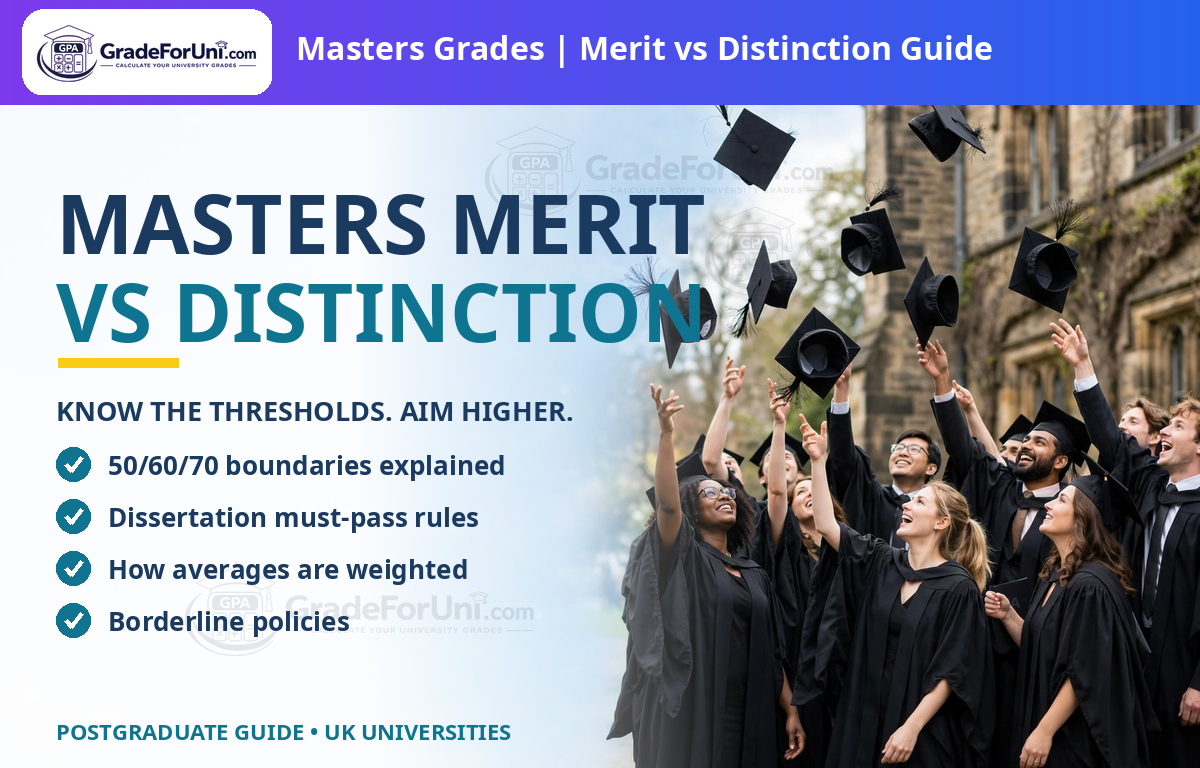
Masters Grading in the UK: What You Need for a Merit or a Distinction
At undergraduate level, a 2:1 is a 2:1 everywhere — the boundaries are standard across the country. At Masters level, things are less tidy. There is no single national rulebook for the merit vs distinction award. Instead, every UK university publishes its own postgraduate award regulations, and the small print varies in ways that genuinely decide outcomes: one university will lift a 68.7 average to a Distinction through a borderline rule; another treats 69.4 as a Merit, full stop.
These distinctions matter more than most students expect. A Distinction on a taught Masters can be the difference between a funded PhD place and a polite rejection — many UK PhD programmes ask for a Masters with Merit as the minimum and quietly prefer a Distinction. Employers, particularly in finance, consulting and policy research, increasingly ask for postgraduate classifications on application forms. And because a full Masters is 180 credits with the dissertation alone worth 60, a single module can decide which side of a boundary you land on.
This guide explains how Masters grading actually works in the UK: the standard 50/60/70 boundaries, how the credit-weighted average is calculated, the dissertation minimums most universities quietly enforce, how real institutions’ rules differ side by side, and what happens when you fall short — resits, borderline zones, and the PGDip and PGCert fallbacks. Two worked calculations show exactly how the numbers play out in practice.
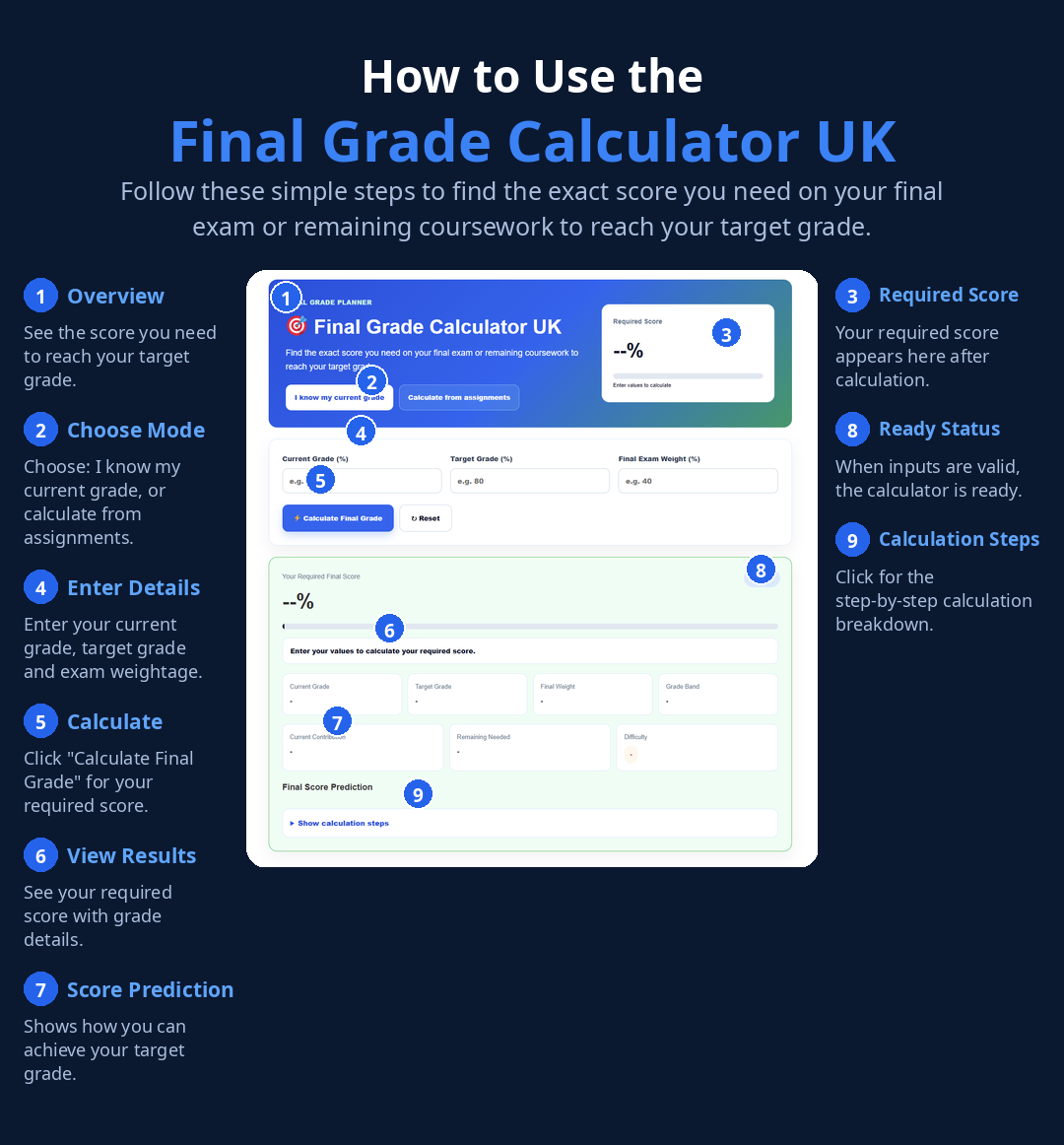
Click Here: Final Grade Calculator UK
The Standard 50/60/70 Scale
The overwhelming majority of UK universities use the same three thresholds for taught postgraduate degrees. This is the national skeleton that almost every set of regulations hangs from:
| Classification | Overall average | What it means |
|---|---|---|
| Pass | 50–59% | You met the standard for a Masters. Below 50 is a fail. |
| Merit | 60–69% | Consistently strong performance — the typical minimum for PhD applications. |
| Distinction | 70%+ | Excellent performance — the tier that strengthens funding and top-tier PhD bids. |
Compare this with the undergraduate scale: a 62% final average gets you a 2:1 (upper second) at undergraduate level, but the same 62% at Masters level is “only” a Merit. The pass mark is also stricter — 50% for Masters, versus 40% for undergraduates. This catches out plenty of students who coast through a conversion MSc expecting undergraduate rules to apply. Below 50% in a Masters module is a fail, and many universities additionally require that you hold at least 50% in a minimum number of credits (including the dissertation) before they will award the degree at all — King’s College London, for instance, requires a mark of at least 50 in 150 credits including the dissertation.
Where the scale stops being uniform is in how that “overall average” is defined, how borderline cases are handled, and what is demanded of the dissertation specifically. That is where the university-by-university comparison below comes in.
How Your Masters Average Is Actually Calculated
A standard UK taught Masters is 180 credits: 120 credits of taught modules and a 60-credit dissertation (or equivalent research project). That is one third of your entire degree in a single module — more than any single undergraduate module is likely to carry.
The award classification is almost always based on a credit-weighted average: every module mark multiplied by its credit value, added together, divided by 180. Because the dissertation counts as 60 of the 180 credits, it has three times the influence of a 20-credit module and four times a 15-credit one. Students who think of the Masters average as “the mean of my module marks” are making a meaningful error — the dissertation pulls the average toward its own mark far harder than anything else on the transcript.
The worked examples below show how this plays out with real numbers, including the scenario every Merit student asks about: my dissertation was Distinction-level — why isn’t my award?
Worked Example 1: A Distinction Dissertation Does Not Guarantee a Distinction
Take Priya, an MSc student with a strong dissertation but middling taught modules:
| Component | Credits | Mark | Weighted points |
|---|---|---|---|
| Taught modules (average of six 20-credit modules) | 120 | 62% | 7,440 |
| Dissertation | 60 | 74% | 4,440 |
| Total | 180 | 11,880 |
Overall average: 11,880 ÷ 180 = 66.0% — a Merit.
Priya’s dissertation was comfortably at Distinction level (74%), yet she graduates with a Merit. The taught average of 62% across 120 credits anchors the overall mark: the dissertation can pull it up, but only by so much. At UCL, her final weighted mark of 66.0% sits squarely in Merit territory (the Merit band needs 59.50%+), nowhere near the 69.50% Distinction threshold. At Manchester, she is equally clearly a Merit — neither element reaches 70, so no boundary-zone rule is triggered.
The reverse error is just as instructive. A Distinction dissertation plus strong taught modules produces the expected result:
| Component | Credits | Mark | Weighted points |
|---|---|---|---|
| Taught modules (average) | 120 | 71% | 8,520 |
| Dissertation | 60 | 73% | 4,380 |
| Total | 180 | 12,900 |
Overall average: 12,900 ÷ 180 = 71.67% — a Distinction. Note how little margin there is: even with both elements above 70, a couple of weak taught modules would drag this below the line.
Worked Example 2: Exactly What Dissertation Mark You Need
Now consider Tom, whose taught average is 68.0% — agonisingly close to a Distinction. He wants to know what dissertation mark gets him over the line. Let d be the dissertation mark:
(68 × 120 + 60 × d) ÷ 180 ≥ 70
8,160 + 60d ≥ 12,600
60d ≥ 4,440
d ≥ 74
Tom needs at least 74% in the dissertation to reach a flat 70.0 average. Now apply UCL’s actual rule — Distinction requires a final weighted mark of 69.50%, not 70.00%:
(68 × 120 + 60 × d) ÷ 180 ≥ 69.5
8,160 + 60d ≥ 12,510
60d ≥ 4,350
d ≥ 72.5
Under UCL’s published regulations, Tom needs 72.5% — a full 1.5 marks lower. This is why reading your own university’s regulations matters: the difference between a 70.00 threshold and a 69.50 threshold, combined with a 60-credit dissertation, swings the required dissertation mark by more than a grade sub-band. Plug your own taught marks into our Final Grade Calculator to run the same equation for your situation.
Read more: How to Calculate Your Uni Grade Using Credits and Module Weighting
The Dissertation Trap: Minimums Most Students Never Read
Here is the rule that ruins more Merit and Distinction hopes than any other: at many universities, the overall average is not the only test. The dissertation must independently clear a minimum for the award you want. A 71% average with a 58% dissertation can be capped at a Merit — or worse.
UCL’s assessment regulations are explicit about this structure. On its research Masters scheme, a Distinction demands a mark of at least 70% in the dissertation alongside the overall threshold; Merit requires 60% in the dissertation. Its taught postgraduate transcript rubric publishes discretion routes where the final weighted mark can be slightly lower (68.50% for Distinction) if at least half of all credits are at 70% or above — a rule that keeps the dissertation’s weight in play but still tests it. King’s College London’s award rules are built around a straight 70/60/50 average for Distinction, Merit and Pass, but require a mark of at least 50 in 150 credits including the dissertation — so a failed dissertation disqualifies the Masters regardless of the average.
The practical consequence: a strong dissertation is necessary but not sufficient for a Distinction, and at several universities a weak dissertation is actively disqualifying even when the taught marks are excellent. Before you celebrate a 73% taught average, check what your programme handbook requires of the dissertation specifically.
How Five UK Universities Compare on Merit vs Distinction Rules
Every university sets its own postgraduate award regulations, so the exact rules behind the 50/60/70 scale differ. Here is how five major UK institutions define the boundaries, the dissertation requirement, and borderline treatment, drawn from their published regulations (for instance, King’s College London’s progression and award rules):
| University | Distinction requires | Merit requires | Dissertation minimum | Borderline / discretion |
|---|---|---|---|---|
| UCL | Final weighted mark ≥69.50% | Final weighted mark ≥59.50% | 70%+ for Distinction, 60%+ for Merit on MRes schemes | Alternative route: ≥68.50% overall + 70%+ in at least half of all credits for Distinction; ≥58.50% + 60%+ in half of credits for Merit |
| King’s College London | Overall average 70–100 (Pass with Distinction) | Overall average 60–69 (Pass with Merit) | Mark of at least 50 in 150 credits including the dissertation; module marks rounded to nearest integer | No automatic uplift published — the rounded average decides |
| Manchester | 70.0 average | 60.0 average | Distinction requires the taught or research element at Distinction level | Boundary zone 68.0–69.9 for Distinction, 58.0–59.9 for Merit; a 68–69.9 can be lifted to Distinction if one element is at Distinction level and two-thirds of credits are at the higher award |
| Edinburgh | 70–100 (A grade — “satisfactory for a distinction”) | 60–69 (B grade — “a very good performance”) | Dissertation must be passed (50%+) for the MSc; students must pass 80 taught credits at 50%+ and average 50% across 120 taught credits just to progress to the dissertation | Common marking scheme bands; 40–49 is diploma-level only, inadequate for a Masters |
| Warwick | 70.0%+ average, no module below 50.0% | 60.0–69.9% average, no module below 50.0% | Dissertation must be among the credits at the award level in borderline cases | Within 2% of a boundary: promoted if at least 50% of weighted credits (including the dissertation) are above the boundary |
Three patterns stand out. First, no university on this list awards a Distinction on the average alone without also testing the dissertation — whether through an explicit dissertation minimum (UCL, Warwick’s borderline rule), a credit profile requirement (KCL, Manchester), or a progression gate (Edinburgh). Second, the headline “70%” is implemented differently everywhere: UCL’s 69.50, Manchester’s 70.0-with-boundary-zone, Warwick’s 70.0 with a 2% promotion rule. Third, a resit at Warwick is capped at 50%, which makes a resat module a dead weight on any Merit or Distinction calculation.
Always read your own programme handbook: individual departments can and do apply stricter “local rules” on top of these university-wide frameworks.

Why 69.4% Is Not a Distinction
A student with a 69.4% average feels one good essay away from a Distinction. The regulations are unmoved. At UCL, the Distinction threshold is a final weighted mark of 69.50% — 69.4 falls short, and the only lifeline is the discretion route: 68.50% plus 70% in at least half of all credits. King’s rounds module marks to the nearest integer but classifies on the overall average: 69.4 is Pass with Merit, not Distinction. Warwick’s borderline rule is more generous — within 2 percentage points of the boundary, students are promoted if at least half their weighted credits (including the dissertation) sit above the boundary — so a 69.4 with a strong profile can be lifted. Manchester’s 68.0–69.9 zone works similarly: 69.4 is in the zone, and the board can award the Distinction if the taught or research element is at Distinction level and two-thirds of the credits are.
The lesson is not that 69.4 is hopeless everywhere — it is that uplift is a defined rule, not a favour. It depends on credit distribution, dissertation performance, and whether your university operates a boundary zone at all. No examiner “bumps” a 69.4 out of kindness; where it happens, it happens because a published criterion was met. If your average lands in a borderline zone, check whether the promotion rule includes the dissertation and how many of your credits clear the higher boundary — that is the calculation that decides it.
Read more: Borderline Grades UK — How Universities Decide Close Calls
Resits and Caps: How a Second Attempt Reshapes Your Award
Masters students get fewer second chances than undergraduates, and the ones that exist come with sharper edges. Two mechanisms matter: the resit cap, and outright ineligibility for the higher awards.
At Warwick, all resit marks are capped at 50%. A resat module therefore contributes a bare pass to the weighted average at best — it can rescue the degree, but it cannot rescue the classification. Manchester’s older award ordinances go further still: students who have resat any unit, or been granted a compensated pass, are not eligible for the award of Distinction or Merit at all. Even where current regulations use boundary-zone mechanics rather than blanket bans, a capped resit mark of 50% on a 15- or 20-credit module drags the weighted average down by roughly a full mark per module — enough to push a 70.2 to a 69.4, which, as shown above, is exactly where discretion stops being automatic.
Compensation (a “condoned pass”) has a similar sting. Where universities allow a failed taught module in the 40–49 range to be compensated, the mark usually stands on the transcript as-is, weighing on the average. Manchester permits compensation of up to 40 taught credits in the 40–49 range while still awarding the MSc — but a compensated 43% in a 20-credit module costs the average over two marks. That is often the quiet difference between a Merit and a Pass.
The other asymmetry to know: you cannot resit a module you have passed to improve the mark. Resits exist to earn missing credits, not to polish a 63 into a 68. If your taught average is the problem, there is no mechanism to retake it — which makes the dissertation your only lever in the final stretch.
Read more: Failed Dissertation UK — Rules, Resits and Next Steps
PGDip and PGCert: The Fallback Awards
If the Masters itself becomes unreachable — most commonly because the dissertation is failed and the resubmission is failed or refused — you do not necessarily leave empty-handed. UK universities award exit qualifications based on the credits you did earn:
| Award | Typical credits required | What it represents |
|---|---|---|
| Postgraduate Certificate (PGCert) | 60 | Roughly one semester of taught modules |
| Postgraduate Diploma (PGDip) | 120 | The full taught stage, without the dissertation |
| Masters (MSc/MA/MRes) | 180 | Taught stage plus the dissertation |
These are genuinely useful credentials — a PGDip with strong taught marks still signals postgraduate-level study to employers — but they are not Masters degrees, and you cannot later “top up” a PGDip to a full Masters at most institutions. Crucially, exit awards are almost always unclassified or classified on a simpler scale: the Distinction/Merit framework applies to the full 180-credit Masters. Students heading into a dissertation resubmission should know where they stand: Edinburgh’s regulations spell out that 40–49 is diploma-level performance, “inadequate for a masters degree” — a reminder that the taught stage alone, however well passed, is a different qualification.
If you are at risk of the dissertation stage, calculate now what your taught credits alone would secure, and whether progression rules even let you start the dissertation. Edinburgh, for example, requires students to pass at least 80 credits at 50% or above and hold a 50% average across the 120 taught credits before progression — a taught average of 48 means no dissertation at all, and the exit-award conversation starts there.
Why the Award Tier Matters: PhD Funding and Careers
This is the stakes section, and it is worth being precise. For PhD applications in the UK, a taught Masters with Merit is the standard minimum — King’s Business School, for instance, asks PhD applicants to hold “a Master’s degree with a Merit or higher” alongside a 2:1 undergraduate degree. But minimum entry is not the same as competitive entry. UKRI-funded studentships and departmental scholarships routinely attract applicants with Distinctions, and supervisors read the dissertation mark closely: a 72 in the dissertation with a 66 average tells a different story from a 66 with a 58 dissertation, even though both are Merits.
For employment, the signal value varies by sector. Finance, consulting, and research-policy roles increasingly filter on postgraduate classification the way they once filtered on undergraduate class. In other sectors, the Masters itself matters more than the tier — a Pass with strong relevant skills beats a Distinction in an unrelated field. The honest summary: Merit keeps every door open; Distinction is a genuine differentiator for the most competitive ones. Neither guarantees anything on its own.
Read more: How UK Universities Calculate Degree Classifications — Explained Simply
Frequently Asked Questions
What mark do you need for a Merit at Masters level in the UK?
A Merit requires an overall average of 60% or above (60–69%) at almost all UK universities. However, several institutions add a dissertation condition: UCL’s research Masters scheme, for example, also requires at least 60% in the dissertation for a Merit. Always check your programme handbook, not just the headline average.
What mark do you need for a Distinction at Masters level?
A Distinction requires an overall average of 70% or above, with most universities also demanding 70% or above in the dissertation itself. UCL sets the bar at a final weighted mark of 69.50% (or 68.50% with 70%+ in at least half of all credits); Manchester uses 70.0 with a 68.0–69.9 boundary zone.
Does my dissertation need to be a Distinction for me to get a Distinction overall?
At most universities, effectively yes. UCL requires 70%+ in the dissertation for a Distinction on its MRes scheme; Manchester’s Distinction rules require either the taught or the research element at Distinction level; Warwick promotes borderline students only if the dissertation is among the credits above the boundary. A weak dissertation is disqualifying even with a 71% taught average.
Is a 69% average a Distinction?
No, not automatically. 69% is a Merit at almost every UK university. Some institutions have boundary-zone rules that can lift a near miss: Manchester considers 68.0–69.9 for Distinction if the profile conditions are met, and Warwick promotes within 2% of the boundary where at least half of weighted credits (including the dissertation) exceed it. Check your university’s published rule — uplift is a defined criterion, not examiner goodwill.
Can you get a Merit or Distinction if you resit a module?
Usually not. Resit marks are commonly capped at the pass mark — 50% at Warwick, for example — which drags the weighted average down. Some universities go further: Manchester’s award ordinances make students who have resat any unit ineligible for Distinction or Merit. A resit rescues the degree; it rarely rescues the classification.
What happens if you fail your Masters dissertation?
You are normally offered one resubmission, usually capped at 50%. If the resubmission also fails, you cannot be awarded the Masters, but you may receive a Postgraduate Diploma (120 credits) or Postgraduate Certificate (60 credits) based on the taught credits you passed. Failing the dissertation does not mean leaving with nothing, but it does mean leaving without the MSc or MA.
Is a Masters Merit good enough for a PhD?
Yes — a Merit is the standard minimum entry requirement for UK PhD programmes. King’s Business School, for instance, asks for a Master’s with Merit or higher. However, for funded studentships and the most competitive programmes, a Distinction — and particularly a strong dissertation mark — makes an application materially stronger.
How is a Masters average calculated in the UK?
It is a credit-weighted average across the full 180 credits: each module mark multiplied by its credit value, summed, and divided by 180. The 60-credit dissertation therefore counts for one-third of the degree — three times a 20-credit module. A simple mean of module marks gives the wrong answer.
Read more: How to Predict Your Final Degree Classification Before Results Day
Conclusion
The headline is simple — 50 for a Pass, 60 for a Merit, 70 for a Distinction — but the machinery underneath decides real outcomes. The credit-weighted average across 180 credits means the 60-credit dissertation carries a third of your degree. Most universities test the dissertation independently of the average. Borderline rules are defined criteria (UCL’s 69.50, Manchester’s 68.0–69.9 zone, Warwick’s 2% promotion), not discretion. And resits, capped at the pass mark or worse, almost never rescue a classification — only the degree.
If you take one action from this guide, make it this: find your own university’s postgraduate award regulations and read the dissertation clause and the borderline rule — the university-wide frameworks from UCL, KCL, Manchester, Edinburgh and Warwick show how much those two paragraphs vary. Then run your numbers honestly with our University Grade Calculator. Knowing whether you need a 72.5 or a 74 in the dissertation, or whether a 69.4 is a lost cause or a boundary-zone case, replaces months of vague anxiety with a number you can actually aim at.



![Read more about the article Placement Year Grading: How Sandwich Years Are Marked [2026 Guide]](https://gradeforuni.com/wp-content/uploads/2026/10/featured-placement-year-grading-300x192.png)