
![You are currently viewing How to Improve a 2:2 to a 2:1 in Final Year: UK Degree Recovery Guide [2026]](https://gradeforuni.com/wp-content/uploads/2026/10/featured-improve-2-2-to-2-1.png)
How to Improve a 2:2 to a 2:1 in Final Year: UK Degree Recovery Guide [2026]
If you finished second year with a 2:2, the instinct is to assume the degree is settled. It is not. At most UK universities your final year carries between 60% and 75% of your degree classification, which means a student sitting on 54% or 56% after year two can still graduate with a 2:1 — provided they know exactly what average they need and where to aim their effort. The difference between students who pull it off and students who don’t is rarely raw intelligence. It is arithmetic plus triage.
This guide shows you how to improve a 2:2 to a 2:1 in your final year with real numbers. You will work out the exact final-year average your university’s weighting scheme demands, learn which modules give you the most leverage per hour of effort, and see the two traps — capped resits and the borderline rules — that quietly decide classification for thousands of students every results day.
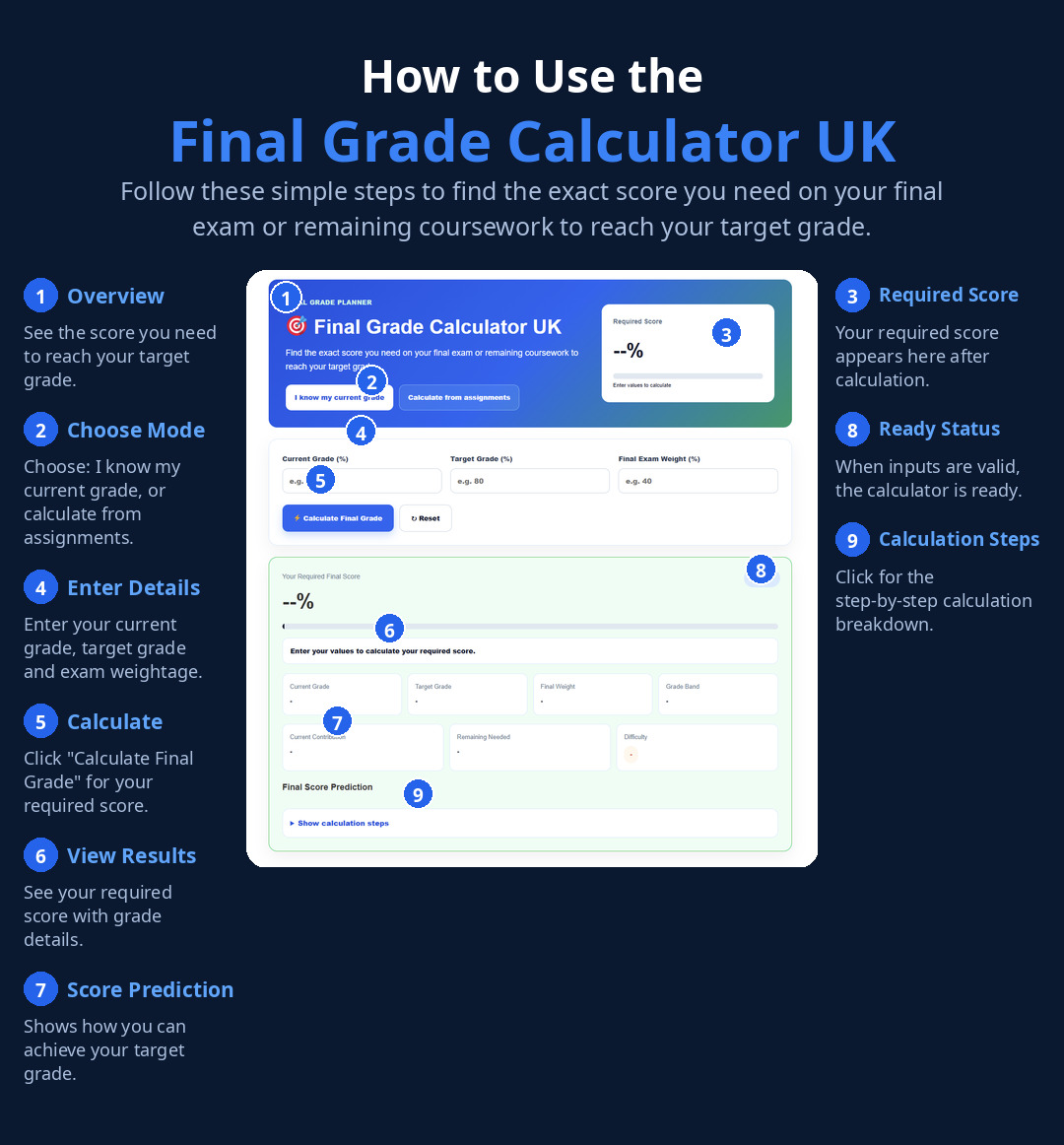
Click Here: Final Grade Calculator UK
The Numbers First: What Your Second Year Actually Gave You
UK degree classifications use fixed boundaries almost everywhere. A First is 70% and above, a 2:1 is 60–69%, a 2:2 is 50–59%, and a Third is 40–49% — the same bands published by the University of Westminster, the University of Southampton and virtually every UK institution (see Prospects’ guide to understanding university grades). Your university does not invent its own boundaries; it applies its own weighting scheme to reach one of these bands.
So if you want to improve a 2:2 to a 2:1 in final year, the target is brutally simple: your weighted overall average must land on or above 60.0%. Not 59.9 (we will come to borderline rules), not “close” — 60. Everything else in this guide is about how many marks each part of your degree contributes to that number.
| Classification | Overall average needed | How students usually describe it |
|---|---|---|
| First Class Honours | 70% and above | “A First” |
| Upper Second Class | 60–69% | “A 2:1” |
| Lower Second Class | 50–59% | “A 2:2” |
| Third Class | 40–49% | “A Third” |
How Final-Year Weighting Works at UK Universities
Here is the fact that makes recovering from a 2:2 realistic: at most UK universities, year one counts for nothing (or almost nothing) towards classification, and the final year is weighted far more heavily than year two. The most common arrangements are 40:60 and 30:70 between years two and three, but schemes vary widely — and the scheme is the single biggest variable in your recovery maths.
| Weighting scheme (year 2 : final year) | Real examples | What it means for you |
|---|---|---|
| 40 : 60 | University of Leicester (standard); most common nationally | Year two contributes 40% of your average — a weak year two can still be outrun |
| 30 : 70 | University of Leicester (Biological Sciences); UAL uses best 100 credits × 30% + full final year × 70% | Final year dominates; one strong year nearly erases a weak year two |
| 25 : 75 | Common in several Russell Group regulations | The most forgiving — year two barely matters |
| 50 : 50 | Some courses, especially where levels are treated equally | Hardest scheme to recover under — you must genuinely average a 2:1 in final year |
| 20 : 80 | Reported by several universities | Nearly a clean slate; second year is almost irrelevant |
Two quirks make the maths kinder than students expect. First, several universities do not use your full year-two average at all: Westminster calculates classification from your best modules at the relevant levels, and UAL uses only the best 100 of 120 year-two credits before applying the 30% weighting. If your year two included one disastrous module, your university may already be quietly discarding it — check your regulations before you write yourself off. Second, first-year marks almost never count, so nothing you did as a fresher constrains what comes next.
The Worked Maths: What You Need to Improve a 2:2 to a 2:1 This Year
This is the calculation. Your university multiplies your year-two average by its year-two weight, and your final year must supply the rest to reach 60:
Required final-year average = (60 − your year-two average × year-two weight) ÷ final-year weight
Run it once and the recovery stops feeling abstract. Take Amara, a fictional but typical student: year-two average 54.5%, university on a 30:70 scheme. Year two contributes 54.5 × 0.30 = 16.35 percentage points. The gap to 60 is 60 − 16.35 = 43.65, and the final year must supply it at 70% weight: 43.65 ÷ 0.70 = 62.36, so 62.4%. Amara needs a solid mid-2:1 across her final year — demanding, but not a miracle.
Take a second case, Josh: year-two average 56.8% on the most common 40:60 scheme. Year two gives 56.8 × 0.40 = 22.72. The gap is 60 − 22.72 = 37.28, and 37.28 ÷ 0.60 = 62.13, so 62.1% in final year. Notice something counterintuitive: Josh finished year two two points higher than Amara yet needs almost the same final-year average, because his university weights year two more heavily. The scheme matters as much as the marks.
Here is the full lookup table. Find your year-two average down the left, your university’s scheme across the top, and read off the final-year average you need to improve a 2:2 to a 2:1 in final year:
| Year-two average | 30 : 70 scheme | 40 : 60 scheme | 25 : 75 scheme | 50 : 50 scheme |
|---|---|---|---|---|
| 52% | 63.4% | 65.3% | 62.7% | 68.0% |
| 54% | 62.6% | 64.0% | 62.0% | 66.0% |
| 56% | 61.7% | 62.7% | 61.3% | 64.0% |
| 58% | 60.9% | 61.3% | 60.7% | 62.0% |
Two things jump out. First, almost every realistic case lands between 60% and 66% — a competent, consistent 2:1 across your final year, not perfection. Second, a student on a 58% year-two average on a 25:75 scheme needs just 60.7%: they are one decent year from the line. If your numbers say 66–68%, be honest with yourself about whether that jump is plausible — and read the borderline section below, because it may save you two or three points of slack.
The Module Triage Plan: Where Each Hour of Effort Pays Most
Knowing you need 62% is half the battle. The other half is spending your effort where it moves that number most. Modules are not equal: a 40-credit dissertation moves your final-year average four times as much as a 10-credit module. Most students who fail to improve a 2:2 to a 2:1 in their final year do not work too little — they work evenly across modules of wildly unequal weight.
The leverage formula is simple: every 10 percentage points you add to a module’s mark raises your final-year average by (module credits ÷ 120) × 10. On a standard 120-credit final year:
| Module size | Typical examples | Final-year average gained per +10 marks on that module |
|---|---|---|
| 40 credits | Dissertation / major project | +3.3 points |
| 30 credits | Dissertation at many unis | +2.5 points |
| 20 credits | Standard taught module | +1.7 points |
| 10 credits | Short or half module | +0.8 points |
Make this concrete. Priya projects a 58.2% final-year average but needs 62.1% — a gap of 3.9 points. Her dissertation is 40 credits, currently tracking at 55. If she lifts the dissertation to 68 (a 13-point gain), her final-year average rises by (40 ÷ 120) × 13 = 4.33 points, landing her at 62.5% — over the line. The same 13-point improvement on a 10-credit module would gain her just 1.08 points. One supervisor meeting a week about the dissertation is worth more than perfecting a minor module.
So rank your modules into three tiers. Tier 1 (maximum effort): your dissertation or major project, and any 30–40 credit module — these decide your classification. Tier 2 (steady effort): 20-credit core modules, especially ones aligned with your strengths. Tier 3 (efficient effort): 10-credit modules and electives — aim for competence, not excellence. This is not laziness; it is portfolio management. Also check whether your university’s “best modules” or “discard lowest module” rule (see the Westminster approach above) already neutralises your weakest tier-3 module, which frees even more hours for tier 1.
Your Dissertation Is the Heaviest Lever You Will Ever Get
The dissertation deserves its own section because it breaks the normal rules of effort-to-marks. Three reasons. First, size: at 30–40 credits it is the single largest item in your final year, often worth a third of it. Second, controllability: unlike an unseen exam, you can iterate — drafts, supervisor feedback, and redrafting mean the mark is substantially a function of hours invested. Third, at several universities a strong dissertation interacts with borderline rules: some institutions will not award a First without a First in the dissertation, and examiners exercising discretion look kindly on strong final-year projects when deciding borderline cases (our borderline grades guide explains exactly how discretion works).

Practical dissertation tactics that move marks: choose a question your supervisor genuinely knows, because detailed supervision is worth marks directly; book feedback on a full draft at least three weeks before the deadline, not the week of; and read the marking criteria for your department’s dissertation rubric before writing a word — most students lose 5–10 marks simply by missing the “critical evaluation” or “methodology” band descriptors. Our guide to how university marking criteria work shows how to map criteria to your own draft.
Borderline Rules: How 59.x Can Still Become a 2:1
Here is the safety net most students never hear about. Many universities operate discretionary uplift rules for students who finish just below a classification boundary — typically within 1–2% of it. A student on 59.4% overall may be uplifted to a 2:1 if, for example, a set proportion of their final-year credits (often half) are at 60% or above. That means your effective target may not be 60.0% at all — it may be 58.5% plus a strong credit profile.
The rules are genuinely university-specific — some use automatic uplift, some require a board-of-examiners decision, some look at your final-year profile rather than your overall average. Because discretion can shave points off your target, anyone trying to improve a 2:2 to a 2:1 in final year should read our dedicated guide to borderline grades and discretionary uplift alongside this article, then check your own regulations for the words “borderline”, “discretion” or “zone of consideration”. If you want to improve a 2:2 to a 2:1 in final year, the borderline rules are the cheapest points you will ever earn.
What Will Not Move the Needle
Three common strategies are wastes of time or worse. Resitting passed modules to boost marks: almost no UK university lets you resit a module you have already passed, and where resits are allowed (after a fail), the mark is capped at the pass mark — 40%. Capped resits can rescue progression but cannot manufacture a 2:1; see what happens if you fail a module. Redoing year two: repeating a year you passed costs a full year of fees and living costs to replace marks that only count at 25–40% weight — the same improvement is almost always achievable in final year. Extenuating circumstances as a marks booster: ECs protect you from being penalised for genuine crises; they do not add marks to work you submitted. They are a shield, not a lever.
The 12-Week Recovery Plan
Strategy without a calendar is a wish. If your final-year assessments are roughly three months away, here is the shape of a realistic recovery plan to improve a 2:2 to a 2:1 in final year — adapt the dates, keep the sequence:
- Weeks 1–2 — Know your numbers. Confirm your weighting scheme in your course handbook, calculate your required final-year average with the formula above, and list every module with its credit value. Rank them into the three triage tiers.
- Weeks 3–6 — Fix the foundations. Pull your year-two feedback for every tier-1 and tier-2 module. The pattern in your feedback (weak critical analysis? thin referencing? missed question focus?) is your personal marking-criteria cheat sheet — fix that one weakness everywhere.
- Weeks 7–9 — Dissertation sprint. This is the window where a full draft exists and can be improved. Book supervisor feedback, apply the marking criteria line by line, and redraft. A 10-mark dissertation gain here is worth more than anything else you can do.
- Weeks 10–12 — Exam and deadline execution. Past papers under timed conditions for exams; for coursework, a personal checklist derived from the marking rubric for each submission. Sleep properly in the final week — a tired brain loses more marks than any last-minute cramming gains.
One more discipline that separates the recoveries from the near-misses: track your marks as you go. A running weighted average of completed assessments tells you in week 8 whether the plan is working, while there is still time to adjust. Our predicted classification guide walks through building that tracker, and the Final Grade Calculator lets you re-run the numbers in seconds.
When the Maths Says It Is Over
Honesty matters here too. If your year-two average is 50% on a 50:50 scheme, the formula demands 70% in final year — a First-level performance every week for a year. That is not impossible, but it is not a plan either. In that position, the rational moves are: confirm whether your university’s best-module or discard rules soften the numbers; check the borderline provisions; consider whether a strong 2:2 with an excellent dissertation and relevant experience serves your actual career goal better than a burnt-out attempt at the impossible; and if a 2:1 is genuinely essential (some graduate schemes and postgraduate courses require one), speak to your personal tutor early about whether repeating the year is an option — an expensive, last-resort option, but one that should be a decision, not a drift. For the full mechanics of how every mark feeds the final number, see how UK universities calculate degree classifications.
A 2:2 after second year is a data point, not a destiny. The weighting schemes at most UK universities mean the majority of your classification is still unwritten — and the students who improve a 2:2 to a 2:1 in final year are almost never the ones who worked the most hours. They are the ones who did the maths first, aimed the hours at the heaviest modules, and used the borderline rules as a safety net rather than a hope. Do the calculation today. Everything else follows from that number.
Can I improve a 2:2 to a 2:1 in my final year?
Yes. At most UK universities your final year carries 60–75% of your degree classification, so a year-two average of 54–58% can still become an overall 2:1 with a final-year average of roughly 61–65%, depending on your university’s weighting scheme.
What final-year average do I need if I got 55% in second year?
It depends on your weighting scheme. On a 30:70 scheme you need about 62.1%; on a 40:60 scheme about 63.3%; on a 25:75 scheme about 61.7%; and on a 50:50 scheme 65%. Use the formula: (60 − your year-two average × year-two weight) ÷ final-year weight.
How much does my second year count towards my degree?
Usually 25–40% of your classification, with the most common schemes being 40:60 and 30:70 between years two and three. Your first year almost never counts. Check your course handbook’s academic regulations for your exact scheme, and whether your university uses best-module or discard-lowest-module rules that soften a weak year two.
Does my dissertation affect my degree classification?
Enormously. Dissertations are typically 30–40 credits — up to a third of your final year. Every 10 extra marks on a 40-credit dissertation raises your final-year average by 3.3 points, four times the effect of the same improvement on a 10-credit module. Some universities also require a strong dissertation mark for borderline uplifts.
What happens if I finish on 59.9% — do I get a 2:1?
Possibly. Many universities have borderline or discretionary uplift rules that can push a student within 1–2% of a boundary up to the higher classification, often if enough final-year credits are at the higher level. Check your regulations for ‘borderline’, ‘discretion’ or ‘zone of consideration’ — and see our borderline grades guide for the full detail.
Can resits help me improve a 2:2 to a 2:1?
No. You generally cannot resit a module you have already passed, and resit marks after a fail are capped at the pass mark (40%) at almost every UK university. Resits protect progression; they cannot manufacture a 2:1.
Do employers care about a 2:2 versus a 2:1?
Many do. A significant number of UK graduate schemes and some postgraduate courses set a 2:1 as a minimum entry requirement, which is why the 2:2-to-2:1 jump has outsized career value. A strong 2:2 with relevant experience still does well, but the 2:1 opens more doors automatically.
Can I retake my second year to improve my average?
Only in exceptional cases, and it is rarely worth it: repeating a year you passed costs a full year of fees and living costs to replace marks that count at only 25–40% weight. The same classification gain is almost always achievable through a strong final year, which is weighted far more heavily.
Conclusion
A 2:2 at the end of second year is not a verdict — it is a starting position. The arithmetic of UK degree classifications is unusually kind to students who find out late: with the final year typically carrying 60 to 75% of the weight, a mid-2:1 average across your final assessments is enough to erase a 2:2 record in almost every weighting scheme. The numbers do not care about your year-two mistakes; they only care about what you do with the credits that count most.
The students who make the jump share the same pattern. They learn their university’s exact weighting scheme, they rank their modules by credit leverage and aim their effort at the heavyweights — especially the dissertation — and they check the borderline rules that can turn 59.x into a 2:1. They also know when the maths says no: chasing an impossible average burns out more students than the 2:2 itself would.
Work out your required final-year average today with our Final Grade Calculator, confirm the scheme in your course handbook, and build your weeks around the modules that move the number. A 2:1 is still there for the taking — the only question is whether you know your target.

![Read more about the article University Exit Awards Explained: CertHE, DipHE & Aegrotat Degrees [2026]](https://gradeforuni.com/wp-content/uploads/2026/10/featured-exit-awards-uk-300x192.png)