
![You are currently viewing How Group Project Marks Are Calculated at UK Universities [2026]](https://gradeforuni.com/wp-content/uploads/2026/10/featured-group-project-marks.png)
There is a particular dread that arrives with the words “group project.” You have read the brief, met your teammates, divided up the work — and then a question surfaces that nobody on the module seems able to answer properly: how will our individual group project marks actually be calculated? Will everyone receive the same mark, will your grade depend on how your teammates rate you, or will the tutor work out who did what?
The honest answer is that it depends on your university, your department, and sometimes even the individual module leader. But UK universities only use a small number of systems to turn a team effort into individual marks, and once you understand which system your module uses, you can predict your grade, protect yourself against free-riders, and know exactly what to do if things go wrong. This guide explains all three marking methods used across UK universities, shows how peer assessment tools like WebPA and Buddycheck adjust your mark with real worked examples, and covers what happens when a group project fails.
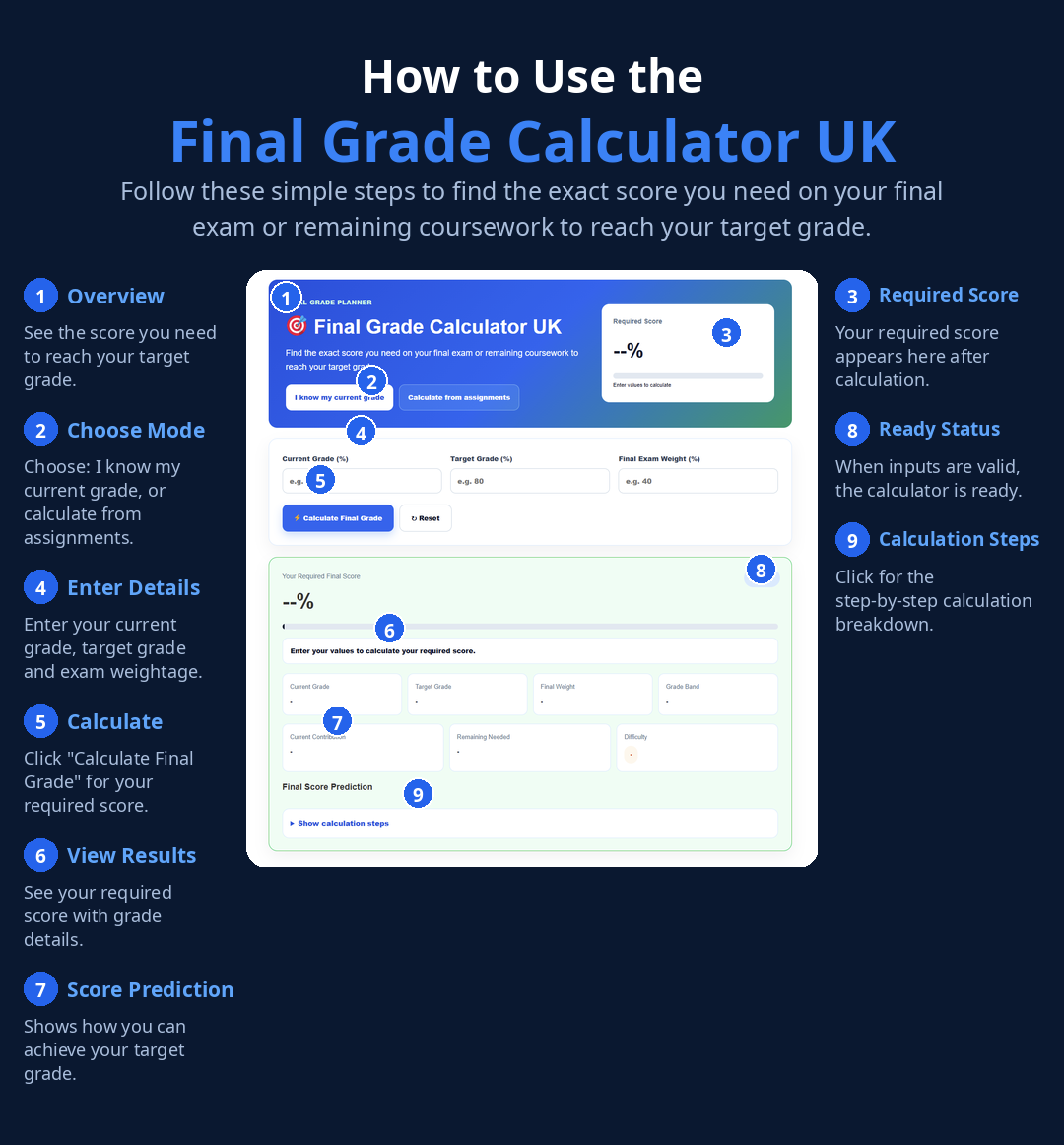
Click Here: Final Grade Calculator UK
How Group Project Marks Are Calculated: The 3 Methods
Almost every UK university calculates group project marks using one of three approaches. The method should be stated in your module handbook — but in practice, many students never read it, and find out which system applies only when the marks come back. The three methods are:
| Method | How your mark is decided | Who is affected by a weak teammate |
|---|---|---|
| 1. Shared group mark | Everyone receives the same mark for the group’s submission | Everyone — one weak member can drag the whole group down |
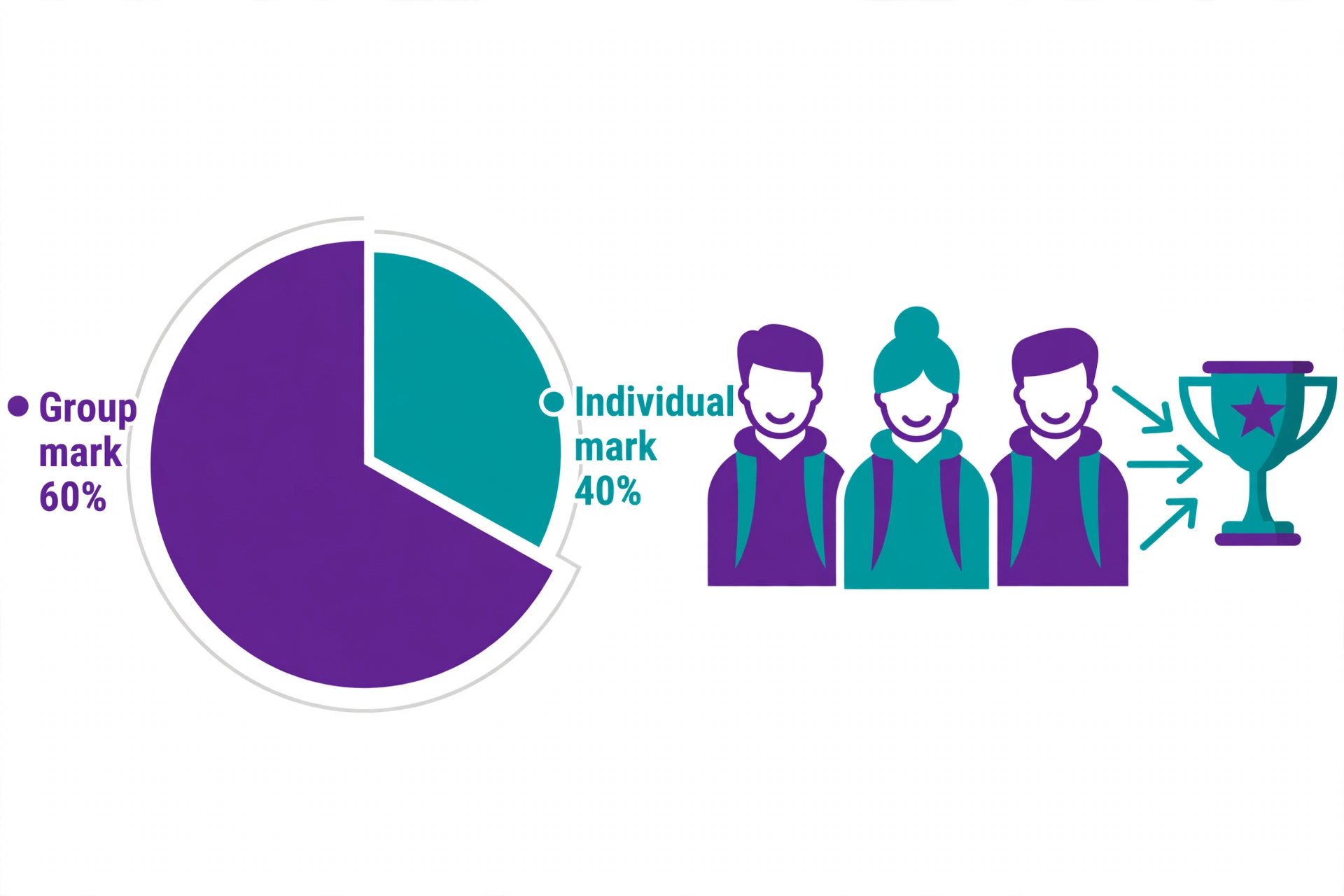
| 2. Split weighting | Your mark combines a group mark with a separately assessed individual component | Partially — the individual component is protected, the group part is shared |
| 3. Peer-adjusted mark | The tutor marks the group submission, then peer ratings adjust each person’s share of it | Least — contributors are lifted and free-riders are pulled down |
The crucial thing to understand is that these methods produce very different results from the same piece of work. A student who contributed half the effort to a group that scored 68 could walk away with 68, 58, or 75 depending on which method their university used. The worked examples below show exactly how.
Method 1: Everyone Gets the Same Group Mark
The simplest and oldest approach: the tutor marks the group’s report, presentation or product, and every member receives that single mark regardless of individual contribution. This is still the stated policy in many departments. The MSc Science Communication Unit handbook at Imperial College puts it plainly: “In group work, we assign a single mark to the whole group, unless serious problems have arisen.” Queen Margaret University’s student guide to peer assessment states the standard criticism outright — group work is “often criticised because each student receives the same team mark regardless of individual performance.”
Universities keep this method for a defensible reason: it rewards collaboration. If everyone gets the same mark, everyone has an incentive to help everyone else succeed, which mirrors how real teams work. The method also keeps marking simple and avoids the awkwardness of students grading each other.
The downside is equally obvious and is the single most common complaint about group work in UK higher education. A Bournemouth University study of groupwork assessment (Clarke & Blissenden, 2013) found the dominant grievance was “passengers” — members who contributed little while others carried the project — and students who did most of the work felt they deserved a higher mark than their teammates. A Warwick study of STEM degree apprenticeship students found that 59% named the free-rider problem as their biggest groupwork concern, ahead of unequal division of tasks (24%) and domination of discussion (10%).
Notice the Imperial caveat — “unless serious problems have arisen.” Most same-mark policies have an escape hatch. If you can document that a member contributed essentially nothing, the tutor can intervene and adjust marks. This is why the evidence log described later in this guide matters even on modules that claim to use shared marks.
Method 2: Split Weighting — Group Mark Plus Individual Mark
Many engineering, business and science departments split the module into a group component and an individual component, each with its own weighting. Your final module mark is then a weighted average of the two, calculated exactly like any other weighted coursework.
Real examples from UK universities show how the splits vary:
| University / module | Split | How it works |
|---|---|---|
| University of Salford (Civil Engineering) | 80% individual portfolio + 20% group Design Exercise | Peer assessment is applied to the group marks before combining |
| University of Nottingham (Economics) | ~70% group + 30% individual (usual) | Groups first try to agree how to redistribute marks; if they can’t, confidential peer assessment adjudication is built by staff |
| University of Exeter (ENG2003) | 80% individual design project at reassessment | At resit, the group element is replaced entirely by an individual project |
The calculation is straightforward weighted arithmetic. Suppose your module is split 70% group / 30% individual. Your group report scores 64, and your individual reflection or portfolio scores 72:
Module mark = (0.70 × 64) + (0.30 × 72) = 44.8 + 21.6 = 66.4 → 66
Split weighting is the fairest-looking method on paper, and it genuinely protects part of your grade from teammates. But it has a quirk worth knowing: the individual component is often a reflection, logbook or viva about the project — which means it can be hard to score well on if the project itself went badly. A weak group still drags down 70% of your module.
Method 3: Peer Assessment Adjusts the Group Mark
This is the method most students mean when they ask how group project marks are calculated — and it is the one with the most actual maths in it. The tutor marks the group’s submission as normal, then each member’s mark is adjusted up or down based on confidential ratings from their teammates. Two systems dominate UK universities.
WebPA — the Loughborough system
WebPA is a free, open-source online peer assessment tool developed at Loughborough University and now used at Edinburgh, Cardiff and many other UK institutions. The mechanics, per WebPA’s official scoring algorithm:
- Each student rates every group member (including themselves) against set criteria — for example meeting deadlines or contributing quality resources — typically on a 1–5 scale.
- Each rater’s scores are normalised to fractions summing to 1, and a student’s WebPA score is the sum of the fractions they received. A score of 1.0 means an exactly average contribution; above 1.0 means above average.
- The final grade is the WebPA score multiplied by the group mark, capped at 100%.
- A PA weighting parameter softens the adjustment. With 50% weighting: Final = (Group × 0.5) + (Group × 0.5 × WebPA score).
- Not completing the peer assessment can itself be penalised — the official guidance allows a non-completion penalty of up to 100% of the mark.
WebPA’s own worked example: with a group mark of 80%, a student with a WebPA score of 1.14 receives 85.6%, while a student scoring 0.41 receives 56.4%. Queen Margaret University’s student guide gives another concrete case: a tutor grades a group at 66%; after peer assessment, a hard-working member (Mary) rises to 73% while a disengaged member (Sam) falls to 59% — and tutors can check, moderate and override the peer scores.
Buddycheck and capped multipliers
The University of Liverpool uses Buddycheck, which generates an adjustment factor used as a multiplier on the group mark — but with recommended hard limits of 0.9 to 1.1, meaning peer ratings can move your mark by at most ±10%. Queen’s University Belfast uses a fixed peer-mark pool: a team of four gets 13 marks to allocate between them, so an equal share is 3.25 out of 5 (65%) — a neat design that stops everyone simply awarding full marks to each other.
City St George’s Moodle tool takes yet another approach: the lecturer’s group mark is combined with the group-average peer grade and each student’s individual peer grades, with “Simple” and “Outlier” modes — the latter uses standard deviation to strip out wildly inconsistent ratings. And UCL’s IPAC system (used in Engineering) has students rate each member’s contribution specifically to tackle “passengers” and dissatisfaction with equal marks, with the tutor generating individual marks from the ratings.
Two rules run through all of these systems. First, ratings are confidential — research cited by Abertay University (Lejk & Wyvill) found that secret peer assessment makes students more discriminating, while public versions cause reluctance and grade inflation. Second, extreme ratings need justification: at Edinburgh, anyone rating a peer “No contribution” or “Very poor” must provide a justifiable explanation, and staff cross-check ratings against actual evidence such as commit history.
Worked Example 1: Capped Peer Multiplier (Buddycheck-Style)
Take a group of four whose project earns a group mark of 68. Peer ratings produce adjustment factors for each member. Without any cap:
- Student A (did little): factor 0.85 → 68 × 0.85 = 57.8 → 58
- Student B (did most): factor 1.10 → 68 × 1.10 = 74.8 → 75
- Students C and D (average): factor 1.00 → 68 × 1.00 = 68
Now apply Liverpool’s recommended ±10% hard limits (0.90–1.10). Student A’s 0.85 factor is clamped to 0.90: 68 × 0.90 = 61.2 → 61. The cap protects the weakest member from dropping further — but notice it also means the same-mark method would have given A a full 68. Under peer adjustment with caps, the spread in this group runs from 61 to 75: a 14-point gap from the same piece of work.
Worked Example 2: WebPA With 50% PA Weighting
Same starting point — a group mark of 70 — but now the department uses WebPA with 50% PA weighting, the official formula:
Final = (Group × 0.5) + (Group × 0.5 × WebPA score)
- Student B (strong contributor), WebPA score 1.15: (70 × 0.5) + (70 × 0.5 × 1.15) = 35 + 40.25 = 75.25 → 75
- Student C (weak contributor), WebPA score 0.80: (70 × 0.5) + (70 × 0.5 × 0.80) = 35 + 28 = 63
- An average contributor (score 1.00): 35 + 35 = 70
Under the shared-mark method both students would have received 70. Peer adjustment moves them ±7 points here — meaningful, but notice how the 50% weighting halves the swing compared with a pure multiplier. This is exactly why departments choose a weighting: it rewards contribution without letting peer politics decide your degree.
Want to see what these numbers do to your overall average? Enter your adjusted mark into the calculator:
Try it: Final Grade Calculator UK — add your group project mark alongside your other modules to see your true year average.
The Free-Rider Problem: What UK Universities Actually Do About It
Every discussion of group project marks eventually lands on the same fear: what if a teammate does nothing and still gets my grade? Universities have heard this complaint for decades, and the protections are more concrete than most students realise.
First, the regulations are on the contributor’s side. Brunel’s Senate regulations state that groupwork assessment “shall be of each individual student’s achievement of the defined learning outcomes” — the university is formally required to assess what you achieved, not just what the group produced. At Edinburgh’s School of Informatics, students who fail to complete their peer feedback lose 20% of their own mark, and peer assessment affects 30% of the mark multiplicatively — the system is designed so that ignoring the process hurts the ignorer.
Second, the single most effective thing you can do is keep a contribution evidence log from week one. This is the original, practical framework this guide recommends — a simple running record that turns “they did nothing” from a complaint into a case:
| Log entry | What to record | Why it matters |
|---|---|---|
| Task allocation | Who agreed to do what, with dates — in the group chat or meeting notes | Proves what was expected of each member |
| Deliverables | Your drafts, slides, code commits, or sections with timestamps | Proves what you actually produced (tutors cross-check this) |
| Missed deadlines | Screenshots of unmet commitments and your follow-up messages | Shows the gap between promise and delivery |
| Meetings | Attendance, who contributed, decisions made | Documents engagement, not just output |
This is not paranoia — it is exactly what students on The Student Room are advised to do when carrying a group: document contributions with screenshots, share work through shared documents so authorship is visible, and escalate through the class rep to the staff–student committee if a member is unresponsive. Report severe under-contribution to your course organiser early, not after the deadline. Tutors can only use the “serious problems” escape hatch in shared-mark policies if they know about the problem while there is still time to act.
One warning: do not try to game peer assessment by agreeing with your group to all award each other maximum scores. Systems like Queen’s fixed 13-mark pool are specifically designed to make that impossible, outlier detection strips out coordinated inflation, and tutors moderate and can override. Collusion on peer ratings can be treated as academic misconduct.
How Group Marks Count Towards Your Degree Classification
Once your individual mark for the group project is decided — by whichever method — it feeds into your degree exactly like any other coursework mark. UK degree classifications are calculated from the credit-weighted average of your module marks (see the Prospects degree classification guide), so a group project carries precisely its module-credit weight. A 20-credit group project counts the same as a 20-credit exam.
That weight is what makes group project marks matter more than students expect. Work through this final-year example:
| Module | Credits | Your mark | Credit × mark |
|---|---|---|---|
| Dissertation | 40 | 64 | 2,560 |
| Group project | 20 | 58 (peer-adjusted down from 68) | 1,160 |
| Exam module A | 20 | 66 | 1,320 |
| Exam module B | 20 | 62 | 1,240 |
| Coursework module | 20 | 70 | 1,400 |
| Total | 120 | 7,680 |
Year average = 7,680 ÷ 120 = 64.0 — a 2:1. Now imagine the peer adjustment had gone the other way and the student received 75 instead of 58 for the group project: the total becomes 8,020 and the average 66.8. Same project, same group, but the marking method is worth nearly 3 percentage points on the year — and across a 40:60 or 30:70 year weighting, that can be the difference between degree classes. Group project marks deserve the same attention you give your exams.
Read more: How to Calculate Your Final Degree Classification in the UK
What Happens If You Fail a Group Project?
Group projects have a resit problem: you cannot fairly reassemble the same group for a second attempt. UK universities solve this the same way almost everywhere — the group task is replaced with an individual one covering the same learning outcomes:
- Sheffield Hallam: “an alternative form of assessment task may be set if it is not appropriate for you to be assessed by exactly the same method as the initial task, for example if this was group work” — and referral marks are capped at the minimum pass.
- University of Exeter (ENG2003): at reassessment the group element becomes an individual design project, and “the peer assessment cannot be reassessed and the original mark will always be retained.”
- Canterbury: group presentations are treated as “incapable of resubmission,” so a different form of assessment is set instead.
- Durham (Common Awards): providers must make resit provision via an alternative assessment task covering the same learning outcomes.
Three practical consequences follow. First, your resit mark will almost always be capped at the bare pass mark (40% undergraduate, 50% Masters) — the same capping rule as other resits. Second, if your whole group failed because the submission was weak, check whether your university offers condonation: a failed module within the condonable range can sometimes be forgiven without a resit. Third, if you failed because a teammate’s section was disastrous and your module used shared marks, raise it with your course organiser before the exam board meets — that is precisely the “serious problems” scenario where individual marks can be unpicked.
Read more: What Happens If You Fail a University Module? — Your Next Options Explained and What Is a Condoned Pass?
How to Maximise Your Group Project Mark: A Practical Checklist
Knowing the marking method changes how you should behave in the group. Use this checklist from the first meeting:
- Find out the method on day one. Check the module handbook for the marking scheme: shared mark, split weighting, or peer adjustment — and the exact percentages. If it isn’t stated, ask the module leader. Everything below depends on this.
- If peer assessment applies, treat the process as part of the assessment. At Edinburgh, skipping peer feedback costs 20% of your mark. Complete ratings honestly, on time, with written justification for extreme scores.
- Volunteer for visible, assessable work. Under peer-adjusted systems, the tasks your teammates can see and remember — the presentation, the final report sections, the demo — carry more weight in their ratings than invisible background work. Keep the evidence log so invisible work is documented too.
- Raise problems early, in writing. A message to the course organiser in week 4 about a non-contributing member is actionable; a complaint after marks are released is not.
- Understand the criteria you’re marked against. Group projects are usually assessed with published marking criteria — read them before you start, not after you submit.
- Don’t confuse effort with output. Peer ratings reward visible contribution to the final product. Ten hours of struggling with a broken build that nobody sees will rate lower than two hours producing the slides everyone remembers.
Read more: University Marking Criteria Explained — How Your Work Is Assessed
Do all members of a group get the same mark at UK universities?
Not always. Some universities award every member the same group mark, but many use split weighting (a group mark plus a separate individual component) or peer assessment systems like WebPA and Buddycheck that adjust each person’s share of the group mark based on teammate ratings. Check your module handbook to find out which method applies.
How does WebPA calculate my individual mark?
WebPA multiplies the group’s mark by your WebPA score, which reflects how your teammates rated your contribution (1.0 is average). With a PA weighting of 50%, the formula is: (Group mark × 0.5) + (Group mark × 0.5 × WebPA score). So with a group mark of 70 and a WebPA score of 1.15, you receive 75; with a score of 0.80, you receive 63.
Can peer assessment lower my group project mark?
Yes, if your teammates rate your contribution below average. However, most universities cap the adjustment — Liverpool’s Buddycheck guidance recommends hard limits of 0.9 to 1.1, so peer ratings can move your mark by at most ±10%. Tutors also moderate peer scores and can override unfair ratings.
What happens if a group member does no work?
Report it to your course organiser early, in writing, with evidence such as meeting notes and timestamps of your own work. Most same-mark policies include a ‘serious problems’ escape hatch, and peer-adjusted systems will automatically pull a free-rider’s mark down. Brunel’s regulations require groupwork assessment to reflect each individual’s achievement of the learning outcomes.
Are peer assessment ratings anonymous?
Yes, in almost all UK systems. WebPA describes its process as ‘fair and confidential’, and research shows secret peer assessment produces more honest, discriminating ratings than public ones. Your teammates cannot see the individual scores you gave them.
Do group project marks count towards my degree classification?
Yes. Your individual mark for the group project feeds into your module mark like any other coursework, and classifications use the credit-weighted average of module marks. A 20-credit group project carries exactly the same weight as a 20-credit exam module.
How do I resit a failed group project?
You won’t redo the group task. Universities replace it with an individual assessment covering the same learning outcomes — Sheffield Hallam, Exeter and Canterbury all follow this approach. The resit mark is normally capped at the bare pass mark (40% undergraduate, 50% Masters).
Can I be penalised for not completing peer assessment?
Yes. WebPA’s official guidance allows a non-completion penalty of up to 100% of the mark, and at Edinburgh’s School of Informatics, failing to complete peer feedback costs 20% of your own mark. Always complete peer ratings honestly and on time.
Conclusion
Group projects feel unfair because the marking is invisible — but as this guide has shown, it is actually one of the most transparent parts of university assessment, once you know which of the three methods your module uses. Same mark for everyone, split weighting, or peer-adjusted: each creates completely different incentives, and your strategy should change accordingly.
The practical move is simple: find out the method before the project starts, not when the marks come back. If peer assessment is involved, document your contributions as you go and take the peer ratings seriously — free-riders get caught by these systems far more often than students expect, but so do quiet contributors who never made their work visible.
And if it goes wrong — a failed group project, a teammate who vanished, a peer score that feels unjust — remember that every method has an appeals and mitigation route. Talk to the module leader early, keep evidence of your contribution, and use the checklist from this guide. The mark matters, but the project management skills matter longer.

![Read more about the article Do UK Universities Curve Grades? How Scaling, Moderation & Final Marks Really Work [2026]](https://gradeforuni.com/wp-content/uploads/2026/10/featured-curve-grades-uk-300x192.png)
![Read more about the article How to Transfer Universities in the UK: Credits, Grades, Funding & Deadlines [2026]](https://gradeforuni.com/wp-content/uploads/2026/10/featured-transfer-universities-uk-300x192.png)
![Read more about the article How Are Nursing Degrees Graded in the UK? Theory, Placements & the NMC [2026]](https://gradeforuni.com/wp-content/uploads/2026/10/featured-nursing-degrees-graded-300x192.png)