
Can You Ask for a Remark? How Re-marking and Mark Reviews Work at UK Universities [2026]
If you sat A-levels, “remark” is a familiar word. Exam boards run formal reviews of marking: you pay a fee, a senior examiner checks the work, and the grade can move up — or down. So when a university module mark lands at 58 and you were certain of a 65, the instinct is to ask for the same treatment. It feels like the same request. It is not. In UK higher education, a student-requested re-mark of assessed work effectively does not exist, and the regulations say so in language that leaves no room for interpretation.
This guide sets out exactly what happens when you ask for a remark at a UK university: the doctrine that blocks the request, the three genuinely different things students mean by “remark” (only one of which you can ask for), what five universities’ regulations actually offer, the real deadlines, the mark-movement risk nobody warns you about, and the routes that work instead. Every policy claim below is drawn from current university regulations or the Office of the Independent Adjudicator’s framework — and where the evidence runs out, that is stated plainly.
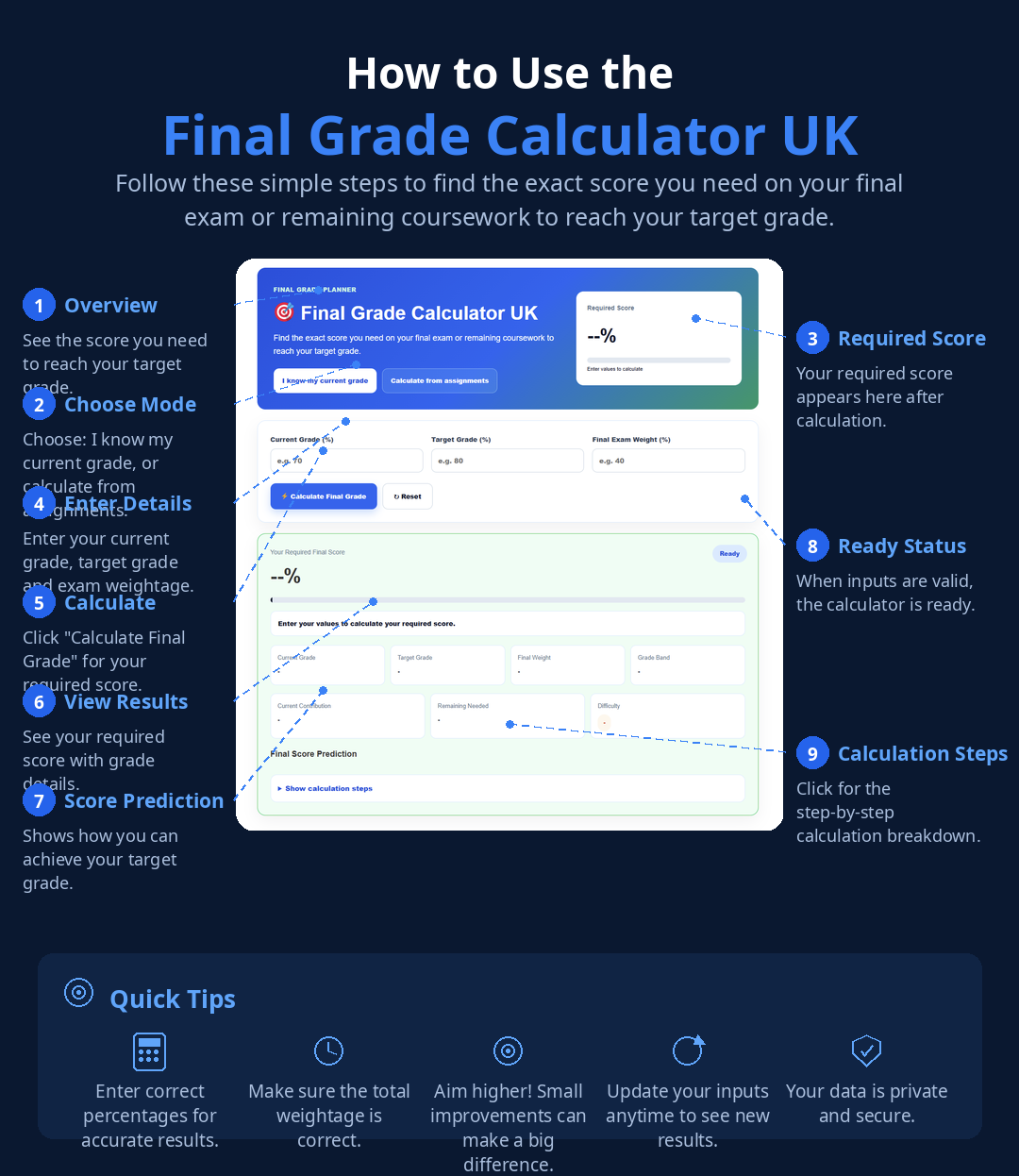
Click Here: Final Grade Calculator UK
The one sentence that ends most remark requests
Open the academic appeals page of almost any UK university and you will find a version of the same sentence within seconds. The University of Manchester’s student support pages state it plainly: “You cannot appeal purely because you disagree with the academic judgement of staff.” Manchester defines academic judgement as a decision made by academic staff using their expertise — “for example, determining marks, feedback, or the application of mitigation” — and adds that it cannot be appealed. King’s College London’s academic regulations go further: an appeal “cannot be used to challenge academic judgement”, and no decision of an assessment sub-board acting in accordance with regulations may be modified. The University of Edinburgh’s appeal regulations put it this way: the mark “is taken to be a reasonable judgment by an academic expert” and cannot be challenged when established policy has been applied.
This is not universities being difficult. It is the sector-wide academic judgement doctrine, and the Office of the Independent Adjudicator (OIA) — the independent body that reviews student complaints in England and Wales — treats it as the default position. Its Good Practice Framework lists questioning “the exercise of academic judgment” as not normally a legitimate ground for an academic appeal, defining that judgement as the decision made by academic staff “on the quality of the work itself or the criteria being applied to mark the work (rather than the administrative marking process)”. Parentheses matter: the framework draws a bright line between the quality judgement (off limits) and the administrative marking process (fair game). That distinction is the whole article in miniature.
Why does the line exist? Because your mark has already survived more scrutiny than most students realise. At UK universities, assessed work typically goes through internal moderation — a sample of scripts double-marked or check-marked by a second academic — and then external examiners, senior academics from other universities, review samples and confirm that standards are comparable across the sector. By the time an exam board ratifies your mark, several professionals have already looked at the marking. Letting any student buy a second opinion after the fact would mean the confident and the well-funded get their work judged twice while everyone else gets judged once — a fairness problem the regulations are explicitly designed to prevent.
Can you ask for a remark? The short, honest answer
Here is the reality check, stated as plainly as the regulations state it: no UK university found in this research offers a student-requested re-mark of assessed work. Queen Mary University of London’s Assessment Handbook states it as a flat rule: “assessments shall not be remarked.” The University of Manchester’s business school handbook tells students they “do not have an automatic right to have papers remarked.” Edinburgh’s appeal regulations are explicit: “The consideration of an appeal does not include remarking academic assessments.”
But students who say “I want a remark” are usually asking for one of three different things, and the answer is different for each. Getting these confused is the single biggest reason remark requests fail — students submit an appeal arguing their work deserved 68, when the process they needed was a two-minute administrative check. The three doors are:
| What you might mean | What it actually is | Who can trigger it | Can it change your mark? |
|---|---|---|---|
| “My script wasn’t marked properly” | Administrative check of marks — verifying every page was marked and the total was added up correctly | You can request this (usually informally, via your department) | Yes — but only to correct a genuine error, to whatever the true figure is |
| “A second academic should judge my work” | Re-mark / second marking — a fresh academic judgement of quality | Only an exam board or appeal committee, in exceptional cases; never on student request | Only where a board orders it — the fresh mark replaces the old one |
| “The process that produced my mark was unfair” | Formal academic appeal — a challenge to the decision, on procedural grounds | You, within strict deadlines and on narrow permitted grounds | Never directly — a successful appeal voids an attempt or sends the case back to the board; the committee does not set marks |
The rest of this guide walks through each door in turn — what it covers, what the regulations of five universities actually say, and the decision framework for working out which door, if any, is yours.
Door one: the administrative check of marks
This is the closest thing UK universities have to “asking for a remark”, and it is deliberately narrow. An administrative check does not ask whether your essay deserved a 2:1 or a First. It asks three mechanical questions: was every part of your assessment marked, was every component mark recorded, and does the published total equal the sum of the parts? If the answer to all three is yes, the check ends and the mark stands.
What a check can fix:
| Error type | Example | Fixable by a check? |
|---|---|---|
| Unmarked section | A whole exam question, or the final page of a script, never received a mark | Yes — the missing part is marked and the total recalculated |
| Addition / transcription error | Question marks sum to 66 but 58 was recorded; a component mark was typed wrong | Yes — the arithmetic is corrected |
| Missing component | Coursework worth 40% of the module never fed into the module total | Yes — the missing component is included |
| Wrong mark published | The online grade differs from the mark the examiners agreed (e.g. QMPlus vs MySIS mismatch) | Yes — Queen Mary’s School of Law directs students to “request an administrative check of the relevant mark” for exactly this |
| Harsh or generous marking | “The marker was too strict on my argument” | No — that is academic judgement |
| Disagreement with criteria | “My referencing shouldn’t have lost me that many marks” | No — applying criteria is academic judgement |
| Borderline sympathy | “I’m one mark off a 2:1, surely someone can look again” | No — borderlines are handled by borderline and discretionary uplift rules, not re-marking |
How you actually request one varies, and this is where the honest caveat belongs: most universities do not publish a formal “request a mark check” procedure with a form, a fee and a deadline. What exists is departmental and informal. The University of Manchester’s maths department handbook captures the typical position: the department “does not remark examination scripts. However, students can request that their script is checked to ensure that all parts have been marked and the total mark has been calculated correctly.” At UCL, the regulations encourage students to “seek clarification of an assessment or a Board of Examiners decision… from their Department or Faculty” before anything formal. Queen Mary requires all schools to run “results surgeries” where students can sit down with academic staff and talk through concerns — and the OIA’s framework describes exactly this kind of early-resolution conversation, where staff explain how the work was marked and moderated and check that marks were recorded accurately.
Practical advice, then: start with your module leader or personal tutor, not with a formal appeal. Say specifically what you think went wrong — “my question 4 has no marks on it” is a check; “I think question 4 deserved more” is academic judgement and will go nowhere. No fees were found for any of these checks in the official documents reviewed, and no university publishes a “your mark can go down” rule for them — a check simply corrects the record to the true figure, wherever that lands.
Door two: the formal academic appeal (and what it cannot do)
If a check is for mechanical errors, the academic appeal is for unfair process. Every university runs one, every university restricts it to narrow grounds, and every university says the same thing about what it cannot do: it cannot raise your mark. King’s College London’s regulations state that “marks will never be raised following an academic appeal” on mitigating-circumstances grounds, and that an appeal committee “is not an Assessment Board, and cannot raise marks in assignments or modules, amend marks from fail to pass, raise degree classifications, or make awards.” Edinburgh’s regulations agree: appeals do not include remarking, and a successful appeal sends the decision back to the board for reconsideration.
The permitted grounds are strikingly consistent across the sector. In various wordings, they are always some version of these three:
1. Procedural or administrative irregularity. The university did not follow its own rules, and it mattered. Examples: you were examined under different conditions from every other candidate, the wrong rubric was applied to your work, or your submitted evidence was never looked at. Manchester’s wording is typical: “a procedural or administrative error… significant enough that it may have affected your outcome.”
2. Extenuating circumstances not disclosed at the time. Something seriously affected your performance — illness, bereavement, a crisis — and you have a good reason why the examiners never knew. Note the emphasis: universities expect you to report problems at the time through the mitigating-circumstances process. An appeal is not a second chance at a claim you could have made earlier; Manchester’s pages warn that schools “will not accept an appeal if you could reasonably have used the Mitigating Circumstances Procedure at the time.” Our guide to extenuating circumstances covers that route in full.
3. Bias or prejudice. Evidence — not a feeling — that an examiner acted with bias. This is the rarest successful ground by a wide margin.
Crucially, a successful appeal does not produce a higher mark. At best it voids the attempt — the mark is set aside and you get a fresh, uncapped first sit, as if the affected assessment never happened — or it sends your case back to the exam board to reconsider. If you failed a module and believe the process was unfair, read our guides to appealing a university grade and referrals alongside this one; they cover what happens after an appeal succeeds.
One more timing rule that catches students out: you can only appeal ratified marks — marks formally confirmed by the exam board. Provisional marks, the ones released on your portal weeks earlier, cannot be appealed anywhere. Edinburgh’s regulations and Manchester’s guidance both state this explicitly. Until ratification, your mark is not final, and it can still move in either direction through moderation.
Door three that isn’t a door: second marking and moderation
Students sometimes hear that their work was “second-marked” and assume they can request the same. Second marking is real, but it is a quality-assurance process, not a student right. Universities routinely double-mark a sample of scripts — particularly borderlines, fails and firsts — and external examiners review samples to confirm standards match the rest of the sector. It happens automatically, behind the scenes, before your mark is ratified. You cannot trigger it, and its existence is actually one of the reasons universities refuse re-mark requests: the work has already been looked at more than once.
There is one narrow exception worth knowing about, because it shows what a genuine re-mark looks like. In research-degree regulations — a different world from undergraduate marking — an appeal board can order a thesis re-examined by new examiners. The University of Liverpool’s research-degree rules provide for exactly this on grounds of inadequate assessment, and note that the new examiners’ recommendations normally stand even where they differ from the original. That “even where they differ” is the tell: a true re-mark is a fresh judgement, not a safety net. It replaces the original mark — it does not sit alongside it as a best-of-two.
Worked example 1 — the unmarked page: 58 becomes 66, and a 2:2 becomes a 2:1
Ravi is in his final year. One 20-credit module is assessed by a single 100-mark exam, and his published mark is 58. He requests his script back through the department — a standard informal step — and works through it with the model answers. Question 4, worth 10 marks, has no marker annotations at all: no ticks, no crosses, no subtotal. It was never marked.
He emails the module leader with the specifics: which question, how many marks, what is missing from the script. This is a textbook administrative check. The marker reviews question 4 and awards 8 out of 10. The arithmetic is now:
Corrected exam mark = 58 + 8 = 66
Corrected module mark = 66 (the module is 100% exam)
Now the knock-on effect. Ravi’s other five final-year modules are all 20 credits too, and they came in at 58, 60, 59, 61 and 59. His second-year average was 59.0, and his university weights the degree 40:60 (second year : final year).
Before the correction — final-year average: (58 + 58 + 60 + 59 + 61 + 59) ÷ 6 = 355 ÷ 6 = 59.17%
Classification = 0.40 × 59.0 + 0.60 × 59.17 = 23.60 + 35.50 = 59.10% → 2:2
After the correction — final-year average: (58 + 66 + 60 + 59 + 61 + 59) ÷ 6 = 363 ÷ 6 = 60.50%
Classification = 23.60 + 36.30 = 59.90% → still 2:2
Wait — that is the point most students miss. An 8-point correction to one module moved Ravi’s final average by only 1.33 percentage points (8 ÷ 6, the module’s share of the year), and his classification by just 0.8 points. He is closer, but he has not crossed the line. This is where the worked arithmetic earns its keep: before chasing any correction, model what it actually changes. At 40:60 weighting, a single 20-credit module contributes just 10% of the final degree mark (one-sixth of the year, times the year’s 60% weight). Had Ravi’s university used borderline uplift rules that raise 59.5%+ averages, his 59.90% would now qualify — which is exactly why the check was still worth doing. The correction did not hand him a 2:1 by itself; it moved him into the zone where the borderline rules might.
Worked example 2 — the procedural appeal: 62 becomes 68, with the risk spelled out
Hannah’s 30-credit project module has two components: a presentation worth 40% and a written report worth 60%. She scores 62 on the presentation and 62 on the report — module mark 62. Then she learns something concrete: her presentation was timed at 10 minutes, but the module handbook guarantees every student 15 minutes, and the presentations timetabled after hers all ran to the full 15. That is not “I deserved more”. That is a procedural irregularity — she was examined under different conditions from her classmates.
She appeals on procedural-error grounds with evidence (the timetable, the handbook wording, witness confirmation). The appeal is upheld. The board voids the presentation mark and orders the component re-assessed — a genuine re-mark, ordered by the board, of the kind students cannot request for themselves. The new assessor awards 68. The arithmetic:
New module mark = 0.40 × 68 + 0.60 × 62 = 27.2 + 37.2 = 64.4 (up from 62.0)
But here is the part nobody tells you, and it is the honest core of this example: the 68 replaced the 62 — it did not sit next to it. A re-mark is a fresh academic judgement, and a fresh judgement can go either way. Had the new assessor found the shortened presentation genuinely weaker and awarded 58, Hannah’s module would have become 0.40 × 58 + 0.60 × 62 = 23.2 + 37.2 = 60.4 — lower than the mark she started with. The original 62 was not protected; there is no “best of two” rule. This is the structural reason universities are so reluctant to re-mark: once you open a mark to fresh judgement, the student who asked for it does not get to keep the old one as a floor.
The same logic applies earlier in the process. Every mark you see before the exam board ratifies it is provisional, and provisional marks move both ways through moderation and external examining. The only marks that cannot move are ratified ones — and those, as we have seen, cannot be re-marked at all.
What five universities actually say: the rules side by side
The doctrine is sector-wide, but the mechanics — deadlines, stages, wording — differ. These are the verified positions in current regulations (paraphrased closely; follow the links for the full text):
| University | Can you challenge a mark you disagree with? | What you can do instead | Appeal deadline |
|---|---|---|---|
| UCL | No — you “cannot contest a Board of Examiners decision on academic grounds”, including disagreement with the mark awarded | Seek clarification from your department first; appeal only on undisclosed extenuating circumstances, material administrative/procedural irregularity, or examiner bias | 10 working days from official notification of the board’s decision |
| Manchester | No — “you cannot appeal purely because you disagree with the academic judgement of staff”; no automatic right to have papers remarked | Department-level clerical check (e.g. maths: verify all parts marked and totals correct); formal appeal on mitigating circumstances, procedural/administrative error, or bias | 20 working days from notification of the academic outcome |
| QMUL | No — “assessments shall not be remarked”; appeals against academic judgement are ineligible | Results surgeries with academic staff; administrative check for grade discrepancies; formal appeal on procedural error or exceptional circumstances only | 15 working days from receiving the results or decision |
| KCL | No — an appeal “cannot be used to challenge academic judgement”; no board decision made under the regulations may be modified on those grounds | Informal resolution first (module leader, programme director); Stage One appeal on undisclosed mitigating circumstances or significant administrative error — but “marks will never be raised” on the former ground | 15 working days (Stage One) / 10 working days (Stage Two) from ratified results |
| Edinburgh | No — the mark “is taken to be a reasonable judgment by an academic expert”; “the consideration of an appeal does not include remarking” | Appeal on undisclosed substantial information about performance quality, or evidence of irregular procedure/improper conduct; upheld appeals go back to the board | 30 working days (final-year undergraduates and postgraduates) / 10 working days (other undergraduates) |
Three patterns to notice. First, the deadlines are short — 10 to 20 working days is the norm, roughly two to four calendar weeks, and late appeals need both a good reason and evidence. Second, nobody charges a fee for any of this; the documents reviewed mention no fees for checks or appeals. Third, Queen Mary’s explicit “assessments shall not be remarked” is the bluntest wording, but every other university in the table enforces the same rule through its academic-judgement exclusion.
The decision framework: check, appeal, extenuating circumstances — or accept
Most students do not need a regulation-by-regulation tour; they need to know which queue to join. Work through this matrix with your actual situation:
| Your situation | The right route | First step | Realistic outcome |
|---|---|---|---|
| The published total doesn’t match your question marks, a page looks unmarked, or a component is missing | Administrative check | Email the module leader with the specific discrepancy — question numbers, marks, what’s missing | The error is corrected to the true figure; everything else stands |
| You were examined under different conditions from classmates, the wrong rubric was used, or your evidence was never considered | Formal academic appeal (procedural irregularity) | Check your university’s appeal grounds and deadline (10–20 working days); gather documentary evidence | Attempt voided with a fresh uncapped sit, or the case referred back to the board — never a raised mark |
| Illness, bereavement or crisis hit during assessment and you told nobody at the time | Extenuating circumstances (or appeal on undisclosed-EC grounds if already ratified) | Mitigating-circumstances claim with evidence, now — or an appeal with a good reason for the delay | Attempt set aside and a fresh sit; your existing mark is not increased |
| You believe an examiner acted with bias | Formal academic appeal (bias) | Evidence, not suspicion — this ground succeeds rarely and needs documentation | Case reconsidered; outcomes as for procedural appeals |
| You simply expected a higher mark, or you’re one mark off a boundary | Accept — and work the system instead | Ask for detailed feedback; check your borderline uplift rules; model your classification | No mark change — but borderline discretion or remaining assessments may still move your class |
| You failed the module and want another chance at the mark | Resit / referral route | See our guides to condoned passes and referrals | Capped resit (usually 40%) or condonement — not a re-mark of the original attempt |
Be honest with yourself at the “simply expected a higher mark” row, because that is where the overwhelming majority of remark requests live — and where they die. If your situation genuinely sits in one of the first four rows, act fast: the deadlines above are unforgiving, and “I didn’t know the deadline” is not a ground for extending it.
Why you can’t just pay for a second opinion
The A-level comparison is worth closing properly, because it explains the confusion. At A-level, exam boards sell reviews of marking: a senior examiner checks the original marking was carried out correctly, and the mark can go up or down (students on The Student Room trade warnings about exactly this). It works there because every candidate in the country sat the same paper against the same mark scheme, marked by an army of examiners who never met them.
University assessment is a different object. Your essay was marked by an academic who designed the module, moderated internally, and signed off by an external examiner — against criteria, not a national mark scheme. There is no second army of examiners waiting, and no national standardisation to check against. A post-hoc re-mark would not be a quality check; it would be a second roll of the dice, available in practice to the students confident enough to ask. That is the fairness argument every regulation in this guide is built on, and it is why the answer stays no even when the student offers to pay.

Frequently asked questions
Can I ask my university for a remark if I disagree with my mark?
No. UK universities do not offer student-requested re-marks of assessed work. Disagreement with a mark is a challenge to academic judgement, which every university’s regulations exclude from appeal. What you can request is an administrative check — verifying that every part of your work was marked and the total was added up correctly — usually by contacting your module leader or department.
What is academic judgement and why can’t I appeal against it?
Academic judgement is the decision academic staff make using their expertise about the quality of your work and how marking criteria apply to it — for example, whether your essay merits 62 or 68. The Office of the Independent Adjudicator’s framework treats it as not normally a legitimate ground for appeal, because marks have already been through internal moderation and external examining. What you can challenge is the administrative process around the marking, not the judgement itself.
What can an administrative mark check actually fix?
A check can fix mechanical errors only: a question or page that was never marked, an addition or transcription error in the total, a missing component mark, or a published grade that differs from what the examiners agreed. It cannot change how generously or strictly your work was judged, how criteria were interpreted, or move a borderline mark up out of sympathy.
Will my mark go down if I ask for a check?
No university publishes a ‘your mark can go down’ rule for administrative checks — a check simply corrects the record to the true figure. But understand the principle behind it: any fresh look at a mark replaces the old one rather than sitting alongside it as a best-of-two. Marks are also provisional until the exam board ratifies them, and provisional marks can move in either direction through moderation. (The well-known ‘marks can go down’ warning applies to A-level exam-board reviews of marking, not university checks.)
Can an academic appeal raise my mark?
Never directly. King’s College London’s regulations state that marks will never be raised following a mitigating-circumstances appeal, and Edinburgh’s state that appeals do not include remarking. A successful appeal can void the affected attempt — giving you a fresh, uncapped sit — or send your case back to the exam board for reconsideration. The appeal committee itself does not set marks.
What are the valid grounds for appealing a mark?
Across UK universities the grounds are consistent: (1) a procedural or administrative irregularity significant enough to have affected your outcome — for example being examined under different conditions from other students; (2) extenuating circumstances that seriously affected your performance and, for good reason, were not disclosed before the board decided; and (3) evidence of bias or prejudice by an examiner. Disagreeing with the mark itself is not a ground at any university.
How long do I have to appeal a university mark?
Deadlines are short and strict: UCL allows 10 working days from official notification of the board’s decision, Manchester 20 working days, Queen Mary 15 working days, King’s College London 15 working days for Stage One, and Edinburgh 30 working days for final-year undergraduates and postgraduates (10 for other undergraduates). Late appeals need a good reason plus evidence, and appeals can only be made against ratified marks, not provisional ones.
What should I do instead of asking for a remark?
Start with detailed feedback from your marker — understanding why you got 62 is worth more than a second opinion you can’t have. Attend your department’s results surgery if one is offered. If you suspect a mechanical error, request an administrative check with specifics. Check whether your mark sits near a classification boundary, where borderline and discretionary uplift rules may apply. And if illness or crisis affected you, use the extenuating-circumstances process promptly rather than saving it for an appeal.
Conclusion
So: can you ask for a remark at a UK university? Not the kind you are imagining. There is no form, no fee, no senior examiner waiting to give your essay a second reading — Queen Mary’s “assessments shall not be remarked” is the sector speaking with one voice. What exists instead is a smaller, sharper toolkit: the administrative check for mechanical errors, the formal appeal for procedural unfairness, the extenuating-circumstances process for life getting in the way, and the feedback conversation that should have come first.
The students who get results from this system share one habit: they name the specific thing they think went wrong. “Question 4 has no marks on it” gets a correction. “I was examined under different conditions from everyone else” gets an appeal. “I deserved more” gets a polite explanation of academic judgement — and, if they are lucky, feedback good enough to earn the higher mark on the next assessment, which is the only re-mark that was ever on offer. Before you write that email, run the numbers on what a correction would actually change, check your deadline in working days rather than weeks, and make sure you are knocking on the right of the three doors. Most remark requests fail not because the system is unfair, but because they were addressed to a door that does not exist.

![Read more about the article Can You Retake a University Module to Improve Your Grade? UK Rules Explained [2026]](https://gradeforuni.com/wp-content/uploads/2026/10/featured-retake-module-improve-grade-300x192.png)
![Read more about the article How Are Open University Degrees Classified? Marks, Grades & Honours Explained [2026]](https://gradeforuni.com/wp-content/uploads/2026/10/featured-open-university-grades-300x192.png)
![Read more about the article Do Predicted Grades Matter for UCAS? How Conditional Offers Work [2026]](https://gradeforuni.com/wp-content/uploads/2026/10/predicted-grades-ucas-featured-300x192.png)