
![You are currently viewing Do All UK Universities Use the Same Grade Boundaries? [2026]](https://gradeforuni.com/wp-content/uploads/2026/10/featured-grade-boundaries-uk.png)
Do All UK Universities Use the Same Grade Boundaries?
Ask a UK student what you need for a first-class degree and the answer comes back instantly: 70%. A 2:1 needs 60%, a 2:2 needs 50%, and anything under 40% is a fail. These numbers feel like laws of nature — quoted on student forums, baked into every grade calculator, repeated in induction talks from Aberdeen to Aberystwyth.
They are not laws of nature. Every UK university sets its own grade boundaries in its own regulations, and while the 70/60/50/40 pattern is overwhelmingly the norm, the exceptions are real, documented, and capable of changing what your marks actually mean. Scotland runs a 22-point grading scale. The Open University grades its modules on 85/70/55/40. Nottingham Trent does not use percentages at all. And even among universities that do use 70/60/50/40, the small print — decimal places, borderline zones, alternative classification routes — means the same average can produce a different degree class at different institutions.
This guide maps the standard boundaries, explains why they are so consistent across the sector, walks through each genuine exception with real university regulations, and shows — with worked examples — how the fine print can move your classification. If you want to see where your own marks sit right now, run them through a calculator after reading.
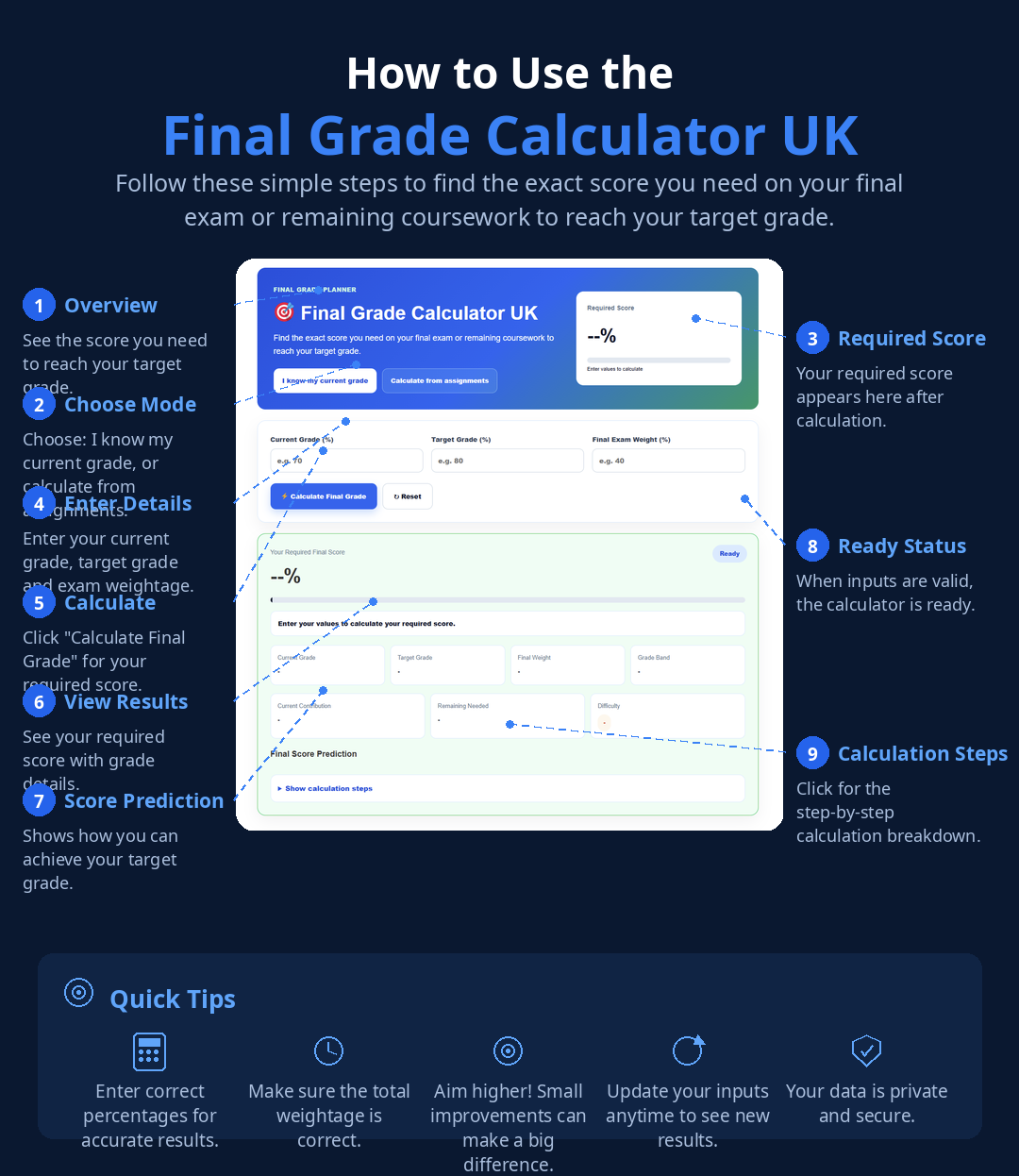
Click Here: Final Grade Calculator UK
The 70/60/50/40 Standard: What It Actually Is
For undergraduate honours degrees across England, Wales and Northern Ireland, the conventional classification boundaries are:
| Classification | Boundary | What it means in practice |
|---|---|---|
| First-class honours (1st) | 70% and above | The top class; roughly one in three graduates now achieves one |
| Upper second-class honours (2:1) | 60–69% | The most common class and the typical graduate-scheme threshold |
| Lower second-class honours (2:2) | 50–59% | Still honours; closes some doors, opens most others |
| Third-class honours (3rd) | 40–49% | The lowest honours class |
| Fail (undergraduate) | Below 40% | Module failed; resit or repeat territory |
Two things about this table matter more than the numbers themselves. First, these are conventional values, not legal ones. As the standard reference on the subject puts it, grade boundaries are defined by institutions — there are simply well-defined conventional values that are generally followed. Your university’s regulations are the only document that decides your class. Second, the taught-postgraduate scale runs on the same numbers but different labels and a higher pass mark: Distinction at 70%+, Merit at 60–69%, Pass at 50–59%, and Fail below 50% — the University of Westminster publishes exactly this mapping in its degree classification calculator.
The uniformity is striking enough that students treat the numbers as universal. It is worth understanding why that uniformity exists — because the reason also explains where the cracks are.
Why the Grade Boundaries Stay Nearly Identical Everywhere
Three mechanisms keep UK grade boundaries in lockstep. The first is the external examiner system. Every UK university appoints academics from other institutions to scrutinise its assessment, and the sector’s own principles for external examining state their first duty plainly: to protect standards and ensure comparability and consistency across institutions, assuring the degree-awarding body that its qualifications are comparable to those at other institutions. An examiner who has marked at Durham, Leeds and Exeter carries a calibrated sense of what a 70 looks like — and flags drift.
The second is the UK Quality Code for Higher Education. Its assessment guidance requires providers to ensure that the measurement of student achievement beyond the threshold standard is reasonably comparable with other UK providers, via external examining and external reference points. A university that quietly moved its first-class boundary to 60% would be out of line with the sector’s agreed standards — and would have to explain itself to its examiners, its students, and eventually the Office for Students.
The third is scrutiny. Grade inflation is now a political issue: roughly one in three UK graduates leaves with a first, and the OfS’s modelling identifies a growing share of “unexplained firsts” — awards that cannot be statistically accounted for by subject mix or entry qualifications. In autumn 2026 the government confirmed it is reviewing whether the external examining system is still fit for purpose. In that climate, no university wants to be the one whose boundaries look generous. The result is a sector-wide gravitational pull toward 70/60/50/40 that is stronger than any single regulation.
And yet the exceptions below are all real. They survive because they sit inside the comparability framework rather than outside it — different routes to the same honours classes.
Difference 1: Scotland’s 22-Point Grading Scale
The biggest structural exception is Scotland. The University of Glasgow — one of the UK’s oldest universities — does not mark work out of 100 at all. It uses a 22-point scale defined in Schedule A of its Code of Assessment: eight letter grades, A to H, each split into bands, with every band carrying a grade point from 22 down to 0.
| Grade | Gloss | Grade points |
|---|---|---|
| A1–A5 | Excellent | 22 down to 18 |
| B1–B3 | Very Good | 17 down to 15 |
| C1–C3 | Good | 14 down to 12 |
| D1–D3 | Satisfactory | 11 down to 9 |
| E1–E3 | Weak | 8 down to 6 |
| F1–F3 | Poor | 5 down to 3 |
| G1–G2 | Very Poor | 2 down to 1 |
| H | No convincing evidence of attainment | 0 |
Edinburgh works similarly through its Common Marking Scheme, where an A1 maps to 90–100% and an A2 to 80–89% — descriptors pitched at “exceptional” work, potentially of publishable standard. Your individual pieces of work get letter-band grades; those convert to grade points; the points are averaged for aggregation. Glasgow’s aggregation bands turn a mean grade point into an overall result: a mean of 18–22 is band A0 (Excellent), 15 to just under 18 is B0 (Very Good), 12 to just under 15 is C0 (Good), and 9 to just under 12 is D0 (Satisfactory).
Here is the crucial part: the final honours classes are still the same First, 2:1, 2:2 and Third used across the rest of the UK. The 22-point scale is a different marking language, not a different classification language. Scotland’s other structural differences sit alongside it — the honours degree takes four years rather than three, and the three-year ordinary degree is a qualification in its own right, graded Pass, Merit or Distinction rather than treated as a failed honours degree.
Difference 2: The Open University’s 85/70/55/40 Module Grades
The Open University, the UK’s largest university, grades its modules on boundaries that look nothing like the standard set:
| OU module grade | Boundary |
|---|---|
| Distinction (Grade 1) | 85% and above |
| Grade 2 pass | 70–84% |
| Grade 3 pass | 55–69% |
| Grade 4 pass | 40–54% |
| Fail | Below 40% |
Two quirks make the OU system genuinely different in operation. First, most modules split your result into two scores: the OCAS (overall continuous assessment score, your coursework average) and the OES (overall examinable score, your exam or end-of-module assessment). You must reach the grade threshold in both — and your final module grade is the lower of the two. An OES of 74 with an OCAS of 49 gives you a Grade 4 pass, not a Grade 2, because the coursework dragged the lower score down. Second, Level 1 (first-year-equivalent) modules are normally recorded as pass or fail only and do not feed grade information into the classification at all.
But note the convergence: when the OU awards the actual honours degree classification at the end, it uses the standard 70%+ for a first, 60–69% for a 2:1, and so on. The 85/70/55/40 scale governs module grades; the familiar boundaries govern the degree. An OU student aiming for a first still needs their weighted module profile to land at 70 — the same target as everyone else.
Difference 3: Nottingham Trent’s Grade-Based Assessment — No Percentages At All
Nottingham Trent University goes further than anyone else in the sector: it does not use percentages for marking. Under its Grade-Based Assessment (GBA) system, every piece of assessed work receives one of 17 grades for foundation and undergraduate degrees — the highest is “Exceptional First” — or one of 14 grades for postgraduate degrees, topped by “Exceptional Distinction”. The grade comes from comparing your work against written descriptors for each assessment criterion, not from adding up marks out of 100.
NTU is explicit about why. GBA was, in the university’s own words, devised as a fair and non-inflationary alternative to the traditional 0–100 marking scale — because under percentage marking it is possible to qualify for first-class honours even when the majority of your work sits below first-class level. At NTU, a first-class degree requires you to produce work consistently at a first-class level. The university publishes numerical equivalents for its grades (used for things like study-abroad conversions), but the marking itself never touches a percentage.
For students this changes the feel of assessment completely: there is no “I got 68, I need 2 more marks” arithmetic. You are chasing descriptors — the difference between a “High 2:1” and a “Low First” is a judgement about the quality of your argument against published criteria, not two percentage points. It is the clearest proof that the UK’s 70/60/50/40 convention is a choice, not a requirement.
Difference 4: The Pass Mark Isn’t Always 40
Even where the classification boundaries look standard, the floor underneath them moves. Three common variants:
| Context | Pass mark | Detail |
|---|---|---|
| Undergraduate modules (standard) | 40% | The familiar floor; 40–49% is a third |
| Taught masters modules | 50% | Below 50% is a fail at most universities; 50–59% is a bare Pass |
| Medicine, dentistry, some professional courses | 50% (often) | Professional and fitness-to-practise requirements push the floor up |
| Ordinary (pass) degree | 35% | Warwick awards a non-honours pass degree at 35–39.9% |
The taught-masters 50% floor catches out more students than any other boundary quirk. A student who scraped through undergrad modules at 42% — a valid third-class mark — discovers that the identical 42% on a masters module is a straight fail. Westminster’s classification calculator states it plainly: on postgraduate awards, 40–49% is Fail, while 50–59% is the lowest passing band. If you are moving from undergraduate to postgraduate study, recalibrate your sense of danger: the red zone starts ten points higher.
Difference 5: The Decimal Trap — 69.9 Is Not a First
Here is where identical-looking boundaries produce different outcomes. The University of Warwick’s published conventions define the bands with decimal precision: a First requires a mean of at least 70.0%, while the upper-second band is defined as 69.9% down to 60.0%. Read that carefully — 69.94% at Warwick is a 2:1. There is no silent rounding to 70. The boundary is a cliff edge measured to one decimal place.
Other universities soften the cliff with borderline zones rather than moving the boundary itself. Birmingham treats marks from 68.0% up to just below 69.5% as a borderline zone for a First, where additional criteria decide the outcome; UCL operates a 68.50% borderline rule alongside conditions on final-year credits. And Leicester offers an entirely different route: miss the 70% average but achieve 70%+ across 120 credits including 30 at final-year level, with an average of at least 68%, and the first is still yours — with parallel alternative routes at 58% for the 2:1, 48% for the 2:2 and 38% for the third.
The lesson: “the boundary is 70” is only half the rule. The other half — how your university handles the points just below it — lives in the regulations most students never read. Our full guide to borderline grades and discretionary uplift rules walks through these zones in detail.
Difference 6: Scaling Can Move the Effective Boundary
Finally, a boundary on paper is not always the boundary in practice. When a whole cohort’s marks come out unusually low — a brutally hard exam, a disrupted term — universities can apply scaling: adjusting marks upward (exceptionally, and usually with external examiner approval) so the distribution reflects the cohort’s true standard. York St John, Loughborough, Birmingham and Exeter all have published policies permitting scaling on an exceptional basis, with rank order preserved.
Scaling does not change the 70/60/50/40 lines; it moves marks relative to them. A 63 that becomes a 71 after linear scaling crosses from 2:1 to first-class territory without any boundary moving. It is rare, tightly governed, and the opposite of grade inflation panic — but it is the reason two students with identical raw marks at different universities can end up with different classifications. We cover the mechanics in how scaling and moderation really work.
What This Means for You: 5 Things to Check
Boundaries only matter the way your own university applies them. Before you assume anything:
- Read your university’s classification regulations, not a forum. The boundary table, the decimal precision, the borderline policy and any alternative routes are all in one document — usually called something like “conventions for the award of degrees”. It outranks everything you read online, including this article.
- Check the decimal places. If your regulations say 69.9 is the top of the 2:1 band, then 69.94 is a 2:1. Rounding rules are a separate policy — see our guide to how universities round marks.
- Know your borderline zone. If you are sitting at 68–69% in final year, find out now whether your university runs a borderline policy and what its conditions are — some require a proportion of final-year credits at the higher boundary.
- Recalibrate if you change level or institution. Moving to a masters? The pass mark just rose to 50. Moving to Scotland? Your marks will arrive as letter-band grades on a 22-point scale. Starting at the OU? Your module grades run 85/70/55/40 with a dual-threshold rule.
- Remember who actually decides. Classifications are confirmed by your programme’s board of examiners, not by an algorithm — which is why understanding how exam boards work matters as much as knowing the numbers.
Worked Examples: Boundaries in Action
Example 1 — Glasgow’s 22-point scale. History student Eilidh receives four module grades: B2, B1, C1 and A5. Converting to grade points: B2 = 16, B1 = 17, C1 = 14, A5 = 18. Her mean grade point is (16 + 17 + 14 + 18) ÷ 4 = 65 ÷ 4 = 16.25. On Glasgow’s aggregation bands, 16.25 sits inside the 15 to under-18 band — B0, “Very Good”. No percentage ever appeared, yet the outcome feeds the same honours classification system as a student with 65% at an English university.
Example 2 — the OU’s lower-of rule. OU student Marcus finishes a Level 3 module with an OCAS (coursework) of 49 and an OES (exam) of 74. The exam alone would be a Grade 2 (70–84); the coursework alone is a Grade 4 (40–54). Because the OU takes the lower of the two, Marcus gets a Grade 4 pass — the 74 buys him nothing. Had the scores been reversed (OCAS 74, OES 49), the result would be identical: Grade 4. This is the single most misunderstood OU rule, and it is why OU students are told to treat coursework and exams as equally decisive.
Example 3 — the decimal cliff and the alternative route. Two students both finish on 68.9%. At Warwick, 68.9 falls inside the 69.9–60.0 upper-second band: a 2:1, no discussion. At Leicester, the same 68.9% average plus 70%+ across 120 credits including 30 at final-year level triggers the alternative first-class route (70 in 120 credits, 30 at level 6, average at least 68%): a First. Same number, different degree class, both fully within published regulations. This is why “what’s 68.9 worth?” has no universal answer.

Do all UK universities use the same grade boundaries?
Almost, but not exactly. The 70/60/50/40 boundaries for First, 2:1, 2:2 and Third are conventional values that nearly all universities follow, but each institution defines its own boundaries in its regulations. Scotland uses a 22-point grading scale, the Open University grades modules on 85/70/55/40, and Nottingham Trent uses no percentages at all — though all still award the same honours classes.
Is 69.5% a first-class degree?
Not automatically. At most universities the first-class boundary is a hard 70% — Warwick’s regulations, for example, define the 2:1 band as 69.9% down to 60.0%, so 69.5% is a 2:1 there. Some universities run borderline policies (such as 68.0–69.5% at Birmingham or 68.50% at UCL) where near-miss marks get extra consideration, but the boundary itself does not move.
How does grading work at Scottish universities?
Many Scottish universities, including Glasgow, mark work on a 22-point scale (A1 = 22 down to H = 0) rather than percentages. Marks are aggregated as grade points and converted into bands. The final honours classes — First, 2:1, 2:2, Third — are the same as the rest of the UK, and Scottish honours degrees take four years instead of three.
What grade boundaries does the Open University use?
OU modules are graded Distinction (85%+), Grade 2 (70–84%), Grade 3 (55–69%), Grade 4 (40–54%) and Fail (below 40%). Most modules split your result into coursework (OCAS) and exam (OES) scores, and your final module grade is the lower of the two. The final honours degree classification still uses the standard 70/60/50/40 boundaries.
Is the pass mark 40% at every UK university?
For undergraduate modules, 40% is the standard pass mark. But taught masters modules usually require 50% to pass, medicine and other professional courses often set the floor at 50%, and some universities award a non-honours ordinary (pass) degree at 35–39.9%. Always check your own course regulations.
Why don’t universities just set their own boundaries freely?
They legally can — each institution defines its own boundaries. In practice, external examiners from other universities scrutinise every institution’s standards, and the QAA Quality Code requires achievement to be reasonably comparable across UK providers. With the OfS now investigating unexplained first-class awards, no university wants boundaries that look generous.
Can scaling change my degree classification?
Scaling adjusts marks, not boundaries, and it is rare and tightly governed — usually requiring external examiner approval and preserving rank order. But when it happens, a scaled-up mark can cross a boundary: a 63 becoming a 71 moves from 2:1 to first-class territory without any boundary moving.
Where do I find my university’s real grade boundaries?
In your university’s academic regulations — look for a document called conventions, regulations or a code of assessment for the award of degrees. It contains the boundary table, decimal-place rules, borderline policies and any alternative classification routes. That document outranks any general guide.
Conclusion
So: do all UK universities use the same grade boundaries? For the number that decides your degree class, near enough — the 70/60/50/40 convention is one of the most stable features of British higher education, held in place by external examiners, the Quality Code, and the glare of grade-inflation scrutiny. A first means 70 at virtually every university in the country, and that comparability is exactly what keeps a degree from Durham meaningful next to one from Dundee.
But “near enough” is doing real work in that sentence. Scotland’s 22-point scale, the OU’s 85/70/55/40 module grades and dual-threshold rule, NTU’s percentage-free descriptors, the masters 50% pass floor, and the decimal-place cliffs and borderline zones hidden in individual regulations all mean that the same raw performance can be labelled differently in different places. The students who get hurt are the ones who assume the headline numbers are the whole story — the 69.9 at Warwick, the 49 OCAS at the OU, the 42 on a masters module.
The fix is unglamorous but effective: read your own university’s classification regulations once, properly, before final year begins. Know your exact boundaries, your decimal rules, and your borderline policy. Then run your marks through the calculator with those numbers — not the generic ones — and you will know precisely where you stand and exactly how far each remaining assessment can move you.

![Read more about the article What Happens to Your Grades If Your University Closes Your Course? UK Student Guide [2026]](https://gradeforuni.com/wp-content/uploads/2026/10/featured-course-closures-uk-300x192.png)