
![You are currently viewing Can You Retake a University Module to Improve Your Grade? UK Rules Explained [2026]](https://gradeforuni.com/wp-content/uploads/2026/10/featured-retake-module-improve-grade.png)
Can You Retake a University Module to Improve Your Grade? UK Rules Explained
You got 58% on a module. It’s a pass — a solid 2:2-level mark — but you know you could have done better, and that one module is dragging your average down. So the question pops into your head: can I just retake it and try for a 70? It feels like a reasonable ask. After all, universities let students resit failed modules every summer. Why not let you resit a passed one for a better grade?
The short answer is no. Across the UK, resits exist to rescue failed modules — not to polish passed ones. Universities from Bedfordshire to Queen Mary write the same rule into their regulations: once you’ve passed a module, the door to reassessment closes. And as you’ll see in the worked example below, even if retakes for improvement were allowed, the 40% resit cap would make them mathematically self-defeating.
This guide lays out the actual rules — the universal ban, the cap, the three narrow exceptions that look like improvement retakes but aren’t, why repeating the year won’t work either, and the five legitimate ways to lift your average instead. Every rule is grounded in real university regulations, so you can stop wondering and start planning.
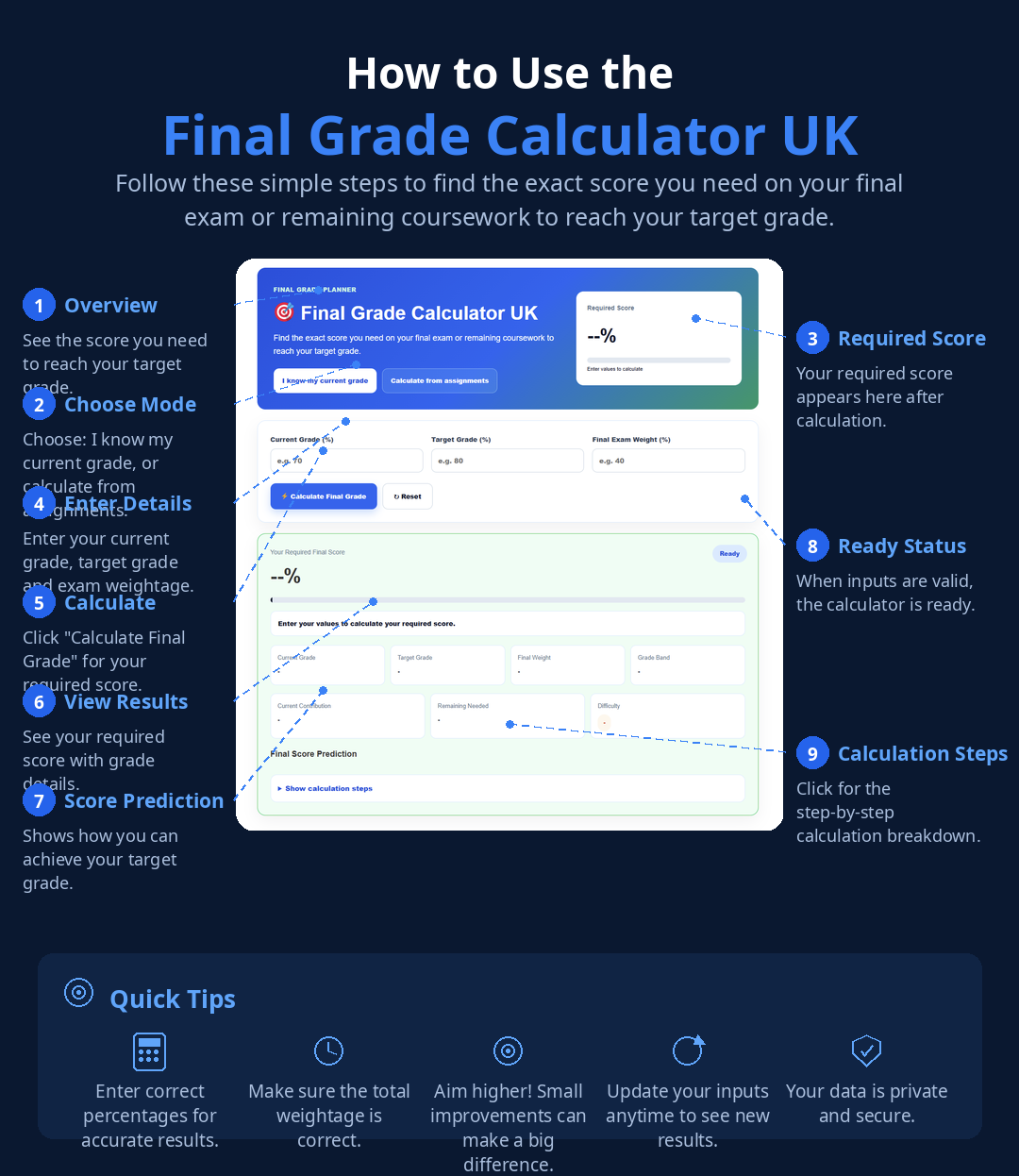
Click Here: Final Grade Calculator UK
The Short Answer: No — Eight Universities Say the Same Thing
This isn’t a grey area or a matter of departmental discretion. The prohibition on resitting passed modules is written into assessment regulations across the sector, usually in near-identical language. Here is a sample:
| University | What the regulations say |
| Bedfordshire | “If you pass a unit, you cannot resit any assessment components or retake the unit to achieve a higher grade.” |
| Regent’s University London | “You are not permitted to resit or retake any assessment or module if passed at the first attempt (or condoned) to try to achieve a higher mark.” |
| LSE | “A student will not be reassessed in any course or course component in which they have already received a pass mark.” |
| UCL | “Students who have passed a course unit assessment cannot reregister for that course unit nor repeat the assessment.” |
| Queen Mary (QMUL) | “A student cannot resit a module that has been passed.” |
| UWE Bristol | “A student who has passed a module may not take those assessment tasks for a second time with a view to improving their mark/s.” |
| Northampton | “A student cannot repeat a module to improve a grade.” |
| Loughborough | “You cannot choose to do reassessment in these modules in order to improve your overall Part Mark.” |
Notice the Regent’s wording: the ban covers passed modules and condoned ones, and it covers individual assessment components too. So you can’t dodge the rule by resitting just the one failed exam inside an otherwise passed module — if the module as a whole passed, it’s closed. A real student on The Student Room asked exactly this — whether they could resubmit a passed coursework piece for a higher mark — and the answer from other students was unanimous: resits are for failures, not for higher pass marks.
Why the Rule Exists: It Protects the Value of Your Degree
The rule can feel harsh when you’re staring at a 58% that doesn’t reflect your ability. But universities defend it on fairness grounds, and the logic is worth understanding. If students could keep re-sitting passed modules until they got the mark they wanted, degrees would stop measuring what you learned in the time available and start measuring how many attempts you were willing to take. As one experienced poster put it in a TSR thread on this exact question, allowing improvement resits would hand an unfair advantage to students with the time and money to keep re-sitting, and it would undermine the integrity of every classification the university awards.
There’s also a practical dimension. Exam boards, external examiners and marking teams are already stretched running the resit diet for students who genuinely failed. Opening resits to everyone who fancied a better mark would multiply that workload several times over — for no academic purpose, since the student already demonstrated they met the module’s learning outcomes. The pass mark isn’t a suggestion; it’s the line the university drew, and crossing it settles the module.
The 40% Cap: Why an Improvement Resit Would Backfire Anyway
Here’s the twist most students don’t know: even if your university did let you resit a passed module, it would almost certainly hurt you. Undergraduate resits are capped at the pass mark — 40% — across the sector. Bedfordshire states it plainly (“Marks for resits are capped at 40%”), LSE caps the overall course mark at 40, and Royal Holloway confirms the same 40% cap for undergraduates. Whatever you actually score on the resit paper, the mark that counts is 40%.
Run the numbers on the fantasy. Daniel is in second year: eight 15-credit modules, 120 credits total. He scored 58% on one module and averages 64% across the other seven. His year average right now is (58 × 15 + 64 × 105) ÷ 120 = 7,590 ÷ 120 = 63.25% — a comfortable 2:1. Now suppose the rules allowed him to resit the 58% module and he produced genuinely 70%-quality work in the resit. The cap doesn’t care: the module is recorded as 40%. His new year average becomes (40 × 15 + 64 × 105) ÷ 120 = 7,320 ÷ 120 = 61.0%. He has spent a summer revising to lose 2.25 percentage points. The cap exists so that resits rescue failures; applied to a passed module, it’s a punishment.
There’s a transcript sting too. Manchester’s guidance explains that resat units are flagged on your transcript — a 40R rather than a clean 40 — so anyone reading it (a postgraduate admissions tutor, an employer running a background check) can see the module was resat. Students on TSR worry about exactly this: one poster fretted that “this 40% will still be displayed on my transcript” when applying for postgraduate study. You would be trading a clean 58% for a flagged, capped 40%. There is no version of this trade you win.
The Three Exceptions That Look Like Improvement Resits (But Aren’t)
Every year, a few students report being allowed to retake something they passed — and the stories are real, but they all fall into narrow, documented exceptions. None of them is a free choice to chase a higher mark.
1. Approved extenuating circumstances: the uncapped “first sit”
If your performance was affected by serious, evidenced circumstances — illness, bereavement, a crisis during the assessment period — an approved extenuating circumstances claim lets you take the assessment again as if for the first time, with no cap. UWL’s regulations award “an uncapped mitigated first attempt in the affected assessment(s)”; Royal Holloway grants a “First Sit” for undergraduates; Liverpool’s policy allows the resit to be regarded as a first attempt.
Crucially, this only covers assessments affected by the circumstances, and the claim needs evidence and a timely application. It is not a route to improving a module you sat under normal conditions and simply underperformed in. The bar is deliberately high: universities treat EC claims as academic judgments, not customer-service requests.
2. Kent’s “deferral on pass” — the rarest exception of all
The University of Kent operates something genuinely unusual: a “deferral on pass” for cases where a passed mark is, in the regulations’ words, significantly out of line — roughly two classifications below the student’s average on unaffected modules — for reasons of extenuation. This is the closest any mainstream UK university comes to letting you redo a passed assessment. Note the conditions: the mark must be anomalous and there must be extenuating circumstances. A merely disappointing 58% from a 62%-average student doesn’t come close.
3. Postgraduate and professional-body variants
Liverpool’s postgraduate regulations explicitly forbid “resitting passed assessments to improve the mark” — then carve out two exceptions: PGT students whose research or independent-study module was EC-affected can take an uncapped first-attempt resit, and resits required to meet professional-body (PSRB) standards are permitted. Similarly, some validating bodies allow a passed module to be repeated only exceptionally, when a student is repeating a whole stage because of significant extenuating circumstances. Every exception is EC- or PSRB-driven. Nobody gets a free improvement attempt.

Why Repeating the Year Won’t Work Either
“Fine,” you might think, “I’ll just repeat the whole year and do everything better.” Universities have closed this door too. Glasgow Caledonian’s regulations state that a student required to repeat a level “will only be required to reenter those modules for which they have failed to record a pass mark” — your passed modules, and their marks, come with you. A Westminster adviser confirmed the same on The Student Room: “If you have passed some modules from your Level 5 already it won’t be possible to re-sit the whole year again. You will have to carry these grades forward into Level 6.”
Repeat years exist for academic failure, and they come with real costs. Bath charges the full annual fee for repeating a full academic year (currently around £9,535 for home students); Edinburgh charges full fee for a full-year repeat and a pro-rata fee for individual courses. Student Finance England’s standard entitlement is your course length plus one “gift year,” so a repeat year usually consumes that safety net — a second repeat would leave you self-funding. And the marking rules don’t help: at QMUL, where a student retakes a year after academic failure, previous marks are replaced but the retake marks are capped. You would pay ~£9,500 for the privilege of capped marks on modules you already passed.
Masters Students: The Same Rule, a Higher Cap
If you’re on a taught postgraduate degree, don’t assume the rules are looser — they’re the same shape, just with a 50% pass mark instead of 40%. Edinburgh records a resubmitted PGT dissertation as 50%; Leicester caps resubmitted work and resit exams at 50%; Aberystwyth permits two resit opportunities, capped at 50%, unless special circumstances apply. And the improvement ban is identical: Wolverhampton’s postgraduate regulations state that “students are not permitted to resit assessments or retake modules in which they have achieved a passing grade” unless an appeal or extenuating-circumstances procedure agrees otherwise.
The one meaningful difference is that a capped 50% at Masters level still counts as a pass for progression, so the cap stings slightly less — but it still can’t lift a 55% to a 65%. If you’re chasing a Merit or Distinction, read our Masters grading guide for how those boundaries actually work.
What You Can Actually Do to Lift Your Grade Instead
The rule targets the module you passed. It says nothing about your overall average — which is decided by the marks you haven’t earned yet. Five legitimate routes exist, and unlike a fantasy resit, they all work.
1. Attack the modules still ahead of you — the maths is on your side
Priya is in final year on a 40:60 weighting. Her second-year average was 60.5%, and she’s completed 60 of her 120 final-year credits at 57.8%. She wants a 2:1 — a final mark of 60%. Her classification is 0.4 × 60.5 + 0.6 × (final-year average) = 24.2 + 0.6 × Y3. To reach 60, she needs 0.6 × Y3 ≥ 35.8, so Y3 ≥ 59.67%. With 60 credits banked at 57.8, her remaining 60 credits need to average X where (57.8 + X) ÷ 2 ≥ 59.67 — which gives X ≥ 61.5%. That’s one strong essay away, not a miracle. Plug your own numbers into the Final Grade Calculator to find your exact target — it’s the single most useful thing you can do today.
2. Weight your effort toward what counts most
Not all remaining marks are equal. Final-year modules usually carry double the weight of second-year ones, and dissertations (often 30–40 credits) are the single biggest lever most students have — our 2:2-to-2:1 recovery guide shows how a strong dissertation can move a classification by over 4 percentage points on its own. Spend your revision hours where the credit-weighting multiplies them.
3. Claim extenuating circumstances properly — for future assessments
You can’t use ECs retroactively on a cleanly-passed module, but if you’re currently struggling — illness, a family crisis, a flare-up of a known condition — filing a claim before or during the assessment period can secure an uncapped first sit instead of a capped resit later. Read our extenuating circumstances guide for what counts as evidence and how deadlines work.
4. Audit your marks for errors
Before you assume a disappointing average is all your own doing, check the arithmetic is right. Wrong credit values, misapplied year weightings and uncapped resit marks entered as raw scores are all real, documented error points — our marks-audit guide walks through the full checklist, built around a genuine university grading-error case.
5. If you genuinely failed something, use the resit system as designed
This whole article is about passed modules. If any module actually failed, the resit and referral system is there to rescue it — capped at 40%, but a capped pass beats a fail. Our referrals guide explains how capped resits, condonement and trailing credits interact.
6 Myths About Retaking for Better Grades
| Myth | Reality |
| “I can resit any module I want, like at A-level.” | A-level resits are a school-exam system. At UK universities, resits are only for failed modules — eight universities’ regulations say so explicitly. |
| “I’ll just resit the exam component, not the whole module.” | If the module passed overall, its components are closed too. Regent’s and LSE both bar reassessment of passed components. |
| “A resit would replace my 58% with my new mark.” | Even genuine resits are capped at 40% for undergraduates — your 58% would become a flagged 40%. |
| “I can repeat the year and start fresh.” | Repeat years only re-enter failed modules; passed marks carry forward. A full repeat costs ~£9,535 and usually burns your Student Finance gift year. |
| “Postgraduate rules must be more flexible.” | The same ban applies at Masters level (Wolverhampton regs); the only difference is the cap is 50% instead of 40%. |
| “Nobody will know I resat.” | Resits are flagged on transcripts (e.g. Manchester’s 40R notation) — a clean 58% looks better than a flagged 40%. |
Can I resit a university module I passed to get a higher grade?
No. UK universities only offer resits for failed modules. Regulations at Bedfordshire, Regent’s, LSE, UCL, Queen Mary, UWE, Northampton and Loughborough all state explicitly that you cannot resit or retake a module you have passed in order to achieve a higher mark.
I got 58% on a module — can I resit it to try for 70%?
No, and the resit cap makes the idea self-defeating even in theory. Undergraduate resits are capped at the 40% pass mark, so a 58% module would be recorded as 40% after a resit — your average would fall, and the resit would be flagged on your transcript (for example as 40R at Manchester).
What if I had extenuating circumstances during the assessment?
An approved extenuating circumstances claim can give you an uncapped retake treated as a first attempt — but only for the assessments actually affected by the circumstances, with evidence and a timely application. It is not a route to improving a module you sat under normal conditions.
Can I repeat the whole year to improve my grades?
No. Repeat years only require you to re-enter modules you failed; your passed modules and their marks carry forward into the next year. A full repeat year also costs around £9,535 in tuition and usually uses up your one Student Finance England gift year.
Will a resit show up on my transcript?
Yes. Resat modules are flagged — Manchester, for example, records them as 40R rather than a clean 40. Postgraduate admissions tutors and employers doing background checks can see which modules were resat, which is another reason a clean 58% beats a flagged, capped 40%.
Do the same rules apply to Masters degrees?
Yes. Taught postgraduate regulations contain the same ban — Wolverhampton’s PG regulations forbid resitting assessments or retaking modules in which you have achieved a passing grade. The only difference is the numbers: the pass mark and resit cap are 50% rather than 40%.
Can I resit just the failed exam inside a module I passed overall?
No. If the module passed as a whole, its individual components are closed as well. Regent’s and LSE both bar reassessment of course components in which you have already received a pass mark.
What should I do instead if I need a higher average?
Focus on the marks you haven’t earned yet: work out exactly what your remaining modules need to average using a final grade calculator, weight your effort toward high-credit final-year modules and your dissertation, claim extenuating circumstances properly for future assessments if you’re struggling, and audit your existing marks for administrative errors before assuming the average is all your own doing.
Conclusion
So: can you retake a module to improve your grade at a UK university? No — not the module, not its components, not by repeating the year, and not at Masters level either. Eight universities’ regulations say it in almost identical words, and the 40% resit cap means the fantasy wouldn’t help even if it were allowed. The three genuine exceptions — uncapped first sits after approved extenuating circumstances, Kent’s vanishingly rare deferral on pass, and professional-body requirements — all exist for circumstances beyond your control, not for grade-chasing.
The productive version of this question is a different one: what do my remaining modules need to average? That’s a question with a real answer and real arithmetic behind it, as Priya’s 61.5% target shows. Run your own numbers through the Final Grade Calculator, aim your effort at the heaviest-weighted work still ahead of you, and let the passed 58% be what it is — a pass, cleanly earned, with no flags on your transcript. In the long run, that’s worth more than any retake could have bought.
![Read more about the article University Transcript UK: How to Read Yours and Fix Issues [2026]](https://gradeforuni.com/wp-content/uploads/2026/10/featured-university-transcript-uk-300x192.png)