Introduction
Starting university is exciting, but it can also feel overwhelming. You’ve settled into your lectures, explored the campus, and received your module handbook. University Assessment Methods: As you look through it, you realise your grade won’t depend on just one final exam. Instead, you’ll be assessed through a mix of essays, presentations, coursework, group projects and practical tasks, each with its own weighting.
Unlike school, UK universities use different assessment methods to evaluate a wider range of academic and practical skills. University Assessment Methods: Understanding how each assessment works can help you manage your workload, prepare more effectively and improve your overall performance.
In this guide, you’ll learn about the main university assessment methods, how they are weighted and marked, and practical tips to help you approach every assessment with confidence.
Calculate Your Module Grade in Seconds
Want to see how your exam, coursework and presentation marks combine into your final result? Use our calculator to calculate your overall module grade instantly. University Assessment Methods
Click Here:UK University Grade
Calculator
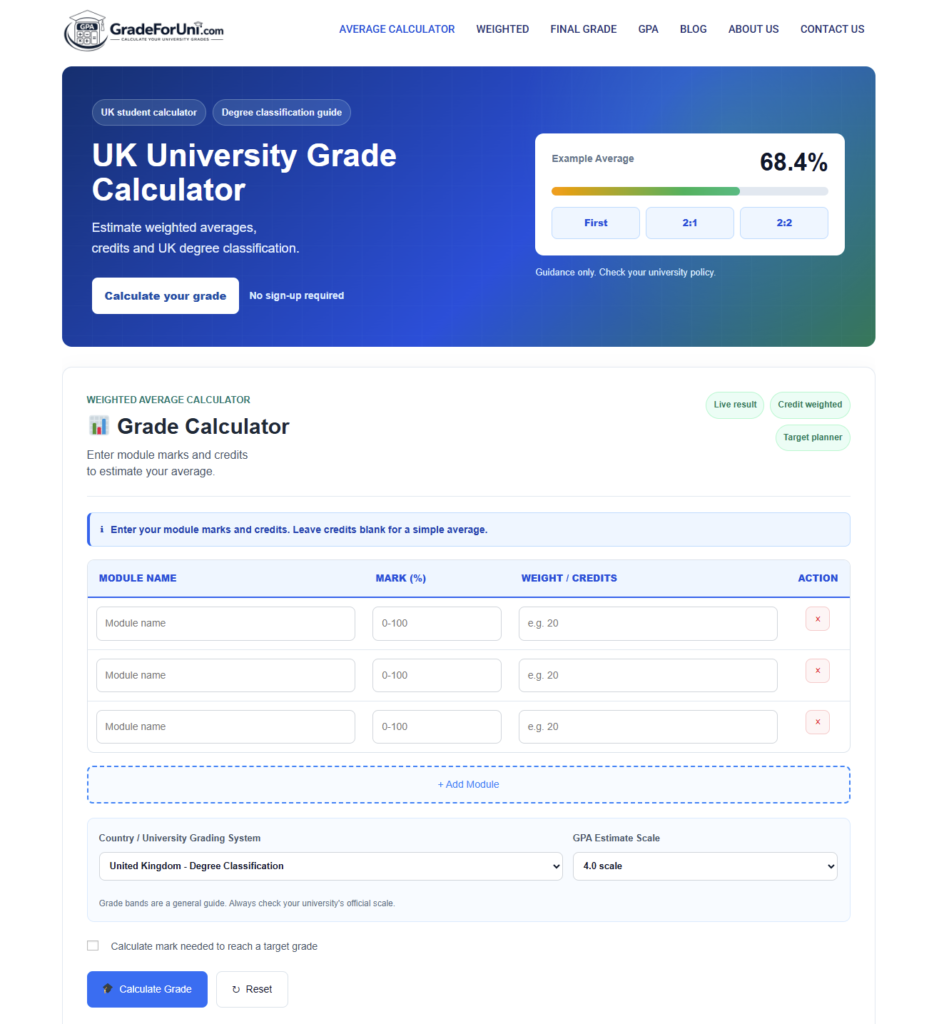
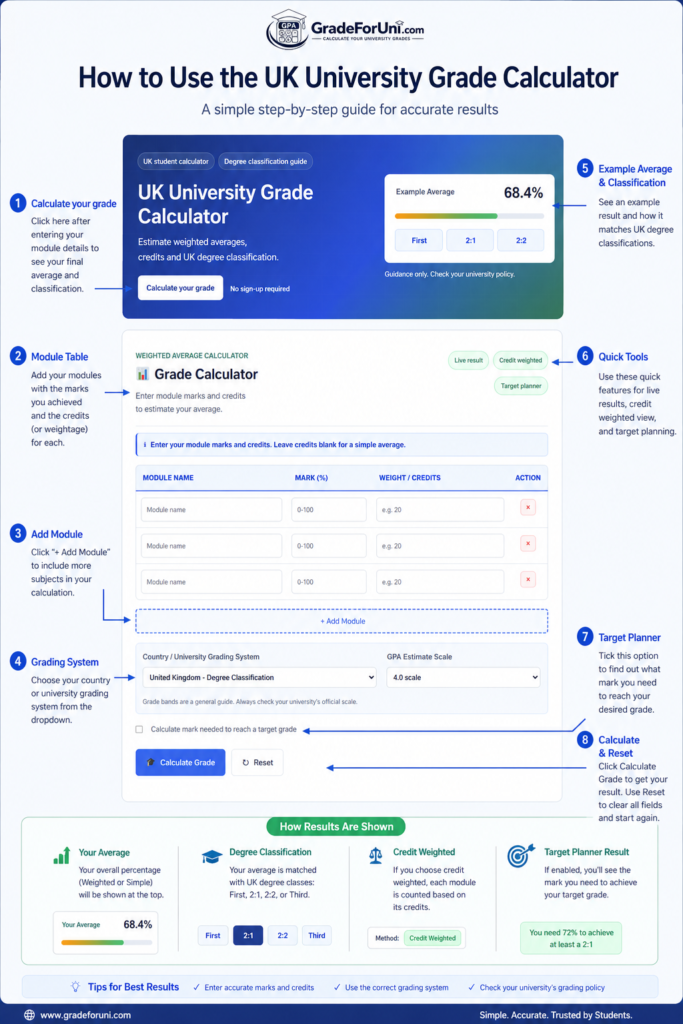
How to Use the UK University Grade
University assessment methods are the different ways UK universities measure a student’s knowledge and skills throughout a module. University Assessment Methods: Common assessment types include written exams, coursework, presentations, practical assessments, dissertations, and group projects. Each assessment usually contributes a percentage towards the final module mark based on its weighting, allowing universities to evaluate both academic understanding and practical abilities.
What Are University Assessment What Are University Assessment Methods?
Why UK Universities Use Different Types of Assessments
No single assessment can measure every skill a student needs to develop. University Assessment Methods. That’s why UK universities use a mix of exams, coursework, presentations and practical tasks to evaluate different aspects of learning.
For example, a Mathematics module may rely on problem-solving exams, while a Marketing module is more likely to include reports, presentations and group projects. University Assessment Methods: Science and healthcare courses often combine written assignments with laboratory or practical assessments to test both theoretical knowledge and practical skills.
Using a variety of assessment methods helps universities:
- Assess a wider range of academic and professional skills.
- Encourage consistent learning throughout the semester.
- Reduce dependence on a single high-pressure exam.
- Prepare students for workplace tasks and real-world situations.
- Give students multiple ways to demonstrate their knowledge.
How Assessments Measure Learning Outcomes
Each university module has learning outcomes, which describe the knowledge and skills students are expected to demonstrate by the end of the course. University Assessment Methods: Every assessment is designed to evaluate one or more of these outcomes.
| Learning Outcome | Suitable Assessment |
|---|---|
| Analyse research and evidence | Coursework Essay |
| Communicate ideas effectively | Presentation |
| Apply knowledge to solve problems | Written Exam |
| Demonstrate practical skills | Practical Assessment |
| Work collaboratively | Group Project |
| Assessment | Weight |
|---|---|
| Coursework Essay | 30% |
| Presentation | 20% |
| Final Exam | 50% |
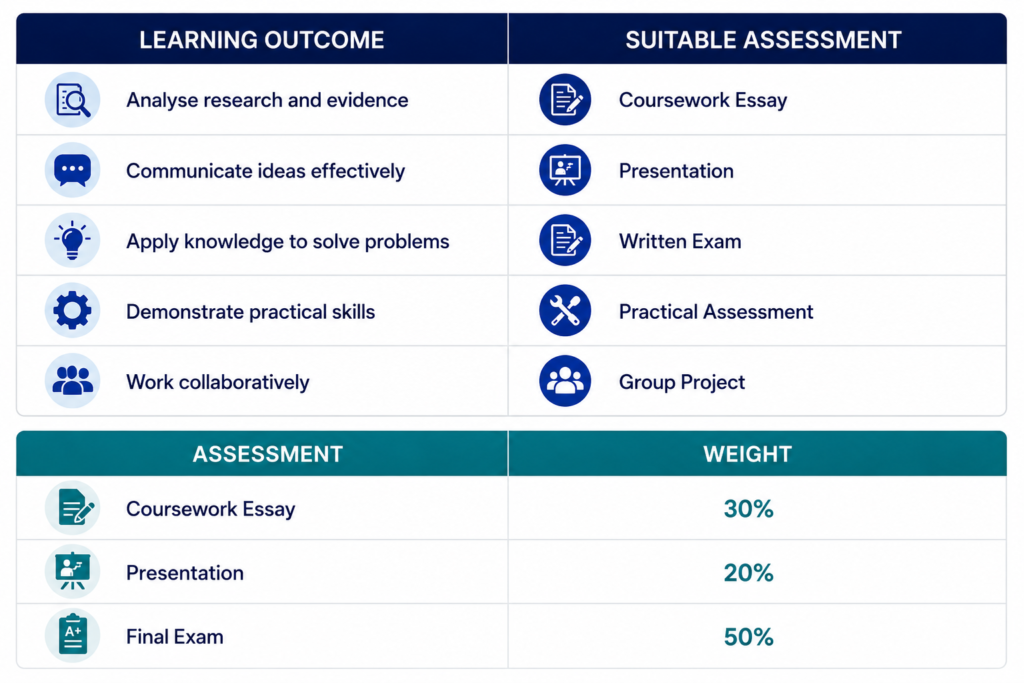
In this example, your final module grade is calculated by combining the weighted marks from all three assessments rather than relying on a single result.
Read More: University Grade CalculatorBy using different assessment methods, universities can evaluate both academic knowledge and transferable skills that are valuable in future employment.
Types of University Assessment Methods
Written Exams
Written exams are one of the most widely used university assessment methods in the UK. University Assessment Methods They test how well you understand the module content and how effectively you can apply your knowledge within a set time.
Depending on the subject, an exam may include:
- Multiple-choice questions
- Short-answer questions
- Essay questions
- Problem-solving tasks
- Calculations
- Case studies
Some exams take place on campus under invigilated conditions, while others are completed online using secure assessment platforms.
Closed-Book Exams
In a closed-book exam, you cannot use notes, textbooks or online resources. Success depends on your understanding of the subject and your ability to recall information under time pressure. University Assessment Methods
These exams are common in subjects such as Law, Medicine and Mathematics, where students need to demonstrate strong subject knowledge.
Preparation tips:
- Revise consistently instead of cramming.
- Complete past papers to understand question styles.
- Practise under timed conditions.
- Focus on understanding concepts rather than memorising facts.
Open-Book Exams
Open-book exams allow students to use approved materials, such as notes or textbooks, during the assessment.
However, access to resources does not make these exams easier. University Assessment Methods Questions are usually designed to assess analysis, evaluation, and problem-solving rather than simple recall. Students who understand the topic well are less likely to waste time searching through notes.
Online Exams
Many UK universities now conduct assessments online. These exams may include:
- Timed quizzes
- Essay-based questions
- Case studies
- Scenario-based assessments
Before sitting an online exam, make sure you:
- Have a reliable internet connection.
- Use a compatible device.
- Read the submission instructions carefully.
- Know the time limit.
- Check your university’s technical requirements.
Some universities also use plagiarism detection software or online invigilation tools to help maintain academic integrity.
Click Here:Mauricette CalculetteCoursework
Coursework consists of assessments completed over a longer period rather than in a timed exam. University Assessment Methods It allows students to research, plan, draft, and refine their work before submission.
Common types of coursework include:
- Essays
- Reports
- Case studies
- Literature reviews
- Business plans
- Research projects
- Portfolios
Because coursework is completed over several days or weeks, it often rewards good planning, critical thinking, and strong academic writing skills.
Essays
Essays require students to answer a question using evidence, research, and logical argument.
A high-quality university essay usually includes:
- A clear introduction
- Well-organised arguments
- Evidence from reliable academic sources
- Critical analysis
- A balanced conclusion
- Accurate referencing
Rather than simply describing information, students are expected to evaluate ideas and support their arguments with evidence.
Reports
Reports are commonly used in Business, Engineering, Science and Healthcare programmes.
Unlike essays, reports follow a structured format that may include:
- Executive summary
- Introduction
- Methodology
- Findings
- Discussion
- Recommendations
- References
They are often based on real-world situations and focus on analysing information before presenting practical recommendations.
Portfolios
A portfolio is a collection of work completed throughout a module. University Assessment Methods: Instead of measuring performance through a single assessment, it demonstrates your progress over time.
Depending on the course, a portfolio may include:
- Design projects
- Programming work
- Creative writing
- Artwork
- Reflective commentary
Portfolios are particularly common in creative, technical and professional courses.
Presentations Other University Assessment Methods
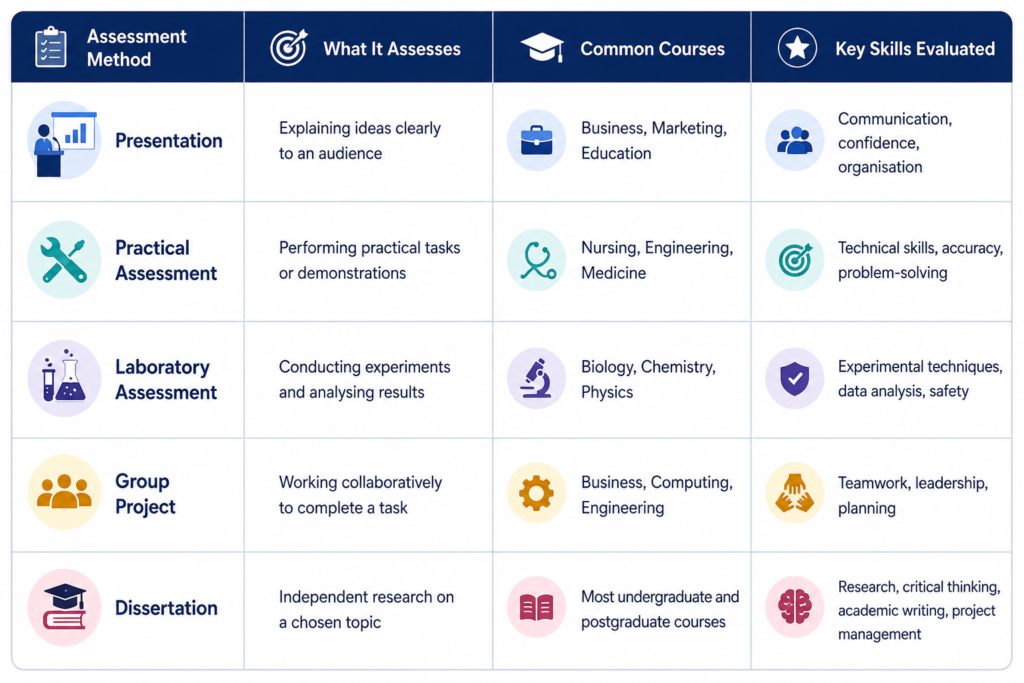
Alongside exams and coursework, many UK universities use presentations, practical assessments, group projects and dissertations to assess different academic and professional skills. University Assessment Methods
| Assessment Method | What It Assesses | Common Courses | Key Skills Evaluated |
|---|---|---|---|
| Presentation | Explaining ideas clearly to an audience | Business, Marketing, Education | Communication, confidence, organisation |
| Practical Assessment | Performing practical tasks or demonstrations | Nursing, Engineering, Medicine | Technical skills, accuracy, problem-solving |
| Laboratory Assessment | Conducting experiments and analysing results | Biology, Chemistry, Physics | Experimental techniques, data analysis, safety |
| Group Project | Working collaboratively to complete a task | Business, Computing, Engineering | Teamwork, leadership, planning |
| Dissertation | Independent research on a chosen topic | Most undergraduate and postgraduate courses | Research, critical thinking, academic writing, project management |
Comparison Table
Table 1: Assessment Method vs Purpose vs Skills Tested
| Assessment Method | Main Purpose | Skills Tested | Typical Format |
|---|---|---|---|
| Written Exam | Test subject knowledge under timed conditions | Knowledge, analysis, problem-solving | In-person or online |
| Coursework | Assess understanding over a longer period | Research, writing, critical thinking | Essays, reports, case studies |
| Presentation | Evaluate communication and subject knowledge | Speaking, confidence, organisation | Individual or group |
| Practical Assessment | Measure practical competence | Technical ability, application | Labs, demonstrations, performances |
| Group Project | Develop teamwork and collaboration | Communication, planning, leadership | Shared project |
| Dissertation | Assess independent research | Research, analysis, academic writing | Extended written project |
| Viva Voce | Test depth of understanding | Critical thinking, verbal communication | Oral examination |
How Each Assessment Is Structured
The structure of an assessment varies depending on its purpose.
- Written exams are completed within a fixed time under controlled conditions and usually test your ability to apply knowledge under pressure.
- Coursework is completed over a longer period, giving you time to research, plan, write and refine your work before submission.
- Presentations require you to explain a topic verbally, often using slides or visual aids, while demonstrating clear communication and confidence.
Knowing the assessment format in advance helps you prepare more effectively.
Skills Required for Each Assessment
Each assessment develops a different combination of academic and transferable skills.
| Assessment | Main Skills Required |
|---|---|
| Written Exams | Knowledge application, problem-solving, time management |
| Coursework | Research, academic writing, critical thinking, referencing |
| Presentations | Communication, organisation, confidence, public speaking |
| Practical Assessments | Technical skills, accuracy, decision-making |
| Group Projects | Teamwork, collaboration, planning, leadership |
Building these skills not only improves your academic performance but also prepares you for the workplace.
Advantages and Challenges
Every assessment method has its own benefits and potential difficulties.
| Assessment | Advantages | Challenges |
|---|---|---|
| Written Exams | Assess understanding efficiently | Time pressure and exam stress |
| Coursework | More time to research and improve | Requires good planning and self-discipline |
| Presentations | Improves communication and confidence | Public speaking can be challenging |
| Group Projects | Develops teamwork and collaboration | Uneven contribution from group members |
| Practical Assessments | Tests real-world application of skills | Performance under observation |
Rather than focusing on which assessment is “easier”, it’s more helpful to identify your strengths and prepare accordingly.
Which Assessment Carries the Most Weight?
There isn’t a standard weighting for every university module. University Assessment Methods: The percentage allocated to exams, coursework, and presentations varies depending on the subject and learning outcomes.
For example:
| Module | Exam | Coursework | Presentation |
|---|---|---|---|
| Mathematics | 100% | 0% | 0% |
| Marketing | 40% | 40% | 20% |
| English Literature | 30% | 70% | 0% |
| Computer Science | 50% | 50% | 0% |
| Education | 20% | 50% | 30% |
Always refer to your module handbook to understand the assessment weighting, as this will help you prioritise your time and effort throughout the semester.
Comparison Table
Table 2: Exams vs Coursework vs Presentations
| Feature | Exams | Coursework | Presentations |
|---|---|---|---|
| Time Available | Limited | Several days or weeks | Planned in advance |
| Research Allowed | Usually No | Yes | Yes |
| Feedback Before Submission | Rare | Sometimes | Often through practice |
| Measures | Knowledge under pressure | Research and analysis | Communication skills |
| Common Weighting | 40–100% | 20–80% | 10–30% |
How Assessment Weighting Affects Your Final Module Grade
A common misconception is that every assessment contributes equally to a module.
In reality, each assessment usually has its own weighting, meaning some pieces of work influence your final mark far more than others.
Understanding weighting allows you to prioritise your effort throughout the semester.
Formula Box
Final Module Mark Formula
Final Module Mark = (Assessment Mark × Weight) + (Assessment Mark × Weight) + …
Remember to convert percentage weightings into decimals when calculating manually.
What Assessment Weighting Means
Assessment weighting is the percentage contribution each assessment makes towards the overall module grade.
For example:
| Assessment | Weight |
|---|---|
| Coursework | 30% |
| Presentation | 20% |
| Final Exam | 50% |
In this example, the exam contributes half of the final mark, making it the most influential assessment.
Worked ExamplesWorked Examples
The following examples show how different assessment methods and weightings can affect your final module mark.
Example 1: Exam (70%) + Coursework (30%)
| Assessment | Mark | Weight | Contribution |
|---|---|---|---|
| Coursework | 78% | 30% | 23.4 |
| Final Exam | 64% | 70% | 44.8 |
| Final Module Mark | 68.2% |
Key takeaway: Even with a strong coursework mark, the exam has the biggest impact because it carries a higher weighting.
Example 2: Exam (40%) + Essay (40%) + Presentation (20%)
| Assessment | Mark | Weight | Contribution |
|---|---|---|---|
| Essay | 70% | 40% | 28.0 |
| Presentation | 76% | 20% | 15.2 |
| Exam | 66% | 40% | 26.4 |
| Final Module Mark | 69.6% |
Key takeaway: Consistently good performance across multiple assessments often leads to a stronger overall result than relying on one outstanding mark.
Example 3: Passing Coursework but Failing the Exam
| Assessment | Mark | Weight | Contribution |
|---|---|---|---|
| Coursework | 75% | 50% | 37.5 |
| Final Exam | 35% | 50% | 17.5 |
| Overall Module Mark | 55% |
Although the overall mark is above the pass threshold, some universities require students to pass each assessment component separately.
Read more: What Is a Passing Grade at University? Example 4: Group Presentation with Individual Marks
| Student | Group Mark | Individual Mark | Final Presentation Mark |
|---|---|---|---|
| Student A | 74% | 82% | 78% |
| Student B | 74% | 76% | 75% |
| Student C | 74% | 68% | 71% |
| Student D | 74% | 60% | 67% |
Key takeaway: Some universities combine a shared group mark with individual performance to ensure each student’s contribution is assessed fairly.
Example 5: Late Coursework Penalty
| Original Mark | Late Penalty | Recorded Mark |
|---|---|---|
| 71% | −10 percentage points | 61% |
Key takeaway: Late submission penalties vary between universities. Always check your institution’s regulations to understand how missed deadlines affect your marks.
Comparison Table
Table 5: Example Assessment Weightings by Module
| Subject | Coursework | Presentation | Exam |
|---|---|---|---|
| Business | 40% | 20% | 40% |
| Law | 20% | 0% | 80% |
| Marketing | 40% | 20% | 40% |
| Computing | 50% | 0% | 50% |
| Education | 50% | 30% | 20% |
| Engineering | 30% | 10% | 60% |
Calculate Your Overall Module Grade
Instead of calculating assessment weightings manually, use our Module Grade Calculator to combine your exam, coursework and presentation marks instantly.
Read More: Module Grade CalculatorWhat Happens If You Fail an AssessWhat Happens If You Fail an Assessment?
Failing an assessment doesn’t always mean you’ve failed the entire module. University Assessment Methods Explained: The outcome depends on your university’s regulations, the assessment weighting, and your overall module performance.
Common Outcomes After Failing an Assessment
| Situation | Possible Outcome |
|---|---|
| Fail a low-weight coursework assignment | You may still pass the module if your overall mark meets the pass requirements. |
| Fail a high-weight coursework assignment | You may need to resubmit the work or complete a reassessment. |
| Fail the final exam | You may still pass the module if compensation applies, or you may be required to take a resit. |
| Miss an assessment without approval | You could receive a zero mark or a failed attempt. |
| Miss an assessment with approved mitigating circumstances | The university may offer a deferred first attempt or an alternative assessment. |
Example: Failing an Exam but Passing the Module
| Assessment | Weight | Mark | Contribution |
|---|---|---|---|
| Coursework | 60% | 72% | 43.2 |
| Final Exam | 40% | 38% | 15.2 |
| Final Module Mark | 58.4% |
Key takeaway: Depending on your university’s regulations, a failed exam does not always mean you’ve failed the entire module. University Assessment Methods Explained
Resits and Reassessments
If a reassessment is offered, it may involve:
- Resitting an examination
- Resubmitting coursework
- Completing an alternative assessment
Many universities cap reassessment marks at the pass mark.
| Original Mark | Resit Score | Recorded Mark |
|---|---|---|
| 34% | 71% | 40% (Capped) |
Some universities remove the cap if the original assessment was missed because of approved mitigating circumstances.
Read More: University Resit Exams ExplainedHow Failed Assessments Affect Your Degree
The long-term impact depends on:
- Your stage of study
- Module credits
- University regulations
- Degree classification rules
A failed assessment in your first year may have little influence on your final degree classification if Year 1 does not contribute to the final award. University Assessment Methods Explained
By contrast, poor performance in final-year modules can have a much greater effect because those marks often carry the highest weighting. University Assessment Methods Explained
If you’re unsure how one assessment affects your degree, calculate your overall position rather than focusing on a single result.
Read More: How to Calculate Your Final Degree Classification in the UK (Complete 2026 GuideHere’s a shorter, cleaner version with unnecessary details removed while keeping the important information.
Common Assessment Rules at UK Universities
Although each UK university has its own regulations, most follow similar assessment rules. Understanding them can help you avoid penalties and know what to do if unexpected circumstances affect your studies.
Always check your module handbook and university regulations for course-specific policies.
Submission Deadlines
Meeting deadlines is essential. Missing one may result in a deduction of marks or a failed submission.
To avoid problems:
- Record assessment deadlines.
- Start assignments early.
- Allow time to upload your work.
- Check you’ve submitted the correct file.
- Save your submission confirmation.
Extensions and Mitigating Circumstances
If unexpected circumstances prevent you from completing an assessment, you may be able to apply for an extension or deferred assessment.
Common reasons include:
- Serious illness
- Bereavement
- Family emergencies
- Hospitalisation
- Other exceptional circumstances
Most universities require supporting evidence for these requests. So it’s important to apply as soon as possible rather than waiting until results are released.
Late Submission Penalties
Late submission policies differ between universities, but penalties generally increase the longer an assessment is overdue.
| Submission Time | Possible Outcome |
|---|---|
| Before the deadline | Full marks available |
| Up to 24 hours late | Mark deduction |
| Several days late | Larger deduction |
| After the permitted period | Zero mark or non-submission |
Academic Integrity and Plagiarism
Universities expect all assessed work to be your own. Academic misconduct can lead to reduced marks or disciplinary action.
Common examples include:
- Plagiarism
- Collusion
- Contract cheating
- Fabricating data
To avoid problems:
- Reference sources correctly.
- Write in your own words.
- Proofread before submitting.
Many universities use plagiarism detection software such as Turnitin.
Using AI Tools Responsibly
AI can support your studies, but you must follow your university’s rules.
It can help with:
- Brainstorming ideas
- Improving grammar
- Organising notes
Submitting AI-generated work as your own may be treated as academic misconduct. Always check your university’s AI policy.
Appeals and Remark Requests
If you believe an assessment was affected by an administrative or procedural error, you may be able to request a review or appeal.
Common grounds include:
- Administrative errors
- Procedural mistakes
- Approved mitigating circumstances
Read your feedback carefully and follow your university’s appeals process within the required deadline. Respond appropriately if you ever need to challenge an assessment outcome.
Practical Scenarios
The following real-life examples show how different university assessment methods and regulations can affect your academic progress. University Assessment Methods Explained
| Scenario | Situation | Outcome | Key Lesson |
|---|---|---|---|
| Pass Coursework, Fail Exam | Emma scores 74% in coursework (60%) and 37% in the final exam (40%). | Although her overall average is above the pass mark, she must resit the exam because her university requires students to pass the exam separately. | Always check whether individual assessment components have minimum pass requirements. |
| Missing an Exam Due to Illness | Ali becomes seriously ill on the day of his exam and submits medical evidence through the mitigating circumstances process. | The university approves a deferred first attempt instead of recording a failed assessment. | Notify your university immediately if unexpected circumstances prevent you from completing an assessment. |
| Unequal Contribution in Group Work | One student contributes very little to a group presentation while the other members complete most of the work. | Individual presentation marks and peer assessment ensure only the underperforming student’s grade is affected. | Understand how group and individual marks are awarded before starting a group project. |
| Late Coursework Submission | Sophie uploads her coursework after the submission deadline. | A late submission penalty reduces her final mark and overall module average. | Submit assignments early to avoid penalties caused by technical issues or last-minute problems. |
| Preparing for an Open-Book Exam | Daniel organises his notes and practises applying concepts before an online open-book exam. | He spends more time answering questions and less time searching for information, leading to a stronger performance. | Open-book exams reward preparation and understanding, not simply access to notes. |
Common Mistakes Students Make
Many students lose marks because of avoidable mistakes rather than a lack of knowledge.
Common mistakes include:
- Ignoring assessment weightings.
- Leaving coursework until the last minute.
- Not reading the marking criteria.
- Missing submission deadlines.
- Incorrect referencing.
- Ignoring feedback.
- Assuming every module is assessed the same way.
Expert Tips for Assessment Success
Plan Ahead
Keep track of deadlines and break large assignments into smaller tasks.
Focus on High-Weight Assessments
Spend more time on assessments that contribute the most to your final mark.
Use Feedback
Apply feedback from previous assignments to improve future work.
Prepare for Each Assessment
- Exams: Practise past papers.
- Coursework: Leave time for research and proofreading.
- Presentations: Rehearse and prepare for questions.
Stay Organised
Keep copies of your assignments, submission receipts, and feedback, and familiarize yourself with your university’s assessment policies.
Frequently Asked Questions
What are university assessment methods?
University assessment methods are the different ways universities evaluate a student’s knowledge, skills and academic progress. Common methods include written exams, coursework, presentations, practical assessments, dissertations and group projects. Each assessment measures different learning outcomes and usually contributes a percentage towards the final module mark.
What is the difference between coursework and exams?
Coursework is completed over a longer period, allowing students to research, draft and revise before submission. Exams are usually completed under timed conditions and assess how well students can apply their knowledge without extended preparation during the assessment.
How are presentations marked at university?
Presentations are typically assessed using a marking rubric that considers subject knowledge, organisation, communication skills, confidence, visual aids, audience engagement and the ability to answer questions. Some group presentations also include individual marks or peer assessment.
What is formative assessment?
Formative assessment is designed to support learning by providing feedback before final grading. Examples include practice essays, mock presentations and classroom quizzes. These assessments usually have little or no impact on the final module mark.
What is summative assessment?
Summative assessment contributes directly to your final grade. Examples include final examinations, graded coursework, dissertations, presentations and practical assessments. Universities use summative assessments to determine whether students have achieved the module’s learning outcomes.
How much does coursework count towards my final grade?
There is no single answer because every module has its own assessment structure. Coursework may count for as little as 20% or as much as 100% of the final module mark. Always check your module handbook for the exact weighting.
What happens if I fail one assessment?
Failing one assessment does not necessarily mean failing the entire module. The outcome depends on the assessment weighting, your overall module mark and your university’s regulations. Some institutions allow compensation or offer resits and reassessments.
Can I resit a failed assessment?
Yes. Most UK universities provide an opportunity to resit failed exams or resubmit failed coursework. However, many institutions cap the recorded resit mark at the pass mark unless approved mitigating circumstances apply.
Are online assessments different from traditional exams?
The main difference is the delivery method. Online assessments are completed through digital platforms and may include quizzes, essays or case studies. Although students may sometimes have access to notes during open-book assessments, they are still expected to demonstrate independent understanding and follow academic integrity rules.
Do assessment methods affect my final degree classification?
Yes. Every assessment contributes towards module marks, which then contribute to yearly averages. Depending on your university’s regulations and the weighting of each year of study, these marks ultimately influence your final degree classification.
Conclusion
UK universities use a variety of assessment methods to measure your knowledge, practical skills, and academic progress. From exams and coursework to presentations and dissertations, each assessment contributes to your overall performance.
Understanding how assessments are marked and weighted helps you manage your time, focus on high-value tasks, and avoid common mistakes like missing deadlines or ignoring marking criteria.
As assessment rules vary between universities, always check your module handbook and university regulations for guidance on pass marks, resits, appeals, and assessment policies.
By understanding how UK university assessment methods work, you can approach your studies with confidence and improve your chances of achieving your target degree classification.