
![You are currently viewing Easiest UK Universities to Get Into: Lowest Entry Requirements [2026]](https://gradeforuni.com/wp-content/uploads/2026/10/featured-easiest-universities-to-get-into.png)
Easiest UK Universities to Get Into: Lowest Entry Requirements [2026]
If your predicted grades are CCD and your firm choice wants BBB, you already know the sinking feeling that comes with every “typical offer” you read. University websites advertise their headline entry requirements, but those numbers describe the offer — not the students who actually enrolled. Now there is a rarer and more honest figure: the average UCAS tariff of the students who walked through the door. So which are the easiest universities to get into, and how should you use that data for your own application?
The Times and The Sunday Times Good University Guide 2027 published entry-standards data for every UK university, and the ranking it produced is startling. At four universities, the average fresher arrived with fewer than 96 UCAS points — the tariff value of three C grades. At the very easiest university in the country to get into, the average student managed just 87 points: roughly a D and two Cs.
This guide ranks the 21 easiest UK universities to get into on that data, translates UCAS points back into the A-level grades you actually understand, explains why averages sit below advertised offers, and shows you how to use the table strategically — for insurance choices, contextual offers and a Clearing-day shortlist. Every number below is re-verified against the source data at the time of writing, and this article covers the 2024/25 entrant figures, not 2026-entry requirements.
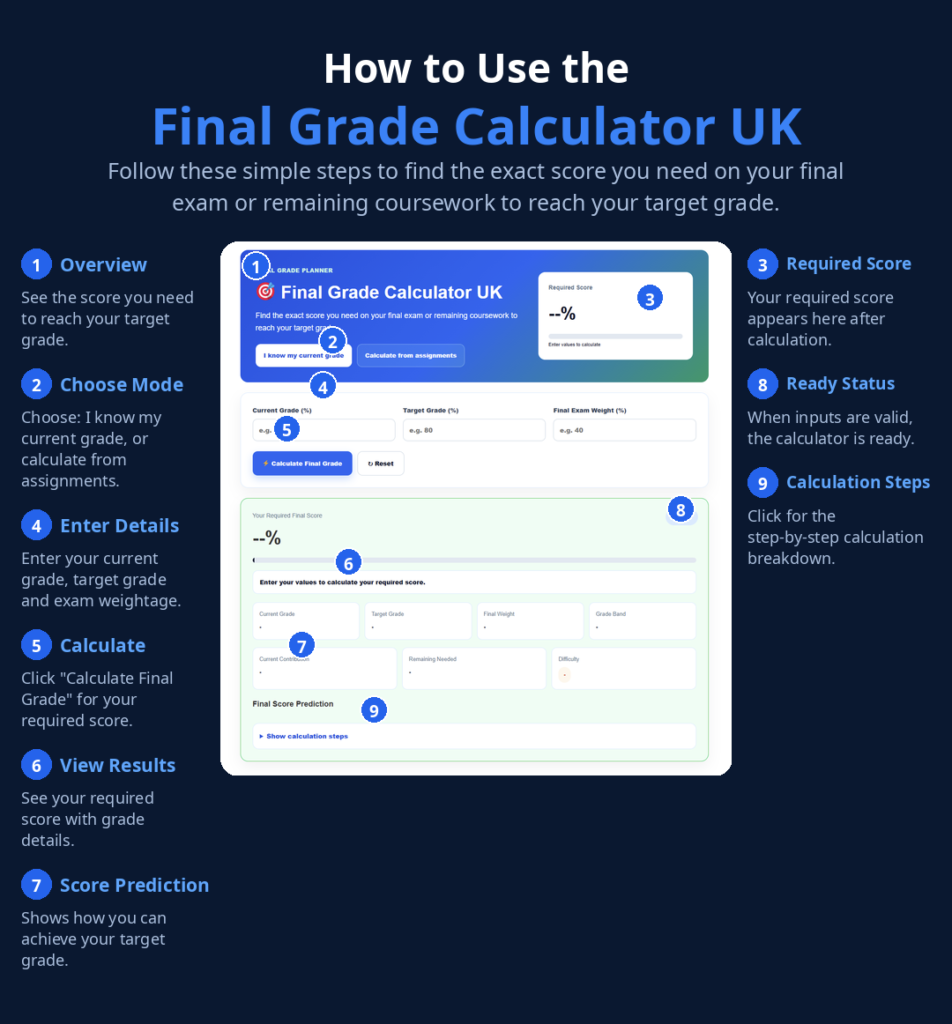
Click Here: Final Grade Calculator UK
What these numbers actually measure
Before the table, one critical piece of context. The Times calculated the mean UCAS points achieved by incoming undergraduates in the 2024/25 academic year, adjusted to reflect the mix of subjects each university offers. This is not a minimum. It is not an offer rate. It is the average tariff of the students who actually started — which means roughly half of each university’s intake arrived with fewer points than the figure shown.
Three caveats keep this data honest. First, it describes 2024/25 entrants, so it reflects results cycles from the last couple of years, not a guarantee about 2026 or 2027 entry. Second, it is an institution-level average: the same university can run a nursing course asking for BBB and a foundation pathway admitting at CDD, and both feed one number. Third, course-level requirements vary enormously, so treat every figure here as “average accepted grades” — never as “you will get in with these grades.”
With that understood, the table below is the most practical admissions data published this year, because it answers the question students actually ask: where do people with grades like mine end up?
The 21 easiest UK universities to get into, ranked
The ranking below counts 21 institutions (the source lists 20 places with ties at 16th and 18th). Points are the mean UCAS tariff of 2024/25 entrants; the “rough A-level shorthand” translates that into the three-A-level profile the points most closely resemble — but remember UCAS points can come from BTECs, T-levels, Scottish Highers and other qualifications too.
| Rank | University | Mean UCAS points | Rough A-level shorthand |
|---|---|---|---|
| 1 | University of Roehampton | 87 | DCC (88) |
| 2 | Plymouth Marjon University | 93 | CCD–CCC |
| 3 | University of Northampton | 94 | CCD–CCC |
| 4 | London Metropolitan University | 96 | CCC (96) |
| =5 | Middlesex University | 100 | CCC–BCC |
| =5 | De Montfort University | 100 | CCC–BCC |
| =7 | Buckinghamshire New University | 101 | CCC–BCC |
| =7 | University of Bedfordshire | 101 | CCC–BCC |
| =9 | University of Portsmouth | 103 | ≈ BCC (104) |
| =9 | Lincoln Bishop University | 103 | ≈ BCC (104) |
| 11 | London South Bank University | 104 | BCC (104) |
| =12 | Anglia Ruskin University | 105 | BCC+ |
| =12 | Birmingham Newman University | 105 | BCC+ |
| =12 | University of Greenwich | 105 | BCC+ |
| =12 | Leeds Trinity University | 105 | BCC+ |
| =16 | Leeds Beckett University | 106 | BCC+ |
| =16 | University of Westminster | 106 | BCC+ |
| =18 | Bournemouth University | 107 | BBC− (112) |
| =18 | Southampton Solent University | 107 | BBC− (112) |
| =18 | University of Wolverhampton | 107 | BBC− (112) |
| =18 | Wrexham University | 107 | BBC− (112) |
A few landmarks in the data. The University of Roehampton is the easiest university in the UK to get into on this measure: freshers averaged 87 points, roughly a D and two Cs at A-level, or four Cs in Scottish Highers. Tellingly, Roehampton’s own published general entry requirement is simply passes in two distinct subjects at GCE Advanced Level — the formal bar is far lower than the averages at most universities, and the achieved average still sits at DCC.
Four universities sit below the 96-point line (three Cs): Roehampton (87), Plymouth Marjon (93), Northampton (94) and London Metropolitan (96). Everyone from Middlesex and De Montfort at 100 up to Wrexham at 107 sits in the BCC-to-BBC band — which, as we will see, is exactly where the tariff maths puts the bulk of English A-level takers. For context, in summer 2026, 78.1 per cent of A-levels taken in England were graded C or higher.
The UCAS tariff decoder: turn your grades into points
Rankings like the one above are useless until you can convert your own grades into the same currency. The UCAS tariff assigns every qualification a points value. For A-levels, the core scale has not changed in years:
| A-level grade | UCAS tariff points |
|---|---|
| A* | 56 |
| A | 48 |
| B | 40 |
| C | 32 |
| D | 24 |
| E | 16 |
Add your three best A-levels together. The combinations that matter most for reading the table above:
| Grades | Points calculation | Total |
|---|---|---|
| AAA | 48 + 48 + 48 | 144 |
| AAB | 48 + 48 + 40 | 136 |
| ABB | 48 + 40 + 40 | 128 |
| BBB | 40 + 40 + 40 | 120 |
| BBC | 40 + 40 + 32 | 112 |
| BCC | 40 + 32 + 32 | 104 |
| CCC | 32 + 32 + 32 | 96 |
| CCD | 32 + 32 + 24 | 88 |
| CDD | 32 + 24 + 24 | 80 |
| DDD | 24 + 24 + 24 | 72 |
Notice how each grade step is worth 8 points. Dropping one grade in one subject — B to C, say — costs you exactly 8 points, so the gap between a BBB offer (120) and what you get with BBC (112) is a single grade in a single subject. That 8-point granularity is what makes the ranking table above so readable: Roehampton’s 87 is one grade-step below CCC’s 96, and the whole 21-university spread from 87 to 107 is just two and a half grade-steps wide.
If you take BTECs, the tariff works the same way — a Distinction* is worth 56 points, a Distinction 48, a Merit 32 — and UCAS publishes the full tariff calculator for every qualification type. Scottish Highers carry their own tariff (an A at Higher is 33 points), which is why the source data can describe Roehampton’s 87 as “four Cs in Scottish Highers” as well as “a D and two Cs.”
Why the average sits below the advertised offer
Here is the part that changes how you read every university prospectus. The “typical offer” on a course page is the asking price; the table above is closer to the sale price. Four mechanisms drag the achieved average below the advertised bar.
1. Contextual offers. Most UK universities now make reduced offers — often one or two grades below the standard — to applicants from under-represented backgrounds, low-participation postcodes or care-experienced routes. A course advertising BBB routinely admits contextual applicants at BBC or BCC, and those lower tariffs pull the institutional average down.
2. Near-miss confirmation on results day. When results land in August, admissions teams routinely confirm applicants who missed their offer by a grade — especially if the course still has places. A near-miss ABB applicant confirmed onto an AAB course contributes 128 points, not 136, to next year’s average.
3. Clearing. Courses that still have places after results day drop their requirements to fill them — sometimes substantially. Clearing is not a footnote in this data; for some universities it is a meaningful share of the intake, and every Clearing entrant admitted below the standard offer drags the mean down. Our guide to what still works after the UCAS deadline covers the late-application routes in detail.
4. Course mix. The institutional average blends everything a university teaches. A university running nursing, teaching and foundation-year courses alongside its mainstream degrees will show a lower average than one that only teaches high-tariff subjects — which is one reason the source data is adjusted for subject mix, and one reason you must always check the requirement for your course, not the university’s average.
How to actually use this table: a strategy, not a daydream
This data is most useful as a planning tool for your five UCAS choices. The classic advice still holds — one aspirational choice, two or three realistic ones, one insurance you would genuinely be happy to attend — but the table lets you sanity-check the bottom of that ladder against reality instead of prospectus optimism.
Worked example. Take Amara, predicted BCC. Her tariff: 40 + 32 + 32 = 104 points. She applies with a firm choice asking for BBB (120), an insurance choice asking for CCC (96), and keeps three universities from the table above on a Clearing shortlist. On results day she achieves CCD: 32 + 32 + 24 = 88 points — 16 points, or two grade-steps, below her prediction, and below both her firm and her insurance.
Is all lost? Her 88 sits almost exactly on Roehampton’s 87 average, and just below Plymouth Marjon’s 93 and Northampton’s 94. Because the figures are averages, a meaningful share of those universities’ freshers arrived with fewer points than the headline number — students in the 70s and low 80s are in the mix. A Clearing phone call to a course at one of those universities is a live option grounded in real admissions data, not wishful thinking. That is the correct way to read this table: not as a guarantee, but as evidence that your grades have a realistic landing zone.
Three practical moves follow from the data. First, build your insurance choice around courses whose typical offers sit at or below your realistic tariff, not your predicted one — check where applicants with your grades actually enrolled using the table. Second, keep a Clearing shortlist of three or four courses from universities in your tariff band before results day, with phone numbers saved; Clearing moves in hours, not days. Third, check contextual-offer eligibility at every university on your list — a two-grade reduction can move a university from “out of reach” into your realistic band, and our predicted grades guide explains how those reduced offers interact with your school’s predictions.
One warning: do not pick an insurance choice you would hate attending just because the tariff fits. The data tells you where your grades can take you; only you know where you want to go. And if you are applying for 2027 entry, the January equal-consideration deadline gives you months to research properly — use them.
What low entry requirements do not mean
It is tempting to read this ranking as a league table of quality. It is not. Entry standards measure the average grades of the students a university admits — nothing about teaching quality, graduate outcomes, student satisfaction or research. Universities with lower entry standards often actively recruit students from disadvantaged backgrounds or areas with low higher-education participation; that is a mission choice, not a failure.
Subject mix matters too. Universities with large nursing, allied-health, teaching or creative-arts portfolios will show lower averages partly because of the tariff profile of those subjects’ applicants — and some of those courses lead to outstanding employment outcomes. Judge a university on what happens to its graduates and whether the course fits you, not on the tariff of its freshers.
The other end of the market is softer than you think
Here is the counterpoint that makes this data genuinely encouraging. While the table above covers the accessible end of the sector, the top end has been quietly moving toward applicants too: average accepted grades have declined at 22 of 24 Russell Group universities since 2018-19, roughly from A*AA down to just over AAA, as institutions compete to fill places. Our Russell Group entry-grades guide breaks down that shift university by university.
The two stories together describe a buyer’s market. At the top, elite universities are accepting lower grades than they did five years ago. At the accessible end, the data above shows exactly where applicants with CCD–BCC profiles actually enrol. Whatever your tariff, there is a documented landing zone — the trick is aiming deliberately instead of guessing.

Which UK university is the easiest to get into?
On the latest entry-standards data (The Times and The Sunday Times Good University Guide 2027), the University of Roehampton is the easiest UK university to get into: its 2024/25 freshers averaged just 87 UCAS points, roughly a D and two Cs at A-level.
What UCAS points do I need for London Metropolitan or Northampton?
These are averages of students who actually enrolled, not entry requirements. London Metropolitan’s 2024/25 freshers averaged 96 UCAS points (three Cs) and Northampton’s averaged 94 — but course-level requirements vary, so always check the specific course page.
Are these figures the universities’ entry requirements?
No. They are the mean UCAS tariff achieved by incoming undergraduates in 2024/25, adjusted for subject mix. Advertised entry requirements are usually higher; contextual offers, near-miss confirmations and Clearing bring the achieved average down.
How many UCAS points is CCC at A-level?
96 points: 32 + 32 + 32. Each A-level grade step is worth 8 points, so CCD is 88, BCC is 104, BBC is 112, BBB is 120 and AAA is 144.
Can I get into university with CCD?
CCD is worth 88 UCAS points, which sits almost exactly on the University of Roehampton’s 87-point average and just below Plymouth Marjon (93) and Northampton (94). Because these are averages, a share of each intake arrived with fewer points — so yes, CCD is a realistic tariff for several universities, particularly through Clearing.
Does low entry requirements mean a bad university?
No. Entry standards measure the average grades of admitted students, not teaching quality, graduate outcomes or student satisfaction. Universities with lower entry standards often deliberately recruit from disadvantaged backgrounds and low-participation areas as part of their mission.
How should I use this data for my insurance choice?
Use it as a reality check on the bottom of your UCAS ladder: pick an insurance choice whose typical offers sit at or below your realistic tariff, and keep a Clearing shortlist of three or four courses from universities in your tariff band with phone numbers saved before results day.
Do Scottish Highers count in the UCAS tariff?
Yes. Scottish Highers carry their own tariff values — an A at Higher is worth 33 points — and the source data describes Roehampton’s 87-point average as roughly four Cs in Scottish Highers as well as a D and two Cs at A-level.
Conclusion
The headline figure is worth repeating: the easiest university in the UK to get into admitted freshers averaging 87 UCAS points — a D and two Cs — and twenty other universities sit within two and a half grade-steps of that. These are not rumours or forum guesses; they are the mean tariffs of the students who actually enrolled in 2024/25, published in The Times and The Sunday Times Good University Guide 2027. Whatever your predicted grades look like right now, there is a documented landing zone for them.
Use the data the way it is meant to be used. Convert your grades into tariff points, check where applicants with your tariff actually enrolled, build an insurance choice you would genuinely attend, and keep a Clearing shortlist ready before results day. And remember the wider picture: with average accepted grades falling at 22 of 24 Russell Group universities too, the whole sector is more accessible than the prospectus headlines suggest. Aim deliberately — the numbers are on your side. If you want to model what this year’s grades need to look like to hit your target tariff, run them through the Final Grade Calculator first.