UCAS Personal Statement 2026/27: The 3 New Questions & What Grades to Mention
If you are applying to Oxford, Cambridge, or any medicine, dentistry or veterinary course for 2027 entry, your UCAS personal statement locks at 18:00 UK time on Thursday 15 October — and if you are applying at all in this cycle, the document you are writing is nothing like the one your older sibling wrote. Since the 2026 entry cycle, UCAS has scrapped the single free-text essay and replaced it with three structured questions. 2027-entry applicants are only the second cohort ever to use the new format, which means most of the advice floating around online — the old 47-line essays, the “From a young age I have been fascinated by…” openers — is written for a format that no longer exists.
The headline numbers are simple, and you should memorise them before you write a word: 4,000 characters total across all three answers, a minimum of 350 characters per answer, and no per-question maximum. The questions themselves do not count toward the limit, and the old 47-line ceiling is gone entirely. Everything else — what tutors actually score in each box, how to split the 4,000 characters, and which grades to mention — is where offers are won and lost.
This guide decodes the three questions one by one, works through the character-budget arithmetic with real numbers, and ties the statement directly to the grades you will be predicted and the deadlines sitting in front of you. Your statement is the last fully editable part of a UCAS application — predicted grades are fixed by your school, admissions tests are already sat — so in the final hours before a deadline, this is the only section you can still improve.
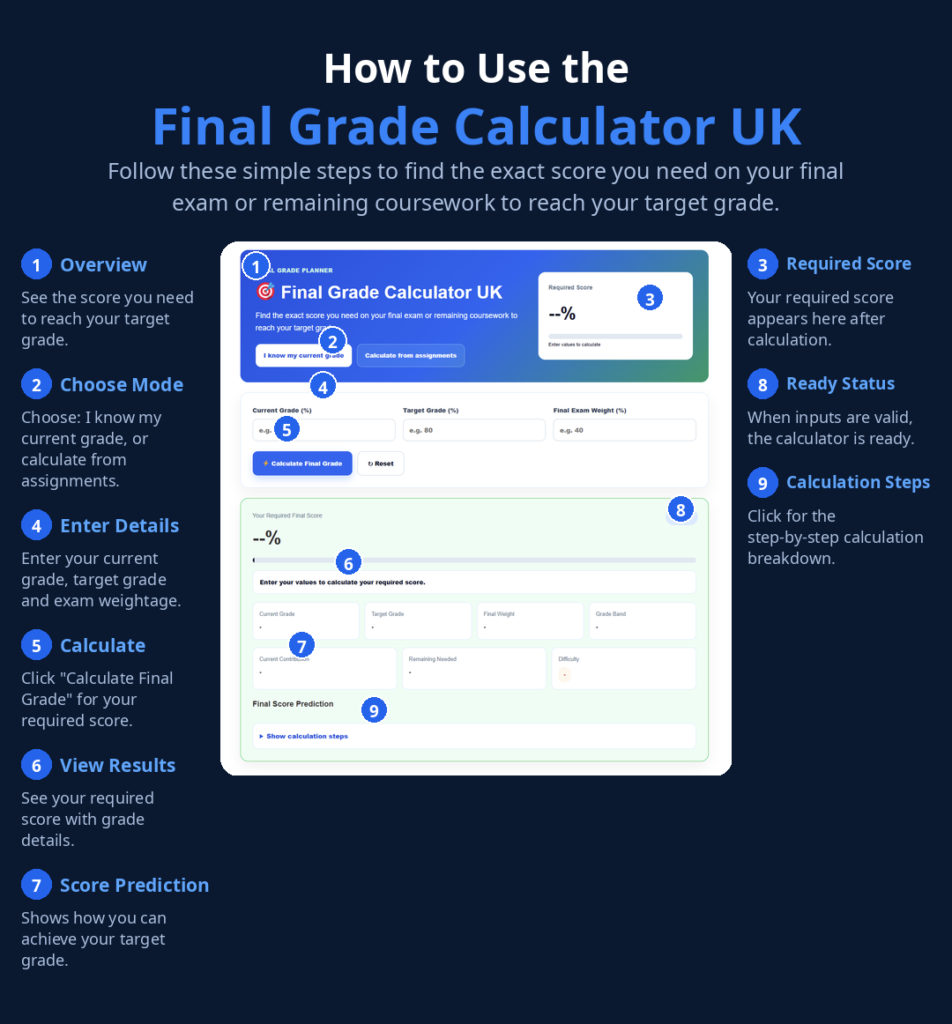
Click Here: Final Grade Calculator UK
What Actually Changed (and What Did Not)
For decades, the UCAS personal statement was one blank box: up to 4,000 characters or 47 lines of whatever you wanted to write. From September 2025, for everyone applying for 2026 entry onwards, UCAS replaced that essay with three “scaffolding questions” — UCAS’s own term for prompts designed to act as a roadmap, breaking the statement into manageable parts. The change applies to every undergraduate UCAS application; no university can opt out of the format.
The official wordings, confirmed by UCAS and every university guidance page since, are exactly:
- “Why do you want to study this course or subject?”
- “How have your qualifications and studies helped you to prepare for this course or subject?”
- “What else have you done to prepare outside of education, and why are these experiences useful?”
What did not change is what universities expect to see inside those boxes. UCAS’s own guidance, echoed by universities from Cumbria to Nottingham, stresses that the content requirements are the same — motivation, academic preparation, wider suitability. Only the scaffolding is new. That matters because it means the strongest source of advice for the new format is the universities themselves: several now publish question-by-question guides for their own applicants, and they all converge on the same reading of the three boxes.
Why did UCAS change it at all? The stated reason is fairness and clarity. The old essay rewarded students who had been coached on structure and punished those who had not — teachers and advisers complained for years that the blank box was the least equitable part of the application. The three questions tell every applicant, regardless of school, exactly what admissions teams want to know. For students from schools with limited UCAS support, that is a genuine advantage — provided you answer what each question is actually asking, not what the old essay used to ask.
The Three Questions, Decoded
The single most common error applicants make with the new format is treating it as three mini-essays with three introductions and three conclusions. Admissions teams read the three answers together as one statement — so write them as one continuous argument across three rooms, not three separate speeches. Here is what tutors are actually scoring in each box.
| Question | What tutors score | What wastes characters |
|---|---|---|
| Q1 — Why this course or subject? | Evidence you understand what the course actually involves, plus one genuine intellectual trigger: a book, a project, a lecture, a problem you could not stop thinking about. Course-specific knowledge, not childhood stories. | “From a young age I have been fascinated by…” — UCAS data shows this opener alone was used 1,779 times in a single cycle. Grand claims about saving the world. |
| Q2 — How have your qualifications and studies prepared you? | The transferable skills behind your grades: what specific modules, projects or assessments taught you analytical thinking, research discipline, or collaboration — and why those skills fit this degree. Predicted grades live here. | A bare list of GCSEs or A-level subjects with no reflection. Quoting every grade without explaining what the studying taught you. |
| Q3 — What else have you done outside education? | Reflection, not inventory. One work-experience insight beats five unexplored activities. Tutors want what you learned — communication, initiative, resilience — and why it is useful for this course. | Lists of hobbies with no link to the course. Part-time jobs described only as duties, never as learning. |
Q1 is about fit, not biography
Question 1 asks why you want to study the course — and the trap is answering it as an autobiography. Tutors cannot score “I have always loved chemistry” because it contains no evidence. They can score a paragraph that names a specific area of the course, shows you have looked at how the university teaches it, and connects it to something you have actually done: a book that changed how you think about the subject, a project that raised a question the degree would answer. Nottingham’s admissions guidance puts it bluntly: be genuine about your interest and link it to topics you have studied or wider reading that sparked it. If you cannot name something specific that pulled you toward the subject, the paragraph is padding — rewrite it.
Q2 is where your grades earn their keep
Question 2 is the grades box — but tutors are not asking for a transcript. Your qualifications are already on the form; this box is where you turn them into an argument. The winning move is to pick the two or three subjects or assessments most relevant to your degree and explain what they taught you: the extended essay that taught you to handle contradictory sources, the statistics module that taught you to distrust a pretty graph, the lab project where your first method failed and the second worked. If you have an EPQ or equivalent, it belongs here, framed as evidence of independent research capacity — the single most useful predictor of degree success that a personal statement can show.
Q3 rewards reflection over listing
Question 3 is the only place work experience, volunteering, part-time jobs, caring responsibilities and competitions appear — and it is the box where most applicants write a list. Tutors score the opposite: pick fewer experiences and go deeper. A Saturday job that taught you to explain technical problems to non-technical customers is worth more than five clubs you “attended”. Admissions guides converge on one rule: for every activity, finish the thought with what you learned and why it matters for the course. An unexplored activity is just a line on a CV; a reflected one is evidence of suitability.
Your 4,000-Character Budget: The Arithmetic
This is the part most applicants never calculate — and it is where the new format quietly punishes the careless. You have 4,000 characters total, including spaces and punctuation. Each answer must clear 350 characters. There is no per-question maximum. Here is what those numbers actually mean.
| Budget line | Characters | Share of 4,000 |
|---|---|---|
| Three 350-char minimums (non-negotiable) | 1,050 | 26% |
| Discretionary characters you can allocate freely | 2,950 | 74% |
| Even split per question (1,333 each) | 4,000 | 100% |
| Wasted: 120-char intro + 120-char conclusion per box | 720 | 18% |
Work it through with a concrete plan. Start from the minimums: 3 × 350 = 1,050 characters are locked in, leaving you 2,950 characters of discretionary budget. An even three-way split — roughly 1,330 characters per question, or about 200–220 words — clears every minimum comfortably and is the default split most guides recommend. If one of your answers is genuinely your strongest material, shift 100–200 characters toward it; the format explicitly allows uneven splits. But there is one hard constraint to respect: because tutors read the three answers as a single statement, a self-contained introduction and conclusion in each box is pure waste.
Do the waste arithmetic honestly. A modest 120-character opener and 120-character closer in each of the three boxes costs 720 characters — 18% of your entire budget — spent saying “in conclusion” three times. One conclusion, at the end of Q3, is all the format needs. That single discipline hands you back nearly a fifth of your budget for actual content, which is more characters than the entire discretionary difference between a mediocre Q1 and a strong one.
Two more budget facts applicants keep getting wrong. First, the questions themselves do not count toward the 4,000 — only your answers do. Second, the old 47-line limit is gone, so you no longer need to compress for line count; characters are the only currency. Draft in a separate document, check the character count with spaces included, and do not paste into the UCAS form until all three answers are final — the form’s own counter is unforgiving at the boundary.
What Grades to Mention (and What to Leave Out)
For a grades website this is the obvious question, and the answer is more disciplined than most applicants expect. Your predicted grades already appear elsewhere in the application — the statement’s job is to give them meaning, not to repeat them. Mention a grade when it carries a story; leave it out when it is just a number.
Mention: predicted grades that explain your trajectory
Question 2 is the natural home for one well-placed predicted-grade reference. Not “I am predicted AAA” — the form already says that — but the story behind the trajectory: the subject where you moved from a C at AS to a predicted A because you rebuilt your exam technique, or the module where a resit taught you something your first attempt did not. Tutors read predicted grades as a promise; your statement supplies the evidence the promise is credible. If you are applying with achieved grades — a gap-year applicant, or an Access student — the same box is where you explain what a year of work or a distinction-level diploma taught you about studying at degree level.
Two things pair naturally with grades in Q2. The first is the EPQ or any independent project: it is the closest school-level proxy for the self-directed work a degree demands, and it gives you concrete material — a research question, a source problem, a conclusion you had to defend. The second is any supra-curricular work: online courses, university taster lectures, subject-specific reading beyond the syllabus. These are not grades, but they function like them — evidence you can handle the academic step up.
Leave out: admissions-test scores and grade lists
Do not mention your UCAT, LNAT, TMUA or ESAT scores. Admissions teams assess those through entirely separate channels — the scores arrive at the university directly, and tutors reading your statement already have them. A sentence celebrating a strong test score wastes characters that could show motivation, and a sentence explaining a weak one reads as excuse-making. The same applies to a full GCSE list: unless one result is directly relevant to the course — a grade 9 in the subject you are applying for, say — the qualifications section of the form has it covered.
The deeper principle: every grade you mention should answer “what did this teach you?” If it does not, cut it. A statement that lists grades is a transcript with worse formatting; a statement that reflects on two or three key results is evidence of an applicant who understands their own learning — exactly the quality degree-level study rewards.
Five UCAS Personal Statement Mistakes That Cost Offers
Across university guidance pages, admissions-tutor interviews and the UCAS data on overused openers, the same five errors recur every cycle. The new format makes three of them worse, because the structured boxes punish padding more visibly than the old essay did.
| # | Mistake | Why the new format punishes it |
|---|---|---|
| 1 | The cliché opener | “From a young age I have been fascinated by…” appeared 1,779 times in one UCAS cycle. Q1 now demands specific, course-linked evidence — a generic opener signals you have none. |
| 2 | Repeating the same example across boxes | Tutors read all three answers as one statement. The work-experience anecdote in Q3 cannot be the same project you already analysed in Q2 — repetition reads as thin material, not emphasis. |
| 3 | An intro and conclusion in every box | As the arithmetic above shows, this burns up to 18% of your 4,000 characters on structural padding. One statement, one conclusion — at the end of Q3. |
| 4 | Naming one university | UCAS sends the identical three answers to all five choices. A sentence about why you want to study at one specific university wastes characters for the other four and looks careless to all of them. |
| 5 | Q3 as an unreflected list | The old essay let a list hide inside 4,000 characters. In a box of ~1,300 characters, five unexplored activities are visibly five missed chances to reflect. Fewer activities, deeper reflection. |
A sixth, quieter mistake: writing the statement in the UCAS form itself. Every university guide says the same thing — draft in a separate document, get feedback from a teacher or adviser, read it aloud for flow, and only paste it in when it is finished. The form saves as you go, but it is not a drafting tool, and a paste at 23:40 the night before a deadline is how 4,012-character statements get discovered.
Deadlines: Where This Sits in the 2027 Cycle
The statement matters most right now because it is the only part of the application you can still change. Predicted grades are set by your school, the reference is written by someone else, and admissions tests for this cycle are already sat or booked. For the early-deadline cohort, the statement is the last lever you control.
| Deadline | Who it covers | Statement status |
|---|---|---|
| 15 Oct 2026, 18:00 UK | Oxford, Cambridge, and most medicine, dentistry and veterinary courses | Locks with the application — this is the urgent cohort |
| 13 Jan 2027, 18:00 UK | Almost all other undergraduate courses (equal consideration) | Three months to refine — but school internal deadlines are usually much earlier |
Two warnings that catch applicants every year. First, your school’s internal deadline is almost always earlier than the UCAS deadline — the reference has to be attached before UCAS will send your application, and schools set their own cut-offs, often weeks ahead. Ask your tutor for the real date, not the UCAS one. Second, if you miss the 15 October deadline for a 15-October course, UCAS’s own guidance is blunt: it is unusual for those universities to consider late applications, because their courses are so competitive. The realistic routes are other courses via the January deadline or a gap-year reapplication with achieved grades.

How the Statement Feeds Interviews and Decisions
How much the statement actually matters varies by course — and honesty requires saying so. At many universities, exam grades remain the main factor in admissions decisions, and the statement is read to understand motivation and suitability rather than to rank applicants. But for competitive courses it does real work: medicine and dentistry admissions teams have rebuilt their scoring rubrics around the three new sections, which means how you split the 4,000 characters now matters as much as what you say. Several universities now score the statement more rigorously under the new structure than they did under the old essay.
The statement’s second life is the interview. At Oxford, Cambridge and for medicine, interview panels routinely use the personal statement as their starting material — the book you named, the project you described, the experience you reflected on. Every claim you make in Q1–Q3 is a potential interview question. That is a powerful reason to write only about things you can genuinely discuss in depth: an invented passion collapses in the first five minutes of an interview, while a real one gives you the easiest possible opening.
One final, non-negotiable rule: keep it original. UCAS runs every statement through plagiarism detection, and copied sentences — including from sample statements online — are flagged to universities. The new structured format makes copied material easier to spot, not harder, because the questions constrain what a natural answer looks like. Write in your own voice, simply and directly; tutors consistently say clear, honest writing beats polished-but-empty prose.
When did the UCAS personal statement change to three questions?
UCAS replaced the single free-text personal statement essay with three structured questions for applications submitted from September 2025 — the 2026 entry cycle onwards. 2027-entry applicants are the second cohort ever to use the new format, and it applies to every undergraduate UCAS application.
What are the three new UCAS personal statement questions?
The three questions are: “Why do you want to study this course or subject?”, “How have your qualifications and studies helped you to prepare for this course or subject?”, and “What else have you done to prepare outside of education, and why are these experiences useful?” UCAS calls them scaffolding questions, designed to guide applicants on what admissions teams want to know.
How many characters can I write in the new UCAS personal statement?
The total limit is 4,000 characters across all three answers, including spaces and punctuation. The question wordings themselves do not count toward the limit. There is no per-question maximum, so you can split the budget unevenly if one answer has your strongest material.
Is there a minimum length for each answer?
Yes. Each of the three answers must be at least 350 characters long. The three minimums together use 1,050 characters, leaving 2,950 characters you can allocate freely between the questions.
Did UCAS remove the 47-line limit?
Yes. The old 47-line ceiling no longer applies — characters are the only limit now. Draft in a separate document and check the character count with spaces included before pasting your answers into the UCAS form.
Should I mention my predicted grades in my personal statement?
Mention grades only when they carry a story. Your predicted grades already appear elsewhere in the application, so use question 2 to explain what your studies taught you rather than listing results. A well-placed reference — for example, how you rebuilt your exam technique to lift a prediction — gives tutors evidence your predicted grades are credible. See our guide on how predicted grades and conditional offers work.
Should I mention my UCAT, LNAT or admissions test scores?
No. Admissions teams assess UCAT, LNAT, TMUA and ESAT scores through separate channels — the scores reach the university directly. Mentioning them in your statement wastes characters on information tutors already have, and explaining a weak score reads as excuse-making. Keep the statement focused on motivation, preparation and reflection.
Does the personal statement matter if grades are the main factor?
It depends on the course. At many universities exam grades drive the decision and the statement is read for motivation and suitability. But for competitive courses — medicine, dentistry, Oxford and Cambridge — the statement is scored, sometimes against rebuilt rubrics for the new three-question format, and it routinely supplies the opening material for interviews. Write every claim as if you will be asked about it in person.
Conclusion
The new UCAS personal statement rewards the applicants who do the arithmetic and answer the questions that are actually asked. Three questions, 4,000 characters, 350 per answer: those are the rules of the game, and they are simpler than the old blank essay ever was. The applicants who lose out will be the ones recycling old-format advice — three mini-essays, per-box introductions and conclusions, a childhood anecdote where course-specific evidence should be.
If you take one discipline from this guide, make it the character budget. Budget roughly 1,300 characters per box, spend the discretionary 2,950 where your material is strongest, and refuse to burn a fifth of your allowance on repeated introductions. Put one genuine intellectual trigger in Q1, turn two or three key results into a learning story in Q2, and reflect — don’t list — in Q3. Then check your deadline: the January equal-consideration date if you have months, or your options if 15 October has passed. And before you paste anything into the form, run your predicted grades through the Final Grade Calculator — the statement can only be as convincing as the grades behind it.
![Read more about the article Can You Do a PhD with a 2:2? UK Doctorate Entry Requirements Explained [2026]](https://gradeforuni.com/wp-content/uploads/2026/10/featured-phd-with-2-2-300x192.png)