![You are currently viewing Access to HE Diploma Grading Explained: How Pass, Merit & Distinction Work [2026]](https://gradeforuni.com/wp-content/uploads/2026/10/featured-access-to-he-diploma.png)
Access to HE Diploma Grading Explained: How Pass, Merit & Distinction Work [2026]
If you left school without A-levels, the Access to HE Diploma is the most established adult route into UK universities: a one-year, full-time Level 3 qualification, regulated by the Quality Assurance Agency (QAA) and broadly equivalent to three A-levels, designed for learners aged 19 and over. Yet its grading system confuses almost everyone who meets it for the first time. There is no overall grade. Only 45 of the 60 credits are graded at all. And universities read your results in two completely different ways, depending on the course.
This guide decodes the whole system behind Access to HE diploma grading: the 60-credit anatomy, how Pass, Merit and Distinction are actually awarded, the UCAS tariff maths that turns your grade profile into points, what real university offers look like (with verified examples from nursing and midwifery), the resubmission and late-submission rules most students discover too late, and the GCSE trap that catches out even strong applicants.
Every number here is checked against current QAA documents, the UCAS tariff tables, and universities’ own published entry requirements — because when an offer says “24 credits at Distinction”, you need to know exactly what that demands of you.
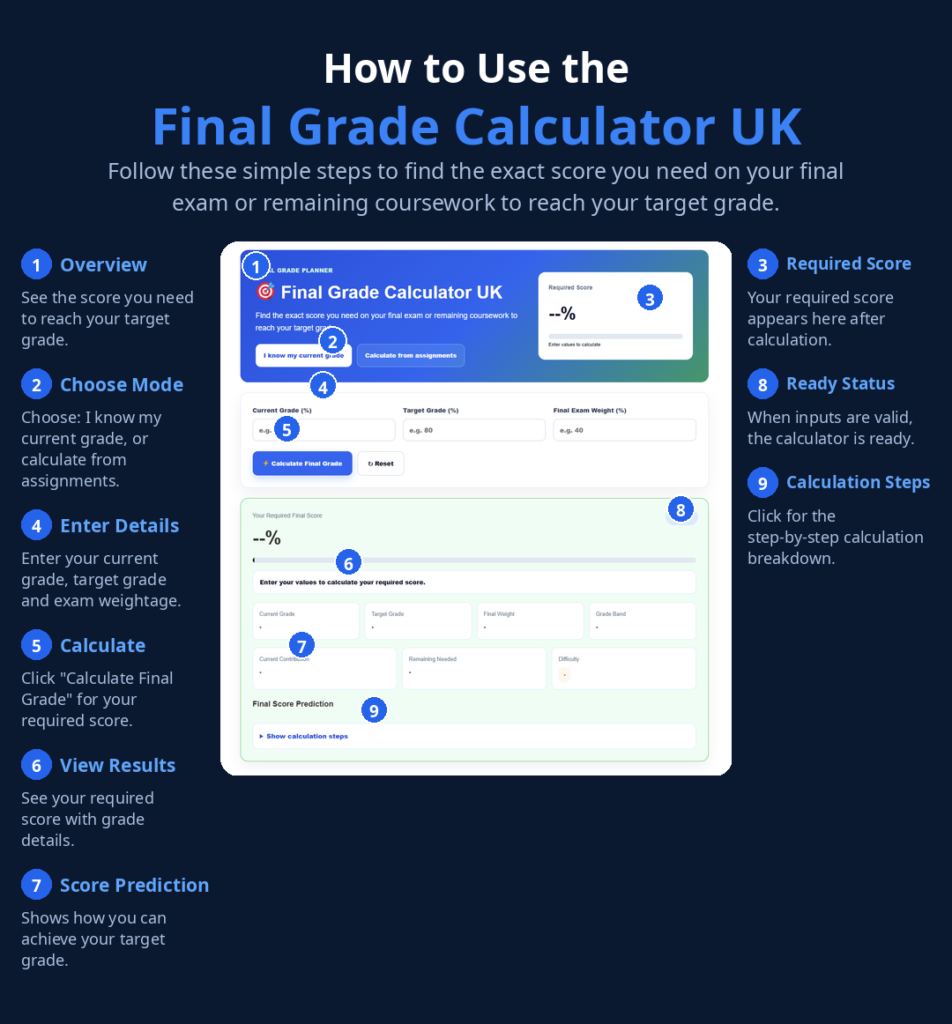
Click Here: Final Grade Calculator UK
The 60-Credit Anatomy of an Access to HE Diploma
The Access to HE Diploma is a credit-based qualification, and the credit arithmetic is the foundation everything else rests on. The QAA’s Diploma Specification sets a hard rule: every diploma requires 60 credits in total, split into two unequal piles with very different jobs.
| Credit block | Credits | Level | Graded? | What it contains |
|---|---|---|---|---|
| Academic subject content | 45 | Level 3 only | Yes — Pass, Merit or Distinction | Your pathway subjects: human biology, psychology, sociology, maths, health studies |
| Study skills / developmental | 15 | Level 2 or Level 3 | No — achieved / not achieved | Academic writing, research skills, numeracy, preparation for HE |
Three things follow from this table that surprise newcomers. First, the grades universities care about come from only three-quarters of your diploma. Second, the 15 ungraded credits still have to be passed — fail them and there is no diploma, whatever your Distinctions look like. Third, the QAA adds structural quirks: units come in 3, 6 or 9-credit sizes, every diploma must contain at least one unit bigger than 3 credits, no more than 30 credits may come from 6- or 9-credit units, and one credit represents 10 notional learning hours — so the diploma is roughly 600 hours of work. The one-year, full-time format is therefore genuinely the equivalent workload of three A-levels compressed into a single year, which is why colleges describe it as high intensity.
Diplomas are organised into pathways aimed at degree destinations. The graded units differ by pathway, and — critically — university offers often name the pathway and the subjects inside it:
| Pathway | Typical graded units | Common degree destinations |
|---|---|---|
| Nursing / Midwifery / Health Professions | Human biology, health studies, psychology, sociology, maths in a nursing context | Adult/child/mental-health nursing, midwifery, paramedic science, radiography |
| Science / Engineering | Biology, chemistry, physics, maths, practical investigations | Biomedical science, engineering, computer science |
| Humanities / Social Sciences | English literature, history, psychology, sociology, politics | Law, psychology, social work, teaching |
| Business | Business management, economics, finance, investigative project | Business management, accounting, marketing |
Choose the wrong pathway and even a Distinction-heavy profile can be rejected: as we will see, nursing offers routinely demand that your Distinctions sit in science units, not just anywhere across the 45 credits.
How Pass, Merit and Distinction Are Actually Decided
Access grading works assignment by assignment, not exam by exam. Your coursework — essays, reports, presentations, practical investigations and, on some diplomas, time-constrained assessments — is judged against published grade descriptors set out in the QAA grading scheme. Each assignment earns grade indicators against the descriptors, and the unit’s final grade comes from the median of those indicators, moderated by professional judgement. The three rungs mean roughly what they say: Pass meets the learning outcomes to the required standard, Merit shows strong achievement beyond the pass threshold, and Distinction shows excellent achievement.
Assessment is internal — your college marks the work — but grades are subject to internal moderation and external moderation by moderators appointed by your Access Validating Agency (AVA), with final grades confirmed at an awards board. In other words, a Distinction is not your tutor’s private opinion; it has survived two layers of quality control.
Two rules here catch students out. The first is the most misunderstood fact in the whole system: there is no overall grade for the diploma. The QAA specification is explicit — Pass, Merit and Distinction exist at unit level only. You cannot “get a Distinction in your Access course”; you can only hold 45 graded credits, some number of which are at Distinction. Universities know this, which is why their offers are written as credit profiles (“24 credits at Distinction”) rather than single grades.
The second is the anti-polishing rule. Once an assignment has achieved a Pass or a Merit, you cannot resubmit it to chase a higher grade. The QAA calls this “polishing the grade” and forbids it: resubmission exists so students can meet the learning outcomes they missed, not so they can upgrade marks they already banked. This makes first-attempt effort disproportionately valuable — the grade you earn on submission day is, in most cases, the grade you keep.
The UCAS Tariff Maths: What Your 45 Graded Credits Are Worth
From the 2017 admissions cycle, the Access to HE Diploma carries UCAS tariff points, and the tariff is calculated on the 45 graded credits only. The full range runs from 48 to 144 points — deliberately aligned with three A-levels. Here is the lookup table, drawn from the published UCAS tariff tables for Access to HE, with the A-level equivalents
| Grade profile (45 graded credits) | UCAS tariff points | Rough A-level equivalent |
|---|---|---|
| 45 Distinctions | 144 | AAA |
| 30 Distinctions, 15 Merits | 128 | ABB |
| 15 Distinctions, 30 Merits | 112 | BBC |
| 45 Merits | 96 | CCC |
| 15 Distinctions, 15 Merits, 15 Passes | 96 | CCC |
| 15 Merits, 30 Passes | 64 | — |
| 45 Passes | 48 | EEE |
Behind the table sits a simple per-credit arithmetic that UCAS’s own calculator applies: each Distinction credit is worth 3.2 points, each Merit credit about 2.13 points, and each Pass credit about 1.07 points (45 × 3.2 = 144; the mixed profiles follow by addition). You can verify any row yourself. Take the 30-Distinction/15-Merit profile: 30 × 3.2 = 96, plus 15 × 2.133 = 32, giving exactly 128. The 15/15/15 split: 48 + 32 + 16 = 96. The maths is consistent — UCAS’s calculator handles the rounding on odd profiles, but the pattern is exact.
Worked example — Amara’s tariff. Amara finishes her Access to HE (Nursing) with 27 credits at Distinction, 12 at Merit and 6 at Pass. Her tariff: 27 × 3.2 = 86.4, plus 12 × 2.133 = 25.6, plus 6 × 1.067 = 6.4 — a total of 118.4, which the UCAS calculator reports as roughly 118 points. That sits between the BBC anchor (112) and the ABB anchor (128): comfortably above a CCC-equivalent profile, short of ABB. Her friend on the same course with an even 15/15/15 split lands on exactly 96 points — the CCC equivalent. Two students, same diploma, same 45 graded credits, a 22-point gap driven entirely by where the Distinctions fell.
Notice what the 15 ungraded credits contribute to all of this: nothing. They are invisible to the tariff. They matter for one reason only — without them, there is no diploma.
What Universities Actually Ask For: Tariff Points vs Grade Profiles
Universities make Access offers in two different currencies, and confusing them is the single most expensive mistake applicants make. A tariff-points offer (“112 UCAS points”) is flexible: any combination of grades that reaches the total will do. A grade-profile offer (“24 credits at Distinction and 21 at Merit”) is rigid: the Distinctions must exist, and on competitive courses they must sit in specified subjects. Always read the offer literally — never silently convert a profile offer into points and assume you are safe.
Here are four real, currently published Access offers, showing how differently universities write the same qualification:
| University and course | Access offer (published) | What it means in practice |
|---|---|---|
| Southampton — Nursing (Child and Mental Health) | Pass in a science/health Access diploma, 60 credits overall, minimum 45 at Level 3, of which 24 at Distinction and 21 at Merit | A Distinction-heavy profile: 24 of your 45 graded credits must be Distinctions. Tariff ≈ 122 points. |
| Manchester — Midwifery | 39 Level 3 credits at Distinction, 6 at Merit; 30 Level 3 credits in health/science subjects including human biology | Near-maximum Distinctions (39 of 45), and they must include 30 credits of health/science with human biology. |
| Edinburgh Napier — Midwifery | Pass Access to HE Diploma in a related subject, 45 credits overall, minimum 39 at Merit and 6 at Distinction | A Merit-led offer: breadth of strong passes matters more than a Distinction count. |
| Brighton — undergraduate degrees (minimum) | Pass with 60 credits (minimum 45 at Level 3) | The floor: the diploma itself, with no grade profile. Competitive courses ask for more. |
The Manchester row deserves a second look, because it shows why the pathway matters as much as the grades. Thirty of your Distinction credits must be in health or science units including human biology. A student with 39 Distinctions concentrated in sociology and psychology units would meet the Distinction count and still miss the offer. When a university specifies subject content, your unit choices at enrolment — months before results — are already shaping your offer chances.
Worked example — Daniel’s near-miss. Daniel applies for a course asking for Southampton’s profile: 24 credits at Distinction, 21 at Merit. He achieves 21 Distinctions and 24 Merits — the same 45 graded credits, the mirror image. His tariff: 21 × 3.2 = 67.2, plus 24 × 2.133 = 51.2, totalling about 118 points — a strong score that would clear most points-based offers at 112. But a profile offer is not a points offer. He is three Distinction credits short of the 24 required, and the offer is not met. The three credits could come from a single 3-credit unit — one assignment, one grade indicator, the difference between an offer met and an offer missed. This is why experienced Access tutors tell students to count Distinction credits, not just Distinctions, from the first week of the course.
If your offer is points-based, the strategy flips: a Distinction-heavy unit and a Pass-heavy unit can balance each other, and the per-credit arithmetic above tells you exactly how many points each unit is worth to you. Work out your running total after every results day, and you will know precisely which remaining units carry your offer.
The GCSE Trap: What Access Does Not Replace
Here is the trap: the Access to HE Diploma gets you past the Level 3 entry requirement, but it does not waive the GCSE requirements that regulated professions impose. For nursing, midwifery and teaching, GCSE English and maths are effectively non-negotiable, and many universities state this explicitly alongside their Access offers.
The University of Manchester’s midwifery entry requirements list English Language, Mathematics and Science as required subjects. Some colleges will not even let you start the Access course without them — one nursing pathway requires GCSE maths and English at grade 4 as a condition of enrolment. And the University of Brighton’s access guidance notes that while some courses accept Level 2 functional skills in place of GCSEs, others require a GCSE equivalency test instead. The pattern is consistent: check the GCSE line on every course page, not just the Access line.
Practically, this means a strong Access profile with missing GCSEs is a weaker application than a modest Access profile with the GCSEs in hand. If you are starting an Access diploma this autumn and you lack English or maths at grade 4, arrange the GCSE (or an accepted equivalent) alongside the diploma — waiting until results day to discover the gap can cost you a full application cycle. Our predicted grades guide and the personal statement decoder both cover how to present a mixed-qualification application; the January UCAS deadline guide sets out the timeline you are working to.

Fail a Unit, Miss a Deadline, or Want a Better Mark: The Rules
Access courses are assessed continuously, and the QAA’s assessment regulations contain several rules that surprise students who are used to school or university conventions:
| Situation | The rule | Why it matters |
|---|---|---|
| You fail an assignment’s learning outcomes | One resubmission opportunity per assignment | You get a second chance at the unit — but only one, automatically |
| You fail the resubmission too | Second resubmission only via referral to the awards board, and referral grades are capped at Pass | A referred unit can never earn Merit or Distinction; referrals are also normally limited to 15 credits in total |
| You submit late without an agreed extension | The unit grade is capped at Pass | One missed deadline can permanently remove Distinction from a whole unit |
| You passed but want a better grade | Resubmission to “polish” a Pass or Merit is not allowed | First-attempt effort is disproportionately valuable |
| You fail after referral, or too few credits overall | No diploma awarded — but achieved credits and grades are banked | You keep what you earned; you can sometimes transfer or retake rather than starting over |
The late-submission row is the one to memorise. At university, a late essay usually costs marks per day; on Access, a single late assignment without an extension caps the entire unit at Pass. For a 9-credit unit, that is nine potential Distinction credits — a fifth of your graded total — reduced to Pass credits by one deadline. Extensions exist precisely for this reason: if you are struggling, request the extension before the deadline, because after it the cap applies automatically.
The referral system, meanwhile, is a genuine safety net with sharp edges. It lets you attempt failed work a second time, but everything about it is capped: the grade at Pass, the total referred credits normally at 15. Treat referral as emergency cover, not as a planning assumption.
Once You’re In: Your Access Grades Stop Counting
A fact worth stating plainly, because it reframes the whole year: your Access grades do not follow you into your degree classification. UK degree classifications are computed from your university marks alone — typically weighted across your second and final years. The Access diploma is an entry ticket. Once you are enrolled, everyone starts from zero, and the student who scraped in with 45 Passes is classified by exactly the same arithmetic as the student who arrived with 45 Distinctions.
This has two practical consequences. First, do not burn yourself out chasing Distinctions beyond what your offers require — the marginal Distinction that takes your tariff from 128 to 144 buys you nothing once you are at university, while the energy is better spent arriving rested. Second, start learning how degree classification actually works before you arrive: our guide to calculating your final degree classification and the 2:2 to 2:1 recovery guide show how year weightings, borderlines and resit caps will shape the next three years of your academic life.
Who It’s For, What It Costs, and How It’s Funded
The Access to HE Diploma is designed for adults — normally aged 19 or over at the start of the course — who have been out of full-time education and lack the Level 3 qualifications for their chosen degree. The standard format is one year full-time, though part-time and distance-learning versions exist (distance learners should check that their diploma is QAA-recognised and that their target universities accept it, since a small number of competitive courses prefer classroom-based Access).
Funding follows your age and history. If you are 19 to 23 and do not already hold a full Level 3 qualification, the course is typically free. If you are 24 or over, or already hold a Level 3, you can apply for an Advanced Learner Loan — course fees commonly sit around £3,000 to £3,900, and the loan is written off entirely once you complete an eligible higher education course. In effect, the diploma costs you nothing if you finish the degree it was designed to unlock — one of the most generous funding arrangements in English further education.
7 Mistakes Access Students Make About Grades
1. Chasing an “overall Distinction.” It does not exist. Universities read credit profiles, so count Distinction credits against your specific offer.
2. Ignoring the ungraded 15 credits. They earn no tariff points, but failing them means no diploma at all. Study-skills units are not optional extras.
3. Trying to “polish” passed work. Resubmitting a Pass or Merit to chase a Distinction is forbidden. Put the effort into the first attempt.
4. Converting a profile offer into points. “24 credits at Distinction” cannot be satisfied with 118 tariff points and 21 Distinctions, as Daniel’s example showed. Read the offer literally.
5. Assuming Access replaces GCSEs. For nursing, midwifery and teaching, English and maths GCSEs (or accepted equivalents) are usually still required. Sort these in parallel, not afterwards.
6. Picking the wrong pathway subjects. A Distinction in the wrong subject does not satisfy an offer demanding Distinctions in science units. Match your units to your target courses at enrolment.
7. Missing a deadline without an extension. A single late submission caps the whole unit at Pass — potentially 9 credits of lost Distinctions. Request extensions before deadlines, not after.
If you are weighing Access against other routes, our easiest universities to get into guide shows where entry requirements are lowest, and the missed-deadline guide covers what happens if your application timeline slips.
Is the Access to HE Diploma graded?
Yes — but at unit level, not as an overall grade. Of the 60 credits, 45 are graded Level 3 credits awarded at Pass, Merit or Distinction, and 15 are ungraded study-skills credits marked as achieved or not achieved. The QAA specification states explicitly that no overall grade is awarded for the diploma; universities read your grade profile instead.
How many UCAS points is an Access to HE Diploma worth?
Between 48 and 144 UCAS tariff points, depending on your grade profile across the 45 graded credits. All 45 credits at Distinction gives 144 points (roughly AAA at A-level); all at Merit gives 96 (CCC); all at Pass gives 48. Mixed profiles fall in between — for example, 30 Distinctions and 15 Merits gives 128 points (ABB). Only the 45 graded Level 3 credits count toward the tariff.
What is a good Access to HE grade profile?
It depends on your target course. For most degrees, a Pass with the 60 credits meets the minimum. For competitive courses such as nursing and midwifery, universities commonly ask for 24 to 39 of the 45 graded credits at Distinction, often in specified science subjects — so a ‘good’ profile is one that matches your specific offers, not an abstract number.
Do universities want Distinctions in specific subjects?
Often, yes. Many nursing and midwifery offers specify not just a Distinction count but where those Distinctions must sit — for example, 30 Level 3 credits in health or science subjects including human biology. A Distinction-heavy profile in unrelated subjects may not meet such an offer, so match your unit choices to your target courses at enrolment.
Can I resubmit an Access to HE assignment to improve my grade?
No — not to improve a grade you already hold. The QAA forbids ‘polishing the grade’: once an assignment has achieved a Pass or Merit, it cannot be resubmitted for a higher mark. You do get one resubmission opportunity if you fail to meet the learning outcomes, and a further attempt via referral — but referral grades are capped at Pass.
What happens if I fail an Access to HE unit?
You normally get one resubmission opportunity for the failed assignment. If that also fails, you can seek a referral from the awards board for a second resubmission, but the grade is capped at Pass and referrals are normally limited to 15 credits in total. If you still cannot meet the rules of combination, no diploma is awarded — though any credits and grades you did achieve are banked.
Do I still need GCSEs if I have an Access to HE Diploma?
Usually yes, for regulated professions. Nursing, midwifery and teaching courses commonly still require GCSE English and maths (often plus science) at grade 4 or above, even alongside a strong Access profile. Some universities accept Level 2 functional skills or equivalency tests instead — check the GCSE line on each course page, not just the Access requirements.
Is the Access to HE Diploma equivalent to A-levels?
It is a full Level 3 qualification regulated by the QAA, broadly equivalent to three A-levels in level and workload — around 600 notional learning hours, normally completed in one year full-time. Universities accept it widely, though a small number of the most competitive courses state preferences, so always check individual entry requirements.
Conclusion
The Access to HE Diploma looks complicated from the outside, but its grading logic is simple once you see the three layers: 45 graded credits that earn Pass, Merit or Distinction; a UCAS tariff that turns those credits into 48–144 points; and university offers written either as flexible points totals or as rigid grade profiles. Master those three layers and every offer letter becomes readable — you will know exactly how many Distinction credits you need, where they must sit, and what each remaining unit is worth.
The habits that pay off are all about counting early and protecting what you earn: track your Distinction credits from the first results day, never submit late without an extension, put maximum effort into first attempts since polishing is forbidden, and sort any missing GCSEs in parallel with the diploma rather than after it. Do that, and the Access year becomes what it was designed to be — not a gamble, but a calculated route through the door. And once you are through it, the Final Grade Calculator is waiting to help you plan the three years that actually decide your degree classification.