

UK University Grading Myths: 12 Beliefs That Could Cost You Marks [2026]
Every UK campus runs on folklore. Ask around your seminar group and you will hear that 69.5% always rounds up, that first year secretly counts, that a resit is a free second shot at 70 — and that a 2:2 ends your career before it starts. Most of it is wrong, and some of it is expensively wrong: students have banked on rounding rules that do not exist, skipped resit preparation believing the mark was uncapped, and turned down insurance choices because they trusted a myth about entry grades.
This guide busts twelve of the most persistent university grading myths in the UK, each one replaced with the verified reality — real classification bands, real resit caps, real employer data and real regulator rulings. Every claim below is drawn from published university regulations, official statistics or the sector regulator, and each myth links to the full GradeForUni guide where the evidence lives.
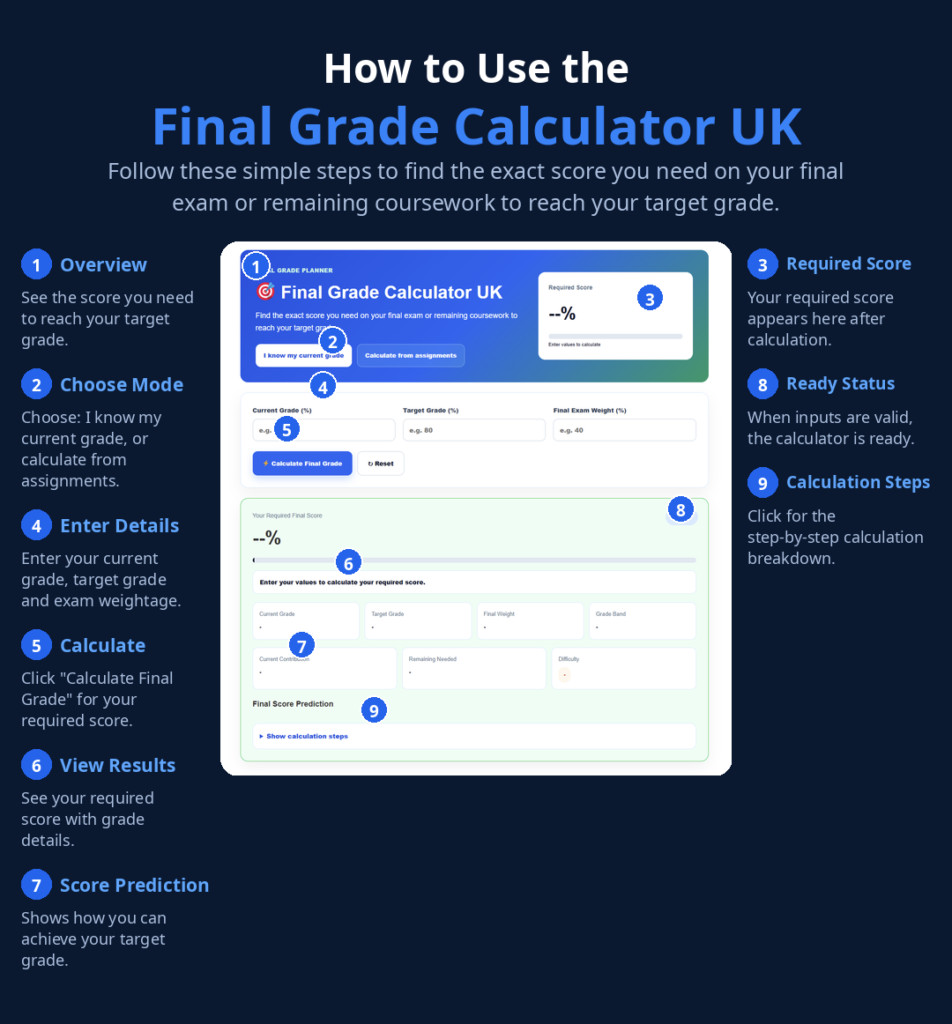
Click Here: Final Grade Calculator UK
Myth 1: A First means near-perfect marks
The belief: 70% is just scraping it — a real First needs 85 or 90%, like an A* at A-level.
The reality: At UK universities, 70% and above is a First. The bands are absolute: 70+ First, 60–69 2:1, 50–59 2:2, 40–49 Third. Nobody expects near-perfect work; a 72% dissertation is a comfortable First, not a borderline one. The scale reflects how hard it is to earn marks at degree level — examiners reserve the top of the range for work that could genuinely not be improved. And Firsts are not rare: roughly 30% of 2024/25 graduates received one, with the proportion ranging from 53% at Imperial to under 25% at some modern universities. If you are sitting on 68%, you are two marks from a First, not twenty.
Why it matters: Students who think a First needs 90% either give up chasing it unnecessarily or — worse — assume their 65% is “close enough” to something it is not. Know the real bands; model your average against them.
Myth 2: Your first year counts toward your degree
The belief: Every mark from day one feeds into your final classification, so a shaky first year haunts you forever.
The reality: At most English universities the first year is weighted at 0%. It is a progression hurdle — typically 40% to move into year two — and then it vanishes from the classification maths entirely. Your degree is computed from years two and three under weightings such as 40:60, 30:70 or 25:75. A 52% first year followed by strong later years costs you nothing; a 72% first year buys you nothing either. (Scotland’s four-year degrees and a handful of English programmes differ — always check your own assessment regulations.)
Why it matters: Worked example below shows a student wrongly folding first-year marks into their average under-reading their degree by nearly 7 percentage points. Read the full does first year count guide before you panic about — or coast on — year one.
Myth 3: A resit is a free second shot at 70%
The belief: Fail in May, smash the resit in August, and the 75 you earn is the 75 you keep.
The reality: Resit marks are capped at the pass mark — 40% for most undergraduate modules, 50% for postgraduate — at the great majority of UK universities, including Nottingham, Plymouth, Westminster, Southampton and Exeter. Write a perfect resit script and your transcript still records 40. The cap then drags on every average it touches: our worked example below shows a single capped resit costing over 5 percentage points on a final-year average. The only routine exception is a resit granted as a first attempt under extenuating circumstances, which is uncapped — one more reason to file EC claims properly.
Why it matters: Students who believe the myth under-prepare for first attempts (“I can always resit”) and then discover the cap too late. The university referrals guide covers caps, fees and the EC escape route in full.
Myth 4: 69.5% automatically rounds up to a First
The belief: Decimal points are just decoration — anything starting with 69 rounds to 70.
The reality: There is no universal rounding rule. Some universities round to the nearest integer, some truncate, and many park 68.00–69.99 in a borderline zone that only promotes you if you meet extra conditions — typically a set share of final-year credits at 70% or above. A 69.4% with a weak final year can stay a 2:1 while a 68.2% with a dominant final year goes up. Treating the boundary as automatic is how students end up shocked on results day.
Why it matters: Borderline policy is one of the highest-value things to look up in your own regulations — it decides classifications every summer. The mechanics are decoded in how UK universities round marks.
Myth 5: Failing one module fails your whole year
The belief: One failed module means repeating the year, whatever your other marks look like.
The reality: Most UK universities operate condoned passes or compensation: fail a module within limits — commonly up to 20 credits, sometimes 40 — and the board can let the failure stand while you progress, provided your overall average is strong enough. The failed mark still counts in your average, but you do not repeat the year for it. Core or professional-accreditation modules are often excluded, so check which of your modules are compensatable before you rely on it.
Why it matters: Students who believe the myth either panic-drop modules they could have carried or, conversely, assume everything is compensatable and neglect a must-pass core module. The rules are in what is a condoned pass.
Myth 6: Universities curve grades so only a few get Firsts
The belief: There is a secret quota — if too many students do well, marks get scaled down to fit the curve.
The reality: UK university marking is criterion-referenced: your work is judged against published criteria, and you receive the mark it earns. There is no forced distribution and no quota of Firsts — which is exactly why 30% of graduates can hold Firsts simultaneously. When marks are adjusted, it happens through transparent moderation (second markers, external examiners reviewing samples) or published scaling policies, not hidden curves. Imperial has even published an explicit statement that it does not scale to a quota.
Why it matters: The curve myth makes students compete against each other instead of against the criteria. Read the marking criteria for your module — they are the actual mark scheme. Full explainer: do UK universities curve grades.

Myth 7: If Turnitin flags your essay, you are automatically guilty
The belief: A 30% similarity score is a misconduct conviction waiting to happen.
The reality: A similarity score is not a verdict — it is a starting point for human review, and there is no universal “guilty” threshold. Properly quoted work, references and common phrases all inflate the score legitimately. The AI-writing indicator is a separate, opt-in feature that many universities leave switched off, and even where it runs, universities are required to investigate rather than punish on the flag alone. The ombudsman has already upheld a student complaint about unfair AI-flag handling. Separately, your submitted work itself is now a data-rights story: several universities have challenged Turnitin over what happens to student essays after submission.
Why it matters: Panicking over a similarity percentage — or ignoring a misconduct notice because “it was only the AI detector” — are both mistakes. Know the process: academic misconduct penalties and hearings and can Turnitin use your essay to train AI.
Myth 8: A 2:2 ruins your career
The belief: Anything below a 2:1 closes every good door — graduate schemes, masters courses, all of it.
The reality: The 2:1 gate is real but shrinking. The Institute of Student Employers found 44% of large recruiters require a 2:1 — a record low, down from 76% a decade ago — while 18% set no academic minimum at all. Graduate-scheme filters are the strictest corner of the market; most employers stop asking about classification after two years of work experience, and SMEs and startups rarely ask at all. Where the 2:2 genuinely stings is funded doctorates, some taught masters courses and the most competitive schemes — a narrower problem than the myth suggests, with narrower solutions (relevant experience, a strong masters, targeted applications).
Why it matters: Believing the myth produces either despair or complacency. The honest picture — where the gate applies and how to get around it — is in does your degree classification matter.
Myth 9: Predicted grades are just guesses — universities do not take them seriously
The belief: Teachers make them up, universities know they are made up, so they barely count.
The reality: Predicted grades are the load-bearing wall of the admissions system. Conditional offers are written directly against them, and UCAS data shows the scale of the inaccuracy: roughly half of applicants are predicted AAA or above, but only about a quarter actually achieve it. That gap cuts both ways — over-predicted students face brutal confirmation-day drops, while under-predicted students never get to apply to the courses they could have reached. Far from being ignored, predictions decide who gets interviewed, who gets offers, and who gets a place when results miss.
Why it matters: If your predictions undersell you, challenge them early through your referee — once submitted, they are very hard to move. The strategy is in do predicted grades matter for UCAS.
Myth 10: You need AAA to get into a good university
The belief: Anything below AAA means a bad university — the top institutions would never look at you.
The reality: Entry standards have been falling, not rising. Analysis of official entry-standards data found average accepted grades declined at 22 of 24 Russell Group universities since 2018/19, as institutions compete to fill places — and the “average accepted” figure sits well below the advertised offer grades thanks to contextual offers, near-miss confirmations and Clearing. At the other end of the sector, the average entrant at the UK’s most accessible universities arrived with around 87 UCAS tariff points — roughly a D and two Cs. Good universities take good students at far lower grades than the myth allows.
Why it matters: The myth stops capable students applying. Aim using real data: Russell Group entry grades and easiest universities to get into.
Myth 11: You can pay someone to boost your marks
The belief: Somewhere out there is a person inside the system who will nudge your 58 to a 62 for a fee.
The reality: No legitimate marker, administrator or exam board ever takes payment to change a mark — anyone offering to is running a scam, full stop. The “pay-to-boost-your-mark” con is one of the most reported student frauds of 2026: victims lose the fee, hand over personal details, and gain nothing, because marks live in audited registry systems with moderation trails. Worse, engaging with grade-selling outfits can itself trigger academic misconduct proceedings. Qualifications are increasingly verified through official channels such as HEDD, so a bought mark would not survive a background check anyway.
Why it matters: If your marks look wrong, the legitimate routes — mark checks, remarks, appeals, extenuating circumstances — are free and actually work. The scam landscape is mapped in UK student scams 2026.
Myth 12: Every university calculates your degree the same way
The belief: A 65% average is a 2:1 everywhere — the algorithm is national.
The reality: There is no national algorithm. Year weightings, borderline rules, condonement limits, resit caps and whether your lowest marks get discounted all vary by institution — two students with identical marks can graduate with different classifications from different universities. The differences are now a regulatory issue: the Office for Students has ruled that discounting students’ lowest marks is “inherently inflationary,” and universities are already rewriting their algorithms — one institution scrapped its best-of-two calculation for all students starting from August 2026. Your algorithm lives in your university’s assessment regulations, not in a national rulebook.
Why it matters: Transfer students, in particular, get reclassified under the awarding provider’s algorithm. Read the regulator story: the OfS ‘inherently inflationary’ ruling, and test your own numbers in the Degree Classification Calculator UK.
Myth vs reality: the 12-second version
Pin this table. Every row is the one-line version of the myth above — and the correction that replaces it.
| # | The myth | The reality |
|---|---|---|
| 1 | A First needs 85–90% | A First starts at 70%; ~30% of 2024/25 graduates got one |
| 2 | First year counts toward your degree | Weighted 0% at most English unis — a progression hurdle only |
| 3 | A resit can still earn 70% | Resits are capped at 40% (UG) / 50% (PG) |
| 4 | 69.5% always rounds up to a First | No universal rule; borderline zones need extra conditions |
| 5 | Failing one module fails the year | Condoned passes let you carry 20–40 failed credits |
| 6 | Universities curve grades to a quota | Marking is criterion-referenced; no forced distribution |
| 7 | A Turnitin flag means automatic guilt | Similarity ≠ verdict; human review is required |
| 8 | A 2:2 ruins your career | Only 44% of big employers require a 2:1 — a record low |
| 9 | Predicted grades are just guesses | Conditional offers are built on them; ~50% predicted AAA+ vs ~26% achieved |
| 10 | You need AAA for a good university | Accepted grades fell at 22 of 24 Russell Group unis since 2018/19 |
| 11 | You can pay someone to boost marks | Grade-selling offers are scams; no marker takes payment |
| 12 | Every uni uses the same algorithm | Weightings and rules vary; the OfS is rewriting the sector’s maths |
What the myths cost: two worked examples
Myths are not harmless — they change decisions. Here is what two of the commonest ones cost in actual marks, worked through in full.
Worked example 1: the resit-cap myth (Amara)
Amara’s final year has six 20-credit modules. She scores 65 in five of them and fails the sixth with 38. Believing Myth 3, she assumes a strong resit erases the failure — and she is right about the script: her resit work is worth 72. But the resit is capped at 40, so her transcript records 40, not 72.
Capped year average: (5 × 65 × 20 + 40 × 20) ÷ 120 = (6,500 + 800) ÷ 120 = 60.83%. If the resit had been uncapped: (6,500 + 1,440) ÷ 120 = 66.17%. The cap costs her 5.34 percentage points on the year. On a 40:60 weighting with a 64% second year, her final classification is 0.4 × 64 + 0.6 × 60.83 = 62.10% (2:1) versus 0.4 × 64 + 0.6 × 66.17 = 65.30% (2:1) uncapped — the same class here, but 3.2 points further from a First, and on a tighter boundary it would flip the class entirely.
Worked example 2: the first-year-counts myth (Daniel)
Daniel scores 48 in his first year, then 66 in year two and 69 in year three. His university weights years at 0:40:60 — first year counts for nothing. His real final average: 0.4 × 66 + 0.6 × 69 = 26.4 + 41.4 = 67.80%, a comfortable 2:1.
Believing Myth 2, Daniel folds year one in as an equal third: (48 + 66 + 69) ÷ 3 = 61.00%. He has under-read his degree by 6.8 percentage points — the difference, on paper, between cruising and worrying. The same error in reverse (a strong first year counted as credit) breeds complacency. Either way, the fix is thirty seconds with the Final Grade Calculator UK and your actual year weightings.
Why these myths survive
Three forces keep the folklore alive. First, the US grading scale: American students need 90%+ for an A, and that intuition leaks into UK seminar rooms where 70% is already the top band. Second, every university genuinely does things slightly differently — one friend’s resit really was uncapped (extenuating circumstances), another’s 69.6 really did round up — and single anecdotes travel further than regulations nobody reads. Third, advice goes stale: the algorithm your cousin graduated under in 2021 may have been rewritten since the regulator’s 2025–26 intervention. The antidote is always the same — your university’s current published assessment regulations, which outrank every forum thread.
Two sources worth bookmarking beyond this site: the Prospects guide to understanding university grades in the UK for the classification bands, and the HESA student statistics release for the official degree-outcomes data behind the Firsts figures quoted above.
Is 70% really a First at UK universities?
Yes — 70% and above is a First-class mark at virtually every UK university, 60–69% is an upper second (2:1), 50–59% a lower second (2:2), and 40–49% a Third. These are absolute bands, not curved quotas: about 30% of 2024/25 graduates received a First, which would be impossible under a forced distribution. Model what your current marks mean for your classification with our Final Grade Calculator UK.
Do resits get capped at every UK university?
Capped resits are the sector norm: a resit pass is recorded at the pass mark — 40% for most undergraduate modules, 50% for postgraduate — no matter how well you actually perform. The cap applies at institutions including Nottingham, Plymouth, Westminster, Southampton and Exeter. The main exception is a first-attempt-equivalent resit granted through extenuating circumstances, which is uncapped. Our university referrals guide explains the full rules.
Does my first year count toward my final degree grade?
At most English universities, no — the first year is weighted at 0% and exists only as a progression hurdle (usually 40% to move to year two). Your classification is computed from years two and three under weightings like 40:60 or 25:75. Some institutions differ, so check your own assessment regulations rather than assuming. See our does first year count guide for the university-by-university picture.
Can a university round 69.5% up to a First?
There is no universal rule, and you should never assume it. Many universities truncate or round to whole numbers, and borderline zones (typically 68.00–69.99) usually require you to meet extra conditions — such as a majority of final-year credits at 70%+. A 69.4% with a weak final year can stay a 2:1. The full picture is in our how universities round marks guide.
Will a 2:2 stop me getting a graduate job?
Usually not. The ISE Student Recruitment Survey found 44% of large employers require a 2:1 — a record low, down from 76% a decade ago — and 18% set no academic minimum at all. For most roles, two years of work experience erases the classification signal entirely; the 2:1 gate matters most for the most competitive graduate schemes, funded doctorates and some taught masters courses. Read does your degree classification matter for the full breakdown.
Are predicted grades accurate?
Statistically, no — and that is precisely why they matter. UCAS data shows roughly half of applicants are predicted AAA or above while only about a quarter actually achieve it, yet conditional offers are built directly on those predictions. Being under-predicted costs you choices just as surely as missing your grades on results day. Our predicted grades guide explains how to work the system.
Do UK universities curve or scale grades?
No — UK university marking is criterion-referenced: you receive the mark your work earns against published criteria, not a position in a forced distribution. Universities do not cap the number of Firsts. When marks are adjusted at all, it is through transparent moderation and published scaling policies, not secret quotas. See do UK universities curve grades.
Is it true every university uses the same degree algorithm?
False — and the differences can move your classification. Year weightings, borderline rules, condonement limits and whether the lowest marks are discounted all vary by institution. The regulator has now intervened: the Office for Students calls discounting your lowest marks “inherently inflationary,” and universities are already rewriting their algorithms. Read the OfS degree-algorithm ruling for what it means for you.
Conclusion
Twelve myths, and a single pattern underneath them: students consistently assume the system is harsher, vaguer or more corruptible than it is. A First starts at 70, not 90. Your first year almost certainly does not count. Resits are capped, rounding is not automatic, one failed module rarely sinks a year, nobody curves your marks, a Turnitin flag is not a conviction, a 2:2 is not a career sentence, predictions run the admissions machine, AAA is not the price of a good university, marks cannot be bought, and the algorithm is yours to look up — not a national secret.
The students who do best are not the ones with the cleverest folklore; they are the ones who read the actual regulations. Open your university’s assessment handbook, find your year weightings, your resit cap, your borderline rule and your condonement limit, then model your classification on real numbers instead of rumours. Myths are free. Marks are not — spend them on the truth.