

Failing your dissertation can feel like the floor has dropped out from under your degree. After months of research, writing and rewriting, seeing a fail mark next to the single biggest module of your final year is genuinely distressing — and it raises an immediate, frightening question: does this mean I lose my degree?
The short answer is: usually not. In the UK, a failed dissertation very rarely means the end of your degree. Most universities offer a resubmission (often called a “referral”), and there are well-established rules for what happens next — including what happens to your marks, your graduation date and, in the worst case, the qualification you leave with.
This guide explains exactly what happens if you fail your dissertation at a UK university: the resubmission process, how capped marks work, how a failed or capped dissertation affects your final degree classification, the differences between undergraduate and Masters rules, and the practical steps to take in the first 48 hours after getting your result.
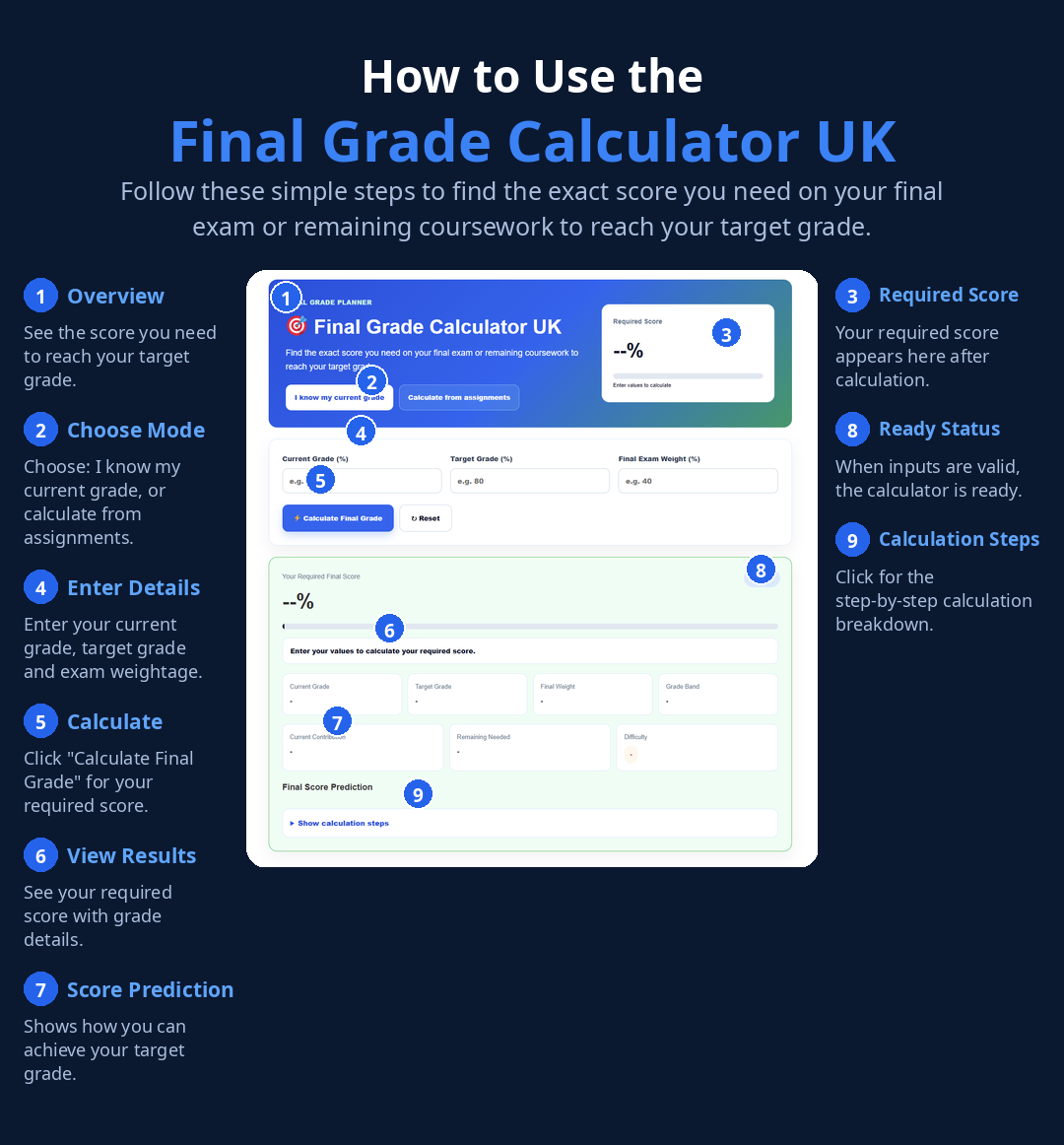
Click Here: Final Grade Calculator UK
How Dissertations Are Marked in the UK
Before understanding failure, it helps to understand what the dissertation actually is in grading terms. At most UK universities, the dissertation is not just another essay — it is typically the largest single module of your degree:
| Level | Typical credit value | Share of final year | Pass mark |
|---|---|---|---|
| Undergraduate dissertation | 30–40 credits (sometimes 60) | 25–50% of final-year credits | 40% |
| Masters dissertation | 60 credits | One-third of the full Masters | 50% |
Because the credit value is so large, the dissertation exerts an enormous pull on your average. A 40-credit dissertation counts four times as much as a 10-credit module. This is why a failed dissertation is serious — but it is also exactly why universities have structured second-chance processes for it, rather than letting one module sink a whole degree.
Dissertations are usually double-marked (two examiners) and a sample is checked by an external examiner, so the mark you receive has been through more scrutiny than a typical essay. If you failed, it is worth taking the feedback seriously — it reflects a considered academic judgement, not a clerical error.
What Counts as “Failing” a Dissertation?
The pass threshold depends on your level of study:
- Undergraduate: below 40% is a fail.
- Masters (postgraduate taught): below 50% is a fail.
Some universities also have a “marginal fail” band with its own rules. For example, the University of Edinburgh allows Masters students who score 45–49 — just below the 50% pass mark — to resubmit their dissertation under a specific regulation, with the award decision deferred until the resubmission is complete. Other institutions have similar borderline provisions, so a mark of 38 or 48 may be treated differently from a mark of 12. Always check your university’s academic regulations for the exact bands.
It is also worth knowing what usually causes dissertation failures, because the examiners’ feedback will typically point to one of these:
- Weak methodology — the research design doesn’t support the conclusions drawn.
- Insufficient critical analysis — descriptive writing without evaluation or argument.
- Poor structure — chapters that don’t connect into a coherent argument.
- Inadequate engagement with literature — too few sources, or sources used superficially.
- Academic misconduct — plagiarism or collusion, which can mean instant failure and different procedures entirely.
- Not answering the research question — the most common underlying issue: the dissertation drifts away from its own title.
If your feedback mentions plagiarism, stop and read your university’s academic misconduct procedure first — the resubmission rules below may not apply, and the penalties follow a separate track.
Can You Resit a Failed Dissertation?
Yes — in the vast majority of cases. The standard outcome of a failed dissertation at a UK university is the offer of a resubmission, sometimes called a “referral.” You are given a deadline to revise and resubmit the work, addressing the examiners’ feedback.
How this works in practice:
- You get one resubmission attempt as standard. A first-attempt fail almost always entitles you to resubmit once.
- The timeline varies. Minor corrections might get a few weeks; a major rewrite can get several months. Your department will set a specific deadline.
- It may not be the same project. Sometimes you revise the same dissertation; sometimes the department requires a new title or substantially different work. Your supervisor will advise.
- Your graduation is delayed. The exam board defers your award decision until the resubmission is marked, so you will likely graduate late — often at the next graduation ceremony rather than with your cohort.
- You usually keep access to resources. Universities typically extend your library access, supervisor contact and student email until the resubmission deadline.
One important misconception to clear up: you cannot resubmit a dissertation you already passed just to improve the mark. As students on forums like The Student Room regularly discover, resits exist to earn missing credits for progression — not to polish a passing grade into a better one. If you passed with 58% and wanted 65%, resubmission is not available to you.
Read more: What Happens If You Fail a University Module? — Your Next Options Explained
Failed Dissertation Capping Rule: Why Your Resubmission Mark Is Limited
Here is the catch that surprises most students: resubmission marks are almost always capped at the bare pass mark.
- Undergraduate resubmission: capped at 40%.
- Masters resubmission: capped at 50%.
This means that even if your resubmitted dissertation is genuinely excellent — worthy of 70% or more — your transcript will record only the pass mark. The cap exists because the resubmission is a second chance to demonstrate minimum competence, not a fresh attempt at the full grade range.
The one common exception is extenuating circumstances: if your first attempt was seriously affected by documented illness or other exceptional factors and your claim is approved, the resubmission may be uncapped. More on this below.
Worked Example: How the Cap Affects Your Average
Consider Amelia, a final-year History student whose 40-credit dissertation was capped at 40% after resubmission. Her other final-year modules:
| Module | Credits | Mark | Weighted points |
|---|---|---|---|
| Modern European History | 20 | 66% | 1,320 |
| Historiography | 20 | 59% | 1,180 |
| Dissertation (resubmission, capped) | 40 | 40% | 1,600 |
| Total | 80 | 4,100 |
Final-year average: 4,100 ÷ 80 = 51.25% — a 2:2 for the year, dragged down from what would have been around 62% (a 2:1) without the cap.
Now compare with Daniel, whose university accepted extenuating circumstances, leaving his resubmission uncapped at 62%:
| Module | Credits | Mark | Weighted points |
|---|---|---|---|
| Modern European History | 20 | 66% | 1,320 |
| Historiography | 20 | 59% | 1,180 |
| Dissertation (resubmission, uncapped) | 40 | 62% | 2,480 |
| Total | 80 | 4,980 |
Final-year average: 4,980 ÷ 80 = 62.25% — a 2:1. The difference between a capped and uncapped resubmission here is an entire degree classification band.
Try your own numbers in our Weighted Grade Calculator to see exactly how a capped mark would move your average.
Failed Dissertation Rules: Undergraduate vs Masters
The stakes of a failed dissertation are noticeably higher at Masters level:
| Issue | Undergraduate | Masters (taught) |
|---|---|---|
| Pass mark | 40% | 50% |
| Resubmission cap | 40% | 50% |
| If resubmission also fails | May repeat the year/module or accept an Ordinary (non-honours) degree | Cannot be awarded the Masters — may receive a PGDip or PGCert instead |
| Dissertation weight | 30–60 credits | 60 credits (one-third of the degree) |
For Masters students, the dissertation is often a must-pass component: many programmes require a minimum mark in the dissertation for each award level (for example, 60% in the dissertation for a Merit, 70% for a Distinction). Failing the resubmission at Masters level usually means leaving with a Postgraduate Diploma or Certificate rather than the full MSc/MA — still a recognised qualification, but not the Masters.
For undergraduates, a second failure more commonly leads to repeating the module or year, or in some cases graduating with an Ordinary degree (a degree without honours classification) if the failed credits can’t be recovered.
What Happens If You Fail Your Dissertation Resubmission?
Failing twice is where options narrow sharply. Most universities do not offer a third attempt as standard. Based on published exam-board procedures (for example, the University of Kent’s exam results guidance), the board of examiners will typically choose one of the following:
- Offer a further resit or repeat — sometimes permitted in the following academic year, though you may not be allowed to attend classes in the meantime.
- Require you to repeat the failed credits — effectively retaking the module/year, with implications for tuition fees and student funding.
- Require you to leave the programme — with an exit award (such as an Ordinary degree, PGDip or PGCert) if you have earned enough credits, or with no award if you have not.
The exact outcome depends on your overall credit profile, your engagement record, and your university’s regulations. This is why the first resubmission deserves your full effort — it is by far your best and simplest route back on track.
Read more: University Resit Exams Explained — Ultimate Guide to Graduating with Honours
Extenuating Circumstances: When the Cap Doesn’t Apply
If your first attempt was seriously affected by circumstances beyond your control — significant illness, bereavement, or other exceptional events — you may be able to submit an extenuating circumstances (EC) claim.
A successful EC claim can change the resubmission terms dramatically:
- The resubmission may be treated as a first attempt, meaning the mark is uncapped.
- In some cases the original fail mark is set aside entirely.
- Deadlines may be extended to give you a fair chance to complete the work.
Key points students often miss about EC claims:
- Evidence is everything. A claim without supporting evidence (medical certificates, death certificates, counsellor letters) is very likely to be rejected.
- Deadlines are strict. Most universities require EC claims within days of the affected assessment — sometimes within 5–10 working days. Late claims need their own explanation.
- “I was stressed” is not enough on its own. Normal exam stress doesn’t qualify; the circumstances must be exceptional and beyond your control.
- Apply even if you’re unsure. The worst outcome of a rejected claim is no change; the best outcome is an uncapped resubmission worth an entire classification band (as Daniel’s example above showed).
International Students: Visa Implications
If you are studying in the UK on a Student visa, a failed dissertation can create immigration complications on top of academic ones:
- Resubmission may require leaving the UK. If your visa expires before the resubmission period, you may not automatically be eligible for an extension — some students have to leave the UK and return for the resit. In exceptional cases the Home Office’s Leave Outside the Rules guidance can provide a route to stay, but this is discretionary.
- Contact your university’s visa compliance team early — ideally as soon as the fail is confirmed, not when the visa is about to expire.
- Graduate visa eligibility can be affected. Extended or out-of-rules leave may disqualify you from the Graduate visa route, so get advice before making any immigration application.
- Attendance requirements still apply while you remain enrolled, even during a resubmission period.
Immigration advice is a regulated area — speak to your university’s international student adviser rather than relying on forum posts for visa questions.
What to Do in the First 48 Hours After a Fail
- Read the full feedback, twice. The examiners’ report tells you exactly what to fix. Most resubmission failures happen because students skim the feedback and repeat the same mistakes.
- Contact your supervisor immediately. Ask for a meeting to go through the feedback line by line. If your supervision was weak the first time, raise it now — politely and in writing.
- Confirm the resubmission deadline and rules in writing. Get the date, the word count, whether it’s the same title, and whether the mark will be capped. Don’t rely on verbal assurances.
- Check the extenuating circumstances deadline. If anything affected your first attempt, the EC clock is already ticking.
- Calculate the damage. Work out what the capped mark does to your final average using our University Grade Calculator — knowing the real number replaces panic with a plan.
- Talk to your personal tutor or student support. Failing hits hard emotionally. Universities have wellbeing and counselling services precisely for moments like this; use them.
How to Make Your Resubmission Pass
Students who pass on resubmission tend to do the same few things differently:
- Treat it as a new project, not a patch-up. Fixing typos won’t turn a 35 into a pass. Address the structural weaknesses the examiners identified — usually methodology, analysis or argument structure.
- Answer the feedback point by point. Make a checklist from the examiners’ report and work through it systematically. Some students even include a short response document showing how each point was addressed.
- Re-check your research question alignment. Every chapter should visibly serve the question in your title. If a section doesn’t, cut or rewrite it.
- Get the academic skills basics right. Referencing, proofreading, formatting — these are easy marks that many failed dissertations throw away.
- Submit a draft chapter early. Don’t wait until the deadline to discover you’re off track again. Most supervisors will review resubmission drafts if you ask in good time.
- Protect your writing time. A resubmission alongside a job or other modules fails for logistical reasons as often as academic ones. Block the calendar.
Frequently Asked Questions
Can you resit a dissertation at a UK university?
Yes, in most cases. A failed dissertation usually leads to one resubmission opportunity (a “referral”). The resubmission mark is normally capped at the pass mark — 40% for undergraduates, 50% for Masters — unless extenuating circumstances are approved.
Is a resubmitted dissertation capped?
Almost always, yes. Undergraduate resubmissions are typically capped at 40% and Masters resubmissions at 50%, even if the work itself deserves a higher mark. An approved extenuating circumstances claim is the main route to an uncapped resubmission.
What happens if you fail your dissertation twice?
Options narrow significantly. The exam board may offer a repeat of the credits the following year, or you may have to leave the programme — possibly with an exit award such as an Ordinary degree (undergraduate) or a PGDip/PGCert (Masters) if you have enough credits.
Can you graduate if you fail your dissertation?
Usually not with the full honours degree until the failed credits are recovered. Undergraduates may be offered an Ordinary (non-honours) degree; Masters students who fail the dissertation resubmission cannot be awarded the Masters but may receive a Postgraduate Diploma or Certificate.
Does a failed dissertation affect your degree classification?
Yes, significantly. Because dissertations carry 30–60 credits, even a capped pass mark of 40% can drag your final average down by a full classification band compared to your other modules. Use a weighted grade calculator to model the exact impact.
Can I resubmit my dissertation to improve a passing grade?
No. Resubmissions are for failed assessments only. If you passed — even with a disappointing mark — universities do not offer resubmission to chase a higher grade.
How long do you get to resubmit a dissertation?
It varies by university and by how substantial the required corrections are: anything from a few weeks for minor amendments to several months for a major rewrite. Your department will set a specific deadline — confirm it in writing.
Will failing my dissertation affect my visa as an international student?
It can. If your Student visa expires before the resubmission period ends, you may need to leave the UK and return for the resit, and out-of-rules extensions can affect Graduate visa eligibility. Speak to your university’s visa compliance team as soon as possible.
Should I appeal a failed dissertation mark?
Appeals are for procedural errors (for example, marking not following published criteria, or bias) — not for disagreeing with academic judgement. If you believe there was a procedural problem, check your university’s academic appeals process and its (usually short) deadline. If the issue was the quality of the work, a resubmission is the more productive route.
How common is failing a dissertation?
More common than students think — which is exactly why every UK university has a formal resubmission process for it. A single failed dissertation, handled properly through resubmission, does not define your degree or your career.
Read more: University Grade Boundaries Explained — What You Need to Pass
Conclusion
Failing your dissertation is a serious setback, but the UK system is designed with second chances built in. The standard path — one resubmission, usually capped at the pass mark — lets the large majority of students recover their degree. The students who recover best do three things quickly: they understand the examiners’ feedback precisely, they confirm the resubmission rules and deadlines in writing, and they check whether extenuating circumstances apply before that deadline passes.
The capped mark will almost certainly lower your final average — sometimes by a full classification band — so go in with open eyes and a calculator, not just hope. Work out the real numbers with our University Grade Calculator, make a plan for the resubmission, and remember: plenty of graduates with successful careers have a resubmission in their history. What matters now is what you do with the second chance.