
Every year, thousands of UK students sit exams or submit coursework while dealing with something far bigger than the assessment in front of them: a sudden illness, a death in the family, a mental-health crisis, a traumatic event. The UK university system has a formal answer for this — extenuating circumstances — and it can be the difference between a failed module and a protected grade. Yet most students either don’t know the process exists, discover it after the deadline has passed, or submit a claim so poorly evidenced that it stands no chance.
Extenuating circumstances (EC) are the formal route by which a university recognises that events beyond your control damaged your assessment performance. A successful claim doesn’t gift you marks — no panel will bump a 52 into a 58 — but it can do something far more valuable: give you a fresh, uncapped attempt, extend a deadline without penalty, or set an affected attempt aside entirely. In a credit-weighted degree, the gap between a capped resit at 40% and an uncapped one can be an entire classification band.
This extenuating circumstances university guide walks you through the whole process as it actually works across UK universities: what qualifies and what doesn’t, the five tests every panel applies, a decision framework to help you decide whether to claim, the strict deadlines that catch students out, evidence standards, self-certification limits, and what each possible remedy does to your grades — with worked examples showing the real numbers.
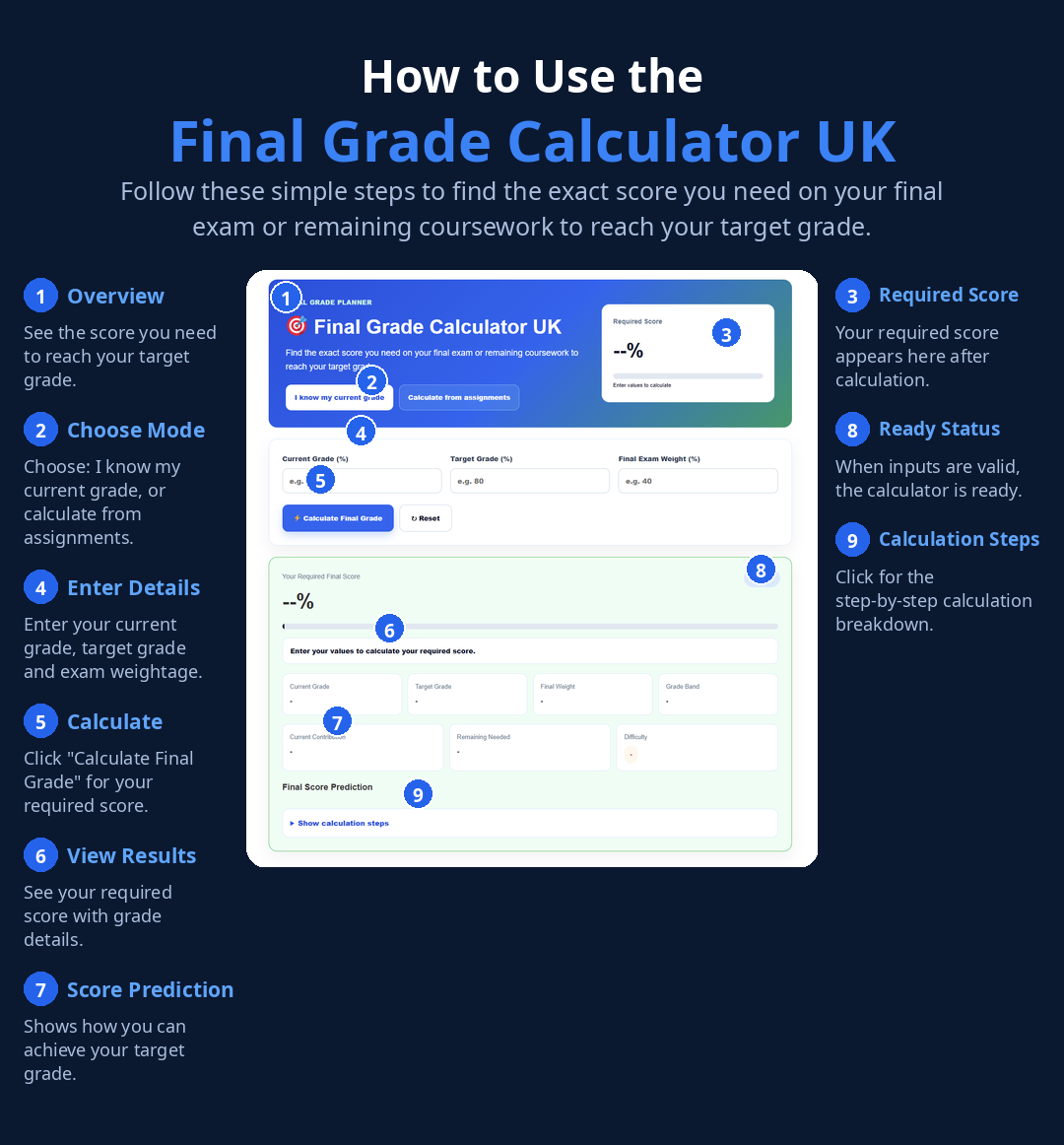
Click Here: Final Grade Calculator UK
Extenuating Circumstances University Guide: What They Are and Why the Name Keeps Changing
Strip away the jargon and the definition is consistent across the sector. Queen Mary University of London, for example, defines extenuating circumstances as “significant and unforeseen circumstances that are outside a student’s control and which have a negative impact on a student’s ability to undertake or complete any assessment.” The Open University runs the same idea under the name “special circumstances”, while the University of Manchester — one of the largest universities in the country — calls the whole process “mitigating circumstances”. Same mechanism, different label.
This matters because your university’s regulations will only ever use one of these terms, and searching for the wrong one will lead you to the wrong form. Before you do anything else, find out which label your institution uses and bookmark the correct policy page. A medical letter from a GP is valid under any name — the terminology affects the paperwork, not the principle.
A handful of universities also run a lighter-touch track alongside the full panel process. At Queen Mary, claims on the student system are filed as either a “Standard Claim” or a “Self-Certification”; the Open University distinguishes its special-circumstances reporting from its separate exam-postponement policy. The full process — panel review, evidence scrutiny, a formal remedy — is reserved for serious, documented situations. Short-term disruption is handled through extensions or self-certification instead.
What Counts — and What Definitely Doesn’t
Panels draw a hard line between exceptional events and the ordinary difficulties of student life. The lists below come directly from published university policies, and they are strikingly consistent:
| Usually accepted | Usually rejected |
|---|---|
| Significant illness, accident or injury — physical or mental | Ordinary exam stress or nerves |
| Bereavement or serious illness of a close family member | A minor cold or headache that didn’t stop you working |
| Being the victim of a serious crime | Poor time management or leaving work to the last minute |
| Major disruption during the assessment itself (e.g. evacuation, serious technical failure in an exam hall) | Misreading the exam timetable or misunderstanding assessment requirements |
| Serious, documented mental-health episode | Panic attacks not diagnosed as an illness (Manchester explicitly excludes these) |
| Sudden, severe caring responsibilities | Holidays, moving house, planned events |
| Consequences of paid employment or work commitments | |
| Last-minute computer or printer problems caused by poor planning |
The pattern is clear: the event must be sudden, serious and outside your control. Universities explicitly state that students are expected to plan around foreseeable problems — transport issues, computer backups, busy exam timetables — even when those problems feel unfair in the moment. “I was stressed” is not a claim; “I was diagnosed with glandular fever during exam week” is.
Read more: What Happens If You Miss a University Exam — Complete Student Guide
The Five Tests Every Panel Applies
Behind the policy documents, EC panels are really asking five questions. Borrowed from the criteria universities like UCFB and the Royal Veterinary College publish, they are worth memorising because they predict outcomes better than any forum thread:
- Was it unforeseeable? You could not reasonably have known it would happen.
- Was it unpreventable? There was nothing reasonable you could have done to stop it.
- Was it beyond your control? The event — not your response to it — is what the panel judges.
- Is it time-specific? It must map onto the dates of the affected assessments. A bereavement six months before an exam, with no evidence of ongoing impact, will struggle.
- Was the impact significant? Panels look for a material effect on performance, judged against your unaffected work. The board can only assess impact in light of your demonstrated academic ability elsewhere.
Test five is the one students underestimate. If your other modules show you as a consistent 65% student and the affected paper came back at 38%, the panel can see the damage. If your record is erratic, the claim is harder to evidence — which is one more reason your statement should describe, factually and specifically, how the circumstances affected that assessment.
Should You Submit a Claim? A Decision Framework
This is the question that actually matters, and most advice skips straight to “yes, always claim” without explaining what follows. Use the table below as a decision aid. It maps common situations to the likely outcome and the evidence you’ll need — drawn from how panels at UK universities actually rule:
| Your situation | Likely outcome | Evidence needed |
|---|---|---|
| Sudden serious illness during exam week (e.g. GP-confirmed infection with high fever) | Claim — strong case. Uncapped resit as a first attempt, or the attempt set aside. | GP letter on headed paper, dated at the time of illness, stating the dates and impact. |
| Bereavement of a close family member near a deadline | Claim — strong case. Extension or deferred assessment. | Death certificate, funeral notice, or order of service. |
| Diagnosed anxiety/depression flare-up affecting several weeks of study | Claim — good case. Extensions, alternative assessment, or affected marks excluded from the average. | Letter from GP, counsellor or university wellbeing service covering the period. |
| Victim of a crime close to an assessment date | Claim — good case. Deferred assessment or uncapped resit. | Police incident or crime reference number. |
| Short 2–3 day bug; you need a brief coursework extension | Self-certify where offered rather than a full panel claim. | None for self-certification (usually limited to once per semester). |
| Ordinary exam stress, poor sleep, feeling underprepared | Don’t claim — will be rejected; normal exam pressure never qualifies. | Not applicable. |
| Misread the timetable and missed the exam | Don’t claim — explicitly excluded in most policies. | Not applicable. |
| Laptop died the night before submission; no backup | Don’t claim — treated as poor planning. Back up your work. | Not applicable. |
Two rules of thumb sit behind the table. First: if in doubt, claim — a rejected claim changes nothing, while a missed deadline forfeits the option entirely. Second: never submit a claim you know to be false or exaggerated. Universities treat false EC claims as attempts to gain unfair advantage, and they are handled under disciplinary procedures, not the EC process.
What a Successful Claim Actually Does to Your Grades
This is the part students understand least. An approved claim never adds marks to an assessment you passed — no panel will turn a 52 into a 58 because you had a difficult month. What it does is change the terms under which the assessment counts. The standard remedies, drawn from published outcomes at universities including Manchester and BPP University, are:
- An uncapped resit treated as a first attempt. The single most valuable remedy. Where a normal resit is capped at the pass mark (40% undergraduate, 50% Masters), an EC-approved resit carries no cap — your real mark counts. Manchester’s own guidance confirms that resits as a “first attempt” are uncapped and are permitted where mitigating circumstances are accepted.
- The affected attempt disregarded entirely. At BPP, an approved claim means the affected attempt is fully set aside and does not count toward your record; you resit at the next available sitting as if the first attempt never happened.
- An extension to the deadline. For coursework, a short extension (commonly up to 5–7 working days) with no late-submission penalties.
- Removal of late penalties. If penalties were already applied, an approved claim can strip them back off.
- The mark excluded from your average. In some cases the affected module or component mark is excluded from the year average or degree calculation rather than resat.
- An alternative assessment. Where resitting in the same format is impractical, the board may set a different task.
Which remedy you get depends on the circumstances, the assessment type and the exam board’s judgement — you can request, but the panel decides. What matters for your grades is that every one of these remedies protects your average far better than a capped resit does.
Worked Example 1: Capped vs Uncapped Resit — a Full Classification at Stake
Tariq is a final-year Business student. Six 20-credit modules make up his final year (120 credits). He sat five of them normally, but the week of his sixth exam his father was hospitalised and he sat the paper in a state of acute distress, scoring 38%. He submitted an EC claim with hospital evidence within the deadline, and it was approved — his resit was treated as a first attempt, uncapped. He scored 62%.
Compare his final-year average with and without the approved claim:
| Module | Credits | Mark (no EC claim) | Mark (EC approved) |
|---|---|---|---|
| Strategic Management | 20 | 64% | 64% |
| Marketing Analytics | 20 | 58% | 58% |
| Corporate Finance | 20 | 55% | 55% |
| Operations | 20 | 61% | 61% |
| Business Ethics | 20 | 67% | 67% |
| International Business (resit) | 20 | 40% (capped) | 62% (uncapped) |
Without the EC claim: weighted points = 20 × (64 + 58 + 55 + 61 + 67 + 40) = 20 × 345 = 6,900. Average = 6,900 ÷ 120 = 57.5% — a 2:2.
With the EC claim approved: weighted points = 20 × (64 + 58 + 55 + 61 + 67 + 62) = 20 × 367 = 7,340. Average = 7,340 ÷ 120 = 61.17% — a 2:1.
One approved claim, one 22-mark difference in a single resit, and the degree classification moves up a full band. Run your own version of this calculation with our Weighted Grade Calculator — the numbers are what turn an abstract policy into a concrete decision.
Read more: University Resit Exams Explained — Ultimate Guide to Graduating with Honours
Worked Example 2: An Extension That Saved a Module
Chloe, a third-year English student, developed a severe migraine two days before a 20-credit module’s second essay was due. Her university’s late-submission rule deducts 10 marks per working day, up to five days. She applied for an EC extension with a GP note before the deadline and was granted five extra working days.
Her essay was marked at 64%. Without the extension, submitting three working days late would have meant a 30-mark deduction — the essay would have recorded 34%. Her module had two equally weighted essays:
| Component | Weight | Mark (no extension) | Mark (extension granted) |
|---|---|---|---|
| Essay 1 | 50% | 60% | 60% |
| Essay 2 | 50% | 34% (64 − 30 late penalty) | 64% |
| Module average | 47% | 62% |
The extension alone was worth 15 percentage points on the module average — the difference between a mark that drags a year down and one that lifts it. Note the key detail: Chloe applied before the deadline. Extensions are almost always prospective; asking after the work is already late is a far weaker position.
Deadlines: The Clock Starts Immediately — Miss It and the Claim Dies
If there is one fact to take from this entire guide, it is this: EC deadlines are brutally short, and they are enforced. Universities set them in working days from the affected assessment, and a strong case submitted late is often rejected on timing alone. Typical windows, taken from published policies:
| University | Claim deadline | Evidence deadline |
|---|---|---|
| King’s College London | 5 working days after the affected assessment | Within 10 working days |
| BPP University | 10 clear working days after the assessment date | With the application |
| Open University (special circumstances) | 4 calendar days after the final assessment submission date | Within 14 calendar days of submitting the form |
| Queen Mary University of London | Within one working week of the assessment | As soon as available after the claim |
| University College Birmingham | With the application, before the Board of Examiners meets | No later than 10 working days after applying |
Your university’s exact window will be in its regulations — 5 to 10 working days is the norm, with the Open University’s 4 calendar days among the tightest. The practical rule: start the claim the moment you realise your performance was affected, not after results day. If evidence isn’t ready yet, most universities let you submit the form first and the evidence shortly after, provided you say when it will arrive. A form with “GP letter to follow by Friday” beats a perfect form submitted a day late.

Evidence Standards: What Panels Actually Accept
Evidence is the currency of EC claims. Panels cannot accept your word alone for a serious claim — they need independent, third-party documentation that covers the dates of the affected assessments. What “counts” as evidence is spelled out in unusual detail in most policies:
- Illness or injury: a letter from a GP, consultant, hospital or counsellor — on headed paper, dated, and ideally issued at the time of the illness. Retrospective letters written weeks later carry less weight, though they are still better than nothing.
- Bereavement: a death certificate, funeral notice or order of service. Note that Stirling’s policy does not require documentary evidence for compassionate grounds — a rare and humane exception.
- Crime: a police incident or crime reference number.
- Other disruption: a letter from an employer on headed paper, a court citation, or a supporting statement from a tutor or student support officer.
- Documents not in English must be submitted with a certified translation.
The evidence must do two jobs: prove the event happened, and connect it to the assessment dates. A GP letter confirming you were ill “in May” is weak; one stating you were unfit to sit an examination on 14 May is strong. When you see your GP, tell them exactly which assessments were affected and ask for the dates to be stated explicitly.
Self-Certification: The No-Evidence Route — and Its Limits
Several universities now let students self-certify short-term issues without medical evidence. UCFB, for instance, permits self-certification once per semester for up to seven working days; Queen Mary’s system offers a self-certification claim type alongside the standard evidenced claim. This is designed for the two-day migraine or the 48-hour stomach bug — situations where getting a GP appointment would take longer than the illness itself.
The limits matter more than the permission. Self-certification is typically extension-only: it buys you a few extra days on coursework, not an uncapped resit or a disregarded exam attempt. It is usually capped at one use per semester or year. And it does not cover exams at most institutions. If your situation is serious enough to need a resit remedy, you need the full evidenced route — self-certification won’t get you there.
Read more: What Happens If You Fail a University Module? — Your Next Options Explained
A Typical Claim Timeline: Day 0 to Decision
Students often imagine the process as a single form, when it is really a sequence with dependencies — evidence takes time to obtain, and panels meet on fixed schedules. Here is a realistic timeline for a standard claim:
| When | What happens | Your action |
|---|---|---|
| Day 0 | The affected assessment takes place (or the deadline passes). | Note the date — this is when the claim window starts. |
| Day 1–2 | You recognise your performance was affected. | Contact your personal tutor or student support; read your university’s EC policy. |
| Day 2–3 | Evidence gathering begins. | Book the GP appointment; request letters; collect documents. Ask for assessment dates to be stated explicitly. |
| Day 3–5 | Claim submitted. | Complete the online form with a clear, factual statement. Submit even if evidence isn’t ready — note when it will follow. |
| Day 5–10 | Evidence window closes (varies by university). | Upload or email all supporting documents before the evidence deadline. |
| Week 2–4 | The EC panel meets (often on a fixed schedule near exam boards). | Wait. Panels typically notify you of accept/reject within days of meeting. |
| Exam board | The board of examiners applies the remedy. | The panel’s recommendation goes to the board, which makes the final decision on your record. |
| Results day + ~7 days | Outcome reflected in your results. | Check your transcript and resit arrangements; confirm any new deadlines in writing. |
Two things to notice. First, the panel decides whether your circumstances are accepted; the board of examiners decides what happens to your grades as a result. Second, EC decisions are handled confidentially — at Stirling, for example, sub-board decisions are anonymised before they reach the module and award boards, so the academics deciding your final grade don’t see the personal detail.
Late Claims, Rejections and What to Do Next
Life doesn’t always cooperate with a five-day window — sometimes the very crisis you’re claiming about is what stops you claiming. Universities do have a route for this: late claims are considered only with their own evidence explaining why you couldn’t engage with the process earlier. That means documenting the barrier itself (for instance, hospital admission records covering the claim window), not just restating the original circumstances.
If your claim is rejected, understand what happened before deciding your next move. A rejection means the panel wasn’t persuaded the circumstances met the threshold — it is not a judgement on you personally, and it doesn’t go on your academic record as a black mark. At BPP, for example, you cannot request a review of the EC decision itself, but you may be able to appeal to the academic appeals board on the official appeal grounds.
One critical distinction: academic appeals are not second attempts at EC claims. Appeals challenge procedural errors — the published criteria weren’t followed, there was bias, or relevant evidence wasn’t considered. “I disagree with the panel’s judgement” is not an appeal ground at any UK university. If the process was followed correctly and the answer was no, the productive routes are the standard resit process and, where relevant, longer-term support arrangements like a disability support plan.
Read more: Borderline Grades in the UK — How Discretionary Uplifts Work
International Students: Visa and Funding Implications
For students on a Student visa, an EC remedy that defers an assessment can create an immigration question alongside the academic one. A deferred exam or resit scheduled after your visa expires may require you to leave the UK and return for it, and periods of interrupted study can affect Student visa sponsorship — universities are required to report changes in your enrolment status to UKVI. The practical advice from university immigration teams is consistent: talk to your institution’s visa compliance team at the same time as you submit the EC claim, not when the visa is about to expire. Manchester’s own regulations flag that resitting without attendance puts students in a difficult position regarding visa status, which is precisely the situation a deferred EC assessment can create.
Funding follows a similar pattern: Student Finance England generally continues support through an approved interruption or repeat period arranged via EC, but you should confirm with your funding body rather than assume. Get both the academic decision and the immigration/funding position confirmed in writing.
Frequently Asked Questions
Do extenuating circumstances improve my grade?
No. An approved claim never adds marks to an assessment you passed. Instead it changes the terms on which the assessment counts: an uncapped resit treated as a first attempt, an extension without late penalties, a disregarded attempt, or an excluded mark. The grade protection comes from the remedy, not from bonus marks.
What is the difference between extenuating and mitigating circumstances?
Nothing substantive — it is terminology. Some universities say “extenuating circumstances” (Queen Mary, BPP), others say “mitigating circumstances” (Manchester), and the Open University calls it “special circumstances”. The process is the same: a formal claim, with evidence, that events beyond your control affected your assessments. Check which term your university uses so you find the right form.
How long do I have to submit an extenuating circumstances claim?
Usually 5 to 10 working days from the affected assessment. King’s College London requires the request within 5 working days, BPP University allows 10 clear working days, and the Open University requires special circumstances to be reported within 4 calendar days. Check your own university’s regulations — late claims need separate evidence explaining the delay.
What evidence do I need for an extenuating circumstances claim?
Independent third-party evidence covering the assessment dates: a GP or hospital letter on headed paper, a counsellor’s letter, a death certificate or funeral notice, or a police incident number. The evidence must connect the event to the dates of your assessments — a letter stating you were unfit on 14 May is far stronger than one saying you were ill “in May”.
Can I self-certify extenuating circumstances without a doctor’s note?
At some universities, yes — for minor, short-term issues. UCFB allows self-certification once per semester for up to seven working days, and Queen Mary’s system includes a self-certification claim type. Self-certification typically only buys a short coursework extension, not an uncapped resit. Serious claims still need proper evidence.
Does exam stress count as extenuating circumstances?
No. Ordinary exam stress, nerves and feeling underprepared never qualify. Manchester’s policy explicitly lists undiagnosed exam stress and panic attacks, misreading the timetable, holidays, poor time management and the consequences of paid employment as things that do not normally count. The circumstances must be exceptional, unforeseeable and beyond your control.
If my claim is approved, will my resit be capped?
Usually not — this is the main benefit. An approved claim typically means the resit is treated as a first attempt with no cap, so your real mark counts (Manchester and Nottingham both confirm this). Some universities instead disregard the affected attempt entirely. Standard resits without an approved claim are capped at the pass mark: 40% for undergraduates, 50% for Masters.
Can I claim extenuating circumstances after results day?
It is much harder. Late claims are only considered with evidence explaining why you could not claim within the normal window — for example, hospital records showing you were unable to engage with the process. The Open University states it will not normally accept special circumstances after you have received your module result unless you can show circumstances beyond your control prevented earlier submission.
Will an extenuating circumstances claim appear on my transcript?
No. Claims are handled confidentially — panels such as Stirling’s anonymise decisions before they reach the exam boards. Your transcript shows the academic outcome (for example, a resit marker), not the personal circumstances behind it. Future employers see grades, not claims.
Conclusion
Extenuating circumstances exist because universities recognise a simple truth: a mark earned while seriously ill, grieving or in crisis is not a fair measure of what you can do. The system is genuinely protective — an approved claim can convert a capped 40% resit into an uncapped one, erase late penalties, or set a disastrous attempt aside — but it is also formal, evidence-driven and unforgiving of delay.
The students who benefit are the ones who act early: they learn their university’s terminology and deadline before they need it, they gather dated evidence as events unfold, and they submit the claim within days, not weeks. If something beyond your control has affected your assessments, check your university’s EC policy today — the five-day clock may already be running. And once you know what remedy you’re aiming for, work out what it means for your average with our Final Grade Calculator, so the decision to claim is backed by numbers, not just hope.

![Read more about the article How to Transfer Universities in the UK: Credits, Grades, Funding & Deadlines [2026]](https://gradeforuni.com/wp-content/uploads/2026/10/featured-transfer-universities-uk-300x192.png)

![Read more about the article How Are Medical Degrees Graded in the UK? Marks, Deciles & the MLA [2026]](https://gradeforuni.com/wp-content/uploads/2026/10/featured-medical-degrees-grading-300x192.png)