

How to Appeal a University Grade in the UK: Grounds, Evidence and Deadlines
There is one fact about academic appeals that surprises almost every student who considers one: you cannot appeal a university grade in the UK because you think the mark is wrong. “I deserved 68, not 58” is not a ground for appeal at any British university, and leading with it is the fastest way to get your case dismissed. An academic appeal is not a request for a second opinion on your work. It is a formal challenge to how the decision about your work was made — the process, not the marking. If you want to know how to appeal university grade UK decisions correctly, that distinction is your starting point.
That single distinction decides almost everything: which ground you can appeal under, what evidence you need, what the panel is actually allowed to do for you, and whether the whole exercise is worth your time. This guide walks through the process in the order you will meet it — informal resolution, formal appeal, internal review, and the external ombudsman — using the actual published rules of UK universities, realistic deadline tables, and two fully worked scenarios showing exactly what changes on your transcript when an appeal succeeds and when one is rejected.
Appeals are governed by each university’s own regulations, so always check your institution’s current procedure before acting. The rules below are drawn from published appeals procedures at Oxford, Manchester, Glasgow, Edinburgh and Birmingham City, the Office of the Independent Adjudicator (OIA) good practice framework for England and Wales, and the Scottish Public Services Ombudsman (SPSO) for Scotland.
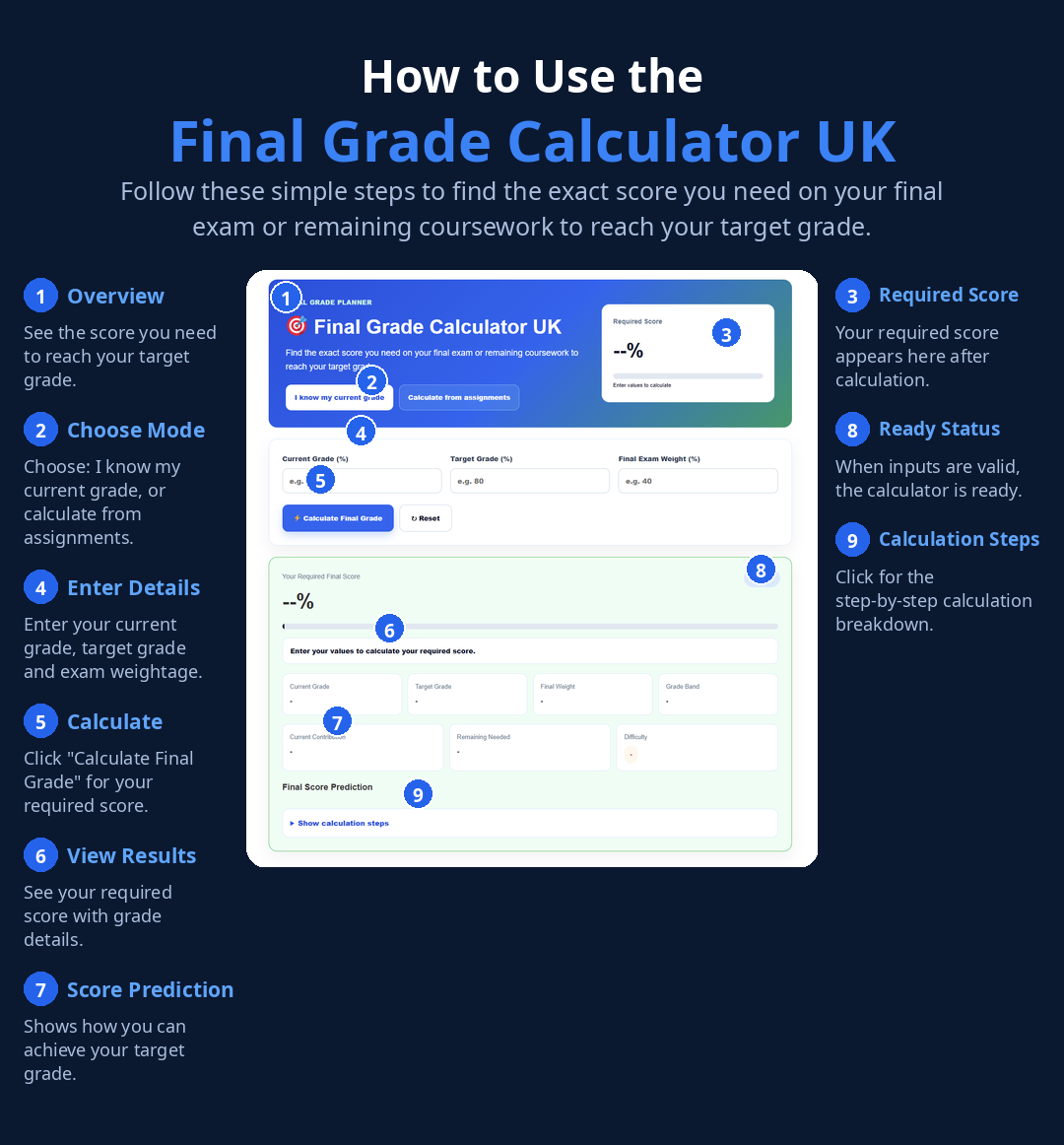
Click Here: Final Grade Calculator UK
The One Rule That Ends Most Appeals: Academic Judgement Is Not Appealable
Every UK university appeals procedure contains a version of the same sentence. Oxford states it bluntly in its Academic Appeals Procedure: “There is no right of appeal over matters of academic judgment.” Birmingham City’s procedure adds that you cannot appeal against the decision made by academic staff on the quality of your work or the criteria being applied to mark it. The OIA defines academic judgement as “a judgment that is made about a matter where only the opinion of an academic expert is sufficient” — and neither your university’s appeals panel nor the OIA will substitute its own opinion for your marker’s.
The reason for the rule is structural. Assessment is the core academic function of a university: work is typically double-marked, a sample is checked by an external examiner, and the exam board ratifies the outcome. If every student who disliked a mark could appeal it, exam boards would become permanent negotiations and degree standards would collapse. So the system gives you a different, narrower right: not the right to a different mark, but the right to a fair process. Your appeal has to identify what was unfair about the process.
This is where most would-be appeals die, usually on one of these misunderstandings:
- “My friend’s essay was weaker and got a higher mark.” Comparative marking claims are academic judgement. Unless you can point to a procedural flaw, the comparison is irrelevant.
- “My tutor said the draft was first-class.” Formative feedback is guidance, not a guarantee. Birmingham City’s procedure explicitly warns that an appeal based solely on positive draft feedback followed by a lower final mark may be deemed ineligible.
- “The feedback was too thin to justify the mark.” The quality of feedback can be raised as a complaint about teaching; it is not an appeal ground.
- “The exam was just too hard.” Difficulty is an academic judgement about standards, applied equally to the cohort. It is not a procedural irregularity.
If your situation genuinely is “I think the marking was wrong,” the productive routes are: request detailed feedback, ask for a clerical check that your marks were added up correctly (an addition error is an administrative matter), and put your energy into the assessments still ahead of you. An appeal is the wrong tool for that problem.
The Three Grounds on Which You Can Appeal
The OIA’s good practice framework recognises three grounds for academic appeal, and almost every UK university mirrors them in its own regulations:
- Procedural irregularity or administrative error. The assessment was not conducted in accordance with the published regulations, or a significant procedural or administrative error prejudiced your performance or the board’s decision.
- Bias or prejudice. There is evidence that the marking or decision-making process was biased. The OIA defines bias as “a tendency to favour one person or group, thing or point of view over another, especially in a way considered to be unfair.”
- Extenuating (mitigating) circumstances not taken into account. Circumstances affected your performance that the exam board did not know about when it decided — and which, for good reason, you could not raise earlier.
Manchester’s student guidance adds a practical sting to the third ground: the university will not uphold an appeal “if you could reasonably have used the Mitigating Circumstances procedure when the issue first arose.” An EC-based appeal must therefore explain two things, not one: what happened, and why it was not declared through the normal EC route at the time. Students who skip that second explanation lose winnable cases.
| Your situation | Realistic example | Valid ground? |
|---|---|---|
| Procedural irregularity | Your exam ran for 90 minutes although the published rubric said 120; or the board applied the wrong late-submission penalty to your cohort | Yes |
| Administrative error | Your EC claim was submitted before the exam board met but never reached the board because of a filing error | Yes |
| Bias | The marker had an undisclosed personal conflict with you and no second marking took place | Yes — but needs hard evidence |
| EC not considered | Hospitalisation during exam week; you were incapacitated and could not file an EC claim in time | Yes |
| “The marker was harsh” | You believe the essay deserved 68, not 58 | No — academic judgement |
| “My friend got more” | A comparative claim with no procedural flaw identified | No |
| Poor teaching or supervision | Lectures were disorganised; your supervisor barely responded | No — file a complaint instead |
| Positive draft feedback | Your tutor praised the draft; the final mark was lower | No — explicitly ineligible at some universities |
| General exam stress | You felt anxious but have no medical evidence and nothing exceptional occurred | No — not exceptional |
Read more: University Marking Criteria Explained — How Your Work Is Assessed
Appeal Deadlines at UK Universities: Shorter Than You Think
Appeal windows are measured in days, not months, and they run from the publication of the decision — not from when you feel ready to deal with it. Missing the deadline usually ends the matter outright. Edinburgh’s regulations accept late appeals only in exceptional circumstances, and never those submitted two or more years late. Glasgow warns that students needing GP letters or subject access requests must start immediately, because gathering evidence takes longer than the window allows.
| University / body | Deadline | Notes |
|---|---|---|
| University of Glasgow | Intimation of intention within 10 working days; full grounds within a further 20 working days | Two-step process; you may skip straight to full grounds within the first 10 working days |
| University of Edinburgh | Final-year undergraduates and all postgraduates: 30 working days; other undergraduates: 10 working days | Counted from being informed of the decision |
| University of Manchester | Informal stage: 20 working days from the results letter; formal appeal: 20 working days; review stage: 20 working days | Three-stage process; late appeals need evidence explaining the delay |
| University of Oxford | Check current procedure | Grounds limited to procedural irregularity and bias — no appeal on academic judgement |
| Other UK providers | Often 10–20 working days, or around 14 calendar days | Some institutions count calendar days, not working days — read your own regulations |
| OIA (England & Wales) | Within 12 months of the Completion of Procedures letter | Only after all internal procedures are exhausted |
| SPSO (Scotland) | Normally within 12 months of becoming aware of the issue | Final stage after the university’s own process is complete |
The practical lesson from Glasgow’s appeals FAQ is worth repeating: if your evidence depends on other people — a GP appointment, a counsellor’s letter, a subject access request — start the clock on those requests the day you decide to appeal, and ask for an extension early if you genuinely cannot meet the window, showing everything you have done so far. Panels judge the timeliness of your own actions when deciding extensions.
How to Appeal a University Grade: The Four Stages
Although the details differ, the shape of the process is similar everywhere. Here are the stages in the order you will meet them.
Stage 1 — Informal resolution. Before anything formal, talk to someone: your academic adviser, personal tutor, supervisor or programme director. Manchester’s procedure expects this first step, and Glasgow advises students to consult their adviser of studies and explore whether the matter can be resolved without a formal appeal. Many cases end here in the best possible way — a clerical error gets corrected, or the marking process is explained well enough that the student understands the result. Note Glasgow’s warning: you can only appeal a published decision of an exam board, not a provisional mark.
Stage 2 — Formal appeal. If the informal route does not resolve things and you believe you have valid grounds, submit a written appeal on the university’s official form: name your ground or grounds, attach your evidence, and state the remedy you are seeking. Manchester requires submission within 20 working days, evidence in English (or with certified translation), and warns that the exam board’s original decision stands while the appeal is considered. Be precise — vague appeals that do not identify a ground are routinely ruled inadmissible at this stage.
Stage 3 — Internal review. If the formal outcome seems unreasonable, most universities offer a review stage. At Manchester, for example, you can write to the Head of the Division of Teaching, Learning and Student Development within 20 working days of the decision. This is a review of whether the process was handled properly, not a re-hearing of your original complaint about the mark.
Stage 4 — The external ombudsman. Once internal procedures are exhausted, the final stage depends on where you study. In England and Wales, the Office of the Independent Adjudicator for Higher Education (OIA) provides a free, independent review. The OIA checks whether your university applied its regulations properly, followed its procedures, and reached a decision that was fair and reasonable in all the circumstances — it does not re-mark work or substitute its own academic judgement. You will receive a Completion of Procedures letter when the internal route ends, and you then have 12 months to take your case to the OIA.
In Scotland, the final stage is the Scottish Public Services Ombudsman (SPSO) — also independent, free and confidential. The SPSO examines how the university handled your appeal or complaint (looking for service failure or maladministration), not the academic substance of the original decision. It normally only considers matters within 12 months of you becoming aware of them. The SPSO has real teeth on procedure: in 2026 it ordered the University of Glasgow to apologise to a former student after finding the university had unreasonably declined to consider an appeal and failed to give the student adequate information and opportunity to provide evidence.
Read more: University Academic Regulations Explained — Rules Every Student Should Know
Evidence: What Wins Appeals (and What Doesn’t)
Glasgow’s appeals FAQ puts it bluntly: “Lack of sound, impartial evidence is bound to weaken an appeal.” Panels decide on documents, not on how strongly you feel. What counts as persuasive depends on your ground:
- Procedural irregularity: the published regulation side by side with what actually happened — the exam timetable, the module rubric, the board minutes, the email chain. If the handbook said 120 minutes and the invigilator’s report says 90, you barely need an argument.
- Bias: the hardest ground to prove. You need something concrete and documented — a declared or demonstrable conflict of interest, evidence of different treatment — not a feeling that the marker disliked you.
- Extenuating circumstances: contemporaneous, independent evidence covering the assessment period. A GP letter dated at the time, hospital records, a death certificate, a counsellor’s letter. Manchester requires evidence relevant to the period being appealed, in English or with a certified translation. A retrospective “I was stressed” with no documentation will fail, and ordinary exam stress does not qualify as exceptional.

Two evidence mistakes sink otherwise valid appeals. The first is timing: EC evidence must cover the assessment period itself, not just the weeks after results when you realised the impact. The second is silence about delay: if you could reasonably have used the mitigating circumstances procedure at the time, explain why you didn’t — Manchester’s guidance makes this an explicit test, and “I didn’t know about it” is rarely accepted from a student who received the standard pre-exam communications.
What Happens If Your Appeal Succeeds: The Possible Remedies
Here is the part students most often misunderstand: a successful appeal very rarely means somebody changes your 58 into a 68. Appeal panels cannot make academic judgements — Nottingham’s procedure states plainly that its Academic Appeal Panel “cannot change marks or degree classifications.” Instead, the available remedies are designed to restore you to the position you would have been in had the irregularity not occurred:
| Remedy | What it means in practice |
|---|---|
| Re-mark of the work | The work is marked afresh under standard procedures. Note: the new mark can go up or down — at least one UK university’s regulations state this explicitly, so a re-mark is not risk-free. |
| Assessment voided; resit as if for the first time | The original mark is set aside and you take the assessment again uncapped — the single most valuable remedy. |
| EC accepted | An uncapped resit, or the circumstances formally taken into account in the award and classification decision. |
| Late penalties waived | Your submission is re-marked without the late-submission deduction. |
| Administrative error corrected | Wrongly recorded or aggregated marks are fixed — the one route by which a mark itself can change directly. |
| Case sent back to the exam board | The board reconsiders your case with the error corrected, sometimes via a freshly constituted panel. |
Two cautions. First, a successful appeal puts you in no better position than a fair process would have — it restores, it does not reward. Second, while your appeal is ongoing, your academic status is frozen: one university’s procedure notes that a degree cannot be conferred whilst an appeal is ongoing, and Glasgow warns that if you are appealing your final award you must withdraw from graduation, because graduating is deemed acceptance of the award.
Worked Example: Priya’s Successful Appeal
Priya is a final-year Business student. Her 20-credit Strategic Management module came back at 38% — a fail. But Priya had submitted an extenuating circumstances claim (her grandmother’s death and the funeral, during revision week) two days before the exam board met. An administrative filing error meant the board never saw it, and the published outcome recorded no EC consideration. Her appeal ground: extenuating circumstances not taken into account, caused by an administrative error. She attached the dated EC submission receipt and the death certificate.
The panel upheld the appeal and voided the 38%. Priya resat the module as if for the first time — uncapped — and scored 64%. Here is what that did to her final-year average (all modules 20 credits):
| Module | Credits | Original mark | Weighted points (original) | After successful appeal | Weighted points (new) |
|---|---|---|---|---|---|
| Research Methods | 20 | 62% | 1,240 | 62% | 1,240 |
| Marketing | 20 | 65% | 1,300 | 65% | 1,300 |
| Finance | 20 | 60% | 1,200 | 60% | 1,200 |
| Strategic Management | 20 | 38% (fail) | 760 | 64% (uncapped resit) | 1,280 |
| Human Resources | 20 | 63% | 1,260 | 63% | 1,260 |
| Operations | 20 | 61% | 1,220 | 61% | 1,220 |
| Total | 120 | 6,980 | 7,500 |
Original final-year average: 6,980 ÷ 120 = 58.17% (a 2:2, with a failed module still to clear). Without the appeal, her resit would have been capped at 40% (7,020 ÷ 120 = 58.50%) — still a 2:2. After the successful appeal: 7,500 ÷ 120 = 62.50% — a 2:1, a swing of more than four percentage points and a full classification band. That is the real monetary and career value of the uncapped-resit remedy, and why evidence of the filing error (the dated submission receipt) was the document that won the case.
Read more: What Happens If You Fail a University Module? — Your Next Options Explained
What Happens If Your Appeal Is Rejected: James’s Case
Most appeals fail, and the commonest reason is a ground that is really academic judgement wearing different clothes. Consider James, a final-year English student. His 20-credit coursework essay was marked at 67%. His final-year average sits at 68.5% — a high 2:1, but he needs 70 for a First. James is convinced the essay deserved 72, and a friend’s “weaker” essay received 70. He appeals on harsh marking and comparative unfairness.
The department’s response: the essay was double-marked, the published criteria were followed, and the external examiner had sampled the batch. No procedural irregularity, no evidence of bias, no unconsidered extenuating circumstances. The appeal was ruled inadmissible — a challenge to academic judgement, which no UK university permits.
The transcript effect is nil:
| Item | Before appeal | After rejected appeal |
|---|---|---|
| Essay mark (20 credits) | 67% | 67% — unchanged |
| Final-year average | 68.5% | 68.5% — unchanged |
James’s productive options were elsewhere: requesting detailed feedback to understand the 67, asking for a clerical check that the marks were aggregated correctly, and — most usefully — working out exactly what he needs in his remaining assessments. Plug your own numbers into our Final Grade Calculator to see what your remaining modules must deliver: for James, the honest answer was that he needed roughly 73+ across his final two essays, a target he could plan for instead of litigating a mark that was never going to move.
Read more: Can You Improve Your Degree Classification? — Everything You Need to Know
Appeals vs Complaints: Don’t File the Wrong One
Appeals and complaints are different procedures with different remedies, and universities will move your case if you file it in the wrong place — Birmingham City’s procedure says exactly this. An appeal challenges an academic decision (a mark, a progression decision, an award) on the three restricted grounds above. A complaint covers dissatisfaction with services, teaching, supervision, facilities or staff conduct.
The OIA’s framework explicitly excludes poor teaching, supervision or academic guidance from appeal grounds — those belong in the complaints procedure. The distinction matters because the remedies differ: a complaint will not change your mark, and an appeal will not fix your teaching. They are not mutually exclusive, though. If your supervision was genuinely poor and the exam board mishandled your EC claim, file the complaint about the supervision and the appeal about the board — each through its own procedure, each with its own evidence.
Get Advice Before You Submit: The Students’ Union
Every university’s appeals guidance points students toward the same first port of call: the students’ union advice service — Glasgow’s SRC Advice Centre, Manchester’s Students’ Union Advice Service, Oxford’s OxfordSU advice team. This is not generic signposting. Union advisers handle academic appeals constantly: they know which grounds panels actually accept, what evidence persuades and what gets skimmed, and how your specific regulations phrase the legalistic tests. They have seen hundreds of cases; you get one attempt at yours.
Go early — ideally before the informal stage, and certainly well before the formal deadline. An adviser reviewing a draft appeal can spot the fatal flaw (“this paragraph argues academic judgement — cut it or reframe it around the procedure”) while there is still time to fix it. Bring your results letter, the relevant regulations, your evidence, and a clear statement of what remedy you want. That single meeting is the highest-value hour in the entire process.
Frequently Asked Questions
Can I appeal a university grade in the UK just because I think the mark is unfair?
No. Disagreeing with academic judgement — believing your work deserved a higher mark — is not a ground for appeal at any UK university. You must show a procedural irregularity, bias, or extenuating circumstances that the exam board did not consider.
What are the valid grounds for an academic appeal?
The three recognised grounds are: (1) a procedural irregularity or administrative error in the assessment process; (2) bias or prejudice in marking or decision-making; and (3) extenuating circumstances that affected your performance but were not known to the exam board, which for good reason you could not raise earlier.
How long do I have to appeal a university grade?
Usually 10 to 30 working days from the publication of the decision, depending on the university — for example, 10 working days to intimate an appeal at Glasgow, 20 working days at Manchester, and 30 working days for final-year students at Edinburgh. Deadlines are strict, so check your own regulations immediately.
What evidence do I need for an academic appeal?
Documentary evidence matched to your ground: the published regulation versus what happened (for procedural claims), documented proof of bias (for bias claims), or contemporaneous independent evidence such as a GP letter, hospital records or a death certificate covering the assessment period (for extenuating circumstances). Panels decide on documents, not assertions.
Can my mark go down if my appeal succeeds?
It can, if the remedy is a re-mark. At least one UK university’s regulations state explicitly that a re-marked piece of work may receive a higher or lower mark depending on the assessors’ academic judgement. Other remedies, such as an uncapped resit, do not carry this risk.
What is the difference between an appeal and a complaint?
An appeal challenges an academic decision (a mark, progression or award) on restricted grounds such as procedural error or bias. A complaint covers dissatisfaction with teaching, supervision, services or facilities. A complaint will not change your mark, and poor teaching is not a valid appeal ground.
Can the OIA change my grade?
No. The Office of the Independent Adjudicator (England and Wales) reviews whether your university followed its procedures and acted fairly and reasonably — it does not re-mark work or substitute its own academic judgement. The same applies to the SPSO in Scotland, which examines how your case was handled.
Should I get help from the students’ union before appealing?
Yes — do it early. Students’ union advice services handle academic appeals constantly and can tell you whether your case fits a valid ground, what evidence will persuade the panel, and how your university’s regulations phrase the tests. Bring your results letter, the regulations and your evidence to the meeting.
Conclusion
The students who win academic appeals are not the ones who argue hardest that their work deserved more marks — they are the ones who identify, precisely and with documents, what went wrong with the process. A lost EC claim, an exam run outside the published rules, a demonstrable bias: these are the cases panels uphold, and the remedy that matters most — an uncapped resit, as Priya’s 58-to-62 swing showed — can move an entire degree classification.
Before you file, run the three-question test: can I name my ground in one sentence, do I have documents to prove it, and am I inside the deadline? If the answer to all three is yes, get your students’ union adviser to review the draft and submit. If the real answer is “I just think the mark was unfair,” save the appeal — and spend that energy on the assessments still ahead, where every mark is still yours to earn. Our Final Grade Calculator will show you exactly what those remaining marks need to be.

![Read more about the article Late Submission Penalties at UK Universities: Exactly What Each Day Costs You [2026]](https://gradeforuni.com/wp-content/uploads/2026/10/featured-late-submission-penalties-300x192.png)
![Read more about the article Joint Honours Grading: How Your Two Subjects Become One Degree Class [2026]](https://gradeforuni.com/wp-content/uploads/2026/10/featured-joint-honours-uk-300x192.png)