

Opening a results email and finding the word “referral” next to your module mark is a peculiar kind of relief wrapped in confusion. You haven’t quite failed out — but you clearly haven’t passed either. On The Student Room, thousands of students post the same question every results season: I’ve been “referred” — what does that actually mean?
A university referral is a formal second chance: the exam board offers you one more attempt at the assessment you failed, usually in the late-summer reassessment period, without having to re-attend the module. It sounds generous, and in many ways it is — but referrals come with strict conditions. Marks are almost always capped at the pass mark (40% for undergraduates, 50% for Masters), you normally redo only the components you failed, and a failed referral can mean repeating the year or leaving the course entirely.
This guide explains exactly how university referrals work in the UK: what the term means in official regulations, who gets offered one and when, how the 40% cap affects your degree classification, what referrals cost, and what happens if the referral itself goes wrong. The rules are drawn from real university assessment regulations — because this is one area where campus rumour and the actual rulebook diverge sharply.
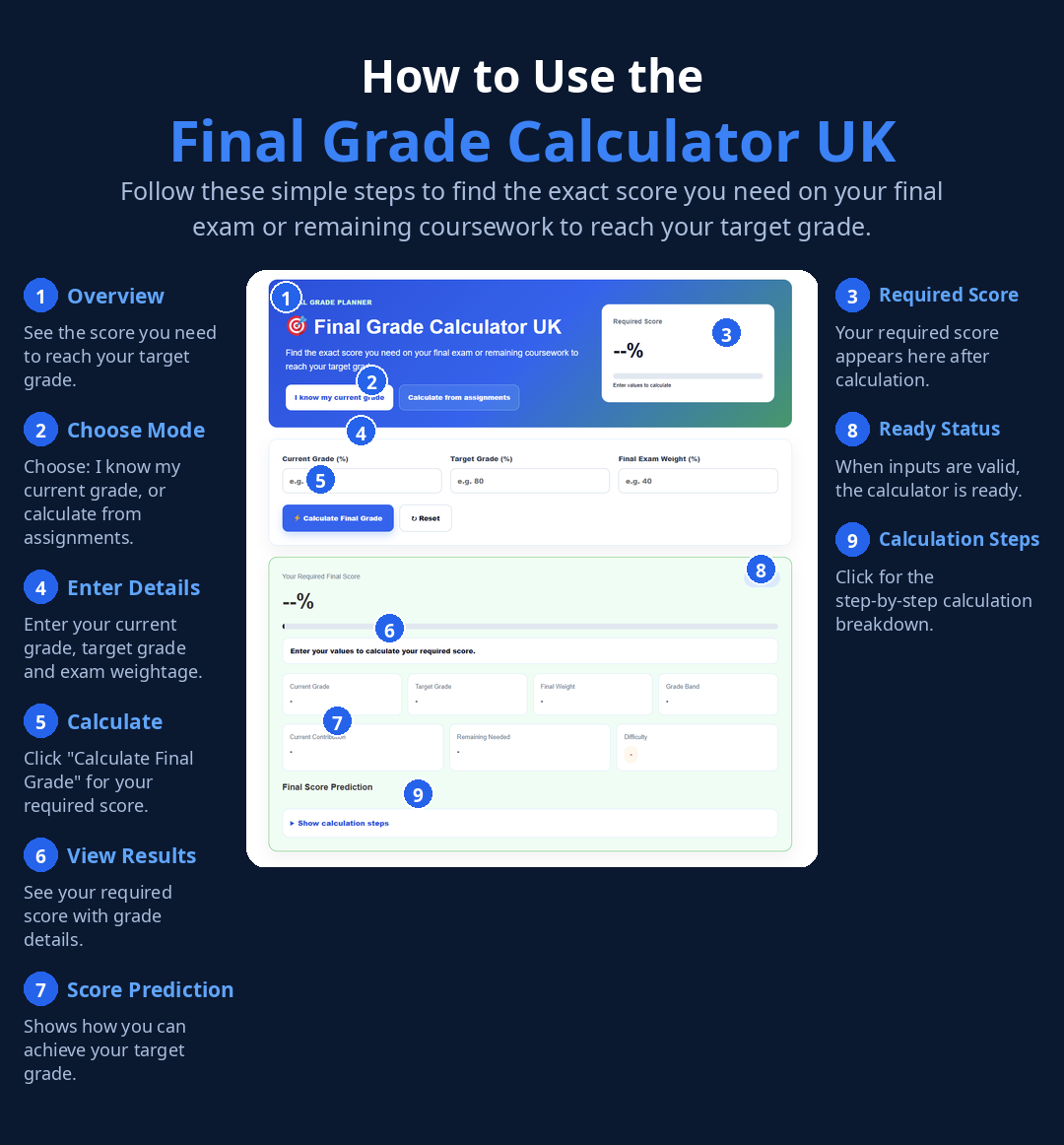
Click Here: Final Grade Calculator UK
What Is a University Referral?
In UK academic regulations, a referral is a defined term, not student slang. The University of Westminster’s postgraduate framework puts it plainly: “A Referral gives the student an opportunity to retrieve the failed assessment component(s) of a failed module without attendance.” That last phrase is the heart of the definition — a referral lets you retake the failed bits without sitting through the teaching again. The full regulation is published openly, and it is worth reading your own university’s equivalent.
Most UK universities now use the term explicitly in their regulations: the University of Derby, Sheffield Hallam, the University of Suffolk, LJMU, the University of Kent, the University of Exeter and Southampton all define referral rights in their assessment rules. LJMU’s student guide translates the legalese into something closer to what you’d actually hear: “Referral — this is classed as a second attempt at a module… marks are capped.”
One caveat: the terminology isn’t universal, and it changes over time. UCL, for example, abolished its referral system in the 2017–18 academic year, replacing it with “Late Summer Assessment.” If your university’s regulations don’t mention referrals, look for terms like reassessment, resit or second sitting — the mechanics are usually the same, even when the label differs.
Referral vs Resit vs Repeat: The Three Second Chances
Students use “resit” and “referral” interchangeably, and universities don’t help — many don’t. But in the regulations, three distinct second-chance routes exist, and which one you get changes everything about marks, attendance and cost:
| Referral | Resit | Repeat (retake) | |
|---|---|---|---|
| Attendance | No — reassessment only | No — reassessment only | Yes — full teaching, new academic year |
| What you redo | Only the failed components | The failed exam/assessment, set by the board | All module components, from scratch |
| Mark cap | Capped at pass mark (40% UG / 50% PG) | Capped at pass mark | Sometimes uncapped — the one route where a full mark is possible |
| When | Late-summer reassessment period | Late-summer reassessment period | Following academic year |
| Passed work | Kept — carried forward | Carried forward where rules allow | Discarded — you start over |
Arts University Plymouth states the distinction cleanly: a referred student “will normally be required to resubmit only the element(s) of the unit which have been failed,” while a student required to repeat “will normally be required to repeat all elements.” UWE Bristol draws the same line from the other side: a referred student has a right to reassessment in the failed components only, but a student on a second or subsequent attempt must retake all assessment and may not carry forward any outcomes from the previous attempt.
The practical upshot: a referral is the lightest-touch rescue. You study for one exam or rewrite one assignment, in the summer, with your passed coursework intact. A repeat is the heaviest — a full year of fees, lectures and labs for one module.
Read more: What Happens If You Fail a University Module? — Your Next Options Explained
Who Decides You Get a Referral — and When It Happens
A referral is not automatic. It is offered by the exam board — usually called the Assessment Board or the Progression and Award Board (PAB) — when it meets to ratify results. UWE’s regulations say it directly: “Students are referred by the PAB.” Northeastern University London’s regulations describe “second sitting assessments where the student has been referred by the PAB.” The board checks whether you qualify (a further attempt must be permitted under the rules, and compensation must not have been applied instead), then records the referral in your results letter. The University of Kent’s results letters even itemise each student’s “referral method” — the exact task you’re expected to complete.
Timing is one of the biggest shocks for students. Referrals almost always happen in the late-summer reassessment period, not in the weeks after results. The University of Kent schedules undergraduate resit exams for 15–28 August 2026 (postgraduate: 5–11 September 2026), and students are automatically enrolled and notified through their results letters. The University of Nottingham says reassessment “will normally be taken in the August resit period,” Imperial College describes resits as “normally over summer vacation period,” and QMUL tells foundation students they are entitled to one resit “in August.”
If you fail a January exam, that can mean a seven-month wait before your second chance — a gap students on The Student Room regularly describe as the hardest part. A University of Westminster staff member posting on TSR put it bluntly to one student: “if your MC’s are not accepted you will be given a referral in the summer… You will have to wait until the summer months.” The waiting is structural, not personal.
You Only Redo What You Failed
Here is the referral’s most under-appreciated kindness: you don’t retake the whole module. The University of Derby’s regulations give students “one referral opportunity in any assessment components where they achieve a mark of less than the minimum pass” — everything you passed stays passed. Westminster limits referral to “the failed assessment component(s)”, and the University of Suffolk reassesses students “once only in those components of assessment not passed.”
This matters enormously for revision strategy. If you failed the 60%-weighted exam but passed the 40%-weighted coursework at 58%, your summer is about one paper — not the module. It also matters for the cap maths below, because only the failed component’s mark gets replaced.
There is a lesser-known safety net here too. What if you attempt the referral and score worse than your first attempt — or fail again? Several universities apply a “best mark stands” principle. The University of Suffolk uses “the highest mark achieved for the component (i.e. the best fail)” when a reassessed component still fails, and Derby’s rules say a referral mark “will also replace the original component unless it is lower than the mark obtained at the first attempt.” A bad referral day can’t push you below where you started.
The 40% Cap: Why Your Referral Mark Is Limited
This is the fact that dominates every student forum thread about referrals, and the one most students discover too late: referral marks are capped at the module pass mark. Score 82% on your August resit and your transcript will still say 40%.
- Northeastern University London: second sittings referred by the PAB “will be awarded a maximum (capped) mark of 40% for undergraduate and 50% for postgraduate.”
- University of Plymouth: referred or repeated modules capped at the pass mark — “40% for Level 0–6 modules, 50% for Level 7 and 8 modules.”
- University of Westminster: “the mark awarded to any referred assessment component will be capped at the pass mark (40 in the case of modules at Level 6, 50 in the case of modules at Level 7).”
- University of Southampton: “The mark obtained at Referral will be Capped at the Module Pass Mark.”
The University of Exeter makes it explicit at module level, so students see it before they sit the paper. For one business module: “The mark given for a re-assessment taken as a result of referral will count for 100% of the final mark and will be capped at 40%.” A psychology module adds the consequence: pass the referral and “the overall module mark will be capped at 40%.” You can see the exact wording on Exeter’s public module pages.
The logic is deliberate, even if it feels unfair. The referral is a second chance to demonstrate minimum competence and earn the credits — not a fresh attempt at the full grade range. As one long-running TSR thread warns pharmacy students: “This is called a referral… Be warned that no matter what mark you get in the referral the mark… may well be capped at 40%.”
Worked Example: What the Cap Does to a Year Average
Take Priya, a second-year Biomedical Science student. She failed one 20-credit module’s exam component with 34% in January and was referred. Her other five modules passed at these marks: 64, 61, 58, 66 and 59. In August she sits the referral paper and earns a genuine 71% — but the cap reduces it to 40%.
| Module | Credits | Mark used | Weighted points |
|---|---|---|---|
| Cell Biology | 20 | 64% | 1,280 |
| Genetics | 20 | 61% | 1,220 |
| Biochemistry | 20 | 58% | 1,160 |
| Microbiology | 20 | 66% | 1,320 |
| Physiology | 20 | 59% | 1,180 |
| Pharmacology (referral, capped) | 20 | 40% | 800 |
| Total | 120 | 6,960 |
Year average: 6,960 ÷ 120 = 58.0%. Had the referral been uncapped at her true 71%, the total would have been 7,580 and the average 63.2% — more than five percentage points higher. That single capped module is the difference between a year that reads “comfortable 2:2” and one that reads “strong 2:1 territory.” This is exactly the calculation TSR students redo obsessively: one user mapped an entire degree plan around a 15-credit Level 6 module “capped at 40%”, checking how it dragged the classification.
Worked Example: A Final-Year Referral Near a Classification Borderline
Now consider James, a final-year Economics student on a 40:60 year weighting (Year 2 counts 40%, final year 60%). His Year 2 average was 61.4%. In final year, he failed one 20-credit module’s coursework (28%), passed everything else at 62, 65, 59, 68 and 64, and passed the August referral — capped at 40%.
Final-year total: (62 + 65 + 59 + 68 + 64) × 20 = 6,360, plus the capped module 40 × 20 = 800. Total 7,160 ÷ 120 = 59.7%. Final degree score: (61.4 × 0.40) + (59.7 × 0.60) = 24.56 + 35.80 = 60.4% — a 2:1, but only just. Without the failed module, his final-year average would have been around 63.6% and his degree score 62.7% — comfortably mid-2:1. One capped referral cost him over two percentage points at the classification that employers actually read.

The One Big Exception: When the Resit Mark Doesn’t Count
Most universities feed the capped referral mark straight into your average. Southampton states that “the Capped Mark achieved at Referral will be used for calculating the Final Average Mark and determining award eligibility and final degree classification.” Reading’s rule is precise: for classification, use the higher of the first-attempt mark and “the lower of 40 and the mark achieved in the reassessment.” UWE similarly restricts a module passed on referral to 40% “for the purpose of determining a differential level of an award.”
The University of Nottingham is the famous exception — and it surprises its own students. There, an undergraduate resit mark “will not be included in your final degree calculations”: the original first-attempt mark is what counts toward classification. Nottingham’s own example: a student scores 38 first attempt, then 63 on re-assessment — “it is the original mark of 38 that will be used when calculating the weighted average.” The resit earns the credits for progression; the degree class is decided by the first attempt. For postgraduate taught courses, Nottingham counts resit marks toward a Pass only — not toward Merit or Distinction.
Two opposite philosophies, same lesson: read your own university’s regulations before assuming either rule. “Capped mark counts” and “original mark counts” lead to very different revision priorities.
Do Referrals Cost Money?
This is the area of widest variation — and the source of the most forum misinformation. TSR threads swing between rumours of “£100 per exam” and reassurances of “no charge,” and both are true somewhere:
| University | Referral/resit fee |
|---|---|
| Nottingham | £86 (undergrad) / £140 (postgrad) — one-off charge, however many resits you take in the period |
| UWE Bristol | No charge for a resit; retakes within a standard year covered by tuition |
| Edinburgh | £0 — no fees for coursework, essay or practical reassessment |
| Reading | Covered — tuition fees include resit fees |
Check your university’s fee policy before the reassessment period — the bill, where it exists, is usually due when you’re enrolled for the resit, and non-payment can block you from sitting it.
What Happens If You Fail the Referral?
This is the question students are most afraid to ask, and the answer is: it depends how far down the ladder your university lets you go.
Imperial College’s ladder allows up to four bites at a module for undergraduates: first sit → resit (summer, capped) → retake of the module with attendance (capped) → resit (summer, capped). Bedfordshire’s ladder is starker: fail the resit and you must retake the unit with all teaching and assessment — this time uncapped; fail the retake and you get one final resit, capped at 40%; fail that and “you will be required to leave your course” (an exit award may be available). UWE, by contrast, gives a right to “one, and only one, further attempt” after the first — the referral is effectively the last standard chance.
On some professional courses there is no ladder at all. Exeter’s pharmacy module rules warn that failing a referral resit means you are “failed in the module and as a consequence… failed in the programme,” with registration terminated. Accredited courses — pharmacy, nursing, teaching — often have stricter progression rules than the university’s general regulations, so always check the programme handbook, not just the university-wide rules.
Two more limits worth knowing. First, some assessments can’t be referred in principle: Imperial requires students to retake the following year — with no resit option — where assessment needs a lab or fieldwork environment, and Derby may set a new task where the original was an unseen exam or group activity. Second, a masters dissertation typically gets only one referral: UWE permits “only one attempt at a masters dissertation module,” with up to twelve months allowed for the resubmission when extenuating circumstances are accepted.
Referral or Deferral? The Uncapped Alternative
There is one legitimate way to sit a second attempt without the cap — and it is the most misunderstood distinction in this whole area. If your first attempt was wrecked by documented illness or another exceptional event and your extenuating circumstances claim is accepted, you are not referred: you are deferred, and the new attempt is treated as a first attempt.
Exeter’s module specifications draw the line explicitly: “Deferral – if you miss an assessment for certificated reasons… The mark given for a re-assessment taken as a result of deferral will not be capped and will be treated as it would be if it were your first attempt.” Contrast: “Referral – if you have failed the module overall… capped at 40%.” Plymouth states the same principle: “Marks will not be capped if the referral or repeat is taken as a first attempt.”
The difference between a capped 40% and an uncapped mark can be a full degree classification — recall the Priya and James worked examples above. Which is precisely why the evidence bar for extenuating circumstances is high, deadlines are strict, and claims must be submitted before or very shortly after the affected assessment. If you think you qualify, read your university’s EC procedure now, not in August.
Read more: Extenuating Circumstances: How UK Universities Protect Your Grades · What Is a Condoned Pass?
Three Quirks Most Students Never Hear About
Academic misconduct can cancel your referral entirely. The University of Derby’s regulations warn that “any and all entitlements to referral can be removed following proven academic misconduct.” Fail because of plagiarism and you may lose the second chance that an honest 34% would have earned you.
Compensation can make the referral unnecessary. Sheffield Hallam’s assessment ladder gives one referral opportunity “unless… compensation has been automatically applied” — if your narrow fail is condoned under the compensation rules, there’s nothing to refer. Always check whether your failed module might be compensated before planning a summer of revision.
The word on your results letter might not be “referral” at all. Beyond UCL’s switch to Late Summer Assessment, universities use “reassessment,” “second sitting,” “resit diet” (Scotland) and “referred assessment” for the same mechanism. Search your university’s regulations for the concept — capped second attempt without attendance — rather than the word.
Your 48-Hour Checklist After a Referral Offer
- Read your results letter properly. Find the referral method — which components, which task, which deadline. Kent-style letters itemise it; others bury it in a PDF.
- Check for compensation first. If the fail is narrow, the board may have condoned it already — or you may have grounds to ask why it wasn’t.
- Consider extenuating circumstances. If illness or crisis affected your first attempt, an EC claim converts a capped referral into an uncapped deferral — but only if you act within the deadline.
- Model the cap. Plug a 40% (or 50% for Masters) into your year average with the Final Grade Calculator UK and see what it does to your classification — then decide how much the referral is worth to you.
- Plan the summer. You usually get one shot in August/September, with no teaching. Book revision time now; the students who treat the referral as a holiday with an exam at the end are the ones posting about failed referrals.
- Sort money and admin. Check whether your university charges a resit fee (Nottingham: £86/£140) and confirm your enrolment for the reassessment period — Kent auto-enrols, others don’t.
- Keep your passed marks safe. Confirm in writing which components carry forward, so a summer admin error doesn’t erase your 58% coursework.
Read more: Borderline Grades: How Discretionary Uplift Works at UK Universities · How to Improve a 2:2 to a 2:1 in Final Year
University Referrals: Frequently Asked Questions
Quick answers to the questions students ask most about university referrals.
What is a referral at a UK university?
A referral is a formal second chance offered by the exam board after you fail a module: one more attempt at the failed assessment components, usually in the late-summer reassessment period, without re-attending the teaching. Universities including Westminster, Derby, Sheffield Hallam, Exeter and Southampton define referral rights in their academic regulations.
Is a university referral the same as a resit?
Not exactly, though students use the words interchangeably. In regulations, a referral specifically means reassessment of only the failed components without attendance, with marks capped at the pass mark. A repeat or retake means re-attending the whole module with teaching the following year, sometimes with uncapped marks. A resit is the generic term many universities use for the summer reassessment itself.
Are referral marks capped at 40%?
Almost always. Undergraduate referral marks are capped at 40% and postgraduate (Masters) referral marks at 50% at universities including Northeastern University London, Plymouth, Westminster and Southampton. Even if your resit work deserves 70%, your transcript records the pass mark. The only common exception is an accepted extenuating circumstances claim, which converts the attempt into an uncapped deferral.
What happens if I fail my referral?
It depends on your university’s ladder. Common outcomes include being required to repeat the module with attendance the following year (sometimes uncapped, as at Bedfordshire), a final capped resit, or — at universities like UWE — no further standard attempt. On accredited professional courses such as pharmacy, failing a referral resit can mean termination of your registration on the programme.
Do I have to pay for a university referral?
It varies. Nottingham charges a one-off £86 (undergraduate) or £140 (postgraduate) resit fee covering the whole reassessment period, while UWE Bristol, Edinburgh and Reading charge nothing extra for resits. Check your university’s tuition fee policy before the August/September reassessment period.
Can I refuse a referral and repeat the year instead?
Sometimes, but it is rarely the better deal. A repeat means paying another year’s tuition and re-attending all teaching, and your passed components are discarded. Universities normally offer the referral as the default route; switching to a repeat usually requires board approval and is only sensible if you failed nearly everything or need the teaching to have any chance of passing.
Will a referral show on my transcript or affect my degree class?
The capped mark feeds into your year average and therefore your final classification at most universities — Southampton and Reading both confirm the capped mark is used for classification, while UWE restricts referred modules to 40% for award purposes. Nottingham is the notable exception: undergraduate resit marks do not count toward classification there; the original first-attempt mark is used instead. Transcripts typically show the module as passed with the capped mark.
Can extenuating circumstances make my referral uncapped?
Yes — but technically it stops being a referral. If your extenuating circumstances claim is accepted, the attempt is reclassified as a deferral (a first attempt), and Exeter’s and Plymouth’s regulations confirm deferral marks are not capped. Claims must be submitted within strict deadlines, usually before or very shortly after the affected assessment, with supporting evidence.
A university referral is the university system at its most pragmatic: one more attempt, no lectures to re-attend, failed components only. But the 40% cap means a referral rescues your credits, not your average — and the students who come through it best are the ones who understood that distinction before August, not after. Check your results letter, check the compensation rules, and if illness played any part, check the extenuating circumstances deadline today.
Conclusion
A referral feels like a verdict, but it is really an invitation — the exam board is offering you a structured second chance instead of making you repeat the year. The price of that chance is the 40% cap and the fact that you only redo the assessments you failed, so treat the referral period as a short, focused campaign rather than a full re-sit of the module.
Move fast. Work through the 48-hour checklist: confirm your referral timetable, check whether any uncapped exception applies (extenuating circumstances can change everything), and get clarity on exactly which components you are redoing. Students who stumble at this stage usually do so on admin, not academics — missed deadlines and misunderstood requirements.
And once it is over, do the maths on what the capped mark means for your average. A 40% where you once hoped for 65% changes your classification trajectory, so recalculate and adjust your targets for the year ahead. One referral does not define a degree — but how you respond to it often defines the year.


![Read more about the article Can You Do a PhD with a 2:2? UK Doctorate Entry Requirements Explained [2026]](https://gradeforuni.com/wp-content/uploads/2026/10/featured-phd-with-2-2-300x192.png)