
![You are currently viewing Do UK Universities Curve Grades? How Scaling, Moderation & Final Marks Really Work [2026]](https://gradeforuni.com/wp-content/uploads/2026/10/featured-curve-grades-uk.png)
If you arrived at a UK university from an American-style education system — or you have just heard horror stories about professors who “grade on a curve” — you may be wondering whether UK universities curve grades, i.e. whether your marks depend on how clever everyone else in the room is. The short answer is no: UK universities do not curve grades. Your 68% is a 68% because of what you wrote, not because only 10% of the class were allowed an A.
UK marking is criterion-referenced: your work is judged against published grade descriptors and fixed classification boundaries (70% for a First, 60% for a 2:1, 50% for a 2:2, 40% for a Third). In principle, every student in a module could score 75% — nobody has to fail to make room at the top. That is the opposite of a bell curve, where grades are rationed by rank.
But there is a wrinkle students rarely hear about. UK universities can adjust marks after marking in a process called scaling — and in exceptional cases, a whole cohort’s marks move up together. This guide explains what curving actually means, why the UK rejected it, how scaling really works (with a full worked example), what moderation and external examiners do, and what it all means for your degree classification.
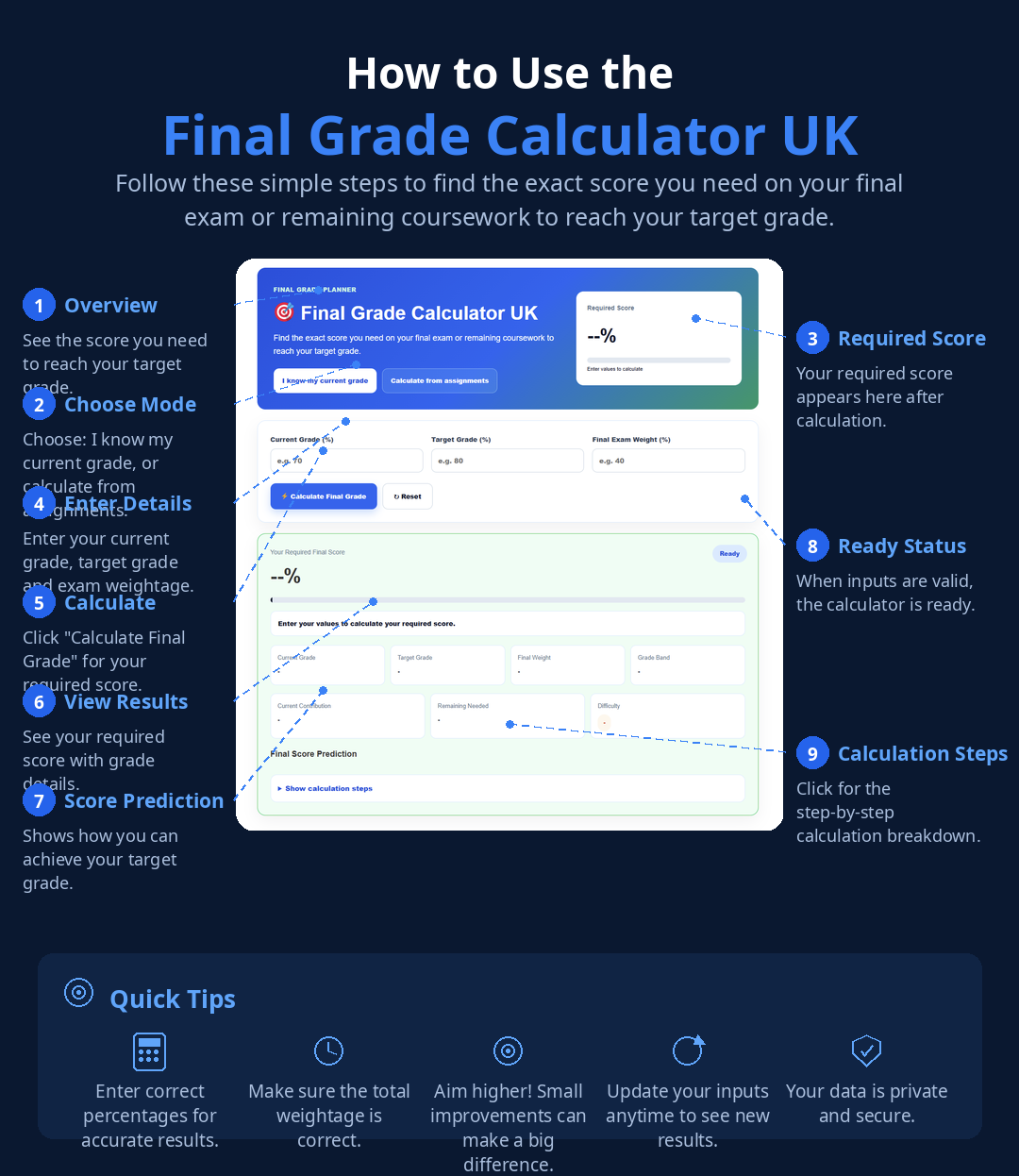
Click Here: Final Grade Calculator UK
What “Grading on a Curve” Actually Means
Grading on a curve — properly called norm-referenced assessment — ranks students against each other instead of against a fixed standard. The classic version forces marks into a bell curve: a set percentage get As, most get Bs and Cs, and a fixed tail must fail, whatever the absolute quality of the work. Your grade depends on your position in the pecking order, not on what you actually demonstrated.
This is normal in much of US higher education. Harvard’s faculty even voted to cap flat A grades at 20% of students per course from autumn 2027, precisely because uncapped grading had inflated the top of the curve. Under a strict curve, a brilliant cohort still produces failures, and a weak cohort still produces firsts — the distribution is decided in advance.
The UK system works the other way. Grade descriptors describe what 70%+ work looks like — originality, critical analysis, synthesis of sources — and any script that meets the description earns the mark. As one UK academic put it, marks here are moderated, second-marked, checked against the marking scale and reviewed by an external examiner, so individual lecturers have less freedom to move marks around on a whim — but also more backup when they defend the marks they gave. There is no quota of firsts to fill and no quota of fails to meet.
The Short Answer: UK Universities Do Not Curve Grades
Every reputable UK university marks against fixed criteria, not against your classmates. The classification boundaries are national and stable: 70% and above is first-class, 60–69% is a 2:1, 50–59% a 2:2, 40–49% a Third. A department cannot decide that this year’s cohort gets only five firsts because last year had eight. If twelve dissertations all meet the first-class descriptors, twelve firsts are awarded.
This is enforced structurally. Your work is marked against published criteria, a sample is second-marked or moderated internally, and an external examiner from another university reviews the standards. The external examiner’s entire job is to confirm that a 68 at your university means roughly the same thing as a 68 elsewhere — the opposite of letting each cohort float on its own curve.
That does not mean marks never move after they are given. It means they move for a completely different reason — and under much stricter rules — than curving. The mechanism is called scaling, and understanding it explains most of the “my whole year got bumped up” stories you hear.
Scaling: The Closest Thing to Curving in the UK
Scaling is a formal process where an exam board adjusts every mark on a module — usually upwards — because something went wrong with the assessment itself, not with the students. The classic trigger: an exam paper turns out to be far harder than intended, and the cohort mean lands far below both the module’s own history and the means of parallel modules. Rather than punish students for a faulty paper, the board applies a mathematical adjustment to bring the mean back into its expected range.
Crucially, scaling is not curving. A curve forces marks into a pre-set distribution every year; scaling is an exceptional repair job, used only when the unadjusted marks are demonstrably unfair. Four universities’ published rules show how tightly it is controlled — see York St John’s scaling policy (PDF) and Loughborough’s assessment handbook for two full examples:
| University | When scaling is allowed | Key safeguards |
|---|---|---|
| York St John (Code of Practice 2026–27) | Exceptional basis only; mean outside expected range vs 3-year history or cohort peers | After moderation complete; applied to all who attempted (not a subset); must not normally lower any mark; no mark above 100; rank order preserved; decided by School Assessment Board |
| Loughborough | Exceptional, not the rule; mean outside expected range from 3–5 year history or cohort comparison | Only after internal moderation by a second module leader; expected ranges based on evidence; module can simply be confirmed instead |
| Birmingham | After moderation, if the mean is outside the expected range on investigation | Marks for one module must not be normalised against other modules; scaling algorithm agreed with external examiners; mean changed by the least amount needed |
| Exeter | Exceptional circumstances only, to rectify anomalies from unanticipated circumstances | Board sees mean, median and standard deviation vs 3 prior years (pandemic “exceptional years” excluded); normally applied at module level; assessment practices then reviewed to avoid repeats |
Notice the pattern: exceptional basis appears in every policy. Scaling is the fire extinguisher behind glass, not a routine dial departments turn. And several rules exist specifically to stop it becoming a stealth curve — Birmingham explicitly forbids normalising one module’s marks against another’s, which is exactly what curving would do.
Worked Example: How a Scaled Module Actually Changes Marks
Policies are abstract, so here is a concrete illustration of how scaling works in practice. Take a fictional second-year module, Quantitative Methods for Business (20 credits, 120 students). The exam paper contains a question on a topic barely covered in lectures. When marking finishes, the module mean is 51.4% — against an expected range of 58–64% drawn from the previous three years, and well below the 59–63% means of the cohort’s other modules this year.
The exam board investigates, confirms the paper — not the students — is at fault, and agrees a simple linear adjustment: add 9 percentage points to every mark, capped at 100. Here is what happens to six students across the distribution:
| Student | Raw mark | Scaled mark | What changed |
|---|---|---|---|
| Amara | 38% | 47% | Still a fail — but 7 points closer; resit task is smaller |
| Daniel | 44% | 53% | Fail becomes a 2:2-level pass |
| James | 55% | 64% | 2:2 becomes a 2:1 |
| Priya | 67% | 76% | 2:1 becomes a First |
| Tom | 72% | 81% | First becomes a stronger First |
| Zara | 94% | 100% | Capped at 100 (94 + 9 = 103 → 100) |
Three things worth noticing. First, everyone moves together — scaling is applied to all students who attempted the assessment, including those who failed. It is never used to rescue only the failures. Second, rank order is preserved: Zara was top before and is top after; nobody overtakes anyone. Third, the cap matters: Zara gains only 6 points, not 9, because no mark may exceed 100.
Now the follow-up question students always ask: how much does this actually move a final degree? Take Priya’s jump from 67% to 76% — 9 points on a 20-credit module. A 20-credit module is one-sixth of the year, and if her university weights the final year at 60% of the degree, that module is worth 10% of her final classification (1/6 × 60%). Nine points × 10% = 0.9 percentage points on her final average. That sounds small — until you remember that degree classes are decided at exact boundaries. Our guide to borderline grades shows how often 0.9 points is the difference between a 2:1 and a First. If you want to see exactly where you stand, run your own numbers through the Final Grade Calculator.
Moderation Always Comes Before Scaling
One safeguard students underestimate: scaling can only happen after marking and moderation are complete. Moderation is the routine quality check that happens on every module, every year — and it is far more common than scaling. It typically works in three layers.
Layer 1: internal moderation. A second marker scrutinises a sample of scripts to check the assessment criteria were applied consistently — Loughborough’s policy requires the sample to be checked by a second module leader before any scaling discussion can even begin. Borderline fails and firsts are almost always second-marked in full. If the sample reveals a marker was harsh (or generous), marks for the whole cohort can be adjusted at this stage — this is moderation, not scaling, and it happens quietly every term.
Layer 2: the external examiner. Every UK university appoints external examiners — academics from other institutions — who review samples of marked work, approve exam papers in advance, and attend exam boards. Birmingham’s code requires scaling algorithms to be agreed with external examiners, and instances of scaling to be discussed with and approved by them, with full academic justification recorded. An external examiner who thinks standards are slipping can — and does — block adjustments.
Layer 3: the exam board. The board reviews module statistics against history before confirming marks. Exeter’s boards are shown the mean, median and standard deviation for each module alongside three years of comparable data, and scaling is considered only for statistically significant deviations. In most cases the board simply confirms the marks as a fair reflection of performance — which is why most students never encounter scaling at all.
The Cambridge Exception: Where Percentages Are Set in Advance
There is one famous near-exception to the no-curve rule: the Cambridge Mathematical Tripos. For that exam, approximate class proportions are published in advance — roughly 30–35% of candidates are placed in the First class, around 70–75% achieve a 2:1 or above, and about 90–95% a 2:2 or above. Examiners set grade boundaries after seeing the distribution of raw scores, which looks curve-like from the outside.
But even here, it is not a mechanical bell curve. The published figures are explicitly approximate, examiners exercise judgement at the margins, and borderline candidates get individual scrutiny rather than being sorted by an algorithm. Other Cambridge subjects — and other universities entirely — do not publish such proportions. The Tripos is the exception that proves the rule: when a UK institution does something curve-adjacent, it is remarkable enough to be famous for it.
Why Marks Still Drift Upward: Grade Inflation and the OfS
If nobody curves grades, why do degree results keep climbing? The Office for Students (OfS), England’s higher education regulator, has tracked this closely. In 2010–11, 15.8% of graduates received first-class degrees. That share more than doubled to 37.7% in 2020–21, before falling back to 28.8% in 2023–24. The OfS’s statistical model — which accounts for subject mix, entry qualifications and student characteristics — expected only about 18% to get firsts. Nearly 40% of firsts awarded could not be explained by anything in the model.
The increases are dramatic at individual institutions. Durham went from 18.4% firsts in 2010 to 39.6% in 2024; Imperial awarded firsts to 53% of its graduates, the highest in the Russell Group; and the University of East London showed the largest unexpected rise of all. Even Oxford and Cambridge now award firsts to more than a third of their cohorts.
Importantly, the OfS does not blame a secret curve — it blames classification algorithms. In a November report, the regulator warned that some universities’ practices were “inherently inflationary”: running two or more degree algorithms and awarding each student the best result, or discounting students’ lowest-scoring credits before calculating the average. Investigations at St Mary’s University Twickenham, the University of West London and Teesside University found increased risk of breaching assessment rules, with two providers having introduced new algorithms the OfS said would have increased firsts and 2:1s. The mechanism inflating grades is not curving against your peers — it is rule changes that systematically favour the student.
The takeaway for you: grade boundaries are not secretly moving against you. If anything, the sector-wide pressure runs the other way — which is also why employers are starting to look past classifications alone, as our guide to whether your degree classification matters explains.
What This Means for You: 6 Practical Takeaways
1. Your classmates are not your competition. There is no fixed number of firsts per module. Helping a friend understand the material cannot cost you your grade — the boundary is 70%, not “top 10%”.
2. Scaling is rare and you cannot request it. It is decided by exam boards on statistical evidence, never by individual appeal. If your whole cohort found a paper brutal, the board will see it in the numbers without anyone writing in. Our guide to appealing a grade explains what you can challenge — and scaling decisions are not on the list.
3. Scaling cannot push you down the ranking. Because rank order is preserved and marks must not normally be lowered, scaling is one of the few university processes with no losers. If it happens, your relative position is untouched.
4. Check whether your marks are provisional. Marks released before the exam board meets are provisional — they can move through moderation (and, rarely, scaling) before confirmation. Do not panic, or celebrate, until the board has confirmed them. This is also why rounding rules apply at the final computed average, not at each step.
5. Read your module handbook’s assessment section. Universities publish their scaling and moderation policies — York St John, Loughborough, Birmingham and Exeter all put theirs online. Knowing the rules beats relying on rumours, and the handbook tells you which board makes the decision.
6. Aim at the criteria, not the cohort. Since marking is criterion-referenced, the highest-return strategy is studying the grade descriptors for your assignments. Our guide to getting a first-class degree breaks down what 70%+ work actually requires, and our classification calculator guide shows how each module feeds your final average.
Do UK universities grade on a curve?
No. UK universities use criterion-referenced marking: your work is judged against published grade descriptors and fixed boundaries (70% First, 60% 2:1, 50% 2:2, 40% Third). There is no quota of each grade and no requirement that anyone fails. The only partial exception is Cambridge’s Mathematical Tripos, which publishes approximate class proportions — but even those are explicitly approximate, not a mechanical bell curve.
What is scaling of marks at university?
Scaling is a formal, exceptional process where an exam board adjusts every mark on a module — usually upwards — because the assessment itself was flawed (for example, an exam far harder than intended). The board compares the module mean against its own history and parallel modules, then applies an algorithm to bring the mean into its expected range. It is a repair job for a faulty assessment, not routine curving.
Can scaling lower my mark?
Normally no. University policies — for example York St John’s Code of Practice 2026–27 — state that scaling must not normally result in any mark being lower after adjustment than before, and the rank order of students must stay the same. Scaling is designed to correct unfairly harsh marking, not to redistribute grades downwards.
Will I be told if my module marks were scaled?
Not always directly. Scaling decisions are recorded in exam board minutes and must be justified to external examiners, but students typically just see their confirmed marks. If an entire cohort’s marks moved and your department mentioned moderation at the exam board, scaling is a possible explanation — though routine moderation is the more common cause.
Does scaling change who gets a first?
It can move individuals across boundaries — in our worked example, a 67% became 76% — but it cannot change anyone’s rank order. Because the adjustment applies to the whole cohort equally, scaling never takes a classification away from one student to give it to another. It corrects the scale; it does not re-rank students.
Is curving the same as moderation?
No. Moderation is the routine quality check applied to every module: second markers review samples, borderlines and fails are re-marked, and external examiners confirm standards. It corrects inconsistent marking. Scaling happens only after moderation is complete, only in exceptional cases, and only on statistical evidence that the whole assessment was miscalibrated.
Do all UK universities allow scaling?
Most have a written scaling policy — York St John, Loughborough, Birmingham and Exeter all publish detailed rules — but the details differ, and some departments never use it. Always check your own university’s code of practice or assessment regulations; the authority to scale usually sits with the school or faculty assessment board, not individual lecturers.
Can I ask for my marks to be scaled?
No. Scaling is initiated by exam boards on the basis of module statistics, not student requests — there is no application process. If you believe your individual mark is wrong, the correct route is your university’s academic appeals process, which deals with procedural errors and extenuating circumstances, not with requests to adjust the marking scale.
Conclusion
UK universities do not curve grades. Your marks are judged against fixed criteria and national classification boundaries, and no department rations firsts or manufactures fails to fit a bell curve. What can move marks after marking is scaling — an exceptional, board-level correction applied equally to a whole cohort when an assessment itself proves faulty — and it is fenced in by rules: academic judgement, external examiner approval, no mark above 100, and rank order preserved.
The more useful insight is what this implies for how you study. Because nobody is grading you against your classmates, every hour you spend understanding the grade descriptors is an hour that pays off directly — there is no curve to beat, only a standard to meet. Check whether your marks are provisional or confirmed, read your department’s assessment regulations so you know which board makes the decisions, and use the Final Grade Calculator to translate each module result into its exact effect on your final classification. The system rewards students who understand the rules — and now you do.


![Read more about the article University Transcript UK: How to Read Yours and Fix Issues [2026]](https://gradeforuni.com/wp-content/uploads/2026/10/featured-university-transcript-uk-300x192.png)
![Read more about the article What Grades Do You Need for a Russell Group University? Entry Requirements Explained [2026]](https://gradeforuni.com/wp-content/uploads/2026/10/featured-russell-group-grades-300x192.png)