
Can You Retake a Module You Passed? UK University Rules Explained
At A-level, if an exam went badly, you simply resat it. Plenty of students carry that reflex into university — and then a 52% lands on a second-year module, the 2:1 starts slipping, and the obvious question appears: can you retake a module you passed to push the mark higher?
The answer is one of the firmest rules in UK higher education: once you have passed a module, that mark is locked. Oxford Brookes states it in a single sentence in its assessment regulations: “Once you pass an assessment, you cannot resit it; and once you pass a module, you cannot retake it.” The same rule, in different words, sits in the rulebooks of Queen Mary University of London, UCL, Sheffield Hallam, the University of Surrey and the University of Bedfordshire. It is not a quirk of one institution — it is how the whole sector works.
This guide explains exactly what the rules say (with the regulation text from six universities), the one fine-print scenario students constantly misunderstand, the only genuine exceptions that exist, and — with full calculations — what to do instead when a passed-but-disappointing mark is dragging your average down.
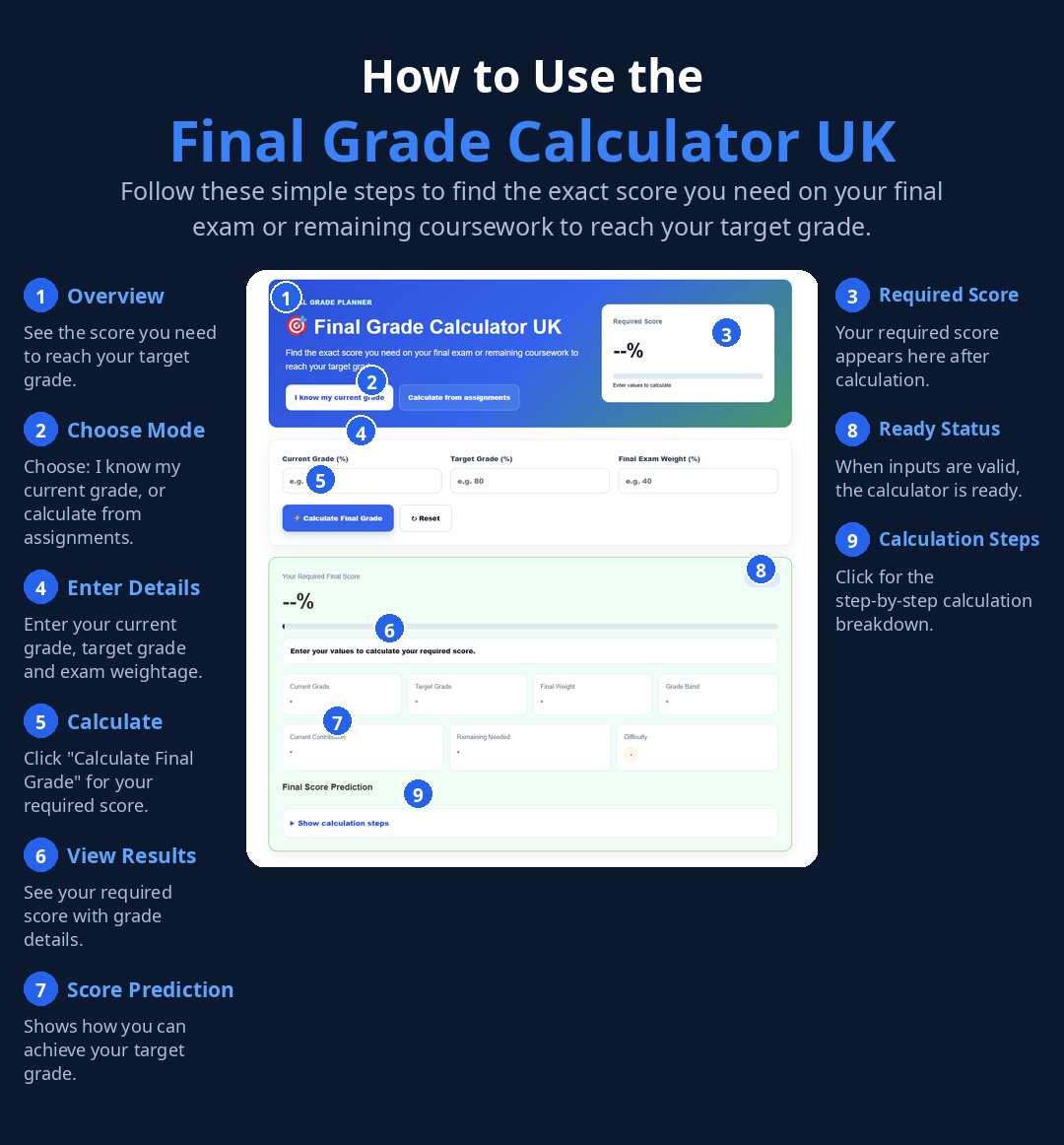
Click Here: Final Grade Calculator UK
The Short Answer: Passed Marks Are Locked
UK universities draw a hard line between failing and passing. Fail a module and the system gives you structured second chances: resits, retakes, sometimes compensation. Pass it — even with 40% on the nose — and the door closes. The mark stands, the credits are banked, and no amount of wishing reopens the assessment.
Here is how six universities phrase the identical rule (links: Oxford Brookes regulations, QMUL registry guidance):
| University | What its regulations say | Any exception noted |
|---|---|---|
| Oxford Brookes | “Once you pass an assessment, you cannot resit it; and once you pass a module, you cannot retake it.” | Successful exceptional-circumstances claim |
| Queen Mary (QMUL) | “If you pass a module, you cannot take any of the assessments again in order to improve your mark.” | None stated — absolute |
| UCL | “Students who have passed a course unit assessment cannot reregister for that course unit nor repeat the assessment.” | None stated — absolute |
| Sheffield Hallam | “When you have passed a module you cannot normally take any more assessment for that module to improve the original mark.” | Level 6/7 exceptions via Extenuating Circumstances policy |
| University of Surrey | “You cannot re-sit a unit of assessment that you have passed.” | None stated — absolute |
| University of Bedfordshire | “If you pass a unit, you cannot resit any assessment components or retake the unit to achieve a higher grade.” | None stated — absolute |
Notice the pattern: resits and retakes exist to let you retrieve a failed position and progress, not to polish marks you already earned. As one widely-quoted student-forum reply puts it: “Resits are not for higher pass marks, they are to achieve the relevant credits in order to progress on the degree in the event of initial failure. It is a common misconception.”
The Fine Print Students Get Wrong: A Failed Component Inside a Passed Module
Here is the scenario that confuses almost everyone. Suppose a module is assessed by 60% coursework and 40% exam. You score 65% on the coursework but only 35% on the exam. Your overall module mark is (0.60 × 65) + (0.40 × 35) = 39 + 14 = 53% — a pass. Can you resit just the failed exam to lift the module mark?
No. Oxford Brookes spells this out explicitly: if you pass some assessment components and fail others but pass the module overall, “you are not entitled to resit the failed assessment components (unless you have made a successful claim for exceptional circumstances).” The failed 35% exam is absorbed into a passed module, and the whole thing is locked.
Compare that with the same student scoring 25% on the exam instead: (0.60 × 65) + (0.40 × 25) = 39 + 10 = 49% — a fail. Now the rules flip in your favour: you get one resit of the failed exam, and your passed 65% coursework stands and is combined with the resit mark. The system rewards failure with a second chance and rewards passing with finality. Understanding that asymmetry saves a lot of wasted emails to registry.
| Your situation | Module outcome | Can you resit anything? |
|---|---|---|
| Coursework 65%, exam 35% → 53% overall | Pass | No — failed component locked inside a passed module |
| Coursework 65%, exam 25% → 49% overall | Fail | Yes — one resit of the exam; coursework mark stands |
| Coursework 45%, exam 45% → 45% overall | Pass | No — 45% is a pass, however disappointing |
| Coursework 30%, exam 35% → 32% overall | Fail | Yes — resit failed components, usually capped at the pass mark |
Why Universities Refuse: Three Real Reasons
The rule feels harsh until you see what it protects. Universities give three consistent justifications, and each one holds up.
1. Fairness — the gaming problem. If passed modules could be retaken, students with time and money could selectively re-sit only their weakest passes until their average crept up, while others sat each exam once. Assessment would stop measuring attainment and start measuring persistence and resources. The worked example below shows how large that advantage would be.
2. Resources. Every resit means a new paper, invigilation, marking, moderation and an exam board decision. Universities ration that capacity for students who need credits to progress — not for students chasing 52% to 62%. When Oxford Brookes charges a fee for retaking failed modules, it is a reminder that reassessment is expensive even for those who need it.
3. What assessment is for. A degree is a certified record of what you demonstrated at set points in time. UCL’s regulation title says it plainly — “Repeating a Passed Course Unit” — treating the unit as a closed chapter. Letting students reopen passed assessments indefinitely would turn the transcript into a draft rather than a record.
The Only Exceptions That Actually Exist
The rule is near-absolute, but “near” matters. There are a small number of genuine exceptions — and a longer list of things students believe are exceptions but are not.
Genuine exception 1: extenuating circumstances leading to a first sit. If illness, bereavement or another serious event genuinely affected your original attempt and your claim is approved, the exam board can grant a “first sit” or “first take” — a fresh attempt where the mark is not capped and counts in the original year (QMUL’s registry describes exactly this mechanism). Crucially, this replaces your original attempt; you do not get to bank the passed mark and keep the higher of the two. Sheffield Hallam’s regulations go further, noting specific exceptions for Level 6 and 7 students inside its Extenuating Circumstances policy. Our full guide to how extenuating circumstances affect your grades walks through what counts and how to evidence it.
Genuine exception 2: the exam board orders reassessment. If the original assessment itself was compromised — a proven administrative or marking error affecting the cohort, for example — the board can order a re-mark or fresh assessment. This is vanishingly rare, initiated by the university rather than requested by the student, and it is about correcting the university’s error, not improving your mark.
Not an exception: repeating a year. Some students ask whether they can “repeat the year” to redo passed modules. Repeating a year means re-enrolling in the year’s modules as a whole — you cannot cherry-pick two modules while keeping the rest, and it usually comes with full tuition fees and student-finance implications.
Not an exception: doing it at another university. Marks do not transfer between institutions like currency. Enrolling elsewhere means starting a new degree, not topping up old marks.
Not an exception: tutor permission. Individual lecturers cannot override academic regulations. Only the exam board can authorise reassessment, and the regulations above tie its hands.
Worked Example 1: The Fantasy Maths of Retaking Passed Modules
To see why universities hold the line, run the numbers on what retaking passed modules would actually be worth. Meet Amara, a second-year student with eight 15-credit modules:
52%, 55%, 58%, 64%, 68%, 71%, 60%, 66%. Her year average is (52 + 55 + 58 + 64 + 68 + 71 + 60 + 66) ÷ 8 = 494 ÷ 8 = 61.75% — a 2:1, but a fragile one.
Now imagine the rule did not exist, and Amara retakes her three weakest passed modules, lifting each to 70%. Her new average: (70 + 70 + 70 + 64 + 68 + 71 + 60 + 66) ÷ 8 = 539 ÷ 8 = 67.38% — a gain of +5.63 percentage points on the year, pushing her toward a First.
That is precisely the gaming problem. Three extra exam sittings — available to anyone with the time and money — would buy more than five points of year average. And it gets worse: because final-year marks are weighted more heavily (commonly 60% of the degree on a 40:60 split), Amara’s +5.63pp year gain converts to roughly +2.25pp on her final classification (0.40 × 5.63). Meanwhile the student who sat every exam once has no equivalent lever. The locked-mark rule is what keeps the competition honest.
There is a second sting in the fantasy: the economics are terrible even if it were allowed. Those three retakes cost roughly 150–200 hours of revision — hours spent re-earning marks that final-year modules would reward 1.5 to 2.3 times more heavily. As the next section shows, the same effort pointed forward buys more.
What To Do Instead: 5 Legal Routes to a Higher Average
You cannot reopen passed modules. But the final classification is still overwhelmingly in your hands. Here are the five routes that actually move the needle, ranked by impact:
| Route | How it works | Realistic gain |
|---|---|---|
| 1. Dissertation / final project | Usually 30–40 credits — the single biggest lever left. A strong dissertation moves the year average more than any two taught modules combined. | Up to +2pp on the final average |
| 2. Target final-year weighting | Compute exactly what final-year average you need (the calculator below does it) and aim module effort at the target, not at perfection everywhere. | Precisely the gap you need |
| 3. Genuine EC claims | If serious circumstances affected an attempt, a first sit gives an uncapped fresh attempt — the only legal “redo”. | Uncapped vs capped difference |
| 4. Borderline uplift rules | Many universities lift students within ~1–2pp of a boundary if enough credits sit in the higher band. Know your university’s rule before results day. | Boundary crossing without extra marks |
| 5. Play the long game | For jobs and taught masters, a 2:1 with a strong final year plus experience often beats a flat 2:1 — what employers actually check is less mark-obsessed than students assume. | Career value beyond the transcript |
Routes 1 and 2 deserve a full worked example, because most students underestimate how recoverable their position is. Our guide to improving a 2:2 to a 2:1 in final year covers this in depth; here is the short version.
Worked Example 2: Daniel’s 2:1 Recovery — Without Touching a Passed Module
Daniel finished second year on 58.2% — a 2:2. His university uses 40:60 weighting (second year 40%, final year 60%). To graduate with a 2:1 he needs a final average of 60%:
0.40 × 58.2 + 0.60 × F = 60 → 23.28 + 0.60F = 60 → 0.60F = 36.72 → F = 61.2%. Daniel needs a 61.2% final-year average — just 3 points above his second-year level.
His final year is 120 credits including a 30-credit dissertation. He targets the dissertation — the module where sustained effort converts most reliably into marks — and scores 68%, while averaging 62% across his other 90 credits. His final-year average: (68 × 30 + 62 × 90) ÷ 120 = (2,040 + 5,580) ÷ 120 = 7,620 ÷ 120 = 63.5%.
Final classification: (0.40 × 58.2) + (0.60 × 63.5) = 23.28 + 38.10 = 61.38% — a 2:1. Notice the dissertation’s leverage: those 6 extra marks on 30 credits contributed (6 × 30) ÷ 120 × 0.60 = +0.9pp to the final classification all by themselves. No passed module was reopened; no rule was bent.

The Reverse Trap: Your Passed 55% Beats Their Capped 40%
Part of the urge to retake comes from watching a friend resit a failed module and assuming they get a second chance you are denied. Run the resit maths and the envy evaporates.
Failed-module resits are capped at the pass mark — 40% for undergraduates at almost every UK university (50% at postgraduate level). Suppose your friend failed with 30%, then produced a brilliant 85% resit performance. Their recorded mark: 40%. Your “disappointing” first-sit 55% is still 15 marks ahead of their best possible outcome. The resit system does not reward failure; it merely limits the damage. For the full mechanics, see our guide to university referrals and capped resits.
There is also a quieter advantage to locked passes: certainty. A passed module is banked credit that no future exam can touch. Students chasing retakes trade that certainty for stress — and as the Amara example showed, the arithmetic rarely justifies it.
6 Myths About Retaking Passed Modules
| Myth | Reality |
|---|---|
| “I can resit in the August resit period like everyone else” | August resits are for failed modules only. Registry will not enter you for a module you passed. |
| “My personal tutor can approve it” | No — only the exam board can authorise reassessment, and published regulations tie its hands (see the six-university table above). |
| “I’ll just pay the retake fee” | Retake fees apply to failed modules. There is no fee schedule for retaking passes, because the option does not exist. |
| “With ECs I can bank two marks and keep the higher” | A successful EC claim grants a first sit that replaces the original attempt — uncapped, but a replacement, not a bonus attempt. |
| “Final year works differently” | The rule is identical in final year. QMUL is explicit: once you have passed enough credits you graduate, “after which you cannot resit any modules.” |
| “Scottish universities allow it” | The same principle applies across the UK, including Scotland’s four-year honours degrees. Always check your own university’s regulations — but expect the same answer. |
Frequently Asked Questions
Can you resit an exam you passed at a UK university?
No. Once you pass an assessment, UK universities do not allow you to resit it to improve the mark. Oxford Brookes states the rule directly: once you pass an assessment, you cannot resit it, and once you pass a module, you cannot retake it. Resits exist only to let students retrieve failed modules and progress.
Can I retake a module to improve my grade in final year?
No — the rule applies in final year exactly as in earlier years. Queen Mary University of London’s registry is explicit that once you have passed enough credits you will normally graduate, after which you cannot resit any modules. Focus instead on maximising your remaining final-year modules and dissertation.
What if I failed one assignment but passed the module overall?
You cannot resit the failed component. If your overall module mark is a pass, the failed assignment is absorbed into the passed module and the whole module is locked. Oxford Brookes confirms students in this position are not entitled to resit the failed components unless they have a successful exceptional-circumstances claim.
Can extenuating circumstances let me retake a passed module?
Possibly, but not as a bonus attempt. An approved extenuating-circumstances claim can grant a first sit — an uncapped fresh attempt that replaces your original mark. Sheffield Hallam notes specific exceptions for Level 6 and 7 students in its EC policy. See our extenuating circumstances guide for what counts as valid evidence.
Do any UK universities allow retakes of passed modules?
As a general rule, no. Queen Mary, UCL, Sheffield Hallam, Surrey, Bedfordshire and Oxford Brookes all prohibit it in published regulations, and this reflects sector-wide practice. Always check your own university’s academic regulations, but expect the same answer.
Can I retake a passed module at a different university?
No. Marks do not transfer between universities as top-ups. Enrolling at another institution means starting a new degree, not improving marks from your current one. Your transcript from your current university remains the official record.
Does the resit cap affect me if I passed first time?
No — the cap only applies to resits of failed modules, which are normally capped at the pass mark (40% undergraduate, 50% postgraduate). Your first-sit passed mark stands in full. In fact, a modest first-sit pass of 55% beats even a perfect resit performance, which would be recorded as 40%.
What should I do instead of retaking a passed module?
Target what is still open: your dissertation (usually 30 to 40 credits, the biggest remaining lever), your final-year modules (weighted most heavily), genuine EC claims where they apply, and your university’s borderline uplift rules. Use a final grade calculator to compute exactly what average you need from your remaining modules.
Conclusion
The rule is blunt but simple: at UK universities, a passed module is finished business. You cannot resit its assessments, retake the module, or reopen a failed component hiding inside a passed overall mark. Six universities say it in near-identical language, and the exceptions — a genuine extenuating-circumstances first sit, or an exam board correcting its own error — are narrow and never amount to a free bonus attempt.
That finality is actually good news disguised as bad. Every passed module is banked credit no future exam can touch, and the calculations in this guide show that retaking passed modules would be poor value even if it were allowed — 150 to 200 hours of revision for barely two points of final classification, while the same effort aimed at your dissertation or final-year modules counts far more. Daniel’s recovery from 58.2% to a 61.38% 2:1 proves the point: the degree is won going forward, not by replaying the past.
So close the tab on retake fantasies, open the Final Grade Calculator, and work out exactly what your remaining modules need to deliver. That number — not the 52% you wish you could redo — is the only mark that still matters.


![Read more about the article When Do Uni Results Come Out? UK University Results Day Explained [2026]](https://gradeforuni.com/wp-content/uploads/2026/10/featured-university-results-day-300x192.png)
![Read more about the article Does First Year Count Towards Your Degree? UK Weighting Rules Explained [2026]](https://gradeforuni.com/wp-content/uploads/2026/10/featured-first-year-count-300x192.png)