
![You are currently viewing Does Attendance Affect Your Grades at UK Universities? Monitoring Rules Explained [2026]](https://gradeforuni.com/wp-content/uploads/2026/10/featured-attendance-grades-uk.png)
Does Attendance Affect Your Grades at UK Universities? Monitoring Rules Explained
Does attendance affect your grades at a UK university? Ask around campus and you will hear two confident answers. One group swears lectures are optional — nobody takes a register, the slides go online, and plenty of people skip without consequence. The other group tells you about the friend who lost marks for missing seminars, or the international student hauled in for a meeting after two quiet weeks.
Both groups are describing something real, because attendance sits in a strange middle ground in UK higher education. Unlike school, your university almost never deducts marks simply because you were not in the room. But universities watch attendance more closely than most students realise — through engagement monitoring systems, visa compliance duties, professional-body rules, and the growing number of modules that assess participation itself. The students who get hurt are rarely the ones who skip a Tuesday lecture; they are the ones who did not know which kind of absence their university actually punishes.
This guide explains exactly how attendance and grades connect at UK universities in 2026: the monitoring systems running quietly in the background, the five doors through which poor attendance can reach your marks or your degree, worked examples showing the real arithmetic, and a four-step check you can run on your own modules this week. If you want to see where your marks stand while you read, plug them into a calculator alongside.
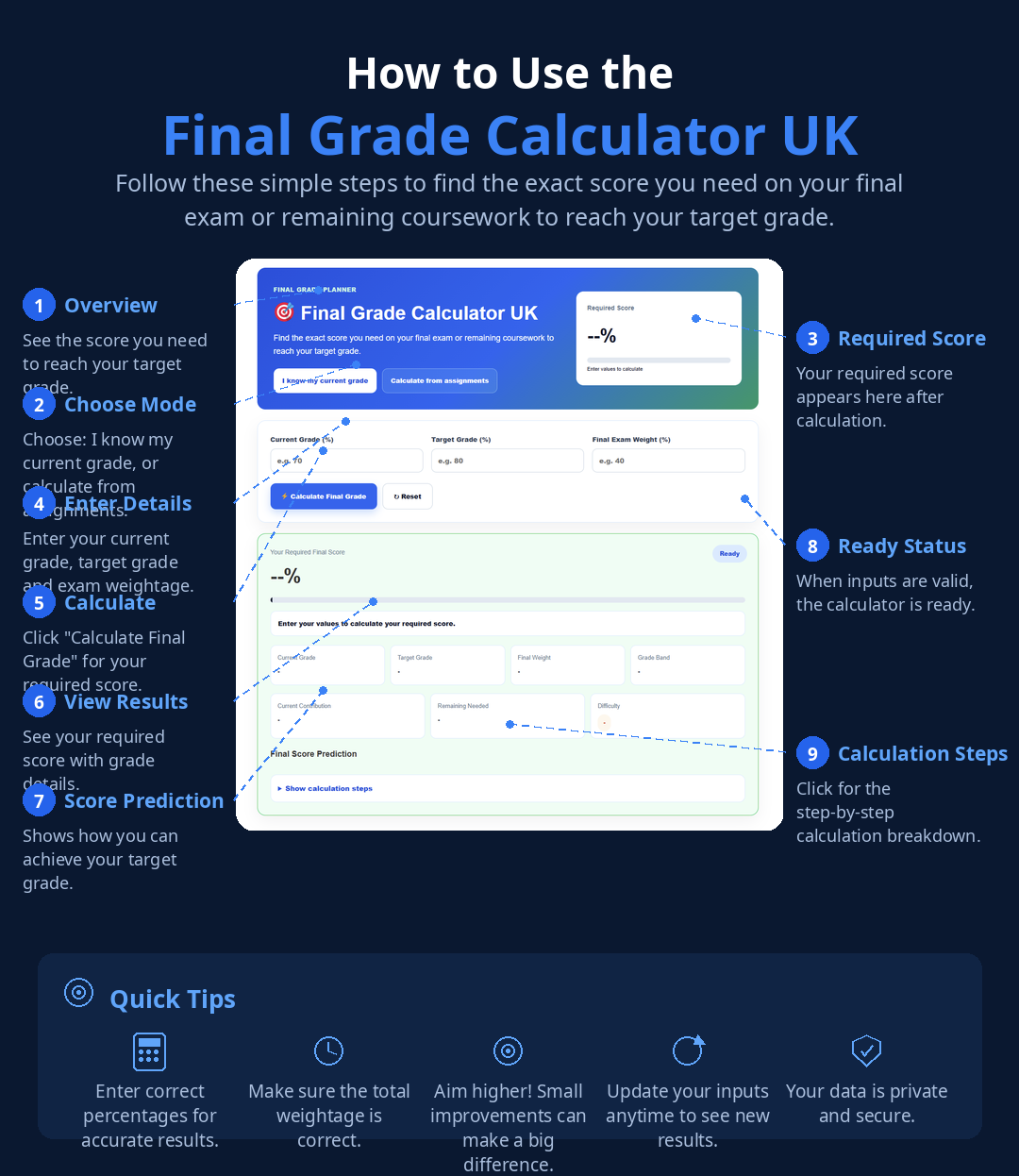
Click Here: Final Grade Calculator UK
The Short Answer: Monitored, Not Marked
At the overwhelming majority of UK universities, attendance is monitored, not marked. Your university keeps records of whether you show up — tapping your student card at lectures, signing seminar registers, logging into the virtual learning environment — but the mark on your essay, exam or project is decided by the quality of the work, not by the register. A student who attends 30% of lectures but writes a 72% essay gets 72%. That separation is deliberate: universities assess academic achievement, and presence is treated as a separate, pastoral matter.
The evidence is in the policies themselves. Take the University of Bristol’s student engagement and attendance policy, which spells out what happens when a student’s attendance and engagement fall below the agreed threshold — and, as a detailed breakdown of the policy notes, makes no reference at all to grades being directly affected. The consequences it does describe are supportive and procedural: conversations with tutors, action plans, formal warnings. Leeds Trinity’s attendance policy frames absence data as something analysed daily so staff can contact students and make appropriate interventions. The University of West London runs attendance checkpoints each semester that identify students for supportive contact or a formal monitoring process. None of these policies describes a mark being reduced because a register was not signed.
Students notice the same split in practice. In student forum discussions about whether skipping lectures affects grades, the most common answer from current students is a version of the same line: your attendance has no direct link to your grade percentage, but not going can still damage your assessments because you miss teaching, feedback and the chance to clarify what the marker wants. One student put it bluntly — the university does not care about attendance on its own; it cares about how well the student is doing, and attendance only becomes an issue when progress slips too.
That is the baseline. Now here are the five doors through which attendance can still reach your grades — and the students who walk through them are the ones who assumed the short answer was the whole answer.
Door 1: Participation Marks — Attendance in Disguise
The biggest exception to “attendance doesn’t affect grades” lives inside the module handbook, where some universities assess participation as a formal component of the module mark. Participation is not literally a register — it is judged on preparation, contribution to discussion and engagement with other students — but you cannot participate in a seminar you did not attend, so chronic absence drains it fast.
Edinburgh’s English Literature department publishes exactly this system. Its Class Participation Assessments are graded against published descriptors covering seminar preparation, contribution to discussion and engagement with fellow students, and tutors keep a record of each student’s attainment across the semester. The policy states plainly that full attendance is expected in normal circumstances — and that persistent absence without reasonable explanation may result in a fail mark for the participation component, which counts for 10% of the overall module grade. That is not an indirect effect. That is a tenth of your module mark, sitting on the register.
It is not unique to Edinburgh. A published UK study of seminar-attendance incentives in university teaching tested a formal policy under which students with perfect seminar attendance and preparation received 10% towards their final module grade — with the component shrinking by 1.25% for every seminar missed. And in student discussions, one student described a module handbook with explicit attendance thresholds written in: attend fewer than 4 of 12 seminars and you fail the module outright; attend 7 or more and your grades are unaffected; the middle band meant reduced marks. Whether or not your university goes that far, the principle travels: if your handbook mentions participation, engagement or seminar contribution as an assessed component, your attendance is being graded under another name.
Group projects are a close cousin of this. When part of your module mark depends on peer-assessed contribution — as covered in our guide to how group project marks are calculated — missing the meetings shows up directly in what your teammates report about you.
Worked Example 1: What a 10% Participation Component Costs
Take a humanities module assessed as 90% written work and 10% class participation — the Edinburgh-style split. Amara’s assessed work averages 62.5% across her essay and exam. Two versions of her semester:
| Scenario | Assessed work (90%) | Participation (10%) | Module mark |
|---|---|---|---|
| Attends most seminars, contributes well | 62.5% × 0.9 = 56.25 | 72% × 0.1 = 7.20 | 63.45% → 63 |
| Misses most seminars, silent when present | 62.5% × 0.9 = 56.25 | 28% × 0.1 = 2.80 | 59.05% → 59 |
Identical essays, identical exam — a 4.4 percentage-point swing on the module, purely from the participation column. The participation mark did not punish absence as absence; it rewarded engagement that absence made impossible. This is the mechanism to check for first, because it is the one students most often miss: search your module handbook for the words “participation”, “engagement” or “contribution” before you assume your mark is register-proof.
Worked Example 2: The Per-Seminar Deduction
Now the version tested in that UK seminar-attendance study: a 10% attendance-and-preparation component across 8 seminars, falling 1.25% for every seminar missed. Daniel’s assessed work sits at 64%. He attends 5 of the 8 seminars and misses 3 without accepted reasons:
| Scenario | Assessed work (90%) | Attendance component | Module mark |
|---|---|---|---|
| All 8 seminars attended | 64% × 0.9 = 57.60 | 10.00 | 67.60% → 68 |
| 3 seminars missed | 64% × 0.9 = 57.60 | 10 − (3 × 1.25) = 6.25 | 63.85% → 64 |
Three missed seminars cost 3.75 percentage points on the module — roughly the distance between a comfortable 2:1 and a borderline one. Not every university runs this policy, but the study exists precisely because the mechanism is live in UK teaching. If your module lists seminar attendance as part of the assessment design, do the same arithmetic for your own numbers.
Door 2: Professional Courses Where Attendance Is the Requirement
For a small group of degrees, attendance is not an assessed component of the mark — it is a condition of qualifying at all. Nursing and midwifery are the clearest cases. The Nursing and Midwifery Council requires preregistration nursing students to complete 4,600 hours of regulated activity: 2,300 hours of theory and 2,300 hours of clinical practice. Universities delivering these programmes — Leeds Trinity and Leeds Beckett among them — publish 100% attendance requirements for all timetabled sessions, taught and clinical, because falling short of the hours means the student cannot be entered onto the NMC register. Missed time generally has to be made up, even where it was covered by extenuating circumstances.
The mechanism here is different from marks: your 68% essay still gets 68%, but if your hours are short you do not graduate as a nurse. Signing in for another student on a register can trigger fitness-to-practise proceedings — a separate disciplinary track from academic misconduct, with career-ending stakes. Medicine, teaching, social work and other regulated professions run their own versions of this: attendance thresholds tied to professional-body standards rather than module marks. If your degree leads to a protected professional title, read the professional-attendance policy before you read the marking scheme — it outranks it.
Door 3: The Visa Route — When Attendance Ends Your Degree
International students on a Student visa face the strictest attendance regime in UK higher education, and it has nothing to do with marks. As your visa sponsor, your university is legally required to monitor your attendance and engagement and to report problems to UK Visas and Immigration. The University of Nottingham’s published sponsor responsibilities state it directly: the university must monitor attendance and engagement and report unauthorised non-attendance to UKVI. Aston tells its students it must report them to the Home Office if they fail on a regular basis to attend classes or submit academic work. Teesside’s compliance pages spell out the endpoint: a sponsored student withdrawn for poor attendance or engagement triggers visa curtailment action — the Home Office shortens the visa and the student must leave the UK.
The monitoring machinery is more thorough than most students expect:
| University | What is monitored | The bar and the consequence |
|---|---|---|
| Aston | Engagement logged by the student | At least one on-campus and one academic engagement every 2 weeks in term time; reminders, then reporting |
| Sheffield Hallam | Attendance via Study Goal app, fortnightly reviews | 85% minimum on pre-sessional and foundation courses; persistent non-attendance leads to a formal meeting and possible sponsorship withdrawal |
| West London | Card touch-ins, registers, Blackboard activity | Attendance checkpoints each semester; students below the line enter a formal monitoring process |
| Leeds (University Centre) | Registers across all sessions | Below 70% overall — or below the UKVI expectation of around 85% in a month for sponsored students — starts the monitoring procedure |
Notice what is being measured: engagement, not attainment. A sponsored student with 90% attendance and 45% marks keeps their visa; a sponsored student with 40% attendance and 75% marks is in danger of losing it. The system does not care that your grades are fine. And because disengagement can also mean missing assessments, visa students sit at the intersection of two risks at once: curtailment proceedings on one side, and uncapped-versus-capped resit territory on the other if missed exams pile up. If you hold a Student visa, attendance is the single most consequential number in your student record — more consequential than any single module mark.
Door 4: The Indirect Effect — Missing Teaching, Weaker Work
The most common way attendance reaches grades is also the least visible: nobody deducts anything, but the work gets worse. Seminars are where markers explain what they actually want; lectures are where the examinable emphasis lands; formative tasks — the ungraded practice work covered in our guide to formative assessments — are where misunderstandings get corrected before they cost marks. A student ambassador at Sheffield Hallam described the mechanism from the marking side: the in-class feedback tutors give is supposed to show up in the final product, and when it does not, markers notice the gap and factor it into the grade.
This is not speculation about learning styles. When your essay misreads the question in exactly the way the week-4 seminar corrected, the marker does not write “−5 for absence” in the margin — they write “does not address the question” and award 52 instead of 62. The register and the mark stay formally separate, and the effect is identical to a deduction.
Worked Example 3: When a Small Drag Crosses a Classification Boundary
Priya’s final year runs on 40:60 year weighting (Year 2: Year 3). In her final year she takes six 20-credit modules. On one of them — a seminar-heavy module with a 10% participation component — her attendance slips, and the module comes back at 59 instead of the 63.4 it would have been with the participation marks intact (the Door 1 arithmetic from Example 1). Her other five final-year modules are unaffected.
First, the year-average effect: a 4.4-point drop on a 20-credit module inside a 120-credit year moves the year average by 4.4 × (20 ÷ 120) = 0.73 points. Say her final year sits at 60.17 without the drag and 59.43 with it. Now the classification, on 40:60 weighting with a 60.0 Year 2:
| Scenario | Year 2 (40%) | Year 3 (60%) | Final average | Class |
|---|---|---|---|---|
| Participation marks kept | 60.0 × 0.4 = 24.00 | 60.17 × 0.6 = 36.10 | 60.10% | 2:1 |
| Participation lost to absence | 60.0 × 0.4 = 24.00 | 59.43 × 0.6 = 35.66 | 59.66% | 2:2 |
Less than half a percentage point on the final classification — and it crosses the 60% boundary between a 2:1 and a 2:2. Borderline policies exist precisely for near-misses like this (see our borderline grades guide), but a student arguing for discretionary uplift while their attendance record shows a semester of empty seminar seats is arguing uphill: exam boards consider the whole academic picture, and disengagement is not the picture that wins uplift. The arithmetic is honest about the scale — a single module’s participation component rarely decides a degree on its own — but it is equally honest that at a boundary, small numbers are the whole game.
Door 5: Your Record at Exam Boards and Appeals
The fifth door is the quietest: your attendance record sits in front of the exam board when discretionary decisions are made. Exam boards do not vote on whether you “deserve” your marks — the marks are the marks — but at the margins they do weigh context. A student whose record shows steady engagement and one bad exam week is a different case from a student whose record shows a semester of disengagement, and boards see both. The same record follows you if you appeal a grade or request a re-mark: nothing in the regulations says poor attendance weakens an appeal, but an appeal that argues you were fully engaged with your studies is harder to make when the data says otherwise. Attendance is character evidence in a system that officially runs on marks.
The 4-Step Attendance Check: Find Out Which Rules Apply to You
Whether attendance can touch your grades depends entirely on your specific course, modules and visa status. Run this check once per semester — it takes about twenty minutes:
| Step | Where to look | What counts as a red flag | If flagged, do this |
|---|---|---|---|
| 1. Participation components | Each module handbook: search “participation”, “engagement”, “contribution”, “seminar” | Any assessed percentage attached to attendance or participation | Treat those sessions as assessments — missing one is skipping part of an exam |
| 2. Professional-body rules | Course handbook or professional placements page (nursing, midwifery, teaching, social work) | Hour requirements (e.g. 4,600 for nursing) or 100% attendance statements | Log every absence and make-up arrangement with your placement team in writing |
| 3. Visa engagement rules | Your university’s international-student pages and attendance policy | Engagement checkpoints (fortnightly is common) you are not meeting | Contact the international advice team before the next checkpoint, not after |
| 4. Your own pattern | Your attendance record on the student portal | Below roughly 70%, or a sudden drop in any module | Talk to your personal tutor — the monitoring systems exist to trigger support, so use them early |
Two honest notes on that table. First, step 4’s 70% is a rule of thumb, not a regulation: it mirrors the kind of threshold at which monitoring procedures typically start, but your university’s policy is the real number. Second, most students who run this check discover they are in the clear — the monitoring-not-marked baseline really is the norm. The check exists for the minority whose modules, professional course or visa status puts them in one of the five doors.
If Your Attendance Has Already Slipped: 6 Steps
Missed a chunk of the semester and now worried? The recovery playbook is short, and order matters:
- Check before you panic. Look at your actual attendance record on the student portal and your module handbooks. Most attendance anxiety is about lectures nobody was monitoring; most real risk sits in seminars nobody checked.
- Talk to your personal tutor now. Attendance systems are designed to trigger supportive contact — arriving voluntarily, with a plan, reads completely differently from being summoned.
- Catch up the assessed bits first. Missed formative work, seminar preparation and group-meeting contributions affect marks directly; missed lectures can usually be covered from recordings and notes.
- If illness or crisis caused the absences, file for extenuating circumstances. Universities distinguish explained absence from unexplained absence across every system in this guide — but claims have deadlines, and late claims are routinely refused.
- International students: engage visibly this week. Log the engagements your sponsor requires, attend the next checkpoint sessions, and email the international advice team so there is a paper trail of re-engagement.
- Professional-course students: account for every hour. Speak to your placement team about making up missed time before the hours shortfall becomes a qualification problem.

Does attendance count towards your final grade at UK universities?
Usually not directly. Most UK universities monitor attendance but assess only the quality of your submitted work, so a skipped lecture does not deduct marks. The exceptions are modules with assessed participation components (often around 10% of the module mark), professional courses with attendance requirements, and Student visa engagement rules.
Can a university fail you for poor attendance?
For standard degrees, poor attendance alone rarely fails you — you fail by not submitting or failing assessments. But some module handbooks set explicit attendance thresholds, professional courses such as nursing require set hours to qualify, and international students can lose visa sponsorship after sustained non-engagement, which ends the degree.
Do seminars and lectures have participation marks?
Some do. Universities including Edinburgh assess class participation — preparation, discussion contribution and engagement — as a formal module component worth around 10%, and persistent unexplained absence can fail that component. Check each module handbook for the words participation, engagement or contribution.
I am an international student — what happens if I stop attending?
Your university must monitor your engagement as your visa sponsor and report sustained non-attendance to UKVI. Many universities run fortnightly engagement checks; if you disengage, you face formal meetings, withdrawal from the course and visa curtailment. Good grades do not protect you — the system measures engagement, not attainment.
Do nursing degrees really require 100% attendance?
Preregistration nursing programmes typically require 100% attendance at timetabled theory and clinical sessions because the NMC requires 4,600 hours (2,300 theory, 2,300 practice) for registration. Missed time usually has to be made up, and falling short of the hours can prevent qualification regardless of your marks.
If attendance does not affect grades, why do universities track it?
Tracking exists for early intervention (spotting struggling students), visa sponsor duties to UKVI, professional-body hour requirements, and funding-body reporting. The data triggers supportive contact, formal monitoring processes and, for sponsored students, compliance action — not mark deductions.
Can poor attendance hurt me in a borderline decision?
Borderline uplift is decided on marks and regulations, not the register. But exam boards see your full record, and arguing for discretionary uplift or appealing while showing a semester of disengagement weakens your case. Strong engagement never guarantees uplift, but it never hurts.
What should I do if my attendance has already dropped?
Check your actual record and module handbooks first — most risk sits in assessed seminars, not lectures. Talk to your personal tutor, prioritise catching up assessed and formative work, file extenuating circumstances if illness or crisis caused the absences, and if you hold a Student visa, re-engage visibly before the next monitoring checkpoint.
Conclusion
Attendance at UK universities is best understood as a system that watches you closely and marks you rarely. For most students on most modules, the register and the mark sheet are separate documents, and skipping a lecture costs nothing on the day. The trouble starts where the separation breaks down: the seminar with a 10% participation component, the nursing degree with 4,600 mandatory hours, the visa with fortnightly engagement checks, the borderline classification where half a percentage point decides between a 2:1 and a 2:2. None of these punish absence as absence — they punish what absence makes impossible: participation, professional hours, demonstrable engagement.
The practical takeaway is a short one. Run the four-step check on your own modules, visa status and professional requirements once a semester. Treat assessed seminars as assessments, because that is what they are. And if your attendance has slipped, act while the systems are still in their supportive phase — tutors, monitoring checkpoints and engagement reviews are designed to catch struggling students early, and they work far better for students who arrive voluntarily than for students who are summoned. Your grades are decided by your work; make sure absence never gets a vote in how good that work can be.
![Read more about the article Do University Strikes Affect Your Grades? What UK Universities Do to Protect Students [2026]](https://gradeforuni.com/wp-content/uploads/2026/10/featured-university-strikes-grades-300x192.png)