

Imagine you’re a few weeks away from submitting your dissertation. Most of your module results are already available, and you’re wondering: What degree classification am I likely to graduate with?
Your university portal shows your marks and credits, but calculating your final degree isn’t always straightforward. Degree Grade Calculator: Some modules carry more credits than others, while your university may also apply different weightings to Level 5 and Level 6. Degree Grade Calculator
A Degree Grade Calculator can help you estimate your final classification using your module marks, credits and relevant weightings. Whether you’re planning your remaining assessments or checking your position before graduation, understanding the calculation can help you set realistic targets.
Click Here: Final Grade Calculator UK
How to Use the Final Grade Calculator UK
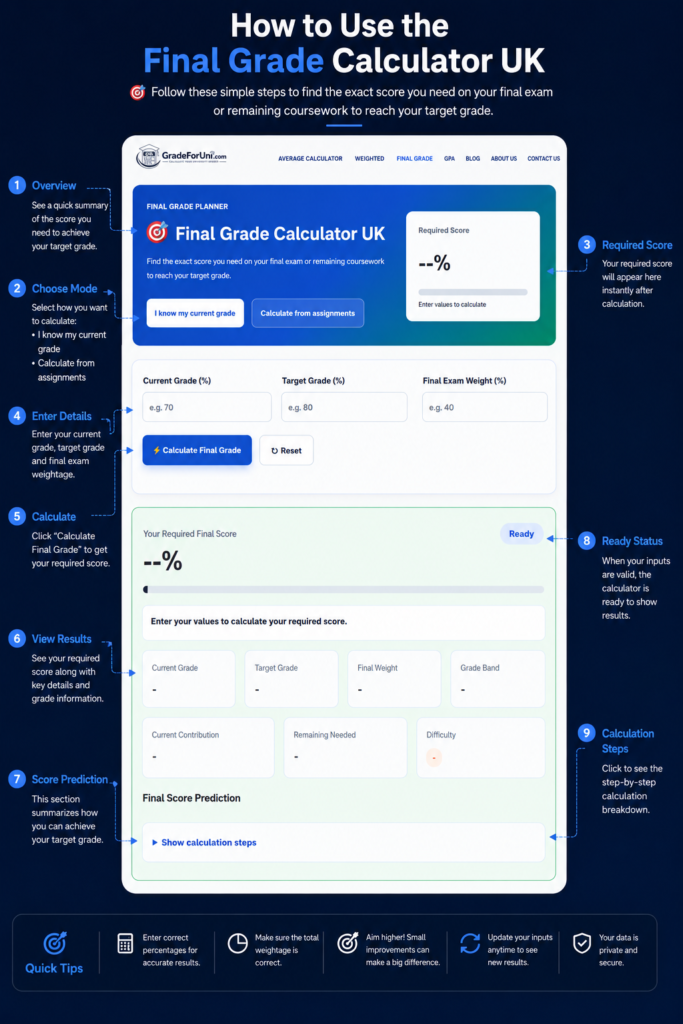
A Degree Grade Calculator estimates your final honours degree by calculating the weighted average of your module marks based on their credit values and, where applicable, your uni. For most UK universities, the process involves:
Comparing the result with the relevant honours classification boundaries.calculations essential when predicting your final classification. Degree Grade Calculator
Entering each module mark.
Adding the corresponding credit value.
Applying module and year weightings.
Calculating the weighted average.
What Is a Degree Grade Calculator?
A Degree Grade Calculator estimates your overall university performance using:
- Module marks
- Credit values
- Assessment weightings
- Year weightings
- Dissertation marks
The result is an estimated honours classification such as:
| Degree Classification | Typical Overall Average |
|---|---|
| First Class Honours | 70% or above |
| Upper Second-Class Honours (2:1) | 60–69% |
| Lower Second-Class Honours (2:2) | 50–59% |
| Third-Class Honours | 40–49% |
This estimate allows students to understand their academic position before official university results are released. Degree Grade Calculator
Who Should Use It
A degree calculator can help you:
Understand the impact of a low module mark.
Prepare for final examinations.
Plan target marks for remaining modules.
Track your progress after each semester.
Estimate your final classification before graduation.
When to Use a Degree Grade Calculator
Good times to calculate your degree include:
Before graduate job applications requiring a minimum classification
After each assessment period
Before selecting optional modules
Before submitting your dissertation
Before resit examinations
During final-year revision planning
Before applying for postgraduate study
Read More: Uni CalculatorHow UK Universities Calculate Final Degree Grades
Although every university has its own academic regulations, many UK institutions use weighted averages for honours classifications. Degree Grade Calculator
The calculation can consider:
Overall weighted average
Credit values
Academic level
Programme regulations
Assessment weightings
Understanding Honours Degree Classifications
Most undergraduate honours degrees in the UK are awarded using five broad classifications.
| Classification | Typical Percentage | General Meaning |
|---|---|---|
| First Class | 70%+ | Outstanding academic performance |
| Upper Second (2:1) | 60–69% | Strong academic achievement |
| Lower Second (2:2) | 50–59% | Good standard of performance |
| Third Class | 40–49% | Pass with honours |
| Ordinary Degree | Below honours requirements | Degree awarded without honours |
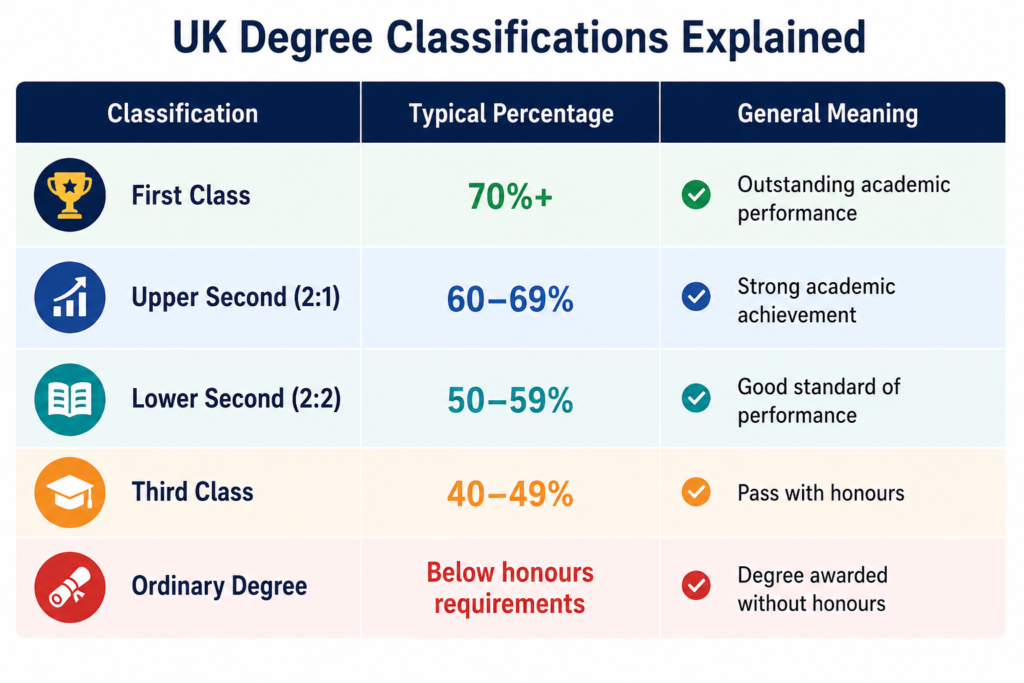
Many graduate employers and postgraduate programmes ask applicants to achieve at least a 2:1, making it one of the most commonly targeted classifications.
Read More: First Class Honours ExplainedHow Module Credits Affect Your Final Grade
Credits represent the academic value of each module.
A higher-credit module contributes more towards your overall degree than a lower-credit module.
For example:
| Module | Mark | Credits |
|---|---|---|
| Business Strategy | 72% | 20 |
| Marketing | 68% | 20 |
| Economics | 64% | 20 |
| Dissertation | 70% | 40 |
Although the dissertation has a similar mark to other modules, it contributes twice as much because it carries double the credits.
This is one reason why many final-year students focus heavily on dissertation performance. Degree Grade Calculator
Understanding Weighted Averages
A common mistake is averaging all module marks equally.
For example:
- 72%
- 65%
- 58%
- 69%
This ignores credit values. A weighted average gives each module an appropriate contribution based on its credits.
For example, a 40-credit dissertation has twice the weighting of a 20-credit module.
How Year Weighting Works
Many UK universities also apply different weightings to different academic years.
Common models include:
| Level | Example Weight |
|---|---|
| Level 4 | 0% |
| Level 5 | 30% |
| Level 6 | 70% |
Some universities instead use:
| Level 5 | Level 6 |
|---|---|
| 40% | 60% |
Some universities base classification mainly on final-year performance.
Check your university handbook for the weighting model used on your course.
UK Honours Degree Classification Boundaries
Understanding classification boundaries helps you set realistic academic goals throughout your degree. Degree Grade Calculator
Although universities can apply their own regulations, the following thresholds are widely recognised across UK higher education.
First Class Honours
A First Class Honours degree is normally awarded for an overall weighted average of 70% or above.
Upper Second-Class Honours (2:1)
A 2:1 usually requires an overall average between 60% and 69%.
It is the most common entry requirement for:
- Graduate schemes
- Master’s programmes
- Professional training
- Many competitive employers
Achieving a 2:1 is often considered a strong academic outcome and opens opportunities across a wide range of careers. Degree Grade Calculator
Lower Second-Class Honours (2:2)
Students with an average between 50% and 59% are typically awarded a Lower Second-Class Honours degree (2:2).
A 2:2 can still provide career opportunities depending on the field, relevant experience and skills.
Third-Class Honours
A Third-Class Honours degree generally requires an average between 40% and 49%.
While fewer postgraduate programmes accept this classification directly, graduates can often strengthen future applications through work experience, professional qualifications or additional study. Degree Grade Calculator
Ordinary Degree
Some universities award an Ordinary Degree where honours requirements have not been fully met.
This may occur when sufficient credits have been completed for a degree award, but honours classification criteria are not satisfied.
The exact rules vary between institutions, so students should always check their university’s academic regulations. Degree Grade Calculator
Degree Grade Calculation Formula
The exact formula used by your university depends on its degree classification regulations. Still, the underlying principle is usually straightforward: higher-credit modules have a greater influence on the weighted average. Degree Grade Calculator
Weighted Average Formula
For a set of modules with different credit values, a useful calculation is:
Weighted Average = Σ (Module Mark × Module Credits) ÷ Σ Module Credits
For example, suppose you have:
| Module | Mark | Credits |
|---|---|---|
| Business Strategy | 72% | 20 |
| Economics | 64% | 20 |
| Finance | 68% | 20 |
| Dissertation | 70% | 40 |
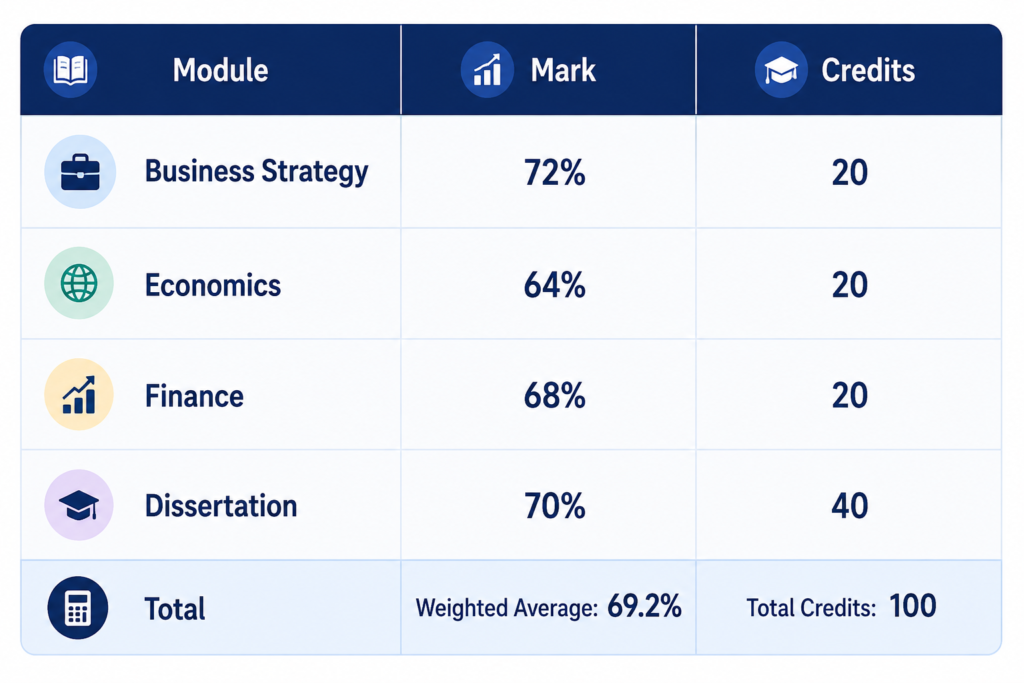
The calculation is:
- Business Strategy: 72 × 20 = 1,440
- Economics: 64 × 20 = 1,280
- Finance: 68 × 20 = 1,360
- Dissertation: 70 × 40 = 2,800
Total weighted marks = 6,880
Total credits = 100
Weighted average = 6,880 ÷ 100 = 68.8%
The estimated classification would therefore fall within the 2:1 range under the typical classification boundaries above.
When This Formula Does Not Apply
This credit-weighted calculation should not automatically be treated as your official university formula. Degree Grade Calculator
It may not apply directly when your university:
- Excludes certain academic levels.
- Uses separate year weightings.
- Applies a specific classification algorithm.
- Treats reassessments differently.
- Uses borderline classification rules.
- Excludes placement or exchange marks.
- Has programme-specific regulations.
Your university’s published regulations should take priority over a general calculator.
Credit Weighting Formula
When modules have different credit values, each mark can first be converted into a weighted contribution:
Weighted Contribution = Module Mark × Module Credits
You then add the weighted contributions together and divide by the total credits included in the calculation. Degree Grade Calculator
This is particularly useful when your degree contains a dissertation or another high-credit module.
For example, a 40-credit dissertation has twice the credit value of a 20-credit module. Assuming both are included in the same calculation, the dissertation therefore has twice the influence. Degree Grade Calculator
Final Degree Formula
When your university applies separate year weightings, the calculation becomes slightly different.
For example, if Level 5 contributes 30% and Level 6 contributes 70%:
Final Degree Average = (Level 5 Average × 0.30) + (Level 6 Average × 0.70)
Suppose:
- Level 5 average = 64%
- Level 6 average = 72%
Then:
64 × 0.30 = 19.2
72 × 0.70 = 50.4
Final average = 19.2 + 50.4 = 69.6%
That gives an estimated final average of 69.6% before any university-specific borderline rules are considered.
How to Calculate Your Degree Grade Step by Step
Calculating your degree manually is useful even when you use a Degree Grade Calculator, because it helps you understand where your final result comes from.
Step 1 – Gather Your Module Marks
Start by collecting the marks for every module that contributes to your degree classification.
Your transcript or university results portal will normally provide the marks. Degree Grade Calculator
Record the actual percentage rather than converting it into a letter grade unless your university specifically requires another system.
For example:
| Module | Mark |
|---|---|
| Business Management | 66% |
| Marketing | 71% |
| Economics | 63% |
| Dissertation | 69% |
Step 2 – Add Module Credits
Next, identify the credit value attached to each module.
A typical undergraduate module might carry 20 credits, while a dissertation may carry 40 credits or another value. Degree Grade Calculator
For example:
| Module | Mark | Credits |
|---|---|---|
| Business Management | 66% | 20 |
| Marketing | 71% | 20 |
| Economics | 63% | 20 |
| Dissertation | 69% | 40 |
Do not assume that every module has the same credit value. Check your course documentation.
Step 3 – Multiply Marks by Credits
Multiply each mark by its credit value.
| Module | Mark | Credits | Mark × Credits |
|---|---|---|---|
| Business Management | 66% | 20 | 1,320 |
| Marketing | 71% | 20 | 1,420 |
| Economics | 63% | 20 | 1,260 |
| Dissertation | 69% | 40 | 2,760 |
The total weighted score is:
1,320 + 1,420 + 1,260 + 2,760 = 6,760
Step 4 – Calculate the Weighted Average
| Step | Calculation | Result |
|---|---|---|
| Total Credits | 20 + 20 + 20 + 40 | 100 |
| Weighted Score | — | 6,760 |
| Weighted Average | 6,760 ÷ 100 | 67.6% |
Step 5 – Identify Your Degree Classification
Once you’ve calculated the relevant weighted average, compare it with the classification boundaries used by your university. Degree Grade Calculator
For a typical system:
- 70%+ → First
- 60–69% → 2:1
- 50–59% → 2:2
- 40–49% → Third
Do not assume that simply reaching a particular number guarantees a classification if your university has additional rules.
Worked Examples
Example 1 – Calculating a First-Class Degree
Consider a student with the following final-year results:
| Module | Mark | Credits |
|---|---|---|
| Business Strategy | 74% | 20 |
| Marketing | 72% | 20 |
| Finance | 70% | 20 |
| Dissertation | 75% | 40 |
Weighted contributions:
- 74 × 20 = 1,480
- 72 × 20 = 1,440
- 70 × 20 = 1,400
- 75 × 40 = 3,000
Total = 7,320
Total credits = 100
7,320 ÷ 100 = 73.2%
The estimated average is 73.2%, which sits above the typical 70% First-Class boundary.
Example 2 – Calculating a 2:1 Classification
A student receives:
| Module | Mark | Credits |
|---|---|---|
| Economics | 65% | 20 |
| Finance | 62% | 20 |
| Marketing | 68% | 20 |
| Dissertation | 66% | 40 |
Weighted contributions:
- 65 × 20 = 1,300
- 62 × 20 = 1,240
- 68 × 20 = 1,360
- 66 × 40 = 2,640
Total weighted score = 6,540
Total credits = 100
6,540 ÷ 100 = 65.4%
The estimated result is 65.4%, placing the student within the typical 2:1 range.
Example 3 – Degree with a 40-Credit Dissertation
A dissertation can have a noticeable effect when it carries more credits than standard modules.
Suppose the results are:
| Module | Mark | Credits |
|---|---|---|
| Module A | 62% | 20 |
| Module B | 65% | 20 |
| Module C | 67% | 20 |
| Dissertation | 74% | 40 |
The dissertation receives the highest mark and also carries the highest credit value.
Weighted score:
- 62 × 20 = 1,240
- 65 × 20 = 1,300
- 67 × 20 = 1,340
- 74 × 40 = 2,960
Total = 6,840
6,840 ÷ 100 = 68.4%
The student’s weighted average is 68.4%.
This demonstrates why looking only at the simple average of module percentages can give a misleading picture. Degree Grade Calculator
Example 4 – Final Year Weighted at 70%
Suppose a universityThe university uses:
- Level 5 = 30%
- Level 6 = 70%
A student has:
- Level 5 average = 63%
- Level 6 average = 72%
Level 5 contribution:
63 × 0.30 = 18.9
Level 6 contribution:
72 × 0.70 = 50.4
Final average:
18.9 + 50.4 = 69.3%
Example 5 – Recovering After a Failed Module
A student initially scores 32% and later achieves 72% in a reassessment.
If the university caps the reassessment mark at 40%, the classification calculation may use 40% instead of 72%.
Check your university’s reassessment rules before entering a resit mark into a calculator. Degree Grade Calculator
Example 6 – Coursework and Exam Weighting
Suppose a mA module consists of:
- Coursework = 30%
- Exam = 70%
The student receives:
- Coursework = 78%
- Exam = 61%
Coursework contribution:
78 × 0.30 = 23.4
Exam contribution:
61 × 0.70 = 42.7
Final module mark:
23.4 + 42.7 = 66.1%
Example 7 – Target Grade Calculation
A student has 68% on the component worth 60% and wants an overall grade of 70%.
Known contribution:
68 × 0.60 = 40.8
Remaining points needed:
70 − 40.8 = 29.2
Required mark:
29.2 ÷ 0.40 = 73%
The student needs 73% in the remaining component to achieve 70%.
Example 8 – Borderline Classification Example
Suppose a student’s calculated average is 69.4%.
This falls within the typical 2:1 range, but some universities have borderline rules that may consider:
- Specific module performance
- Credits achieved at the higher classification
- Final-year results
- Programme regulations
Check your university’s borderline rules if your average is close to a classification boundary.
How Dissertation and High-Credit Modules Affect Your Degree
A dissertation can have a substantial effect on your final degree average when it carries more credits than a standard module. Degree Grade Calculator
Why Dissertation Credits Matter
If your dissertation is worth 40 credits and other modules are worth 20 credits, the dissertation has twice the credit value of a standard module.
A higher dissertation mark can therefore have a greater effect on your weighted average, while a lower mark can reduce it more significantly.
High-Credit Modules vs Standard Modules
Consider two modules:
| Module | Mark | Credits |
|---|---|---|
| Standard Module | 60% | 20 |
| Dissertation | 72% | 40 |
The standard module contributes:
60 × 20 = 1,200
The dissertation contributes:
72 × 40 = 2,880
The dissertation therefore contributes more than twice the weighted points of the standard module because both its mark and credit value are higher.
How Strong Dissertation Marks Can Improve Your Classification
If your dissertation is worA dissertation’s impact depends on:
- Dissertation credits
- Other module credits
- Year weighting
- University classification rules
Enter the actual dissertation credits into your Degree Grade Calculator to get a more accurate estimate.
How Different University Weighting Systems Affect Your Final Grade
Different universities and programmes can use different methods to determine final classifications.
This is one of the most important reasons to check your own academic regulations before treating an online calculation as an official result.
30% Level 5 + 70% Level 6
Under this model, Level 5 contributes 30%, and Level 6 contributes 70%.
For example:
- Level 5 = 65%
- Level 6 = 71%
Calculation:
65 × 0.30 = 19.5
71 × 0.70 = 49.7
Final average:
69.2%
The final year has considerably more influence because it represents 70% of the calculation.
40% Level 5 + 60% Level 6
Another possible model gives Level 5 a 40% contribution and Level 6 a 60% contribution.
Suppose:
- Level 5 = 65%
- Level 6 = 71%
Then:
65 × 0.40 = 26
71 × 0.60 = 42.6
Final average:
68.6%
The same academic results can therefore produce a different weighted outcome when the weighting model changes. Degree Grade Calculator
Final-Year-Only Models
Some programmes may place the main classification emphasis on final-year study rather than combining all undergraduate levels in the same way. Degree Grade Calculator
This can make final-year performance especially important.
However, students should not assume that their university uses a final-year-only calculation simply because their final year is academically significant.
Check the programme regulations first.
Why Universities May Calculate Differently
There is no single calculation formula that applies identically to every UK university.
Differences can arise from:
- Degree programme regulations
- Academic level weighting
- Credit requirements
- Reassessment rules
- Borderline policies
- Placement arrangements
- Programme-specific regulations
For that reason, an online calculator should be treated as an estimate unless it is configured specifically for your university and course rules.
| Weighting Model | Level 5 | Level 6 | Main Effect |
|---|---|---|---|
| Model A | 30% | 70% | Strong emphasis on final year |
| Model B | 40% | 60% | Moderate final-year emphasis |
| Model C | 50% | 50% | Equal weighting |
| Model D | 0% | 100% | Final-year result dominates |
These are calculation models for illustration rather than a universal list of UK university rules.
Borderline Classifications Explained
Being close to a classification boundary can make your final results particularly difficult to predict.
A student with a calculated average of 69.4% may understandably wonder whether they are close enough to a First to be considered for one. Another student finishing on 59.6% may want to know whether a 2:1 is possible.
The answer depends on the regulations of the university and programme.
What Is a Borderline Classification?
A borderline classification is a result that falls close to the boundary between two degree classifications.
For example:
- 69.4% is close to the 70% First-Class boundary.
- 59.5% is close to the 60% 2:1 boundary.
- 49.6% is close to the 50% 2:2 boundary.
Being close to a boundary does not automatically mean your classification will be upgraded. Some universities have specific borderline rules based on factors such as module marks or credit performance.
Typical University Borderline Policies
A university may consider adDepending on the university, borderline decisions may consider:
The university’s classification algorithm
Marks in particular modules
Credits achieved at the higher classification
Final-year performance
Programme-specific requirements
| Calculated Average | Basic Classification | What to Check |
|---|---|---|
| 69.0% | 2:1 | University’s borderline rules |
| 69.5% | 2:1 | Whether a First-Class borderline rule applies |
| 70.0% | First | Confirm university calculation |
| 59.5% | 2:2 | Whether 2:1 borderline rules apply |
| 60.0% | 2:1 | Confirm final classification rules |
The table illustrates why the exact percentage matters, but the university’s regulations remain the final authority.
Can Universities Round Your Final Grade?
Not necessarily.
A calculated average of 69.6% should not automatically be treated as 70%.
Some universities may have specific rounding procedures, while others may retain decimal values throughout the calculation and apply classification rules afterwards.
The important distinction is between:
- Mathematical rounding
- Classification rules
- Borderline regulations
These are not always the same thing.
If your calculator shows 69.6%, check your university’s regulations rather than manually changing it to 70%.
How Resits, Failed Modules and Compensation Affect Your Degree
A failed module does not always mean that a student cannot graduate, but the effect on the final degree depends on the university’s regulations and the student’s circumstances.
Reassessment rules can also make online calculations less straightforward.
Capped Resits
A university may allow a student who has failed an assessment or module to undertake a reassessment.
In some circumstances, the mark recorded after a successful reassessment may be capped at the minimum pass mark. Degree Grade Calculator
For example:
- Original mark: 32%
- Reassessment performance: 72%
- Recorded mark under a capped system: 40%
The student may have demonstrated 72% performance in the reassessment, but the classification calculation could use the capped mark.
This is why entering the raw reassessment score into a calculator can produce an inaccurate estimate.
Failed Modules
The effect of a failed module depends on factors such as:
- Whether the module can be compensated.
- Whether reassessment is permitted.
- Whether the module must be repeated.
- Whether the failed credits prevent progression.
- Whether the final award requirements have been met.
A failed module therefore cannot be assessed in isolation.
Students should first establish how their university records the result and whether those credits contribute to the final classification.
Compensation Rules
Some programmes allow certain failed modules to be compensated when specific conditions are satisfied. Degree Grade Calculator
These conditions can include requirements relating to:
- The module mark.
- The total number of failed credits.
- Overall academic performance.
- The level of study.
- Core or compulsory module requirements.
Compensation is programme-specific, so students should not assume that a failed module will automatically be ignored.
Repeated Modules
Repeating a module can also affect the calculation differently from a standard first attempt.
The university may have rules determining:
- Which mark is recorded.
- Whether the new mark is capped.
- Whether both attempts appear on the transcript.
- Which result is used for progression.
- Which result contributes to classification.
Always check the reassessment or repeat-module section of your university’s regulations.
Impact on Final Classification
The key point is that a failed or reassessed module should not simply be replaced in your calculator with whichever mark looks most favourable.
Before calculating your final degree, identify:
- The official recorded mark.
- Whether the mark is capped.
- Whether the module contributes to classification.
- Whether the module was compensated.
- How your university treats repeated credits.
Read More: University Resit Exams ExplainedPractical Scenarios
Scenario 1 – Predicting Your Final Degree Before Exams
A studA student has completed most of their degree with an average in the mid-60s and has several final assessments remaining.
They can enter their completed results and remaining credits into a calculator to see whether achieving a First is realistic.
Testing conservative, expected and target marks can show how different results would affect the final average. Degree Grade Calculator
Scenario 2 – Calculating the Marks Needed for a First
Suppose a student’s completed work contributes 60% of the final result, with a current average of 67%. They want an overall 70%.
Known contribution:
67 × 0.60 = 40.2
Remaining points needed:
70 − 40.2 = 29.8
Required mark from the remaining 40%:
29.8 ÷ 0.40 = 74.5%
The student needs an average of 74.5% in the remaining component to achieve 70%.
Scenario 3 – Estimating the Effect of Your Dissertation
A student has anA student has a final-year average of 65% before receiving their dissertation result. Degree Grade Calculator
The dissertation is worth 40 credits, while the remaining modules total 80 credits.
They can test different dissertation marks:
- 60%
- 65%
- 70%
- 75%
This shows how the dissertation result could affect their final-year average.
Scenario 4 – Checking the Impact of a Resit
A student initially receives 35% in a 20-credit module and later completes a reassessment.
The reassessment mark is 68%, but the university records the result as 40% because of its reassessment rules. Degree Grade Calculator
For classification planning, the student should use the mark that actually contributes under the university’s regulations, rather than simply entering 68%.
This prevents an online calculation from overstating the student’s final average.
Scenario 5 – Comparing Different University Weighting Models
A studA student has:
- Level 5 average: 64%
- Level 6 average: 72%
30:70 weighting:
64 × 0.30 + 72 × 0.70 = 69.6%
40:60 weighting:
64 × 0.40 + 72 × 0.60 = 68.8%
Common Mistakes When Calculating Degree Grades
Ignoring CredIgnoring Credit Weighting
Treating every module as equally important can produce the wrong result when modules have different credit values.
Using a Simple Average Instead of a Weighted Average
Adding module percentages and dividing by the number of modules ignores credit differences.
Counting Year 1 Incorrectly
Check whether Level 4 contributes to your final classification before including its marks.
Forgetting Dissertation Weighting
If your dissertation carries more credits than a standard module, enter its correct credit value when calculating your degree average.
Ignoring Resit Rules
If a reassessment mark is capped, use the recorded mark that contributes to your classification.
Misunderstanding Borderline Policies
Being close to 70% does not automatically guarantee a First. Check your university’s borderline rules.
Assuming EveAssuming Every University Uses the Same Formula
University regulations can differ, so use your institution’s calculation method.
Mixing GPA with UK Degree Classifications
GPA and UK honours classifications use different grading systems and should not be treated as interchangeable.
Entering Incorrect Credit Values
Check your module handbook or transcript to ensure the correct credit values are entered.
Misreading Assessment Weightings
For a module worth 30% coursework and 70% exam, apply those weightings rather than taking a simple average.
Expert Tips for Improving Your Final Degree Classification
Prioritise High-CrediPrioritise High-Credit Modules
High-credit modules have more influence on your overall average, so consider their weighting when planning your workload.
Focus on Dissertation Performance
A high-credit dissertation can significantly affect your final average, so start planning it early.
Track Your Weighted Average Throughout the Year
Update your weighted average as new marks become available to monitor your progress towards your target.
Know Your University’s RegulationsKnow Your University’s Regulations
Check your university’s rules for:
- Degree weighting
- Resits
- Borderlines
- Compensation
- Repeated modules
- Placement years
Plan Target Marks Before Exams
Calculate the marks you need in your remaining assessments and use them to set realistic revision targets.
Make the Most of Coursework Opportunities
Check the weighting of each assessment and focus on components that have a greater impact on your module mark. Degree Grade Calculator
[Internal Link: University Coursework Guide]
Check Borderline Rules Early
If your average is close to a classification boundary, check your university’s borderline regulations.
Verify Calculator Results Manually
Check your:
- Module credits
- Year weightings
- Recorded marks
- Resit treatment
- Classification boundaries
Use your university’s official regulations if they differ from the calculator.
Frequently Asked Questions
What is a degree grade calculator?
A degree grade calculator estimates your overall university average and potential honours classification using information such as module marks, credits and applicable year weightings.
It is useful for academic planning, but the official result comes from your university’s classification process.
How do I calculate my final honours degree?
You normally calculate the weighted contribution of each relevant module, account for any year weighting used by your university, and then compare the resulting average with the applicable classification boundaries.
The exact process depends on your programme regulations.
What percentage is a First Class degree?
A First Class Honours degree is typically associated with an overall average of 70% or above.
However, universities can have additional classification and borderline rules, so students should check their own regulations.
How is a 2:1 calculated?
A 2:1 is typically associated with an overall average between 60% and 69%. Degree Grade Calculator
The calculation may involve module credits and different academic-year weightings.
Does Year 1 count towards my final degree?
Not always.
Some universities or programmes exclude Level 4 from the final classification, while others may use it in a particular way.
Check your course regulations rather than assuming all three years are weighted equally. Degree Grade Calculator
How are university credits used?
Credits indicate the relative academic value of modules.
When a credit-weighted calculation is used, a higher-credit module has greater influence on the overall average than a lower-credit module.
What is a weighted average?
A weighted average gives different results different levels of influence, according to their assigned weight.
For degree calculations, the weight may come from module credits, academic-year weighting or both.
Can I calculate my degree before graduation?
Yes.
A calculator can estimate your likely final classification using completed marks and reasonable assumptions for outstanding assessments.
The estimate becomes more accurate as more official marks become available.
How does a dissertation affect my final grade?
The impact depends on the dissertation’s credit value and your university’s classification formula.
A 40-credit dissertation, for example, can have greater influence than a 20-credit module when both are included in the same credit-weighted calculation. Degree Grade Calculator
Can I still get a First after a low module mark?
Potentially, depending on how much that module contributes to your degree and the marks you achieve elsewhere.
One low mark does not automatically make a First impossible. Degree Grade Calculator
Use your completed credits and remaining weighting to calculate what average you need from your remaining work.
Do resits affect my degree classification?
Universities may cap reassessment marks, use specific recorded results or apply other reassessment rules.
The treatment varies, so check your programme regulations before entering a resit result into a calculator.
How accurate are online degree calculators?
They can be highly useful for estimates when the correct marks, credits and weighting rules are entered. Degree Grade Calculator
However, an online calculator cannot automatically know every university’s programme-specific regulations.
Treat the result as an estimate unless the calculation exactly reflects your university’s official rules.
What happens if I finish on 69.5%?
A 69.5% average would normally sit below the standard 70% First-Class threshold.
However, some universities have borderline classification procedures that may consider students close to a boundary. Degree Grade Calculator
Check your university’s regulations to see whether additional criteria apply.
Do all UK universities calculate degree grades the same way?
No.
Universities can use different weighting systems and classification regulations.
Differences may include Level 5 and Level 6 weighting, reassessment treatment, borderline rules and programme-specific requirements.
Can coursework improve my degree classification?
Yes, if the coursework contributes to a module that counts towards your degree and you perform better in it than in other assessment components.
Its effect depends on the coursework weighting within the module.
How many credits are required for an honours degree?
Many standard UK bachelor’s degrees involve 360 credits, commonly spread across three years of full-time study.
However, credit requirements and award structures can differ between programmes, so your university’s course regulations should be used for confirmation. Degree Grade Calculator
How do placement years affect degree calculations?
Placement years can be treated differently depending on the programme.
A placement may carry credits without contributing to the final classification, or the programme may have specific rules governing how those credits are treated.
Check your course handbook before including placement results in your calculation.
What is the difference between GPA and UK degree classifications?
GPA is a grade-point system, while UK honours classifications commonly use percentage-based categories such as First, 2:1, 2:2 and Third.
They should not be treated as interchangeable without a recognised conversion method.
Conclusion
Calculating your final university result is easier when you understand your module marks, credits, year weighting and assessment weighting. Degree Grade Calculator
A Degree Grade Calculator can help you estimate your final honours classification and see how remaining marks could affect your result.
Check your university’s regulations for the modules included, credit values, weighting, resits and borderline classifications. Degree Grade Calculator
![Read more about the article Academic Probation UK: What It Means at UK Universities [2026]](https://gradeforuni.com/wp-content/uploads/2026/10/featured-academic-probation-uk-300x192.png)

![Read more about the article Does Attendance Affect Your Grades at UK Universities? Monitoring Rules Explained [2026]](https://gradeforuni.com/wp-content/uploads/2026/10/featured-attendance-grades-uk-300x192.png)