
![You are currently viewing How Do University Marking Criteria Work? Rubrics Explained [2026]](https://gradeforuni.com/wp-content/uploads/2026/10/featured-marking-criteria.png)
You got 62. Your flatmate got 68 for what looks like the same essay. Neither of you can explain the six marks sitting between you — and the feedback says “good analysis, could develop the argument further,” which could mean almost anything. This is the moment most students first ask the question this guide answers: how do university marking criteria actually work, and who decides what a 62 is?
The short answer is reassuring: markers do not invent numbers. Every UK university publishes the rulebook it marks against — a set of generic grade descriptors plus module-level rubrics that spell out exactly what a First, a 2:1 or a 2:2 looks like in each dimension of your work. Under the European Standards and Guidelines for quality assurance (ESG 1.3), which UK quality arrangements follow, assessment must have “clear and published criteria for marking,” and students are expected to be told what will be expected of them. The criteria are not a secret. Most students simply never read them.
This guide opens up the machinery: what marking criteria are and why the UK marks against fixed standards rather than against your classmates, the anatomy of a real rubric, generic grade descriptors decoded into plain English, two fully worked marking examples showing how a 64 and a 71 are actually constructed, the five things markers reward that students consistently underestimate, and how to use the criteria to lift your next grade — including when a mark is worth challenging.
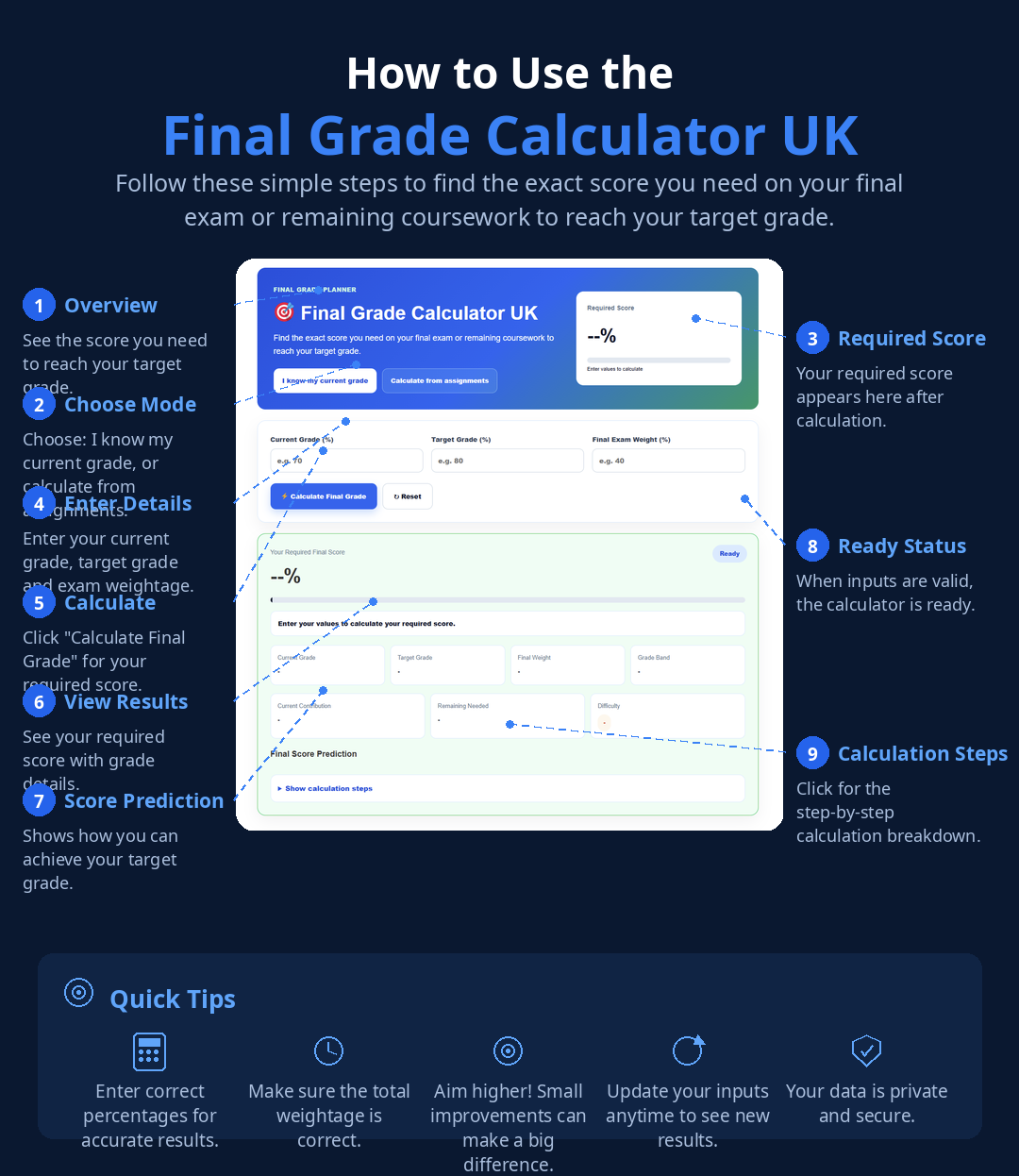
Click Here: Final Grade Calculator UK
What marking criteria actually are
UK universities use criterion-referenced marking. That single fact clears up most confusion. Your essay is judged against a fixed description of quality — the intended learning outcomes of the module — not against the rest of the cohort. There is no quota of Firsts and no curve quietly dragging marks down: in principle, every student on a module could score 70+. When students say “marking feels subjective,” what they usually mean is that the criteria are qualitative, which is not the same as arbitrary. Two markers can legitimately differ by a few marks on the same essay while both applying the same criteria honestly — which is why moderation and second-marking samples exist.
Criteria operate at two levels. The first is generic grade descriptors: university-wide statements of what each classification band demands. Bristol’s faculty marking criteria, Westminster’s generic grade descriptors and Manchester’s marks-scale descriptors all follow the same genre — a ladder from “exceptional, original, publishable” at the top down to “criteria not met” at the bottom. The second level is the module-specific marking scheme or rubric: the concrete grid your marker actually works from, which translates those generic bands into the dimensions of this assessment — and, crucially, states how much each dimension counts.
One more concept matters before we open a real rubric: best fit. Leeds’ business school criteria state it explicitly — the mark reflects the overall best-fit band for the piece of work, not a checklist where every cell must be ticked. Your essay can show one or two characteristics of the band above while sitting, on balance, in the band below. That is why a brilliant introduction does not rescue a descriptive middle, and why markers talk about the “feel” of a script: they are making a holistic judgement against the band descriptions, not adding up micro-points.
The anatomy of a rubric
A rubric is a grid. Once you see the grid, the mystery of the 62 starts to dissolve. Down the left-hand side run the criteria dimensions — the separate things being judged. For a typical humanities or social-science essay there are usually four: knowledge and understanding; argument and analysis; research and evidence; presentation and referencing. Science and maths-based assessments swap in dimensions like method, accuracy of technique, or problem-solving, but the architecture is identical.
Across the top run the grade bands — First (70+), 2:1 (60–69), 2:2 (50–59), Third (40–49), Fail (below 40). Each cell where a row meets a column holds a descriptor: a sentence or two describing what that dimension looks like at that standard. And alongside each row sits a weighting: the percentage of the final mark that dimension controls. Weightings are the part students most often miss, and they change everything — a 68 for argument matters far more when argument carries 40% than when it carries 20%.
Here is a realistic rubric for a 2,000-word second-year essay, written in the genre every UK university uses. Read it the way a marker does — row by row, asking which column each dimension of your work best fits:
| Criterion (weight) | First (70+) | 2:1 (60–69) | 2:2 (50–59) | Third (40–49) |
|---|---|---|---|---|
| Knowledge & understanding (30%) | Broad, deep and accurate; engages confidently with complexities and alternative viewpoints | Extensive and accurate; aware of complexity but does not fully explore it | Adequate grasp of core material; some inaccuracies or notable gaps | Thin or patchy; misunderstands key concepts |
| Argument & analysis (40%) | Sustained, original critical argument; engages analytically with the question throughout | Clear, well-structured argument; genuine critical engagement in places | Argument present but largely descriptive; drifts from the question | Weak or incoherent argument; mostly narrative |
| Research & evidence (20%) | Wide, well-chosen reading beyond the list; sources deployed in service of the argument | Good range of relevant sources; generally well integrated | Relies mainly on set texts; sources listed rather than used | Minimal or poorly chosen sources; weak referencing |
| Presentation (10%) | Fluent, lucid academic prose; precise referencing throughout | Clear writing; referencing accurate with minor slips | Readable but clumsy in places; referencing inconsistent | Poor expression obscures meaning; referencing largely absent |
Notice what the grid rewards and what it does not. Nothing in it mentions length, effort, or how many hours you spent. “Comprehensive content” without originality sits at 65–69 in several universities’ published criteria — Leeds’ geography descriptors describe that band as “notable for comprehensive content rather than the level of originality required for a First.” The rubric is telling you, in writing, that stuffing in more facts will not cross the 70 threshold. Only a change in kind — from coverage to critical, original argument — does that.
Generic grade descriptors, decoded
Module rubrics vary, but the generic bands underneath them are remarkably consistent across the sector — they have to be, because degree classifications must mean roughly the same thing at every university. Below is a plain-English decoding of the standard undergraduate ladder, drawn from the genre of published criteria at Bristol, Westminster, Manchester and Leeds. Treat it as a translation layer: when your feedback says “largely descriptive,” this table tells you which band you are in and what the next one demands.
| Band | What it means | What markers are looking for |
|---|---|---|
| 80+ (exceptional First) | Work of publishable quality that pushes at the boundaries of the topic | Significant originality or deep insight; the argument makes the examiner think differently about the subject |
| 70–79 (First) | Excellent in all assessed dimensions | Extensive knowledge, very good critical analysis, fluent and lucid writing, full and accurate use of sources |
| 60–69 (2:1) | Good solid work with real critical engagement | Clear structured argument, good knowledge, some originality; may be comprehensive rather than deeply original |
| 50–59 (2:2) | Adequate — meets the criteria without distinction | Sound grasp of basics but largely descriptive; limited reading; argument drifts or stays surface-level |
| 40–49 (Third) | Just meets the threshold for a pass | Thin knowledge, weak argument, notable gaps — but enough to demonstrate the minimum learning outcomes |
| Below 40 (Fail) | One or more criteria not met | Missing, misunderstood or incoherent work; at 30–39 some universities allow condoned progression — see our condoned pass guide |
Three qualifications keep this honest. First, taught Masters programmes usually pass at 50, not 40, with Merit at 60 and Distinction at 70 — the same descriptors, shifted up a band, which is why postgraduate marking can feel harsher. Second, problem-based subjects mark differently: Bristol’s criteria note that in mathematical subjects a First means near-perfect answers to a considerable proportion of the questions attempted — there, marks genuinely do track correctness. Third, and most important for essay subjects: 70 is not “70% correct.” It is a quality band. Nobody got 70% of the facts right and 30% wrong; the marker judged the work, on balance, to display the characteristics of excellent rather than merely good work.

Worked example 1: how Maya’s essay scored 64
Time to watch the grid in action. Maya is a second-year history student. Her 2,000-word essay asks: Was the New Deal a turning point in American history? She worked hard — a week in the library, fourteen sources — and received 64. She expected 70. Here is how her marker built that number from the rubric above, dimension by dimension.
Knowledge & understanding (30% weight) — judged 66. Maya’s factual coverage was broad and accurate: the First and Second New Deals, the Supreme Court fight, the revisionist historiography. But it stayed inside the reading list, and she never quite engaged with the deeper debate about whether “turning point” is even a coherent category. Solid 2:1, upper end.
Argument & analysis (40% weight) — judged 62. This is where the mark was decided, and it carries the biggest weight. Maya’s thesis — “the New Deal was a turning point economically but not politically” — was clear, but the middle third of the essay drifted into describing programmes rather than analysing their significance. Genuine critical engagement appeared in the introduction and conclusion; the body summarised. Classic mid-2:1.
Research & evidence (20% weight) — judged 68. Her best dimension. She found and used a 1935 Farm Security Administration photograph collection to make a point about visual propaganda — exactly the kind of well-chosen evidence the First column describes. One dimension flirting with the boundary above.
Presentation (10% weight) — judged 60. Clear enough prose, but her footnotes slipped between two referencing styles and one quotation lacked a page number. Competent, not polished.
Now the arithmetic the marker effectively performed:
| Dimension | Judged mark | Weight | Contribution |
|---|---|---|---|
| Knowledge & understanding | 66 | 30% | 66 × 0.30 = 19.8 |
| Argument & analysis | 62 | 40% | 62 × 0.40 = 24.8 |
| Research & evidence | 68 | 20% | 68 × 0.20 = 13.6 |
| Presentation | 60 | 10% | 60 × 0.10 = 6.0 |
| Total | 100% | 64.2 → 64 |
The single number 64 was hiding four separate judgements. Notice two things. First, the weightings did the quiet work: her weakest dimension (argument, 62) carried 40% of the mark, while her strongest (evidence, 68) carried only 20%. If the weights had been equal, she would have scored 64.0 anyway here — but on many rubrics the highest-weighted row is analysis, which is precisely where most students are weakest. Second, her feedback now reads differently: “good analysis, could develop the argument further” maps to the argument row sitting at 62 while the knowledge row sits at 66. The marker was telling her, in rubric language, that coverage was never the problem.
Worked example 2: what separates a 68 from a 72
Maya rewrote the essay over the holidays and wants to know what a First would have required. The crucial insight — the one the rubric has been whispering all along — is that the four marks between 68 and 72 are not bought with more facts. Leeds’ published criteria draw the line exactly here: the 65–69 band is “notable for comprehensive content rather than the level of originality and understanding required for a First,” while 70–74 demands “an at times original argument” with “consistently strong critical engagement.” Crossing into a First is a change in kind, not amount.
Concretely, here is what Maya changed and how a marker would re-judge each row:
- Argument (62 → 72): she reframed the thesis around a genuine tension — that the New Deal’s economic interventions were radical while its political coalition depended on not disturbing Southern racial hierarchies — and sustained that tension through every section instead of resolving it in the introduction and forgetting it. The middle third stopped describing programmes and started weighing their significance against the thesis. That is “sustained critical engagement”: the single most expensive phrase in the rubric.
- Knowledge (66 → 70): she added one revisionist historian from beyond the reading list and used him to complicate, not decorate, her argument. Breadth plus a flash of independent reach.
- Evidence (68 → 74): the photograph collection stayed, but now each image was made to do argumentative work — one paragraph shows how a single image supports two competing readings. Sources in service of argument is the First-column behaviour.
- Presentation (60 → 68): one consistent referencing style, every quotation paginated, topic sentences that actually signpost. Unremarkable, but no longer a drag.
Re-running the weighted arithmetic: 70 × 0.30 = 21.0; 72 × 0.40 = 28.8; 74 × 0.20 = 14.8; 68 × 0.10 = 6.8. Total: 71.4 → 71. The rewrite gained seven marks, and five of them came from the argument row — the heaviest-weighted dimension. This is the general lesson: find your rubric’s highest-weighted row and attack it first. Students usually do the opposite, polishing presentation (10%) while the argument (40%) sits untouched.
It also explains the notorious stickiness of the high 60s. A 68 is typically a strong 2:1 — comprehensive, well-organised, well-evidenced — that lacks the originality and sustained critical edge the First column demands. Markers are not withholding four marks out of stinginess; the work is displaying the characteristics of the 60s band on a best-fit judgement. If you are parked at 66–69 across modules, the fix is almost never “write more.” It is “argue harder.” Our guide to how to get a First-class degree builds on exactly this distinction.
Five things markers reward that students underestimate
Read a dozen published criteria documents and the same quiet priorities surface — things students rarely optimise for because nobody told them they were being scored on them:
- Answering the question that was actually set. “Engages closely with the question” is the first criterion in several universities’ First-class descriptors. The most common way strong students lose marks is answering an adjacent, easier question — usually visible by paragraph three.
- Analysis over description. The single most frequent 2:2-to-2:1 lever. Description tells the marker what happened; analysis tells them why it matters, what it connects to, and where the standard account is weak. One analytical paragraph outweighs three descriptive ones.
- Structure the marker can navigate. Markers read fast. An introduction that maps the argument, topic sentences that signpost, and a conclusion that answers rather than summarises will lift the “structure and organisation” judgement a full band on its own.
- Evidence integrated, not inventoried. A bibliography of twenty sources you never engage with scores worse than eight sources woven into the argument. The rubric rewards sources deployed, not sources listed.
- Presentation as a tiebreaker. Sloppy referencing will not single-handedly fail a brilliant essay, but at a borderline — 68 versus 70, 59 versus 60 — markers reach for every signal. Clean presentation nudges best-fit judgements upward; chaotic referencing nudges them down. It is the cheapest mark on the grid.
Marking criteria myths vs reality
| Myth | Reality |
|---|---|
| “70% means getting 70% of things right” | In essay subjects 70 is a quality band, not a percentage correct. You can write a factually flawless essay and score 62 if it is purely descriptive. |
| “There’s a quota of Firsts per module” | UK marking is criterion-referenced: everyone is judged against the published standard, not ranked against each other. Whole cohorts can — occasionally do — clear 70. |
| “Longer essays score higher” | No published criterion rewards length. Word counts are ceilings, not targets; padding usually dilutes the argument row. |
| “You can’t question a mark” | You can. If you believe the criteria were misapplied or the process was flawed, you can request a re-mark and ultimately appeal a university grade — though appeals succeed on procedural grounds, not on “I deserve more.” |
| “Criteria don’t matter in first year” | First year is where you learn the game the criteria describe. The students coasting on A-level habits — description-heavy, question-adjacent — are the ones shocked by their first 58. |
| “All markers interpret criteria identically” | They don’t, which is why moderation samples exist and why marks can move a few points on second marking. If your mark looks out of line with the feedback, you have the right to see your marked work and check. |
How to use the criteria to lift your next grade
Everything above is only useful if it changes what you do before the deadline. Here is the practical routine:
- Find your criteria. They live in the module handbook or on your VLE, sometimes under “assessment” rather than “marking.” The university-wide generic descriptors are usually one search away — try “[your university] generic assessment criteria” or “[your university] grade descriptors.” If a module publishes nothing, email the module lead and ask: under ESG 1.3-aligned quality arrangements, sharing criteria is the expectation, not a favour.
- Self-mark a draft against the rubric. Before submitting, grade each row of the rubric honestly and compute the weighted total the way Maya’s marker did. Students who do this routinely report the same shock: the draft they “felt” was a 68 prices out at 61, and the gap is always in the same row.
- Attack the heaviest-weighted row first. Revision time is finite. An hour spent sharpening the argument (typically 30–40% of the mark) beats an hour perfecting footnotes (typically 10%).
- Use criteria language in feedback meetings. “Which row held me at 62?” gets you a far more useful answer than “how do I improve?” — it forces the conversation onto the grid the marker actually used.
- Know when a mark is challengeable. If the feedback contradicts the published criteria, if the rubric weightings were never shared, or if you suspect an arithmetic or process error, start with our guide to checking your university calculated your marks correctly — then the remark and appeal routes above. Criteria cut both ways: they tell you when to accept a 64, and when not to.
One final connection worth making explicit: criteria explain individual marks, but your degree classification is built from many marks combined by weighting rules — year weightings, credit values, condoned fails. Once you can read a rubric, the next skill is reading the arithmetic that turns module marks into a classification. Our Final Grade Calculator (guide above) lets you model exactly that: plug in the marks your criteria now help you predict, and see what your final year needs to deliver. Students who understand both halves — how marks are earned and how they are combined — stop being surprised by results day. Our borderline grades guide covers what happens when the combined number lands agonisingly close to the next class.
What are marking criteria at university?
Marking criteria are the published standards your work is judged against. They describe what each grade band (First, 2:1, 2:2, Third, Fail) looks like across dimensions such as knowledge, argument, evidence and presentation. UK universities are expected to publish them under quality-assurance arrangements (ESG 1.3), and most also provide module-level rubrics showing how much each dimension counts.
What is the difference between marking criteria and a rubric?
Marking criteria are the general standards; a rubric is the concrete grid a marker works from for a specific assessment. The rubric’s rows are the criteria dimensions, its columns are the grade bands, each cell describes what that dimension looks like at that standard, and each row carries a weighting showing how much it contributes to the final mark.
Is 70% at university the same as 70% at A-level?
No. At A-level, marks often track how much of the content you got right. At university, 70 is a quality band meaning excellent work — extensive knowledge, strong critical analysis and fluent writing — not 70 per cent correctness. A factually flawless but purely descriptive essay can score in the 60s.
Can two markers give different marks for the same essay?
Yes, by a few marks. Criteria are qualitative, so honest markers can legitimately differ while applying the same standards — this is why universities moderate samples of marking and use second markers. Large discrepancies should be investigated, which is one reason you can request to see your marked work.
Where do I find the marking criteria for my module?
Check the module handbook or your virtual learning environment under assessment or marking. University-wide generic grade descriptors are usually published on your university’s website — search for your university name plus generic assessment criteria. If a module publishes nothing, email the module lead and ask; sharing criteria is the expectation, not a favour.
Do all UK universities use the same marking criteria?
The 70/60/50/40 classification bands are sector-wide, and the genre of the descriptors is very similar everywhere because degree standards must be comparable. But the exact wording, the dimensions assessed and the weightings differ by university, department and module — always work from your own module’s rubric, not a generic one.
Can I appeal if I think the criteria were applied unfairly?
You can request a re-mark and ultimately appeal, but appeals succeed on procedural grounds — for example, the published criteria were not followed, weightings were never shared, or there was a process error — not simply because you feel you deserved more. Start by checking your marks were calculated correctly, then follow the formal remark and appeal routes.
Do marking criteria work differently for Masters degrees?
The structure is the same, but the scale shifts: taught Masters programmes usually pass at 50 rather than 40, with Merit at 60 and Distinction at 70. Expectations of independence and critical depth are also higher, with more emphasis on originality and engagement with current debates in the field.
Conclusion
The six marks between Maya’s 64 and her flatmate’s 68 were never a mystery to the marker — they were four separate judgements, weighted and combined, against a grid most students never read. That is the real story of university marking criteria: not a secret formula, but a published one that hardly anyone opens. Criterion-referenced marking means you are measured against a fixed description of excellence, not against the people around you; the rubric means every mark can be decomposed into rows you can actually work on; and the best-fit principle means borderlines are decided by the overall character of your work, not by a single brilliant paragraph.
If you take one habit from this guide, make it the pre-submission self-mark: grade your draft against the rubric, row by row, with the real weightings, before the marker does it for you. It is a slightly uncomfortable exercise the first time — most drafts price out lower than they feel — but it converts vague anxiety about grades into a concrete repair list, and it directs your effort at the heaviest-weighted row instead of the easiest polish. Students who do this stop being surprised by their marks, in both directions.
And keep the two halves of the grading game together. Marking criteria explain how individual marks are earned; weighting rules, condoned passes and classification algorithms explain how those marks are combined into the degree you graduate with. Understand both, model your trajectory with the Final Grade Calculator, and results day becomes something you predicted months ago — not something that happened to you.
![Read more about the article Can You Ask for a Remark? How Re-marking and Mark Reviews Work at UK Universities [2026]](https://gradeforuni.com/wp-content/uploads/2026/10/featured-ask-for-a-remark-300x192.png)
![Read more about the article When Is the UCAS Deadline 2027? January Equal-Consideration Date Explained [2026]](https://gradeforuni.com/wp-content/uploads/2026/10/featured-ucas-deadline-2027-300x192.png)
![Read more about the article How to Improve a 2:2 to a 2:1 in Final Year: UK Degree Recovery Guide [2026]](https://gradeforuni.com/wp-content/uploads/2026/10/featured-improve-2-2-to-2-1-300x192.png)