
![You are currently viewing How University Marking Is Moderated in the UK [2026]](https://gradeforuni.com/wp-content/uploads/2026/10/featured-marking-moderation.png)
How University Marking Is Moderated in the UK [2026]
You submit your essay at 11:58pm, one eye on the Turnitin countdown, and the moment you press “submit” it disappears into a black box. Weeks later a number appears on your portal — 63, say — and it is tempting to imagine a single tired lecturer read your work once, picked a number, and moved on. That is almost never how it works. Between submission and results day your work passes through a small production line of marking-moderation checks: first marking, moderation, sometimes a second marker, an external examiner, and finally a board of examiners. Understanding that pipeline explains why marks are “provisional” for weeks, why you cannot simply ask for a re-mark, and the one narrow set of circumstances in which a check can actually move your mark.
This guide walks you through the real marking moderation machinery UK universities use in 2026 — the sampling rules, the second-marking models, the external examiner’s actual powers (smaller than students think), and when anonymous marking applies. Every claim below comes from published university regulations or the QAA’s external-examining guidance, linked at the end. Moderation practice varies between departments even within one university, so treat named policies as the verified examples they are, not as universal law.
One thing to know before we start: nothing on this page will help you predict your marks. What it will do is show you exactly who checks your work, in what order, and what you can legitimately do if you believe an error was made — which is a shorter list than most students expect, and a more useful one.
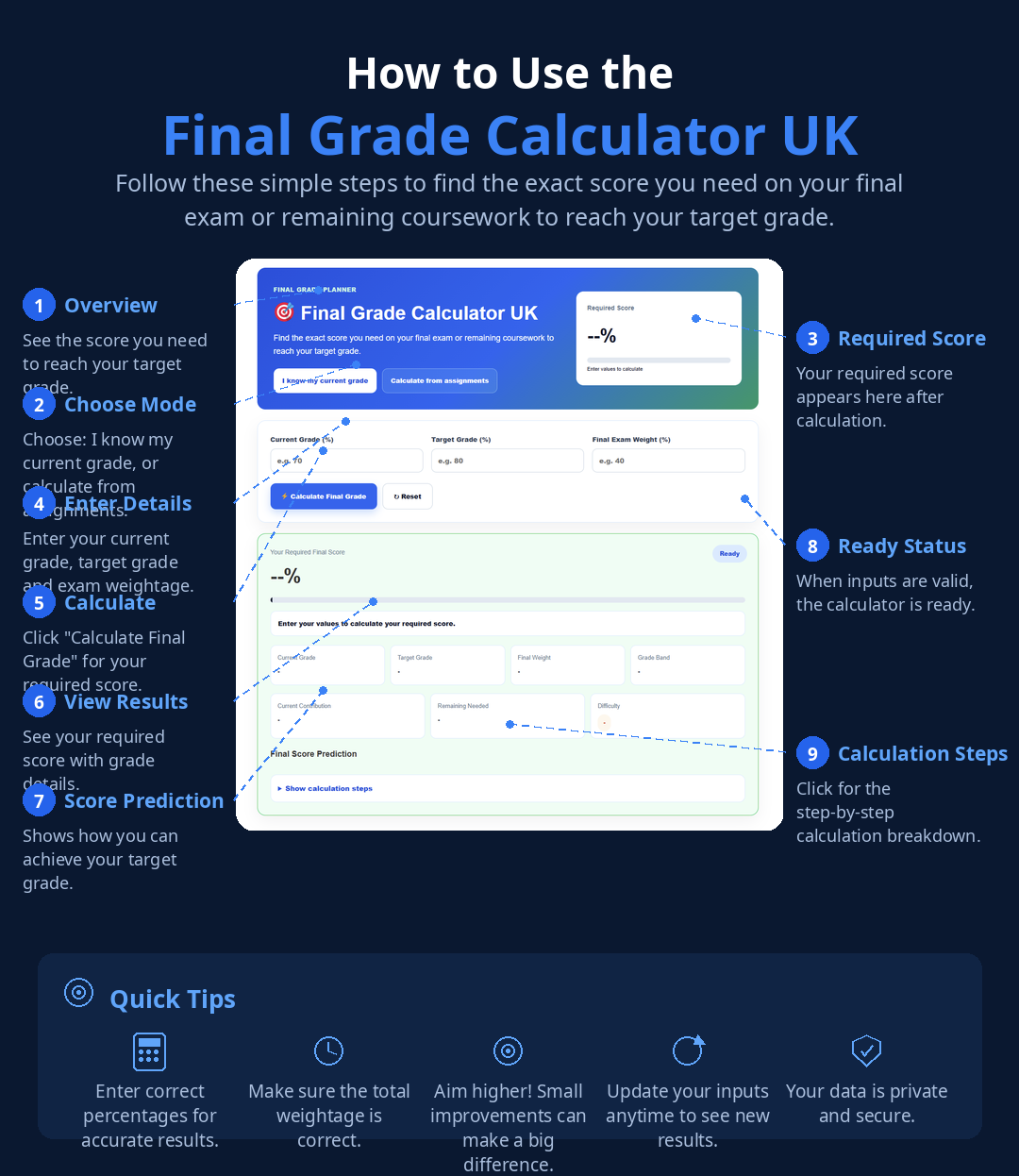
Click Here: Final Grade Calculator UK
The Five Stages Every Script Passes Through
However your university phrases it, a piece of assessed work that counts toward your degree goes through up to five distinct stages. Not every assessment gets all five — a 10% lab report will not see an external examiner — but anything substantial does:
- First marking — the marker who taught you (or their colleague) marks your work, usually without knowing your name.
- Moderation by sampling — a second academic reviews a sample of scripts to check the marking standard, not to re-mark individuals.
- Second (double) marking — every script is independently marked a second time; reserved for the work that matters most.
- External examiner scrutiny — an independent academic from another university reviews samples and confirms standards.
- The exam board — the board of examiners ratifies the marks. Until this happens, everything you have seen is provisional.
The most common misunderstanding is treating stages 2, 3 and 4 as the same thing. They are three different jobs, done by different people, with different powers. Mix them up and the rest of the system stops making sense — so let’s take them one at a time.
Stage 1: First Marking — And Why Your Name Is Hidden
The first marker is usually the academic who taught the module, marking against the published criteria. Before anything else happens, most universities remove your name from the process entirely. UCL’s assessment framework puts it bluntly: “Examinations and tests must be assessed against Candidate Number only.” Exam scripts are the clearest case — at Liverpool John Moores, candidates literally fold and stick down the corner of the answer book to conceal their name, and anonymity is only lifted when the final mark is transcribed.
Anonymous marking is standard for exam scripts and, wherever possible, coursework. Aston requires all formal written fixed-time assessments to be marked anonymously, and Northumbria University London extends the same rule to all summative coursework at every level. The point is obvious: no marker, however professional, should be able to adjust for who wrote the script.
But there are honest exemptions, and universities publish them. Canterbury Christ Church’s anonymous-marking policy carries a per-type table: dissertations and theses — no; presentations — no; viva voce — no; group practicals and performances — no; exhibitions — no; clinical skills — no; written coursework — yes where possible. York St John publishes a similar exemption list covering vivas, OSCEs, artwork, dissertations, group work and reflective essays. The logic is practical: where the marker supervised you closely, watched you perform, or sat across from you in a viva, anonymity is impossible. Essex handles this with a neat compromise — in the exempted cases the second assessor must still receive an anonymised copy. And UCL closes the biggest loophole of all: where a dissertation supervisor acts as a marker, the dissertation must be subject to full, independent and anonymous second-marking.
So if you have ever wondered whether a lecturer could mark you down because they dislike you: for anonymous exam scripts, they cannot identify you. For the rest, the system compensates with the stages that follow.
Stage 2: Moderation by Sampling — The Check Most Marks Actually Get
Here is the sentence that unlocks the whole topic: moderation is a quality check on the marking, not a re-mark of your work. A moderator takes a sample of scripts from across the mark range and asks one question — was the first marking fair, consistent and at the right standard? They do not assign you a new mark. Glasgow Caledonian defines moderation precisely this way: a second marker who is aware of the first marker’s marks and comments reviews borderline assessments, all fails, and representative samples. Sheffield Hallam’s policy puts the scope plainly: all first-sit percentage or graded work is internally moderated, either as a representative sample across the marking range or as second marking of the whole cohort.
What goes into the sample matters, because it is designed to catch the mistakes that matter. UCL publishes the minimum sampling rule its departments must follow when sampled second marking is used: the sample must include all fails, mid-class examples from each class (mid-40s, 50s, 60s and Firsts), all upper borderlines (39, 49, 59, 69), and the higher of 10% of assessments or at least five scripts. Borderlines and fails get automatic inclusion because those are the marks where a small error has the largest consequence.
Now the part students consistently get wrong: what happens when the moderator disagrees with the first marker on a sampled script. The instinct is to assume the sampled student’s mark gets corrected. It doesn’t — it can’t, and the reason is fairness. UCL’s manual states it as a rule: “Individual student marks must not be changed unless all marks have been checked.” If the markers disagree over a sample, the prescribed response is to extend the sample, not to change the sampled marks. Durham states the same principle from the other direction: an individual mark cannot be changed unless the second marker has marked every other script in the run — otherwise what happened was moderation, not double marking. The fairness logic is worth pausing on: changing marks only for students lucky enough to land in the sample would advantage or disadvantage them arbitrarily relative to everyone else. No student should be helped or harmed by the accident of being sampled.
Stage 3: Second Marking — When Every Script Gets a Second Look
Second marking — also called double marking — is the stronger medicine: every script is reviewed, and individual marks genuinely can move. Universities reserve it for the assessments that matter most. Edinburgh’s internal moderation guidance names the trigger precisely: any single assessment item worth 40 or more credits must be double marked, and dissertations or capstone projects marked by the student’s own supervisor are expected to be double marked even below that threshold. All other assessments worth more than 10% of the course mark get sampled moderation instead. Durham’s quality-assurance policy uses the same split: full moderation — systematic review of all pieces — is required for every dissertation and major project, and departments may not water that down into mere sampling.
But “second marking” is not one thing. UCL’s assessment framework lays out the full taxonomy, and it is worth learning because students conflate the variants constantly:
| Variant | What the second marker does | Used for |
|---|---|---|
| Full independent (double) marking | Marks every script independently, then the two markers reconcile | Dissertations, major projects, 40+ credit items |
| Sampled second marking | Reviews a defined sample (fails, borderlines, 10% minimum) | Most module assessments |
| Check marking | Checks the first mark is appropriate — no separate mark assigned | Quantitative or multiple-choice work |
| Blind marking | Second marker never sees the first marker’s marks or comments | Dissertations (mandatory at several universities) |
| Open marking | Second marker sees the first mark and may take it into account | Routine sampled moderation |
| Live marking | Two or more markers present at the assessment itself | Presentations, orals, practicals, group work |
At Edinburgh, double marking follows a clear protocol: two markers mark independently, record their marks and comments separately, then compare and resolve to an agreed mark. If they cannot agree, a third marker is appointed to settle it. Glasgow Caledonian’s undergraduate regulations describe final-level projects and dissertations being marked by two independent examiners, “neither of whom is aware of the views of, or the marks being awarded by, the other examiner” — blind marking as the default for the work that carries your classification.
And when two honest markers disagree by a small amount, the resolution is prosaic, not dramatic. Durham gives departments an example procedure: a discrepancy under 5% of the module mark that does not span a classification border can be resolved by averaging the two marks. UCL draws the line at 10%: for differences of 10% or more, or spanning a class boundary, marks are reconciled through discussion of the criteria — mathematical averaging is explicitly not to be used; for differences under 10%, averaging is allowed. No university lets departments invent a private reconciliation method outside these bands; faculties may set their own thresholds above the university minimum, but the minimum is the floor, not a suggestion.
Stage 4: The External Examiner — Marking Moderation’s Independent Eye
Every UK university appoints external examiners: senior academics from other institutions whose job is to protect standards and keep degree classifications comparable between universities. This is the stage students most overestimate. The external examiner does not mark your work and is not responsible for assessing individual students. What they do, per the QAA’s external-examining guidance, is review samples — including work from different degree classifications and fails — to judge whether the marking practices are at the right standard. (One honest caveat the QAA itself insists on: its external-examining principles are sector advice, “not regulatory in any part of the UK.” They describe best practice, not law.)
The single most important rule about external examiners: they cannot normally change your individual mark. The QAA puts the reason plainly — an external examiner “should not expect or encourage an examination board to raise or lower marks for individual students, because this would be unfair to those candidates whose work is not part of the sample.” Universities say the same in their own regulations. Nottingham’s examiner guidance states that external examiners must not normally be involved in adjusting individual marks before or at the exam board. York’s assessment guide is even blunter: external examiners “should not be asked to change marks agreed by the Board of Examiners for an individual piece of work under any circumstances.” Birkbeck’s policy allows a mark change only if the examiner has seen all the assessed work for the module. UWE Bristol’s guide says externals cannot change a mark for an individual student at all.
What the external examiner can do is recommend action at cohort level. If scrutiny of the whole cohort’s assessment reveals marking that is systematically harsh or lenient, they can recommend that the marks be rescaled — adjusted for everyone, not just the sample. York allows exactly this: a rescaling recommendation must apply to all marks for the assessment task, never just the scripts the external saw, and the final decision stays with the board. Nottingham’s one recognised exception shows how narrow this is: where a poor exam question slipped through, all marks for the whole suite of answer papers may be raised by a set percentage. And if a board rejects the external’s recommendation, York requires the recommendation and the reasons to be minuted — the disagreement goes on the record.
Externals also write annual reports, and institutions are expected to act on them. The QAA guidance says universities should tell the external examiner when they decide not to act on a comment, and explain why. So the external examiner is real quality assurance with real teeth — just aimed at the standard of the whole cohort’s marking, never at your individual script. A student hoping an external examiner will personally rescue their 59 is misunderstanding the job entirely.

Stage 5: The Exam Board — Where Marks Become Final
All of the above feeds into the board of examiners (also called the exam board, or the Progression and Awards Board). Until the board ratifies your marks, everything you have seen is provisional — this is the single most useful sentence in the whole assessment system. Edinburgh’s regulations state it exactly: before consideration by a board of examiners, marks “are provisional and have no status until they are approved or modified by the Board.” Swansea’s marking policy says the same: all marks not yet presented to the Progression and Awards Board “are considered provisional and therefore may be subject to change.” A Manchester faculty handbook warns students that all marks given before the final examiners’ meeting “must be regarded as provisional.”
This is why your portal can show you a coursework mark in March and the official result in June can differ. Coursework marks are often released early as a performance guide with an explicit provisional warning; exam marks at some universities (Bristol is one) are not released at all until the faculty exam board has met. And there is a hard procedural line behind it: Newcastle’s board rules state that any adjustment of a cohort’s marks must happen before the board meeting — once marks have been returned to the board they cannot be adjusted, except to correct transcription errors.
Even the exam papers themselves are quality-checked before you ever sit them. Lincoln’s assessment policy notes that exam papers and mark schemes are internally peer-reviewed and approved by the external examiner before teaching begins. The pipeline starts before the module does.
How long does all this take? Universities publish turnaround targets: Manchester’s handbook and Lincoln’s policy both aim for marking and feedback within 15 working days of hand-in; Newcastle targets 20 working days for coursework marks. Swansea notifies formal results normally within one working week of the Progression and Awards Board meeting. So when results feel slow, the delay is usually this machinery running — marking, sampling, reconciliation, external scrutiny, board scheduling — not anyone losing your script.
When Moderation Moves Your Mark: A Worked Example
Time to put the machinery together with numbers. The scenario below is illustrative — no university publishes how often moderation moves marks or by how much — but every rule it uses is a real published rule: UCL’s sampling minimum, the UCL/Durham “no individual changes unless all checked” rule, and the York/Newcastle whole-cohort adjustment rule.
The setup. A 100-student module, assessed by 30% coursework and 70% written exam. Student A (let’s call her Amara) gets 66 on the coursework and 58 on the exam at first marking. Her provisional module mark is (0.30 × 66) + (0.70 × 58) = 19.8 + 40.6 = 60.4 → 60, a low 2:1.
The moderation sample. Under UCL’s minimum rule, the moderator’s sample includes all fails, mid-class examples (mid-40s, 50s, 60s, Firsts), all upper borderlines (39, 49, 59, 69), and at least 10% of scripts — so at least 10 scripts for this cohort. Amara’s 58 may or may not be in the sample; it doesn’t matter, and you’ll see why.
The finding. The moderator’s independent check averages about 5 marks above the first marker’s across the sampled range — evidence of systematic under-marking, not an isolated slip. Under the fairness rules, the sampled students’ individual marks are not corrected one by one. Instead, the board approves a uniform +4 mark adjustment to all 100 exam scripts (decided before the board meeting, per Newcastle’s rule).
The arithmetic. Amara’s exam mark moves 58 → 62. Her module mark becomes (0.30 × 66) + (0.70 × 62) = 19.8 + 43.4 = 63.2 → 63. Her module mark moves 60 → 63 — and a student who scored 58 on the exam but was not in the moderation sample gets the identical +4, because the adjustment applies to the whole cohort. That is UCL’s fairness principle in action: “no student is advantaged or disadvantaged by being included in the sample.”
The teaching point: this is how marking moderation moves marks in reality — cohort-wide adjustment after a sample reveals a pattern, or agreed-mark changes under full double marking with third-marker resolution. What it never does is quietly tweak one student’s script. If your mark changed between provisional and final results, one of these two mechanisms is almost certainly why — and our check-your-marks guide shows how to verify the arithmetic yourself.
What Moderation Doesn’t Do — Five Myths
| Myth | Reality |
|---|---|
| “If everyone did badly, moderation pushes all our grades up.” | Moderation checks whether the marking was fair, not whether the paper was hard. A hard paper with accurate marking needs no adjustment — scaling is not the same as moderation, and most universities don’t scale at all (see our grade-curving guide). |
| “The external examiner can raise my individual mark.” | Normally no — externals recommend cohort-level rescaling only, and the board decides. Individual marks are protected unless every script was re-checked. |
| “Moderation only checks failing scripts.” | Fails are always included, but so are borderlines and mid-class examples from every class — the sample is designed to span the whole range. |
| “First-year marks aren’t moderated.” | They are. Moderation applies to all first-sit percentage-marked work at most universities; first-year marks simply don’t count toward your classification at most institutions (see does first year count). |
| “I can ask for my exam to be re-marked if I’m unhappy.” | Almost never. Disagreement with academic judgement is not valid grounds at most universities — but there is one genuine exception and one legitimate check, covered below. |
If You Think Your Mark Is Wrong: What Actually Works
This is where the pipeline meets your options, and the options are narrower than students hope — but they are real. The critical distinction, enforced across the sector, is between academic judgement (what your work deserves — you cannot challenge this) and administrative or procedural error (which you can).
1. Check for administrative errors first. Transcription mistakes, a missing question mark, a component left out of the total — these happen, and universities have a procedure for exactly this. Swansea’s “Accuracy of Published Marks” procedure lets students apply to verify the accuracy of published marks, while explicitly stating students may not challenge the marking itself. Regent’s regulations similarly let students informally request an administrative check that the expected marking process was followed. This is the fastest, least adversarial route, and our marks-checking checklist walks through recomputing your own weighted average from your transcript.
2. Ask to see your marked script. Some universities let you view your marked exam scripts after the boards have met — seeing the annotations often resolves the mystery (or confirms the arithmetic was right). Our see-your-scripts guide covers how to request them.
3. The genuine re-mark exception. The general rule is a hard no: the University of Law’s student guide states “You cannot challenge the Board’s academic judgement. This means that you can’t ask for your paper to be remarked”; Gloucestershire’s appeals procedure (4.2) says students “do not have the right to request that an assessment is re-marked”; Aston’s appeals page says the same. But there is a notable exception: UEA’s re-marking policy allows remark requests within 10 working days of publication for work that was second marked — not blind double marked, not exams — provided you can justify it (mark inconsistent with feedback, part of the submission not considered, criteria misapplied) and have first discussed it with the marker. Treat UEA as the exception that proves the rule: unless your university publishes a re-marking policy, assume no such route exists.
4. Appeal — only on permitted grounds. Appeals are not second attempts at the marking; they are challenges to the process. Gloucestershire permits appeals only where there is an administrative error or procedural irregularity that materially affected the mark, or extenuating circumstances not previously communicated with evidence — and explicitly excludes disagreement with the board’s academic judgement. That exclusion is sector-wide (Aston, Regent’s, and the OIA’s definition of academic judgement all agree). Our appeals guide covers grounds, evidence and deadlines in full.
One more practical note: if your issue is a borderline mark rather than a suspected error, the borderline-grades rules and the marking-criteria guide explain how classification boundaries and rubrics actually work — often the “error” is a rubric the student never read.
The sources behind this article: the QAA’s external-examining guidance, UCL’s Academic Manual (Chapter 4, Marking & Moderation), the University of Edinburgh’s Internal Moderation Guidance, and Swansea’s Assessment, Marking and Feedback Policy.
Does every university exam get moderated?
Yes, in almost all cases. Most universities require internal moderation of all first-sit percentage or graded work, though the depth varies: routine module assessments get sampled moderation (a defined sample spanning fails, borderlines and mid-class examples), while dissertations, major projects and assessments worth 40+ credits are fully double marked. Departmental thresholds can sit above the university minimum, so the exact coverage on your module is set by your faculty.
Can my mark go down in moderation?
In principle, yes, but in practice moderation is a fairness check, not a punishment. If moderation finds systematic over-marking, the same cohort-wide adjustment rules apply in the other direction. Individual sampled marks are not changed one by one: where only a sample was reviewed, the rule is that no individual mark moves unless every script was re-checked. Your own mark changing is rare, and it happens through the published cohort mechanisms, never as a quiet tweak to your script alone.
Can the external examiner change my individual mark?
Normally, no. External examiners review samples of work to judge whether marking standards are right across the cohort; they do not mark individual students. The QAA’s guidance states they should not expect exam boards to raise or lower marks for individual students, because that would be unfair to everyone outside the sample. What an external examiner can do is recommend the board rescale the whole cohort’s marks if the marking was systematically harsh or lenient — and the board, not the examiner, makes the final decision.
Are exams marked anonymously? Could a lecturer mark me down personally?
Written exams are marked anonymously almost everywhere: scripts carry your candidate number, not your name, and anonymity is only lifted when the final mark is transcribed. All formal written fixed-time assessments are marked anonymously at universities like Aston. For work where anonymity is impossible — presentations, vivas, performances, closely supervised dissertations — the safeguard is the second stage instead: blind or open second marking by an independent academic, plus external examiner scrutiny.
Is only failing work moderated?
No. Failing scripts are always included in moderation samples, because a fail is the highest-consequence mark, but so are upper borderlines (for example 39, 49, 59 and 69), mid-class examples from every class, and a minimum proportion of the whole cohort. The sample is deliberately spread across the mark range so the moderator can judge whether the standard is consistent everywhere, not just at the pass line.
Why did my mark change between the provisional mark and the final result?
Because marks are provisional until the board of examiners ratifies them. Between the provisional mark you saw and the final result, moderation sampling, marker reconciliation, external examiner scrutiny and board decisions all happen. If a sample revealed systematic harsh or lenient marking, a cohort-wide adjustment was applied; if your work was fully double marked, the agreed mark may differ from the first mark. Transcription and addition errors are also caught at this stage.
How long does moderation take? Why are my results late?
Most universities target 15 to 20 working days from hand-in for marking and feedback, and formal results are normally confirmed within about a week of the exam board or Progression and Awards Board meeting. The full pipeline — first marking, moderation sampling, reconciliation of disagreements, external examiner review and board scheduling — is what fills those weeks. Slow results usually mean the machinery is running, not that your script is lost.
Can I ask for my exam to be re-marked if I disagree with the mark?
Almost never. Disagreement with academic judgement — the marker’s professional opinion of what your work deserves — is explicitly excluded as appeal grounds at most UK universities, and there is generally no right to request a re-mark. What you can do is request an administrative check for errors (wrong totals, missing components, transcription mistakes), ask to see your marked script, and, in one documented exception, use UEA’s re-marking policy if your university publishes an equivalent route.
Conclusion
University marking moderation is less mysterious than it feels from the student side, and less powerful in the ways students wish it were. Nobody re-marks your exam because you email them. No external examiner swoops in to rescue a borderline script. What actually happens is quieter and more structural: anonymous first marking, a sampled check that spans fails, borderlines and every class, full double marking for the work that carries your degree, an independent examiner guarding the standard of the whole cohort, and a board that ratifies everything only when the checks are done.
The two ideas worth keeping are the fairness rule and the provisionality rule. Marks are never changed for one student on the basis of a sample — the system would rather extend the sample, apply an adjustment to everyone, or re-mark everything than advantage one script by accident. And nothing you see before the board of examiners is final, however official the portal looks. If a mark ever moves between provisional and confirmed, it moved through one of the mechanisms above — and now you know exactly which ones to ask about.
![Read more about the article What Grades Do You Need for a Russell Group University? Entry Requirements Explained [2026]](https://gradeforuni.com/wp-content/uploads/2026/10/featured-russell-group-grades-300x192.png)
![Read more about the article Does Your Degree Classification Matter? What UK Employers Actually Check [2026]](https://gradeforuni.com/wp-content/uploads/2026/10/featured-degree-classification-jobs-300x192.png)
![Read more about the article When Do Uni Results Come Out? UK University Results Day Explained [2026]](https://gradeforuni.com/wp-content/uploads/2026/10/featured-university-results-day-300x192.png)