
![You are currently viewing How Are Nursing Degrees Graded in the UK? Theory, Placements & the NMC [2026]](https://gradeforuni.com/wp-content/uploads/2026/10/featured-nursing-degrees-graded.png)
How Are Nursing Degrees Graded in the UK?
If you are starting a nursing degree this autumn — or waiting on results — you have probably already spotted the oddity: nursing degrees are graded differently from almost every other UK degree. This guide explains exactly how nursing degrees graded in the UK split into two parallel systems, what counts towards your degree class and what does not, and the NMC rules that no university is allowed to bend.
The headline version: your essays and exams are percentage-marked like any other degree, with a 40% pass mark and the familiar First, 2:1, 2:2 and Third bands. But your placements — half of your entire degree — are assessed on a pass-or-fail basis, and no amount of brilliant coursework can compensate for a failed placement. Once the distinction between the two tracks is clear, the rest of the grading system makes sense.
This guide covers how theory modules are marked, who actually signs off your placements, how your final classification is calculated (with a full worked example), what happens when placements or OSCEs go wrong, and the university-by-university quirks — from Scotland’s letter grades to the one university that still grades practice numerically. Every rule below is drawn from real university regulations and official Nursing and Midwifery Council (NMC) standards, with sources linked.
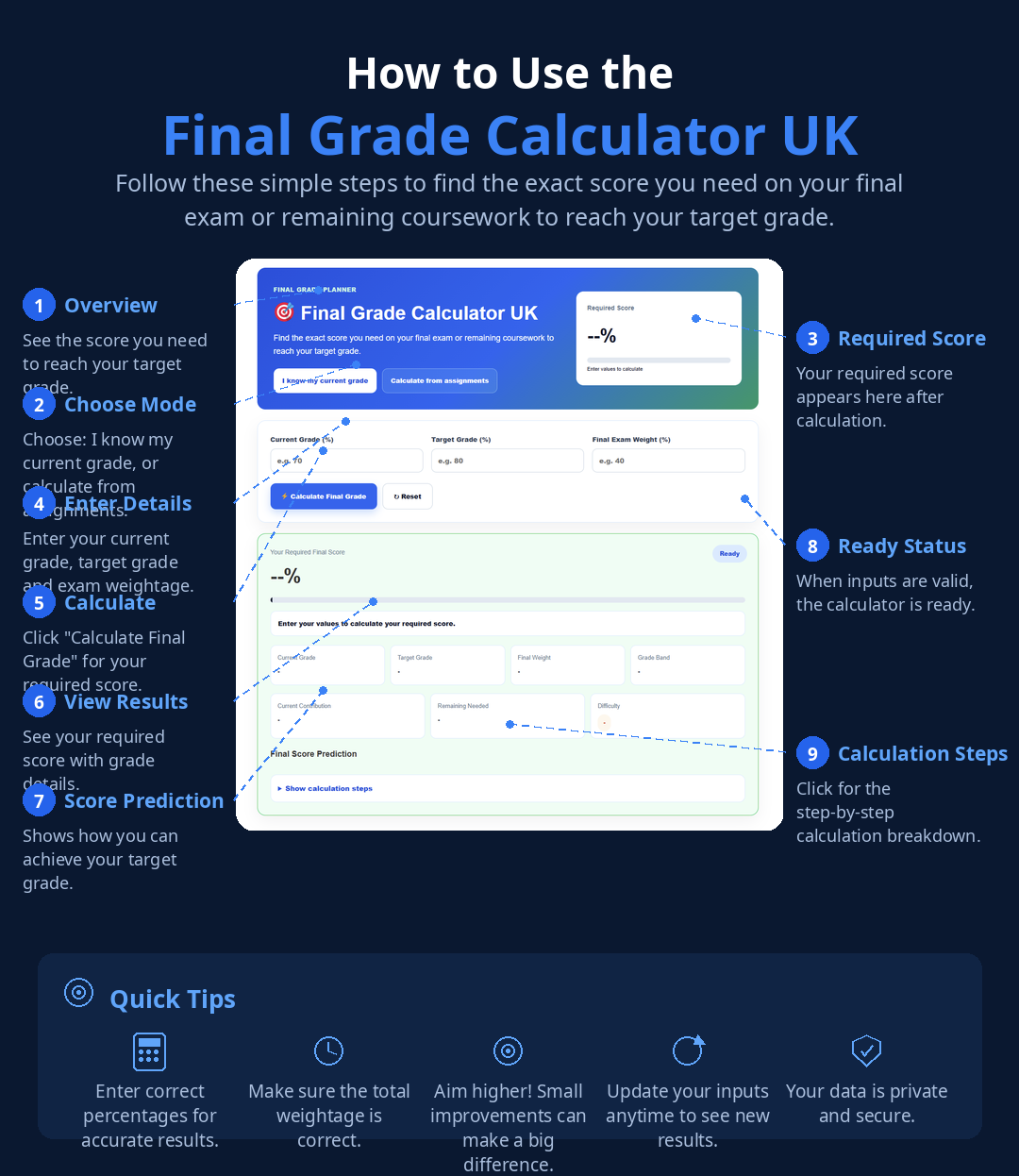
Click Here: Final Grade Calculator UK
The two-track grading system nobody explains at open days
A pre-registration nursing degree in the UK is not graded like a single academic course. The NMC’s standards for pre-registration nursing programmes require every approved degree to total at least 4,600 hours over a minimum of three years, split 50:50 between theory and practice — 2,300 hours of each. That split is not just a timetable detail; it is the entire logic of nursing grading. The two halves are assessed by different people, under different rules, and one half contributes nothing at all to the number on your degree certificate.
Here is the split, side by side:
| Theory track | Practice track | |
|---|---|---|
| What it covers | Essays, exams, presentations, literature reviews, research modules | Placements on wards, in community and in simulation suites |
| How it is assessed | Percentage marks (0–100%) | Pass or fail — no percentage |
| Pass mark | 40% at undergraduate level | Every proficiency signed off; “pass” is binary |
| Effect on degree class | Your classification is calculated from these marks alone | Contributes nothing to the number — but gates the award entirely |
| Who assesses it | University lecturers, moderated and externally examined | Practice supervisors, practice assessors and academic assessors (see below) |
There is one live caveat to the hours rule. On 30 April 2026 the NMC opened a consultation proposing to cut the total from 4,600 to 3,600 hours, with placements dropping from 2,300 to 1,800. The consultation closed in July 2026 and, as of writing, no outcome has been confirmed — the 4,600-hour rule below is the current law of the land. If the change is adopted, it will alter the balance of the degree, not the two-track grading logic itself.
How theory modules are graded: the 40% pass mark and honours bands
Theory on a nursing degree works like the academic side of any UK honours degree. Canterbury Christ Church University’s special regulations for its BSc (Hons) Nursing (Adult) programme — one of the clearest published examples — state that all assessments must be passed, with the familiar honours bands:
| Average mark | Degree class |
|---|---|
| 70% and above | First Class Honours |
| 60–69% | Upper Second (2:1) |
| 50–59% | Lower Second (2:2) |
| 40–49% | Third Class |
| Below 40% | Fail |
The University of Southampton’s BSc Adult Nursing programme specification follows the same pattern: all modules are core and “must be passed at 40% or higher”. Southampton also flags something worth noting — pre-registration nursing carries a formal variation from the university’s standard progression and classification regulations, which is why you should always read your nursing regulations, not the generic university ones. And on postgraduate nursing courses the pass mark rises to 50%, with 60–69% earning a Merit and 70%+ a Distinction (confirmed in the University of Reading’s postgraduate nursing programme specification). There is no Merit or Distinction at undergraduate level — honours classes only.
How placements are assessed: pass or fail, never a percentage
Practice is where nursing grading departs from every other degree. At Canterbury, Stirling, Southampton and most other UK universities, assessment of practice is pass/fail. You do not get 68% for a good placement or 55% for a mediocre one. You pass, or you do not.
What “pass” means is defined by the NMC’s Standards of proficiency for registered nurses, which group everything a nurse must demonstrate into seven platforms — from being an accountable professional, to assessing needs and planning care, to leading and improving safety — plus two annexes covering communication and nursing procedures. Every one of those proficiencies must be achieved to enter the NMC register. A placement is passed when your assessors confirm you have met the required proficiencies for that part of the programme, recorded in your Practice Assessment Document (PAD). Pan-London’s PLPAD 2.0 (used across London universities including King’s) and the All Wales PAD map each NMC proficiency to sign-off points across the three years.
There is one notable exception to the pass/fail norm. The University of Plymouth publishes a grading of practice guide that awards criterion marks — 40–48% means you meet minimum requirements, rising through bands to 86–100% for outstanding — with a 40% minimum in every single criterion and only two attempts at practice allowed. It is a genuine variation, but it is the exception, not the rule. For most nursing students in the UK, a placement result is a word, not a number.
Who actually decides if you pass a placement?
Nobody grades your placement alone in a back office. The NMC’s Standards for Student Supervision and Assessment (SSSA) define three distinct roles, and the separation between them is deliberate:
- Practice supervisor — any NMC registrant or other registered health or social care professional who supports your day-to-day learning, gives you feedback and contributes formative observations. This is the nurse showing you the ropes.
- Practice assessor — an NMC-registered nurse with equivalent experience in your field (adult, child, mental health or learning disability). The practice assessor makes the summative, evidence-based pass/fail decision, informed by the supervisors, service users and direct observation. Crucially, the practice assessor must not simultaneously be your practice supervisor — the NMC separates the coaching role from the judging role.
- Academic assessor — based at the university, this person collates and confirms your achievement of proficiencies and makes the progression recommendation. A different academic assessor is assigned for each part of the programme.
This three-role structure is why appealing a failed placement works differently from appealing a failed essay — the decision is triangulated across multiple registered professionals and service users, not one lecturer’s judgement. It also means your relationship with your practice assessor is the single most consequential professional relationship of your degree. Ask early, in week one of every placement, what “pass” looks like in their eyes.
Why a brilliant essay can’t rescue a failed placement: the no-compensation rule
On many non-professional degrees, a strong module can “compensate” for a weak one — the university lets a failed mark stand because the overall average is fine. On a nursing degree, the NMC forbids this across the theory/practice boundary. Standard 5.16 of the NMC’s education framework requires that there is no compensation in assessments across theory and practice learning. The University of Stirling’s regulations mirror it directly: compensation is not permitted on the programme, and students must demonstrate achievement of all proficiencies across the seven NMC platforms to progress.
The practical effect is stark. A student averaging 75% on theory who fails a placement does not get a 2:1 with a blemish — she does not progress at all until the practice requirement is met. Canterbury’s regulations go further: nursing students are explicitly excluded from the university’s “trail and progress” scheme, meaning you cannot carry a failed practice assessment into the next year. You progress to the next year only on successful completion of the required practice assessment.
Related: What Is a Condoned Pass? How UK Universities Let You Progress After Failing a Module — note that everything in that guide about condonement stops at the boundary of professional practice on a nursing degree.
How your degree classification is actually calculated
Here is the part that confuses students most on forums like The Student Room, where nursing students regularly post entire pages of academic regulations trying to work out how their final grade is computed. Because practice is pass/fail, the classification number comes from theory marks alone. Canterbury’s regulations give the concrete formula: the degree class is based on a weighted average of the four Level 5 theory modules and the four Level 6 theory modules, weighted by credit rating with Level 6 to Level 5 in a 60:40 ratio, rounded to the nearest integer. Practice results contribute nothing to the number.
The exact weighting varies by university — forum-quoted regulations for the University of West London, for instance, describe a best-200-credits method with Level 5 weighted at 0.35 and Level 6 at 0.65 — so the Canterbury numbers below are illustrative of the principle, not your university’s formula. Check your own course handbook for the precise ratio. The principle, though, is universal on NMC-approved courses: only percentage-marked theory feeds the calculation.

Worked example: Priya’s 2:1 — and what a capped resit would cost her
Meet Priya, a fictional final-year adult nursing student. Her four Level 5 theory modules came back at 58, 62, 64 and 55. Her four Level 6 theory modules came back at 68, 71, 66 and 69. She passed every placement and completed her practice hours. Here is the classification maths, Canterbury-style:
Step 1 — Level 5 average: (58 + 62 + 64 + 55) ÷ 4 = 239 ÷ 4 = 59.75%.
Step 2 — Level 6 average: (68 + 71 + 66 + 69) ÷ 4 = 274 ÷ 4 = 68.50%.
Step 3 — Weighted classification average: (0.40 × 59.75) + (0.60 × 68.50) = 23.90 + 41.10 = 65.00% → a comfortable 2:1. Her passed placements changed nothing about that number — they simply unlocked the award.
Now the counterfactual. Suppose Priya had failed the 68% Level 6 module and passed the resit. Most UK universities apply the standard undergraduate convention of capping resit marks at the bare pass mark — 40% (confirm your own university’s nursing regulations; the convention is generic, not nursing-specific). Her Level 6 average becomes (40 + 71 + 66 + 69) ÷ 4 = 246 ÷ 4 = 61.50%. The classification becomes (0.40 × 59.75) + (0.60 × 61.50) = 23.90 + 36.90 = 60.80% — still a 2:1, but only 0.8 percentage points above the boundary. One capped resit cost her 4.2 percentage points of classification and turned a comfortable 2:1 into a borderline one. On the theory track, every mark behaves exactly like any other degree; on the practice track, marks do not exist at all.
Related: How Are University Exam Marks Calculated in the UK?
OSCEs: how nursing practical exams are marked
OSCEs — objective structured clinical examinations — are the timed, station-based practical exams where you demonstrate skills like taking observations, hand hygiene, medication calculations or breaking bad news while examiners score you against a marking scheme. Within a UK nursing degree, OSCEs are set and marked by your university; they are university exams, not NMC-run exams. Marking schemes vary:
- The University of York’s guideline for an advanced clinical practice module uses 4 unseen OSCE stations, each marked out of 100% with a 70% pass mark; safety-critical criteria must all be achieved, only failed stations are resat, and the final outcome is recorded as pass or fail. (That example is from a postgraduate module, but it illustrates standard UK university OSCE practice.)
- Sheffield Hallam research on its pre-registration nursing OSCE describes a 100-point scale with a 40% pass mark, where essential safe-practice criteria are must-pass.
An OSCE usually sits inside a percentage-marked theory module, so its outcome feeds the module mark through the normal rules rather than straight into your classification. The detail that matters is the must-pass safety criteria: you can score well overall and still fail a station — and sometimes the module — if you miss a safety-critical step. Examiners treat patient safety as non-negotiable, which is exactly how the NMC wants it.
The university OSCE vs the NMC Test of Competence: don’t mix these up
Student forums are full of a genuine and widespread confusion worth clearing up. Nursing students on The Student Room regularly discuss “failing my OSCE” and mix two completely different exams. Your university’s OSCE — the one above — is a course assessment with resits under your university’s rules. The NMC Test of Competence OSCE is something else entirely: it is the practical exam that internationally qualified nurses sit when applying to join the UK register, with its own pass/fail-per-station structure, three-attempt limit and resit fees. UK nursing students do not sit it, will never be asked to sit it as students, and its rules have nothing to do with their course OSCEs. If a forum thread starts quoting three attempts and six-month waits, it has crossed into the wrong exam.
What happens if you fail a placement?
This is the question that keeps nursing students awake, and the rules are stricter than on most degrees. The University of Stirling’s regulations are the clearest published example:
- Practice modules do not permit reassessment. A failed practice module must be repeated in its entirety — not patched up, not partially redone.
- That repeat is your only remaining opportunity. Failing the second registration leads to a withdrawal decision at the progression board.
- There is a 6-year maximum completion window for the programme.
Other universities follow the same shape with their own numbers: Canterbury excludes nursing students from trail-and-progress (you cannot carry a failed placement into the next year), and Plymouth allows only two attempts at practice. Fitness-to-practise procedures — covering conduct, health and character — sit alongside the academic rules and can end a placement route independently of marks.
What if you cannot pass practice at all? Universities offer exit awards that acknowledge the academic work completed — but they are explicit that these do not lead to registration. Southampton lists BSc Health Studies, DipHE and CertHE exit routes; the University of Bradford states plainly that its Ordinary Degree “does not confer eligibility to register with the NMC”. Only the full honours degree, with all proficiencies achieved and all 4,600 hours completed, puts you on the register.
Related: What Happens If You Repeat a Year at University? and What Happens at a University Exam Board?
Quirks worth knowing before results day
- Scotland uses letter grades. The University of Glasgow’s Bachelor of Nursing programme spec requires Grade D or better in all courses and Grade C or better in core nursing courses, at first attempt, to progress. Same honours classes at the end; a different alphabet getting there.
- Award titles vary. Wrexham awards a “Bachelor of Nursing (Honours)” rather than a BSc. The letters after your name may differ; the NMC registration they unlock is the same.
- Practice may be numerically graded at a handful of universities — Plymouth’s criterion-marked model above is the verified example. If your handbook shows percentage bands for practice, that is your university’s local variation, not an NMC requirement.
- The hours rule is under review. The NMC’s April 2026 consultation on cutting total hours from 4,600 to 3,600 (placements 2,300 → 1,800) closed in July 2026 with no confirmed outcome. Until the NMC publishes a decision, the 4,600-hour requirement stands — do not plan your final year on a proposal.
- External examiners still check everything. Theory marks pass through the same external-examiner and exam-board scrutiny as any other degree, which is why the classification number carries the same weight with employers and postgraduate admissions.
5 mistakes nursing students make about grading
- Treating a great placement like it boosts your average. It cannot. Practice is pass/fail and contributes nothing numeric to your classification. Spend your grade-chasing energy on theory modules.
- Assuming a failed placement can be condoned. The NMC’s no-compensation rule means a failed placement is a hard stop, whatever your essay marks look like. Pass/fail modules elsewhere in the university work differently — nursing practice is the strictest version of the concept.
- Confusing the university OSCE with the NMC Test of Competence OSCE. One is your course assessment with university resit rules; the other is for internationally qualified nurses joining the UK register. They share a name and nothing else.
- Forgetting the hours. Even with superb marks, failing to complete the required practice hours blocks progression and registration. Hours are a graduation requirement in their own right.
- Not reading the PAD until it is too late. Proficiencies must all be signed off; a PAD with one unsigned proficiency at the end of the year is a failed placement. Track it like a bank balance, not a diary.
What is a good grade on a nursing degree in the UK?
The same honours bands as other UK degrees apply: 70% and above is a First, 60 to 69% is a 2:1, 50 to 59% is a 2:2 and 40 to 49% is a Third. These bands describe your percentage-marked theory modules. Your placements are graded pass or fail and do not carry a grade at all, but every placement must be passed for the degree to be awarded.
Do placements count towards your degree classification?
No. On almost all UK nursing degrees, placements are assessed on a pass or fail basis and contribute nothing numeric to your classification. Your degree class is calculated from your percentage-marked theory modules only, typically with final-year modules weighted more heavily. A failed placement does not lower your average, but it blocks progression and graduation entirely until it is passed.
Can you fail a nursing placement and still graduate?
Only if you pass it on a repeat. A failed practice module usually has to be repeated in its entirety, and most universities give you one further opportunity. Failing twice typically leads to withdrawal from the programme. You may be offered a non-registering exit award, such as a BSc in Health Studies or an ordinary degree, but these do not lead to NMC registration.
What happens if you fail a nursing OSCE?
University OSCEs follow your university’s resit rules. Typically only the failed stations are resat, and safety-critical criteria are must-pass regardless of your overall score. Check your course handbook, because pass marks vary: some universities use 40% with must-pass safety criteria, while others, such as York on its advanced practice modules, require 70% per station. This is separate from the NMC Test of Competence OSCE, which is for internationally qualified nurses and is not taken by UK students.
Can a failed module be condoned on a nursing degree?
Not across the theory and practice boundary. The NMC requires that there is no compensation in assessments across theory and practice learning, so a failed placement can never be offset by strong essay marks. Whether a failed theory module can be condoned depends on your university’s own regulations, but practice failures are always a hard stop.
How many placement hours do nursing students complete?
The NMC currently requires a minimum of 4,600 hours over at least three years, split equally between 2,300 hours of theory and 2,300 hours of practice. All hours must be completed to register. In April 2026 the NMC consulted on reducing the total to 3,600 hours with 1,800 on placement, but as of writing no decision has been published, so the 4,600-hour rule stands.
Is there a Merit or Distinction on an undergraduate nursing degree?
No. Undergraduate nursing degrees award honours classifications only: First, 2:1, 2:2 or Third. Merit and Distinction are postgraduate awards, used on masters-level nursing courses where the pass mark is 50%, 60 to 69% earns a Merit and 70% and above earns a Distinction.
Do nursing students get a degree if they pass the theory but fail placements?
You can receive an exit award that recognises the academic work you completed, such as a BSc in Health Studies, a DipHE or an ordinary degree. These are non-registering awards: without all placements passed, all NMC proficiencies signed off and all practice hours completed, you cannot join the NMC register and cannot practise as a registered nurse.
Conclusion
Nursing degrees are graded on two tracks because nursing itself has two halves: the knowledge you can prove on paper and the competence you can prove at a bedside. The theory track behaves like any other UK degree — percentage marks, a 40% pass line, honours bands, and a weighted average that decides whether you leave with a First, a 2:1 or a 2:2. The practice track behaves like a licence: pass or fail, every proficiency signed off, no compensation, no shortcuts. Both must be cleared to graduate and register, and that is not a quirk of your university — it is an NMC requirement no UK nursing school is allowed to bend.
The most useful thing you can do with this knowledge is to stop treating the two tracks as one competition. Pour your grade-chasing energy into theory modules, where every extra mark moves your classification — Priya’s worked example above shows how a single capped resit can cost four percentage points of a final average. Treat placements as a parallel discipline: learn your PAD early, ask your practice assessor what “pass” looks like in week one, and never assume a brilliant essay will cover a weak ward performance. It cannot, and the rules are explicit that it must not.
Finally, remember that variation is real. Scotland’s letter grades, Plymouth’s numerically graded practice, and each university’s own classification weighting all mean the fine print lives in your course handbook, not in this guide. Use the framework here — two tracks, no compensation, hours as well as marks — and then verify the details against your own regulations. If anything is unclear, your academic assessor exists precisely for that conversation. Ask it now, while there is still time to act on the answer.