
What Is a Third-Class Degree? Your Real Options After a Third [2026]
A third class degree is the band every student fears and almost nobody plans for: an overall average of 40-49%, the lowest honours class a UK university awards. It is a real degree — still honours, still a BA or BSc — and it is more common than the silence around it suggests. HESA data for 2024/25, reported by Prospects, puts Thirds at roughly 3% of classified first degrees: 49% of graduates left with a 2:1, 30% with a First, 19% with a 2:2, and about 3 in every 100 with a Third.
If you are in that 3%, the question that matters is not whether a third class degree is respectable — it is an honours degree, full stop — but which doors it closes and which stay open. Some close firmly: structured graduate schemes with 2:1 academic filters, and the Department for Education’s teacher training bursaries, which require at least a 2:2. Others stay open wider than you would expect: masters programmes via direct entry or pre-masters routes, a postgraduate loan with no classification requirement at all, and the large majority of the labour market, which hires on experience and skills rather than honours classes. This guide maps every realistic route — including, if you have not graduated yet, the arithmetic that can still pull a Third up into a 2:2.
Click Here: Final Grade Calculator UK
What Counts as a Third Class Degree?
UK honours degrees use four classes, and the Third is simply the bottom one — not a fail, not a consolation prize, but the lowest band of an honours award. The pass mark at most UK universities is 40%, so a Third covers 40-49%:
| Classification | Typical percentage band | What it means |
|---|---|---|
| First-class honours (First) | 70% and above | The top honours class |
| Upper second-class honours (2:1) | 60-69% | The most common outcome — 49% of 2024/25 qualifiers |
| Lower second-class honours (2:2) | 50-59% | A solid pass; the floor for many graduate routes |
| Third-class honours (Third) | 40-49% | The lowest honours class — still honours |
| Fail | Below 40% | No degree awarded (unless an exit award applies) |
Two confusions are worth clearing up immediately. First, a Third is not an ordinary degree. An ordinary degree is a separate unclassified award — no First, 2:1, 2:2 or Third at all — usually given when a student does not complete honours requirements. A Third proves you completed an honours programme; an ordinary degree says the programme was not completed to honours standard. Our honours vs ordinary degrees guide walks through the difference. Second, the exact band edges can shift slightly between universities — some use 39.5% as the Third/fail line with rounding rules — but the 40-49% Third band is effectively universal.
How Common Is a Third? The Honest Numbers
The national picture from HESA’s 2024/25 qualifiers, as reported by Prospects:
| Classification | Share of classified first degrees, 2024/25 |
|---|---|
| First | 30% |
| 2:1 | 49% |
| 2:2 | 19% |
| Third | 3% |
Three percent sounds small — until you convert it to people. With well over 400,000 first-degree qualifiers a year, roughly twelve thousand graduates a year finish with a Third: enough to fill several university lecture theatres. And the direction of travel sharpens the picture. Firsts have roughly doubled as a share of awards since the mid-2000s while the lower classes have shrunk, as our degree grade inflation guide documents — so a Third in 2026 sits further from the middle of the pack than it did a generation ago. That is a fact about the sector, not a verdict on you: classifications are norm-shaped by cohort standards, and thousands of capable students land in the Third band after one bad year, one failed module, or one health crisis they never disclosed.
The Honest Picture: What a Third Changes — and What It Does Not
A third class degree changes your strategy; it does not end your career. The doors it closes are specific and nameable, which is good news — specific doors can be walked around:
| Route | What a Third means | The workaround |
|---|---|---|
| Structured graduate schemes with academic filters | Closed at the application form: Institute of Student Employers research found 44% of graduate employers require a 2:1 | Target the 56% without filters; return via a masters |
| Teacher training bursaries (DfE) | Closed: the 2026-27 funding manual requires at least a 2:2 (up to £29,000) | Salaried ITT routes; raise your highest qualification first |
| Funded PhD routes | Effectively closed direct from a Third | A masters with a Distinction re-opens the academic track |
| Standard taught-masters entry (2:1/2:2 advertised) | Below the advertised bar | Direct entry with experience, pre-masters, or PgDip routes |
| SMEs, startups, specialist and non-scheme roles | Open: hired on skills, experience and interview | Lead with projects and work history, not your class |
| Postgraduate Master’s Loan | Open: no classification requirement | GOV.UK eligibility asks for a bachelor’s, not a class |
Notice what is not on the closed list: employment itself, further study itself, professional careers themselves. A Third is a handicap at the filtered gates — the schemes and bursaries with hard academic cut-offs — not a ban from the labour market or from education. Every route below is built around that distinction.
Route 1: A Masters — Yes, It Really Is Possible
The single most persistent myth about a third class degree is that it ends your education. It does not. Taught-masters entry is more flexible than the advertised 2:1/2:2 lines suggest, because universities assess the whole application — experience, references, personal statement — and several formal routes exist specifically for lower-class graduates:
Direct entry with work experience. 2026 recruitment reporting lists universities including the University of Bolton, University of Bedfordshire, Birmingham City University, University of East London, University of Greenwich, University of Hertfordshire, University of Sunderland, Teesside University, London Metropolitan University, University of West London and University of Wolverhampton as accepting Third-class graduates directly onto selected MSc programmes — typically with one to three years of relevant work experience plus a strong personal statement. Selection is course-by-course, so treat any list as a starting point for your own applications, not a guarantee.
Pre-masters programmes. A 3-9 month bridging programme that feeds directly into a masters: pass at around 50% and you progress. Pathway providers include Kaplan, INTO, Navitas and Study Group (partnering with universities from Liverpool and Manchester to Sheffield and Glasgow), alongside in-house pre-masters at universities such as Coventry, Hertfordshire, Greenwich, Sheffield Hallam, Sunderland and Teesside — with 2026 recruitment reporting putting typical fees in the region of £8,000 to £15,000. Northumbria’s QA pre-masters route is one verified example that accepts a Third directly. Think of it as buying a second first impression: the masters admission decision is made on your pre-masters performance, not your undergraduate class.
The PgDip back door. A postgraduate diploma is roughly the first two-thirds of a masters — the taught modules without the dissertation — and several providers accept Third-class graduates where a full MSc would not. Complete it well and you can ‘top up’ to the full masters by submitting the dissertation later, splitting the risk into two stages.
And the money: a Postgraduate Master’s Loan has no classification requirement at all. GOV.UK’s eligibility page asks that you are under 60, ordinarily resident, studying an eligible taught or research masters, and do not already hold a masters-level qualification — nothing about your degree class. The loan is a contribution toward fees and living costs, not means-tested, paid directly to you. It funds the course; your job is securing the place. Our guide to doing a masters with a 2:2 maps the application routes in detail, and much of it applies a fortiori to a Third.
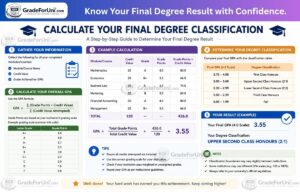
Worked arithmetic — the pre-masters route, costed. Take a reported in-house pre-masters at £9,500 for six months, then a one-year MSc with fees of £11,000. Total tuition outlay: £20,500 over 18 months, against which the Postgraduate Master’s Loan contributes toward both fees and living costs. Compare that with the alternative — three years of applications bouncing off 2:1 filters — and the pre-masters is not an expensive detour; it is the cheapest ticket back into the filtered half of the graduate market. Run your own numbers with our Degree Classification Calculator UK once the masters offer lands: a Distinction at masters level effectively retires the undergraduate Third from every conversation that matters.
Route 2: Graduate Jobs — the Experience-First Strategy
For the labour market, a third class degree is a filter problem, not a capability problem — and filters can be routed around. The data from our does your degree classification matter guide: 44% of graduate employers in the ISE survey require a 2:1, which means 56% do not, and outside the big structured schemes — SMEs, startups, specialist firms, most non-scheme graduate roles — hiring runs on skills, experience and interview performance. Careers advisers’ practical playbook for Third-class graduates converges on the same five moves:
| Move | What to do | Why it works with a Third |
|---|---|---|
| Target unfiltered employers | Apply where no academic minimum is published — most SMEs and startups | You are assessed on merit, not screened out by software |
| Stack two years of proof | Internships, placements, freelance, open-source, volunteering in your field | Experience outranks class in almost every hiring conversation |
| Write the class out of the story | List degree + university; add the class only where forms require it | Honest, standard practice — you claim nothing untrue |
| Use your university careers service | Free for graduates — often for two to three years after leaving | They see Third-class graduates every year and know which employers hire them |
| Consider the masters reset | One good postgraduate result retires the undergraduate class | A masters Distinction changes the headline on your CV |
One honest warning from student forums: entry-level roles that explicitly require ‘an IT degree’ or similar will often quietly expect a 2:1 or 2:2 unless you have substantial work or high-level skills to offset the class — niche specialist roles can be the exception, because they struggle to recruit at all. The grind is real, but it is a grind with an end: after two to three years of work history, almost no employer asks about your degree class again. Your transcript has an expiry date; your experience does not.
Route 3: Teaching and Other Funded Routes — Read the Fine Print
Some funded routes have hard academic floors, and a third class degree sits below them. The clearest example: the Department for Education’s 2026-27 teacher training bursaries — up to £29,000 tax-free for shortage subjects — require at least a 2:2, with no discretion. A Third gets £0 from that pot, as our teacher training bursaries guide (every figure verified from the DfE funding manual) documents. But funding and training are different questions. Salaried initial teacher training routes pay you a wage instead of a bursary, making the bursary floor irrelevant; and providers assess your highest qualification, so a masters or PhD earned later can re-open the bursary door even with a Third underneath — confirm with the specific provider before enrolling. The same pattern repeats across funded routes: check the actual eligibility line rather than assuming a blanket ban, because the ban is usually on the money, not the training.
Still Studying? The Recovery Arithmetic That Beats a Third
If you have not graduated yet, stop reading routes and do the maths — because the gap between a Third and a 2:2 is often smaller than it feels. A Third tops out at 49%; a 2:2 starts at 50%. On a standard 33:67 second-to-final-year weighting, a student averaging 44% after second year needs a final-year average of only 53% to reach a 50% overall: (50 − 0.33 × 44) ÷ 0.67 = 35.48 ÷ 0.67 = 52.96%. Nine percentage points across one year — the exact territory our 2:2-to-2:1 recovery guide‘s module-triage method is built for.
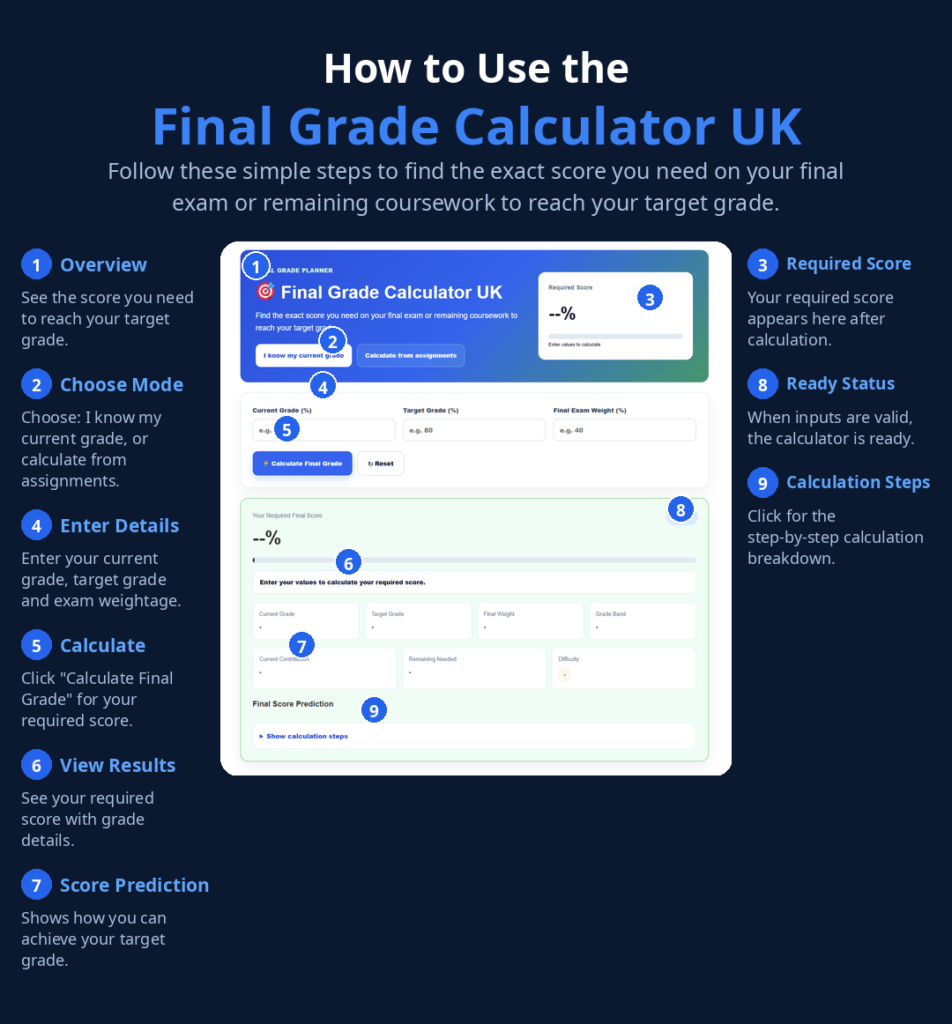
Worked example: Priya’s final-year rescue. Priya finishes second year on 44% — squarely in the Third band — on a 33:67 weighting. Her final year is 120 credits: a 40-credit dissertation, three 20-credit taught modules, and a 20-credit project. She triages ruthlessly: the dissertation gets 40% of her effort (it is one-third of her final year), the project 20%, and the taught modules the rest. Her results: dissertation 58, project 55, taught modules 50, 52, 48. Final-year average: (58×40 + 55×20 + 50×20 + 52×20 + 48×20) ÷ 120 = (2320 + 1100 + 1000 + 1040 + 960) ÷ 120 = 6420 ÷ 120 = 53.5%. Overall degree: 0.33 × 44 + 0.67 × 53.5 = 14.52 + 35.85 = 50.37% — a 2:2, by less than half a point. One focused year turned a Third into a 2:2, and with it reopened every 2:2-gated route on this page. Plug your own transcript into our Final Grade Calculator UK to find your number — then read our final-exam marks guide for the module-level tactics.

Your 90-Day Plan: Four Routes, Compared
If the Third is already on your transcript, you do not need all four routes — you need the one that fits your money, timeline and temperament. Here is the decision framework:
| Route | Typical cost | Timeline | Best for |
|---|---|---|---|
| Pre-masters → masters | Pre-masters £8k-£15k (reported range) + masters fees; PG loan contributes | 18 months to a new headline qualification | Re-entering filtered graduate schemes and academia |
| Direct-entry masters with experience | Masters fees only; PG loan contributes | 1-2 years’ work first, then 1-year masters | Career-changers who can earn while building the CV |
| Experience-first job hunt | Free (plus living costs) | Immediate — compounding from day one | Hands-on fields: tech, media, sales, trades-adjacent roles |
| Salaried training / professional quals | Earn while you train | 1-2 years | Teaching, accountancy, and other structured professions |
Whichever you pick, do the unglamorous admin first: get your official transcript, confirm your exact final average with our Degree Classification Calculator UK (a 49.6% that rounds to a 2:2 changes everything), register with your university’s careers service while graduate access lasts, and tell your story in one honest line — ‘Third-class honours; two years’ relevant experience and a distinction-level pre-masters’ beats a silent transcript every time.
Is a third-class degree still an honours degree?
Yes. A third class degree is awarded at 40-49% and is a full honours degree — your certificate will typically read something like BA (Hons) or BSc (Hons) Third Class. It sits one band below a 2:2 (50-59%) and one band above a fail (below 40%). It is not the same as an ordinary degree, which is a separate unclassified award — our guide to honours vs ordinary degrees explains that distinction. A Third means you met honours standard; it is the lowest honours class, not a non-honours degree.
Can I do a masters with a third class degree?
Yes — through three realistic routes. Direct entry with experience: 2026 recruitment reporting lists universities including Bolton, Bedfordshire, Birmingham City, East London, Greenwich, Hertfordshire, Sunderland, Teesside, London Metropolitan, West London and Wolverhampton as accepting Third-class graduates directly onto selected MSc programmes, usually with 1-3 years of relevant work experience. Pre-masters: a 3-9 month bridging programme (providers include Kaplan, INTO, Navitas and Study Group; reported fees around £8,000-£15,000) where passing at around 50% progresses you to the masters. PgDip: start a postgraduate diploma (the first two-thirds of a masters, no dissertation) and top up to the full MSc later. And the funding: a Postgraduate Master’s Loan has no classification requirement at all — GOV.UK’s eligibility page asks for a UK bachelor’s or equivalent, not a particular class. Our masters with a 2:2 guide maps the entry routes in detail.
Will employers care that I got a third?
Some will, many will not — and the split is predictable. Structured graduate schemes with formal academic filters are the hard gate: Institute of Student Employers research found 44% of graduate employers require a 2:1, a record low but still nearly half (see our does your degree classification matter guide). The rest of the labour market — SMEs, startups, specialist roles, most non-scheme graduate jobs — weighs experience, skills and interview performance far more heavily. The practical playbook from careers advisers: lead applications with two years of relevant experience and projects rather than your class, target employers without published academic filters, and where a form asks for your classification, answer honestly and move the conversation to what you can do. A Third closes filtered schemes; it does not close employment.
Can I get a postgraduate loan with a third class degree?
Yes. Student Finance England’s Postgraduate Master’s Loan has no classification requirement — GOV.UK’s eligibility page lists age (under 60), residency, course eligibility and not already holding a masters-level qualification, but nothing about your degree class. The loan is a contribution toward fees and living costs, not means-tested, and paid to you directly. The catch is that the loan funds the course, not your admission: you still need a university to accept you, which is where the pre-masters and direct-entry routes above come in.
Can I retake modules or appeal to turn a third into a 2:2?
Only in narrow circumstances — and the distinction matters. An appeal cannot be a request for a second opinion on your marking: it must rest on procedural grounds, such as an administrative error or extenuating circumstances the board never saw (see our grade appeal guide). If you suspect the arithmetic itself is wrong — a wrong credit value, a missing module, a resit entered uncapped — work through our marks-verification checklist first, and ask your department about its remark/administrative-check process. Retaking passed modules to lift your average is rare and usually barred by regulations. If you have not graduated yet, the honest route is recovery: read the arithmetic section below.
Is a third class degree worse than an ordinary degree?
Not in the way the names suggest. A Third is an honours degree; an ordinary degree is a separate, unclassified award (no First/2:1/2:2/Third at all), typically given when a student does not meet honours requirements or accepts an exit award. Employers and postgraduate admissions understand honours classes, so a Third is generally the stronger credential — it proves you completed an honours programme. The confusion arises because both can follow difficult final years, but they are different awards with different transcripts. Our honours vs ordinary degrees guide breaks the comparison down fully.
Can I train as a teacher with a third class degree?
The bursary door is closed, but training is a separate question from funding. The Department for Education’s 2026-27 funding manual requires at least a 2:2 for postgraduate teacher training bursaries (worth up to £29,000), so a Third gets £0 from that pot — see our teacher training bursaries guide. But providers set their own entry requirements, and salaried training routes pay you a salary instead of a bursary, making the bursary irrelevant. Your strongest funding-side play is raising your highest qualification first: providers assess your highest award, so a Masters or PhD can re-open doors a Third closed. Check specific course pages rather than assuming a blanket ban.
Should I put a third on my CV?
Include the degree; the class is a judgement call. Most advisers suggest listing your degree subject and university, and adding the classification only where the application form asks for it — leaving it off a speculative CV is common and honest, since you are not claiming anything untrue. Where it must be stated, own it in one line and move on: ‘BSc Computer Science (Third), University of X — 18 months’ placement experience, two deployed projects.’ What sinks applications is not the class but the silence around it: a CV with no experience and a Third reads as a weak candidate, while a CV with two years of relevant work and a Third reads as a capable one. The class is one line; the rest of the page is yours to write.
Conclusion
A third class degree is the least forgiving line on a UK transcript and the most misunderstood. It is an honours degree — 40-49%, earned, classified — held by roughly three in every hundred graduates. It closes the filtered gates: the 2:1 graduate schemes, the DfE bursaries, the standard masters entry lines. It does not close education, employment, or a good career. The routes are specific and proven: direct-entry masters with experience, pre-masters programmes that judge you on new work rather than old marks, a postgraduate loan that asks for a bachelor’s and nothing more, an experience-first job hunt aimed at the unfiltered majority of employers, and — if you are still studying — the recovery arithmetic that turns 44% into 50.37%.
The graduates who do best after a Third share one habit: they stop defending the class and start building the next line of the CV. Run your numbers through our Final Grade Calculator UK, pick one route from the framework above, and give it ninety days of full effort. Three percent of graduates finish with a Third; a much smaller fraction lets it define them.